





















































Support for the operation is highest among those who are the most connected to Israel and those who are most affiliated with Jewish institutions

Getty Images
A large plume of smoke rises over Tehran after explosions were reported in the city during the night on March 28, 2026 in Tehran, Iran.


 Add JewishInsider on Google
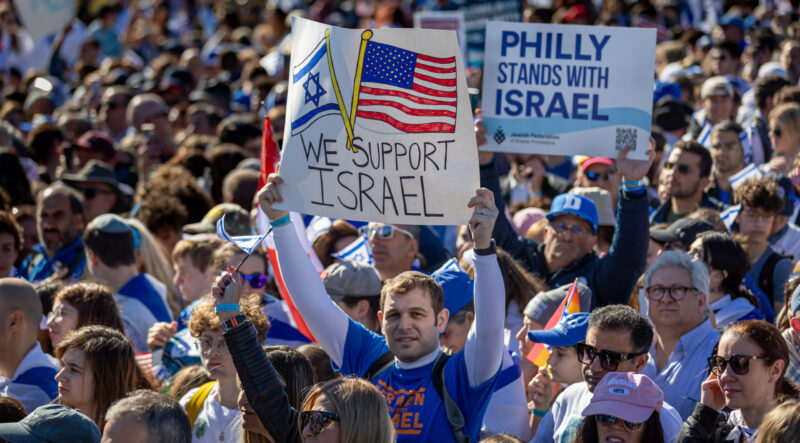
Two new polls of Jewish voters released this week show broad opposition to the U.S. military action against Iran, with support for the operation highest among those who are the most connected to Israel and those who are most affiliated with Jewish institutions.
A Mellman Group poll on behalf of the Jewish Electoral Institute (JEI)found that 32% of Jewish voters back the current military action against Iran, while 55% disapprove and 13% remain undecided. Support tracked closely along partisan lines, with 83% of Republicans, 49% of independents and 13% of Democrats approving the war.
Among those who said they were very connected to Israel, the poll found nearly two-thirds of Jewish respondents supportive, with just 27% opposed. But among those only “somewhat” connected to Israel, 58% said they disapprove of the war with just 25% approving. Nearly all of those Jewish respondents unconnected to Israel said they disapprove of the military action against Iran.
Support also was strongest based on those who are more religiously observant. The vast majority of Orthodox Jews (83%) approve of President Donald Trump’s military action, with just 11% opposing. But among Conservative Jews, opinion is more evenly split, with 40% approving and 48% disapproving. And among Reform Jews, support is the lowest, with just 24% approving and 67% disapproving.
There’s also a pronounced gender divide within the Jewish community: 40% of Jewish men support the military action against Iran, with 49% opposing. But among women, only 26% approve of the war in Iran, with 59% opposing.
The poll also found a significant share of Jewish Democrats (28%) and independents (29%) who said they feel “torn” about the war — agreeing that Iran is a threat to peace but disagreeing with Trump’s handling of the operation.
The “torn” constituency, which makes up 23% of the Jewish vote, generally draws from those who said they were opposed to the war in the end. When the “torn” constituency is broken out, there’s a more even divide between those who support the war (31%) and those who oppose it (41%).
The Mellman Group poll surveyed 800 Jewish voters between March 13-22.
A separate poll of Jewish voters, conducted by GBAO for the progressive Israel advocacy group J Street, found a similar response towards the war in Iran: A 60% majority of Jewish voters disapprove of U.S. military action against Iran, while 40% support the war. Of note: A sizable 20% minority of Jewish Kamala Harris voters expressed support for Trump’s military action.
The J Street poll, notably, found higher support for the war among Conservative Jews, with 62% supporting and 38% opposing. It also found moderate Jews nearly evenly split, with 51% of self-described moderates in support, and 49% opposed.
The survey also asked whether U.S. military action makes Israel more or less secure, and found a 45% plurality agreeing that it helped Israel’s defense, with 36% concluding it made Israel less safe. But a 58% majority also said that the war weakened the United States, with only 30% believing it strengthened American national security.
The J Street poll also found that 77% of Jews don’t think Trump has a clear plan and mission for the war in Iran.
And it found that 70% of Jewish respondents said their sympathies are more with the Israelis, with 30% expressing more sympathy with the Palestinians. Asked about Israeli Prime Minister Benjamin Netanyahu, 28% of Jewish respondents said they viewed him favorably, with 66% viewing him unfavorably.
Polls find a sharp divide between Republicans and Democrats and a further split between MAGA-aligned Republicans and other Republicans

Alexi J. Rosenfeld/Getty Images
People take shelter in an underground bomb shelter amid reports of incoming missiles on February 28, 2026 in Tel Aviv, Israel.
More than 80% of Israelis support the war against Iran, polls by two major Israeli research institutions found this week, while several U.S. polls found that a majority of Americans oppose it.
The Israel Democracy Institute found that 82% of Israelis — 93% of Jewish Israelis and 26% of Israeli Arabs — support the war with Iran.
Among Jewish Israelis, the war has strong support across the political spectrum, with 76% of respondents on the left backing it, 93% of voters from the center and 97% from the right.
Similarly, the Institute for National Security Studies at Tel Aviv University found that 81% of Israelis back the war against Iran, and 63% support continuing military efforts until the Iranian regime falls.
Among Jewish Israelis, support for the war was at 92%, while only 38% of Israeli Arabs support it. About half (49%) of Israeli Arabs oppose the war, while the rest said they did not know.
According to the IDI poll, three-fourths (74%) of Jewish Israelis said they supported continuing the war until the Iranian regime is overthrown, while only 18% of Israeli Arabs agreed; 61% of Israeli Arabs called for a ceasefire as soon as possible, while only 3% of Jewish Israelis chose that as their preferred option.
Over a third of respondents (37%) to the INSS poll said that Israelis would be able to live under the current war situation for up to a month, while 29% said they could continue for over a month.
At the start of last year’s Iran war, half of the respondents said it could continue for over a month.
IDI found that most Jewish Israelis (74%) feel protected from Iranian attacks, whereas only 15% Israeli Arabs feel the same. Among Israelis who have a safe room in their homes, 76% feel safe, whereas among those who have to go to a shelter elsewhere, 63% feel safe.
Nearly two-thirds (64%) of Jewish Israelis feel that Israel’s security is a central consideration for President Donald Trump, while only 43% of Israeli Arabs do.
Meanwhile, in the U.S., a CNN poll, conducted by SSRS shortly after the war began on Saturday, found that nearly 41% of Americans approve of the U.S. military action in Iran, with a sharp divide between Republicans, Democrats and independents — 77% of Republicans approve of the launch of the operation, compared to 32% of independents and 18% of Democrats. The poll found that 59% of Americans disapprove of the U.S. decision to strike.
Similarly, an NBC poll found that 41% of American registered voters approve of Trump’s approach to Iran, while 54% disapprove and 5% aren’t sure. Just 8% of Democrats approve of the president’s handling of the situation, while 79% of Republicans and 28% of independents approve of it. In addition, the poll found that 52% oppose the current U.S. military operation. A sizable majority of Republicans (77%) agree with the U.S. decision to strike Iran, while 89% of Democrats and 58% of independents disagree.
There is a further divide between self-identified MAGA-aligned Republicans and other Republicans, the poll found: 90% of the former back the strikes, while 54% of the latter support them. The CNN poll found that MAGA Republicans are 30 points more likely than non-MAGA Republicans to strongly approve of the decision to take military action.
A Reuters/Ipsos poll found that just 27% of Americans approve of U.S. strikes — 55% of Republicans, 7% of Democrats and 19% of others. According to the poll, some 56% see President Donald Trump as too willing to use military force to advance U.S. interests — with 87% of Democrats holding this view, 23% of Republicans and 60% of people who don’t identify with either major party.
A Fox News poll found that Americans were evenly split between support and disapproval of the current U.S. action against Iran with Republicans overwhelmingly supportive and Democrats overwhelmingly against. Most American respondents (61%) saw Iran as a “real national security threat,” and only 38% did not.
A notable takeaway was just how different the preferences of Boomers and Gen Zers were — even among those affiliated with the same party

Campaign website
James Fishback
A pair of new polls — one in a Democratic Senate primary in Maine and one in a Republican gubernatorial primary in Florida — should sound alarm bells about the political and ideological trajectory of Gen Z voters, and the younger generation’s creeping tolerance of antisemitism that transcends party ID.
While the top lines from the polls generated the most headlines, the more notable takeaway was just how different the preferences of Boomers and Gen Zers were — even among those affiliated with the same party. The younger voters gravitated toward the candidates with checkered (at best) records on antisemitism.
James Fishback, a 31-year-old Republican investor who made a name for himself with incendiary social media posts attacking Israel and invoking antisemitic tropes, is barely winning a following among most Florida Republicans as he runs for governor. But among younger Republican voters, he appears to be building a growing base of support.
Graham Platner, an anti-establishment oyster farmer who for years had a skull-and-bones Totenkopf tattoo on his chest, a symbol adopted by a Nazi SS unit, is barely facing any backlash from Maine voters in his outsider Senate campaign. (He had the tattoo covered up during the campaign, amid widespread controversy.) Indeed, he may soon become the favorite to win the Senate seat in Maine, fueled by near-universal support among younger Democratic voters.
The polling underscores the dramatic generational disconnect.
In the University of North Florida poll, Fishback only received 6% support among Florida Republican voters, badly trailing front-runner Rep. Byron Donalds (R-FL), who is 47, by 25 points. But among voters 18-34 years old, the little-known Fishback is dominating Donalds, 31-8%. (It’s worth noting the subsample of young voters is small, but the polling is consistent with anecdotal reporting that Fishback has built a base of support among younger right-wing voters.)
Meanwhile in Maine, a Senate poll conducted by the University of New Hampshire found Platner, 41, not only holding a commanding primary lead over the state’s 78-year-old sitting governor, Janet Mills, (64-26%), but comfortably leading Sen. Susan Collins (R-ME) in a potential general election matchup. His support is fueled by Gen Z Democrats, who back him over Mills overwhelmingly, by a 73-point margin (84-11%). Those 65 and older preferred Mills, who is 78, by a four-point margin, 49-45%.
At the very least, these polls underscore that experience and credentials — no less the policy knowledge and credibility typically required of governors and senators — are barely valued by younger voters.
At worst, it’s an indicator that radicalism is actually a selling point for young voters, who are getting most of their information from social media sites whose algorithms promote polarization and extremism, and very little from reliable, trusted sources.
As we’ve noted before, it shouldn’t be a surprise that given the incentive structure on social media, antisemitism is thriving. If you build even artificial demand for extremism, the supply of hateful influencers — and eventually like-minded political candidates — will follow.
Michael M. Santiago/Getty Images
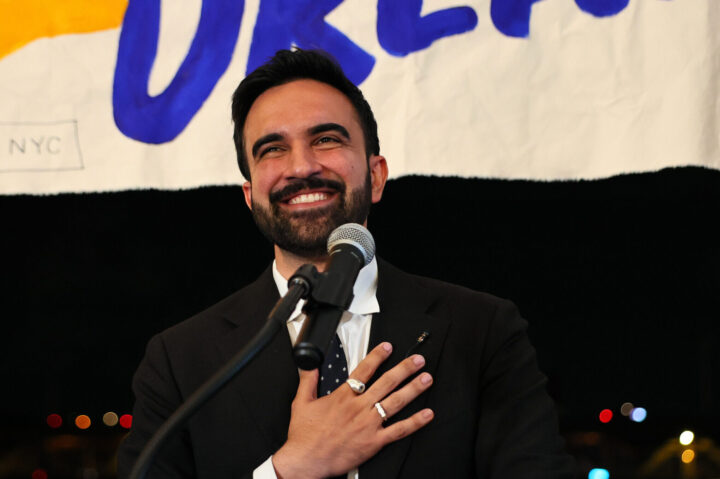
New York mayoral candidate, State Rep. Zohran Mamdani (D-NY) speaks to supporters during an election night gathering at The Greats of Craft LIC on June 24, 2025 in the Long Island City neighborhood of the Queens borough in New York City.
Since Zohran Mamdani won the Democratic nomination for New York City mayor, there’s been a fascinating disconnect between the polls showing Mamdani still vulnerable in the general election and the sclerosis among political leaders unable to make the tough decisions on whether to rally behind an alternative in a bid to stop the socialist candidate from becoming the next mayor.
There hasn’t been much good polling since the primary, but the most recent general election surveys all paint a picture of Mamdani leading the race with a plurality, but far below what a typical Democratic nominee should be receiving after a stunning, come-from-behind defeat of former New York Gov. Andrew Cuomo.
One poll, conducted by the Democratic firm Slingshot Strategies between July 2-6, found Mamdani winning 35% of registered voters, Cuomo at 25%, Republican nominee Curtis Sliwa tallying 14%, Mayor Eric Adams at 11% and attorney Jim Walden at 1%. Thirteen percent said they were undecided.
A late-June poll by the GOP firm American Pulse found Mamdani at 35%, Cuomo at 29%, Sliwa winning 16% and Adams with 14%. Asked whether they were leaning towards voting for Mamdani or anyone but Mamdani, it was close to an even split, with 48% leaning towards Mamdani and 46% preferring anyone else.
Of note, both polls found the combined Cuomo and Adams vote — which roughly encompasses the lion’s share of the moderate Democratic electorate — narrowly outpacing Mamdani’s share of support. In other words, the Mamdani alternative wouldn’t necessarily need a large portion of the Republican vote to prevail.
The obvious challenge for the anti-Mamdani forces is consolidating the field behind one leading opponent — or at least encouraging one of the two Democratic candidates in the race to drop out and endorse the other one. That’s a lot easier said than done.
The Cuomo camp rightly claims that, on paper, their numbers are stronger than the scandal-plagued Adams. The Adams camp rightly argues that Cuomo had his chance after blowing a very winnable race, thanks to a lackluster campaign operation and a lack of energy on the campaign trail — traits that won’t bode well for a general election rematch.
Both sides are correct in that all the Mamdani alternatives are seriously flawed. But looking at summer polls to predict how things could develop throughout the summer is a foolhardy exercise. After all, as we’ve written in these pages, the argument for defeating Mamdani doesn’t rest on the strength of the challenger, but the desire to build a broad coalition to stop a far-left activist from taking charge of the nation’s largest city.
Adams, as the incumbent, might be the better vehicle to put together that coalition despite his dismal favorability ratings right now. He’s already shown more agility as a general election candidate, framing the race between a silver-spooned socialist (Mamdani) against his blue-collar background.
On paper, Adams also seems better-positioned to win over enough Black voters and some crossover Republicans that Cuomo would likely struggle more in turning out. Cuomo is viewed as a partisan villain to most New York Republicans, and Adams has shown resilience with Black voters in his early campaign efforts.
But regardless of who is the strongest alternative, outside groups and business leaders need to start picking a side now if they have any hope of blocking Mamdani’s path to Gracie Mansion. It’s notable that most of the state’s top elected leaders — from Gov. Kathy Hochul to Senate Minority Leader Chuck Schumer to House Minority Leader Hakeem Jeffries — have still not endorsed Mamdani, even though he was declared winner of the primary over two weeks ago.
The longer the anti-Mamdani forces wait to make their move, the easier it becomes for him to consolidate enough Democratic support to make the efforts even harder. The reality is the fear of failure is as significant for many of these stakeholders as the desire to prevent a far-left candidate from taking over Gracie Mansion.
The Israeli prime minister also said that Israel continues to work on ceasefire efforts after accepting the latest U.S.-sponsored proposal

Marc Rod
Israeli Prime Minister Benjamin Netanyahu speaks to reporters on Capitol Hill after a meeting with House Speaker Mike Johnson (R-LA) on July 8, 2025.
Israeli Prime Minister Benjamin Netanyahu on Tuesday blamed coordinated anti-Israel advocacy campaigns for recent polls showing falling support for the Jewish state in the United States, particularly among Democrats, but argued that effective Israeli counter-messaging could reverse those trends.
Recent surveys have shown that support for Israel has declined among Democrats since the Oct. 7, 2023, Hamas attacks on Israel, with a majority now viewing Israel unfavorably.
“I am certainly interested in maintaining the great support that Israel has had. I think there’s been a concerted effort to spread vilifications and demonization against Israel on social media,” Netanyahu said in response to a question from Jewish Insider at a news conference on Capitol Hill following a closed-door meeting with House Speaker Mike Johnson (R-LA).
“It’s funded, it’s malignant, and we intend to fight it, because nothing defeats lies like the truth, and we shall spread the truth for everyone to see it,” Netanyahu continued. “Once people are exposed to the facts, we win, hands down.”
The Israeli premier hinted that he may have a second meeting with President Donald Trump before leaving the U.S. later this week, following their Monday evening meeting, as some media reports have indicated.
At a news conference on Capitol Hill, Jewish Insider's @marcrod97 asked Israeli Prime Minister Benjamin Netanyahu about polls showing falling support for Israel in the U.S.
— Jewish Insider (@J_Insider) July 8, 2025
"I think there’s been a concerted effort to spread vilifications and demonization against Israel on social… pic.twitter.com/z5JwidJeo5
Netanyahu said he and Trump had discussed the need to “finish the job in Gaza, release all our hostages, eliminate and destroy Hamas’ military and governance capabilities” in their private conversation on Monday — an issue left unaddressed in their public remarks.
Netanyahu told reporters that he has continued to work on ceasefire efforts as recently as this morning. Asked about a Hamas counterproposal, Netanyahu emphasized that Israel had accepted the proposal put forward by U.S. Mideast envoy Steve Witkoff and the Qatari mediators.
He demurred in response to a question about Qatar’s role in the negotiations, saying that he would “talk about the process later. I have a lot to say about it, but right now I’m totally focused on the result, as is President Trump.”
Netanyahu also aligned himself with Trump’s foreign policy motto — cribbed from President Ronald Reagan — of “peace through strength.”
“First comes strength, then comes peace,” Netanyahu said. “Our resolute action, the resolute decision of President Trump to act with us against those who seek to destroy Israel and threaten the peace of the world has made a remarkable change in the Middle East. … There are opportunities for peace that we intend to realize.”
Asked about a proposal on Capitol Hill to provide Israel with American B-2 bombers and bunker-buster bombs in the event that further strikes on Iran are needed, Netanyahu said that he would “of course … like it” if Israel had the same capabilities as the U.S., but added, “We are appreciative of the systems we receive that I think could serve not only the interests of Israel’s security, but American security and the security of the free world.”
“I won’t get into specifics. There’s much, much more to discuss, and many variegated areas that are best left a more confidential forum,” he continued.
Please log in if you already have a subscription, or subscribe to access the latest updates.
 Continue with Google
 Continue with Apple