

























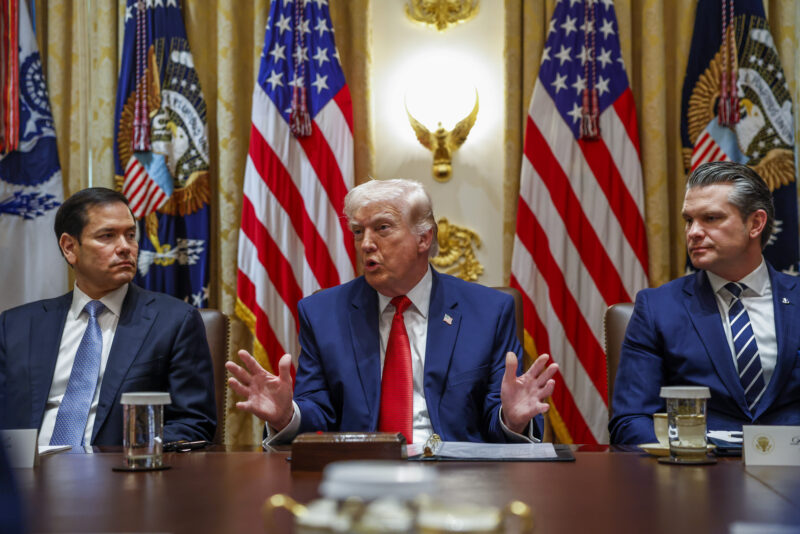



















The board's charter describes a body concerned with peace worldwide, not with removing Hamas’ terror threat in Gaza
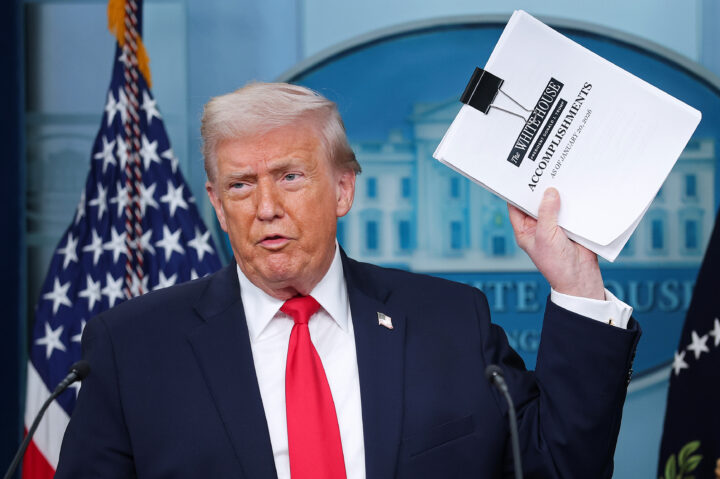
Kevin Dietsch/Getty Images
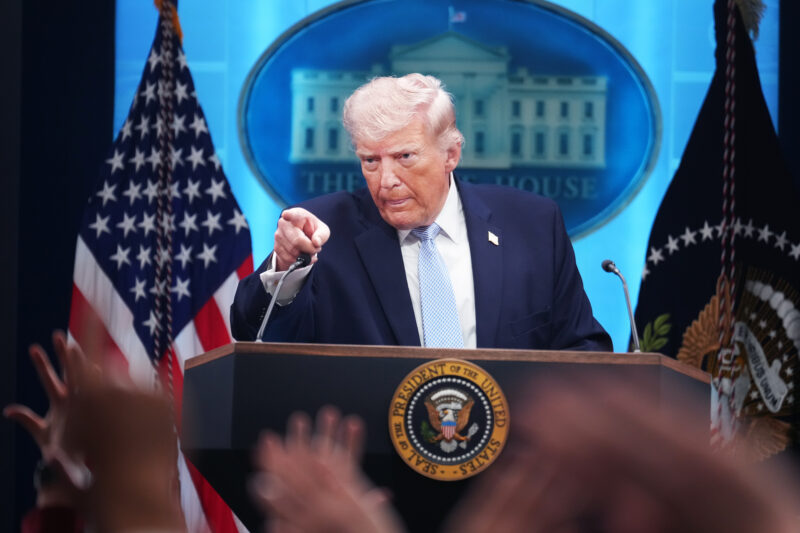
President Donald Trump gives a press briefing at the White House on January 20, 2026 in Washington, DC.


 Add JewishInsider on Google
When President Donald Trump first raised the idea of establishing a Board of Peace in October, it was as part of his 20-step ceasefire plan for Gaza. The board was meant to oversee a committee of Palestinian technocrats — whose composition was announced last week — and “set the framework and handle the funding for the redevelopment of Gaza … [and] call on best international standards to create modern and efficient governance that serves the people of Gaza and is conducive to attracting investment.”
The following month, the U.N. Security Council passed a resolution supporting the ceasefire plan and “welcom[ing] the establishment of the Board of Peace,” authorizing it to operate in Gaza until the end of 2027.
But the board’s charter describes a body concerned with peace worldwide, not with removing Hamas’ terror threat in Gaza, and in fact, it does not mention Hamas, Gaza or Israel at all. Its expansive, stated role is to “promote stability, restore dependable and lawful governance, and secure enduring peace in areas affected or threatened by conflict.”
Indeed, it appears to be an attempt to compete with the United Nations. Its preamble says: “Declaring that durable peace requires pragmatic judgment, common-sense solutions, and the courage to depart from approaches and institutions that have too often failed … Emphasizing the need for a more nimble and effective international peace-building body.” Asked at a press conference on Wednesday if he intends for the body to replace the U.N., Trump said it “might.” “I wish the United Nations could do more. I wish we didn’t need a Board of Peace,” he said.
Israeli Prime Minister Benjamin Netanyahu also acknowledged, in a speech to the Knesset on Monday, that the Board of Peace is meant to serve as a kind of alternative U.N. — something that Israel is unlikely to have a problem with, considering the deep anti-Israel bias in Turtle Bay, Geneva and beyond — and he announced on Wednesday that Israel would be joining.
The problem for Israel is that the Board of Peace’s mission creep could distract from what is, for Israel, the most important part of the ceasefire plan, which is to dismantle Hamas as a governing and fighting force.
As Netanyahu put it in the Knesset this week: “In Gaza, we are before Stage 2 of the Trump plan. Stage 2 says one simple thing: Hamas will disarm and Gaza will be demilitarized. We are sticking to these goals and they will be achieved, either the easy way or the hard way.”
In the lengthy announcement about the various committees and boards involved in Gaza reconstruction and its oversight, the White House did not even mention Hamas, let alone demilitarization.
Plus, Hill hums along to F-35s for Saudi
Chip Somodevilla/Getty Images
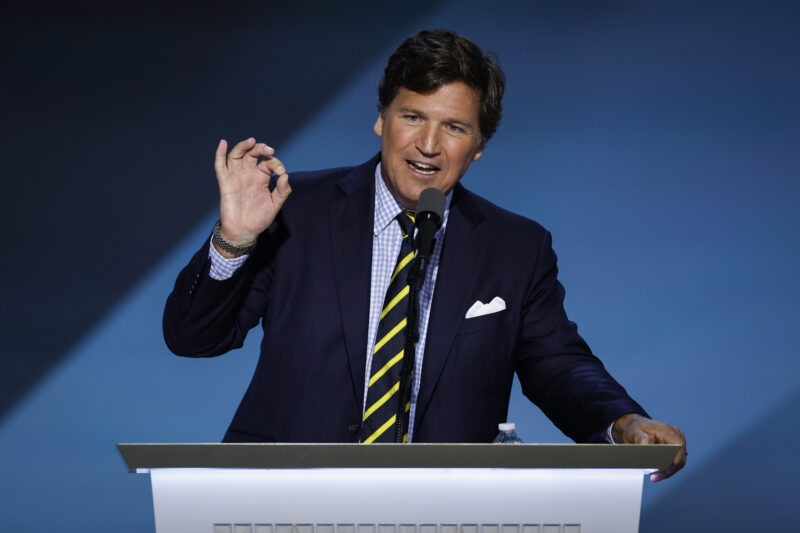
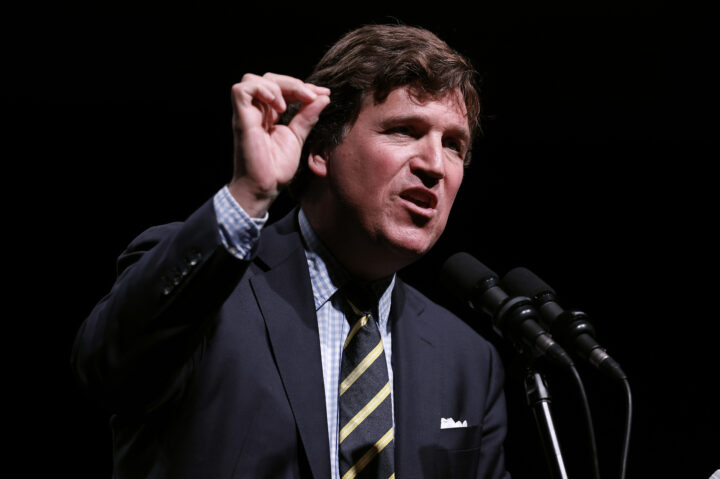
Tucker Carlson speaks at his Live Tour at the Desert Diamond Arena on October 31, 2024 in Phoenix, Arizona.
Good Tuesday morning.
In today’s Daily Kickoff, we preview Saudi Crown Prince Mohammed bin Salman’s meeting with President Donald Trump today at the White House, and look at how Jewish Republicans are reckoning with resurgent antisemitism on the right. We report on the U.N. Security Council’s support for Trump’s plan for postwar Gaza, and cover Israel’s push for the International Criminal Court to drop its arrest warrants for Israeli leaders over claims the court’s chief prosecutor pursued the case to distract from sexual harassment allegations. Also in today’s Daily Kickoff: Gov. JB Pritzker, Robert George and Troye Sivan.
Today’s Daily Kickoff was curated by Jewish Insider Executive Editor Melissa Weiss and Israel Editor Tamara Zieve with assists from Marc Rod and Danielle Cohen-Kanik. Have a tip? Email us here.
What We’re Watching
- All eyes are on Washington today for Saudi Crown Prince Mohammed bin Salman’s visit to the nation’s capital and meeting with President Donald Trump, followed by a formal dinner in honor of the crown prince’s visit. More below.
- The National Task Force to Combat Antisemitism is holding a daylong conference on “Exposing and Countering Extremism and Antisemitism on the Political Right.”
- Elsewhere in Washington, the Aspen Cyber Summit is taking place at the Kennedy Center.
- The Jewish Federations of North America’s General Assembly wraps up today. Speakers at this morning’s closing plenary, which features a musical performance by The Tamari Project, include Sen. Ted Cruz (R-TX) and “Call Me Back” host Dan Senor. JI’s Lahav Harkov will be moderating a session this morning on the future of the Middle East.
- The One Israel Fund is holding its annual gala tonight in New York. Rep. Elise Stefanik (R-NY) is keynoting this year’s event.
- In Turtle Bay today, U.S. Ambassador to the U.N. Mike Waltz will be joined by rapper Nicki Minaj as the two deliver remarks on the persecution of Christians in Nigeria.
- Outgoing New York City Mayor Eric Adams concludes his trip to Israel today. Following a trip to Kibbutz Nir Oz in Israel’s south, Adams will depart Israel for Uzbekistan.
What You Should Know
A QUICK WORD WITH JI’S Matthew Shea
President Donald Trump is hosting Saudi Crown Prince Mohammed bin Salman today at the White House, marking the first time MBS has visited Washington since 2018.
Trump plans to roll out the red carpet for the visit, which includes a welcome ceremony, bilateral meeting in the Oval Office and a black-tie dinner in the evening. Tiger Woods and Elon Musk are expected to be in attendance at the dinner, among other high-profile attendees. “We’re more than meeting,” Trump said late Friday. “We’re honoring Saudi Arabia, the crown prince.”
The visit is not an official state visit, as MBS is not Saudi Arabia’s head of state; however, the crown prince holds almost all responsibility in ruling the kingdom.
The bilateral meeting will feature high-stakes discussions on several key issues, including the sale of F-35 fighter jets, Saudi-Israel normalization and a possible U.S.-Saudi defense pact. Experts told Jewish Insider such an agreement is likely to be modeled after the assurances Trump gave Qatar in September, in the wake of an Israeli strike on Hamas in the Gulf state, when he issued an executive order stating that the U.S. will regard “any armed attack” on Qatar “as a threat to the peace and security of the United States.”
Trump announced on Monday he would approve the sale of the F-35s to Riyadh, helping the Saudis secure a long-coveted deal and making them the first country in the Middle East other than Israel to obtain the advanced fighter jets. “They want to buy. They are a great ally. We will be doing that. We will be selling them F-35s,” Trump told reporters in the Oval Office.
Concerns remain within the foreign policy community over the impact that the sale of F-35s will have on the military balance in the region and Israel’s qualitative military edge, which the U.S. is bound by law to uphold. Experts also cautioned the risks of transferring sensitive technology to Riyadh after Saudi naval forces conducted a joint military exercise with China last month. Israel has requested that such a sale be conditioned on the kingdom joining the Abraham Accords, however Trump made no mention of such a provision.
THE RIGHTS NEW DIVIDE
‘Confused young groypers’: Jewish Republicans reckon with resurgent antisemitism on the right

During a talk at a Turning Point USA event at the University of Mississippi last month, Vice President JD Vance listened carefully as a student took the microphone and asked him a question grounded in antisemitic tropes. Vance took the question at face value, declining to push back. The exchange came soon after right-wing podcaster Tucker Carlson hosted neo-Nazi provocateur Nick Fuentes for a decidedly friendly interview, a shocking but not altogether surprising cultural moment that catapulted an intra-party rift into the open: a shift among a small but growing contingent of young conservatives away from Israel and, increasingly, into a conspiratorial worldview that holds the Jewish state — and Jews — responsible for the world’s ills. The question facing party leaders is just how deeply this perspective has rooted itself among the right and how to deal with it: whether to fight it, accept it or stay quiet and hope it disappears, Jewish Insider’s Gabby Deutch reports.
Looking ahead: Vance’s response at the Turning Point event sparked concern among Jewish conservatives about how a potential future GOP presidential nominee plans to deal with a growing segment of the political right that is not just critical of Israel but of Jews — and why he has been willing to make excuses for the bigotry of some of his supporters. Earlier this month, at the RJC conference in Las Vegas, Republican fundraiser Eric Levine told JI that he has concerns about Vance, though he added that those concerns are balanced out by the fact that President Donald Trump remains “the most pro-Israel president in the history of the country.”
F-35 FACTOR
House Republicans largely supportive of F-35 deal with Saudi Arabia

House Republicans sounded largely supportive of President Donald Trump’s announcement on Monday that he plans to sign a deal to sell advanced F-35 fighter jets to Saudi Arabia, despite an apparent lack of progress toward normalization of relations between Saudi Arabia and Israel, Jewish Insider’s Marc Rod reports. Democrats, meanwhile, were generally more skeptical of the deal.
What they’re saying: “I’m very supportive of the president in every effort to reach out to Saudi Arabia,” Rep. Joe Wilson (R-SC), a senior member of the House Foreign Affairs Committee, told JI. “Saudi Arabia has been so significant in addressing the regime change in Syria and so over and over again, Saudi Arabia is proving [itself].” Rep. Brad Schneider (D-IL), a co-chair of the Abraham Accords caucus, suggested that normalization should precede the sale of F-35s. Saudi Arabia joining the Abraham Accords “would certainly require a reassessment of the assumptions underpinning our strategic outlook for the region and revisions to our policy doctrines, including provision of the F-35 platform to Saudi Arabia, while also preserving Israel’s qualitative military edge,” he said.
Read the full story here with additional comments from Reps. Mike Lawler (R-NY), Ann Wagner (R-MO), Jared Moskowitz (D-FL), Brad Sherman (D-CA) and Adam Smith (D-WA).
Forceful feedback: The Lebanese Armed Forces is facing pushback from Sens. Joni Ernst (R-IA) and Lindsey Graham (R-SC) over a statement it posted to social media on Sunday blaming Israel for flare-ups with Hezbollah in southern Lebanon, Jewish Insider’s Emily Jacobs reports. The Trump administration reportedly canceled an upcoming trip to the U.S. by Lebanese Armed Forces commander Gen. Rodolphe Haykal as part of Washington’s concern over the LAF’s moves.
PATH TO PEACE
U.N. Security Council backs Trump’s Gaza plan
The U.N. Security Council adopted a U.S.-led resolution on Monday backing President Donald Trump’s peace plan for Gaza, including the creation of an international security force, in a move that could boost efforts to advance into the next phase of the Israel-Hamas ceasefire, Jewish Insider’s Matthew Shea reports. In the first phase of Trump’s 20-point peace plan, originally presented in September, the Israel Defense Forces have partially withdrawn to a “yellow line” dividing Gaza, while Hamas has returned all of the living hostages and all but three of the deceased hostages’ bodies. However, the plan has faced significant roadblocks, and questions remain about the feasibility of implementing the following phases, including effectively disarming Hamas and determining who will govern Gaza.
What it means: Monday’s vote follows coordinated diplomacy between Washington and Arab partners aimed at reviving momentum behind the U.S. plan, including hosting a summit in Sharm El Sheikh, Egypt, last month and issuing a joint statement of support last week. With the adoption of the resolution, the U.N. showed a rare consensus on Gaza — 13 countries voted in favor and none against, with Russia and China abstaining. Experts told JI that moving to the second phase of the plan now becomes more plausible — even if challenges remain.
RESIGNATION RIPPLE
Heritage board member resigns amid continued fallout over Tucker Carlson controversy
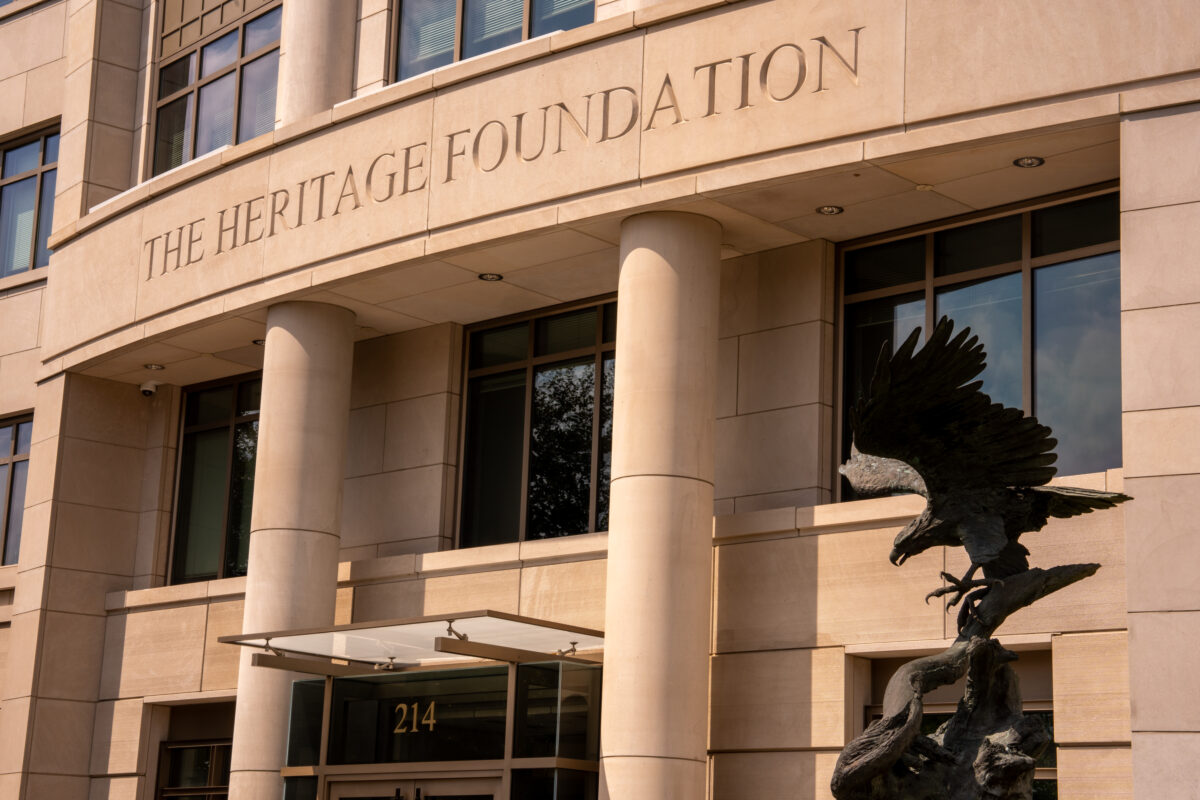
Robert George, a prominent board member of the Heritage Foundation, said on Monday that he was resigning from the conservative think tank, in the latest sign of continued fallout over its president’s controversial defense of Tucker Carlson after his friendly interview last month with a neo-Nazi influencer, Jewish Insider’s Matthew Kassel reports.
What he said: “I could not remain without a full retraction of the video released by Kevin Roberts, speaking for and in the name of Heritage, on October 30th,” George said in a Facebook post Monday morning, referring to the group’s president. “Although Kevin publicly apologized for some of what he said in the video, he could not offer a full retraction of its content. So, we reached an impasse.” His decision to step down indicates that Roberts is likely secure, for now, in his role atop Heritage, as its board remains split about his future, according to a former Heritage staffer familiar with internal discussions.
PARTING WAYS
Matt Gaetz producer fired for sharing virulently antisemitic video
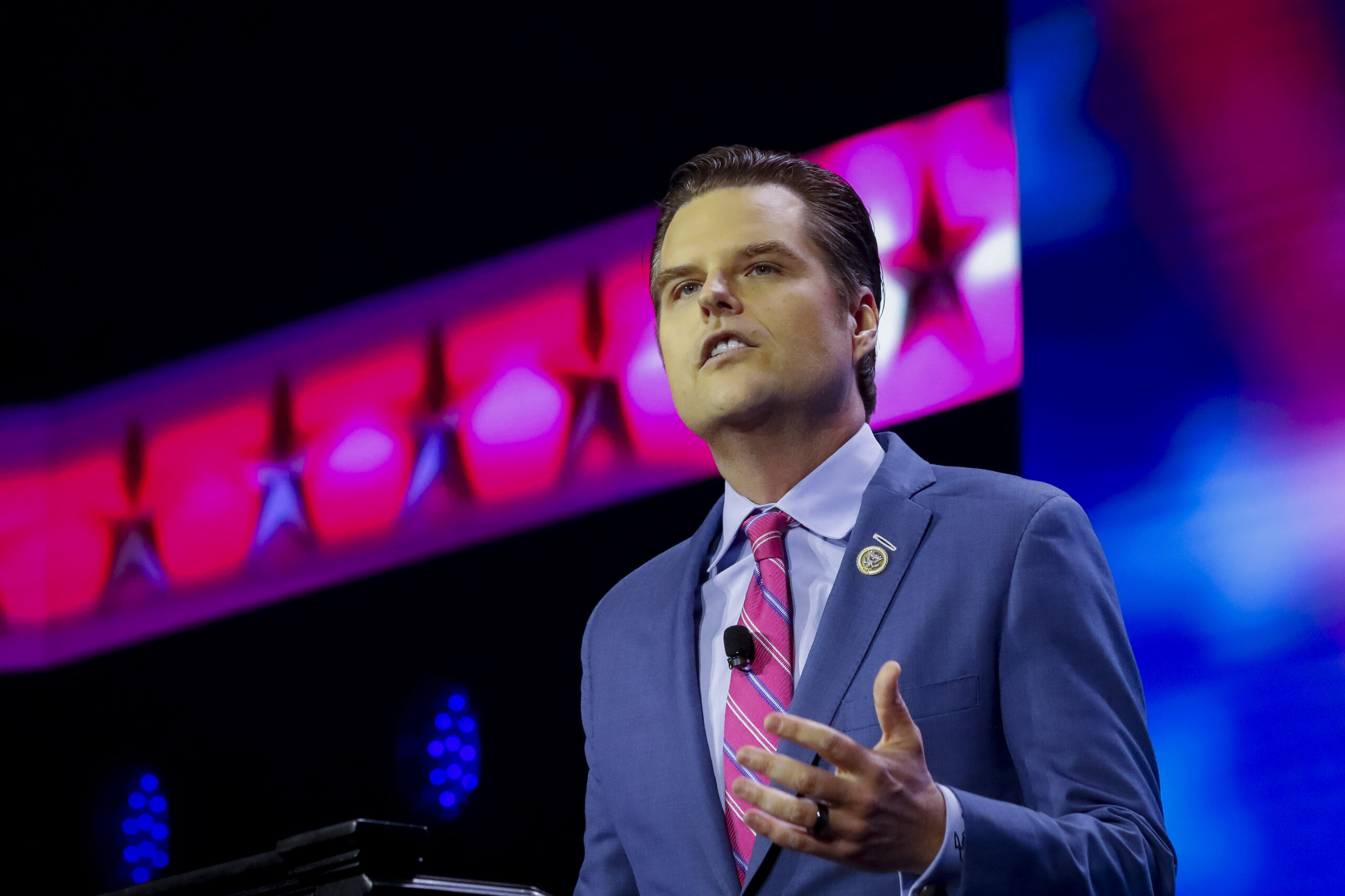
A producer for former Rep. Matt Gaetz’s (R-FL) weeknight show on the right-wing One America News Network has reportedly been fired after he shared a vehemently antisemitic social media post depicting Jews as cockroaches, Jewish Insider’s Matthew Kassel reports. Vish Burra, who was a booker and script writer for Gaetz, had drawn widespread backlash for posting an AI-generated animated video last week showing him entering a “scheming room” with Stars of David on the door to find a group of cockroaches counting money, who scurry away upon his arrival. The post has since been deleted.
Additional hate speech: “I will expose the vermin in the venomous coalition and their transgression against MAGA, America First, and Kevin Roberts at The Heritage Foundation,” Burra said in another post to X, which has also been deleted. “It all starts with Susan Lebovitz-Edelman,” he wrote, referring to a Jewish trustee at the Manhattan Institute who is married to the hedge fund manager Joseph Edelman. Lebovitz-Edelman, he wrote, “is behind the entire campaign to oust Kevin Roberts from The Heritage Foundation by using her leverage as a recent big dollar donor to take control of the organization.” Burra’s firing was reported by The Wrap and The Independent on Monday.
TRIBUNAL TURMOIL
Israel petitions ICC to remove chief prosecutor from case, citing conflict of interest

Israel petitioned the International Criminal Court on Monday to remove chief prosecutor Karim Khan from its case, saying he pursued charges against Israeli leaders to distract from sexual harassment accusations lodged against him. Israel also asked the court to cancel its arrest warrants against Israeli Prime Minister Benjamin Netanyahu and former Defense Minister Yoav Gallant over Khan’s allegations that they perpetrated war crimes and crimes against humanity in Gaza including “starvation of civilians as a method of warfare” and “intentionally directing attacks against a civilian population,” Jewish Insider’s Lahav Harkov reports.
Background: The petition came after two women submitted complaints against Khan for workplace sexual misconduct. One is an ICC employee, who alleged the misconduct occurred as recently as 2024 and that Khan attempted to dissuade her from making claims against him. In a leaked recording of a phone call between Khan and the ICC employee, she lamented that she had been accused of being a “Mossad plant” over the complaint. Khan was recorded telling the woman that someone had leaked the complaint to the media to “get rid of the warrants for Palestine,” among other open cases. According to The Guardian, private investigators hired by Qatar had attempted and failed to find a link between the accuser and Israel.
Worthy Reads
A Magazine’s Missteps: In Commentary, Jamie Kirchick does a deep dive into the antisemitism within The American Conservative — underscored by the language of its opposition to the U.S. strikes on Iranian nuclear facilities earlier this year that put it at odds with both the White House and the conservative movement. “The more one reads the American Conservative and listens to its contributors, the more one realizes how deeply ingrained the idea of Jewish perfidy is in the magazine’s Weltanschauung. … There is no greater rebuke to isolationism than Auschwitz. Isolationists know this, which is why they spend so much time relitigating World War II. It’s also why so many isolationists harbor antipathy toward Jews, the Holocaust’s chief victims and the stewards of its memory. The Jews are a living reminder of what happens when evil is not confronted, and their survival is deeply offensive to those who prefer not to confront the evil in our world.” [Commentary]
BBC Bias: The Wall Street Journal’s Gerard Baker raises concerns over the impact of the BBC’s biases on public opinion and policy. “There were — and are — many talented, honest people there. But in the past 10 years, it has, like other institutions worldwide, been captured by the cultural revolution that has swept the world of graduate-level work, seized by an activist class not content to report the news but insisting instead on telling people what to think. Their orthodoxy is familiar: on race, gender, sexuality, immigration and national sovereignty, climate alarmism, Western civilization and international affairs. I believe that the BBC’s coverage of Gaza is the most important factor in the recent rise of antisemitism in Britain. The daily repetition of Hamas propaganda about supposed Israeli atrocities has played in Britain (and around the world) for two years.” [WSJ]
Word on the Street
Illinois Gov. JB Pritzker contributed $25.5 million to his campaign fund over the last two weeks as he makes a bid for a third term and as speculation mounts that he may enter the 2028 presidential race…
New York City Councilmember Chi Ossé filed paperwork to challenge House Minority Leader Hakeem Jeffries (D-NY) in New York’s 8th Congressional District; Ossé, an ally of New York City Mayor-elect Zohran Mamdani, is challenging Jeffries from the House leader’s left…
Former Harvard President Larry Summers will step away from his upcoming public commitments following the release of extensive email correspondence with Jeffrey Epstein that lasted until the day before Epstein’s arrest; Summers will continue teaching five classes this semester, and will stay on as director of the Mossavar-Rahmani Center for Business and Government at the Harvard Kennedy School…
Federal prosecutors in New York are seeking an 18-year prison sentence for a neo-Nazi leader who pleaded guilty to soliciting hate crimes for his role in a plot to give poisoned candy to Jewish children…
Canadian officials said that worker error was the reason an Israeli-born woman applying for a passport was told that she could not list Israel as her country of birth; an employee had reportedly told the woman that the denial was due to “the political conflict”…
A collection of Gustav Klimt works owned by art collector and philanthropist Leonard Lauder, who died earlier this year, is expected to garner more than $400 million when they are auctioned by Sotheby’s today…
A German auction house canceled the planned sale of more than 600 items that belonged to Holocaust victims after coming under criticism by a Berlin-based organization for survivors…
The Washington Post spotlights the efforts of a Brazilian magazine publisher to uncover rumored underground tunnels in his hometown that had been constructed by Nazi officials who had fled to South America after World War II…
Israeli Prime Minister Benjamin Netanyahu condemned recent settler violence in the West Bank following the release of video that showed dozens of settlers setting fire to vehicles and homes in the Palestinian village of Jab’a…
The New York Times reports on the shadowy effort that brought hundreds of Palestinians from Gaza to South Africa in the last month…
Parts of western Iran flooded after heavy rainfall, following months in which the Islamic Republic faced severe drought issues…
Singer Troye Sivan listed his home in Los Angeles’ Hollywood Hills, which he bought in 2017, for $2.545 million…
Rabbi Shlomo Porter, the executive director of the Etz Chaim Center for Jewish Learning, died at 78…
The New York Times spotlights psychoanalyst Sabina Spielrein, who was believed to have been killed by a Nazi death squad in Russia in 1942, in its “Overlooked” series…
Pic of the Day
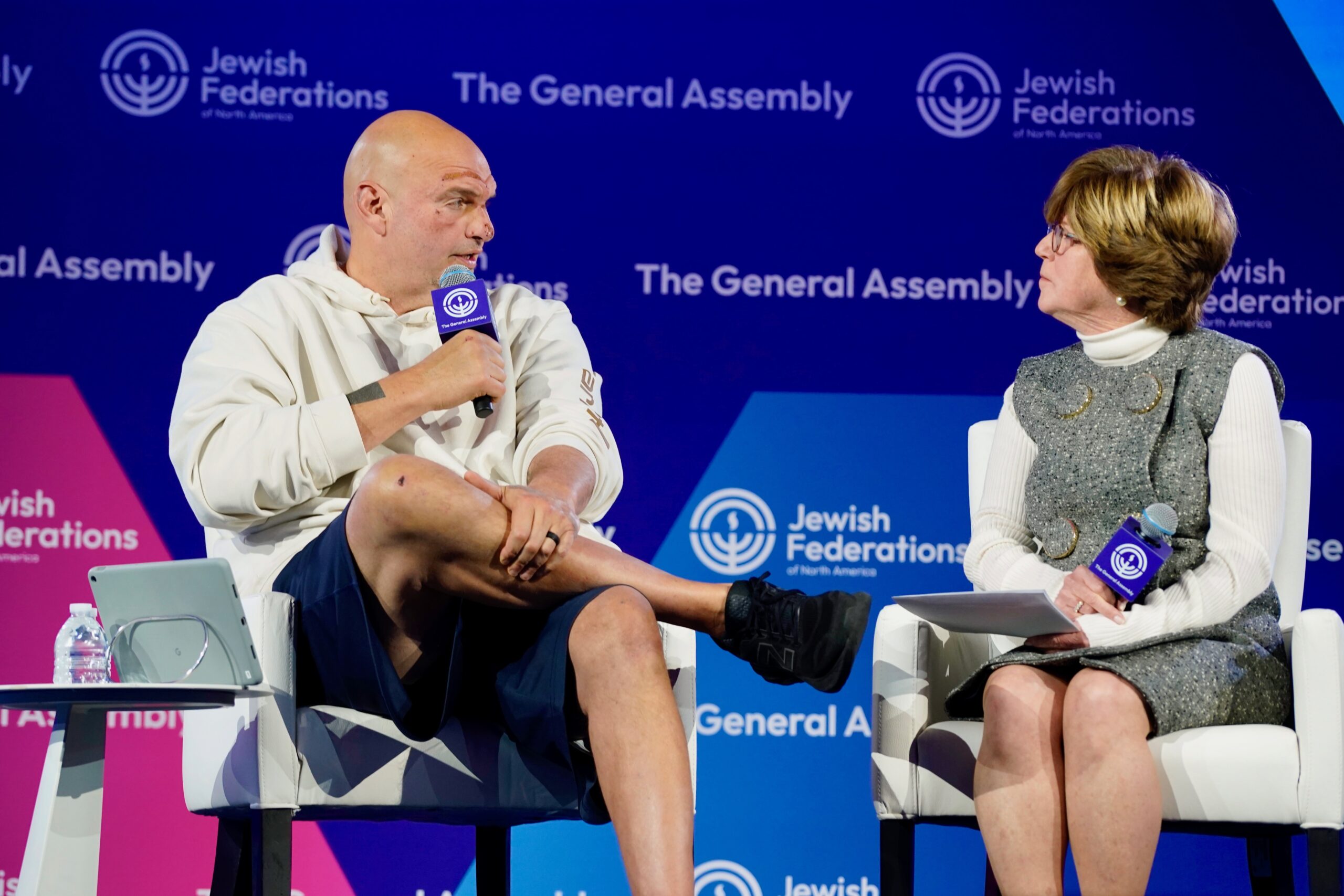
Sen. John Fetterman (D-PA) spoke in conversation with Julie Platt, the immediate past board chair for the Jewish Federations of North America, at a Monday plenary session at the JFNA’s General Assembly in Washington.
Birthdays
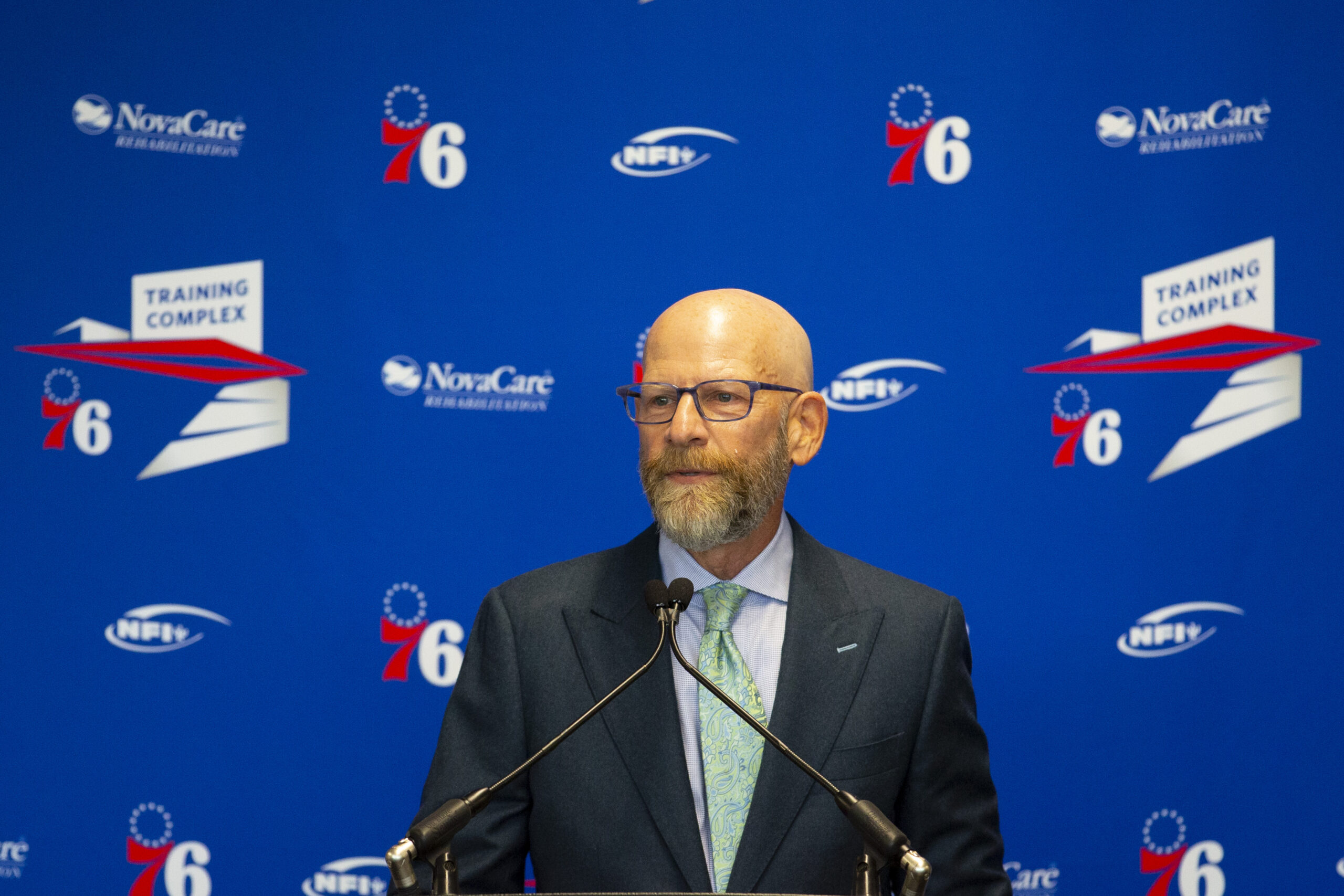
Longtime former play-by-play sportscaster for the NBA’s Philadelphia 76ers, Marc Zumoff turns 70…
Theoretical physicist, at age 27 he became a professor and then later president of the Weizmann Institute, he is the founder of the Davidson Institute of Science Education at Weizmann, Haim Harari turns 85… Former president of East Bay Federation, Steve Goldman… Former national director of major gifts for the American Committee for the Shaare Zedek Medical Center in Jerusalem, Paul Jeser… Lecturer at Boston University School of Law, he was formerly SVP and general counsel of Fidelity Management & Research Company, Eric D. Roiter turns 77… Atlanta resident, Lynda Wolfe… Israeli cantor and actor, known for his Broadway performance as Jean Valjean in “Les Misérables,” David “Dudu” Fisher turns 74… Professor emerita at Harvard Business School, Shoshana Zuboff turns 74… Professor of epidemiology and neurology at Columbia University, Walter Ian Lipkin turns 73… Former U.S. ambassador to South Africa, she is a luxury handbag designer, Lana J. Marks turns 72… Singer-songwriter, he is also the author of a popular Passover Haggadah, Barry Louis Polisar turns 71… Mayor of Dallas from 2002 until 2007, Laura Miller turns 67… SVP and general counsel of HSP Group and ARF Financial, Robert Bruce Lapidus… Moroccan-born, member of the Knesset since 2003 for the Shas party, he currently serves as the minister of welfare and social affairs, Yaakov Margi turns 65… NYC-based writer, activist and performer, Shira Dicker… Pulitzer Prize-winning Washington-based correspondent for The New York Times covering health policy, Sheryl Gay Stolberg turns 64… Retired Baltimore attorney who devotes her time to philanthropic and pro-Israel activities, Laurie Luskin… Rabbi of Burbank Temple Emanu El and former national coordinator of Rabbis Without Borders, Tsafreer “Tsafi” Lev turns 54… Chabad rabbi in Kyiv and executive chairman of the Federation of Jewish Communities of Ukraine, Raphael Rutman turns 53… President and CEO of the Jewish Federation of Broward County, Audra P. Berg… Member of the Knesset for the Yesh Atid party, Michal Shir Segman turns 46… Freshman U.S. senator (R-MT), Tim Sheehy turns 40… Real estate agent at Coldwell Banker and a consultant for Bridals by Lori, Talia Fadis… Israeli singer-songwriter and music producer, Elisha Banai turns 37…
The adoption of the U.S.-led resolution provides an international legal framework for the international stabilization force to deploy in Gaza
ANGELA WEISS/AFP via Getty Images
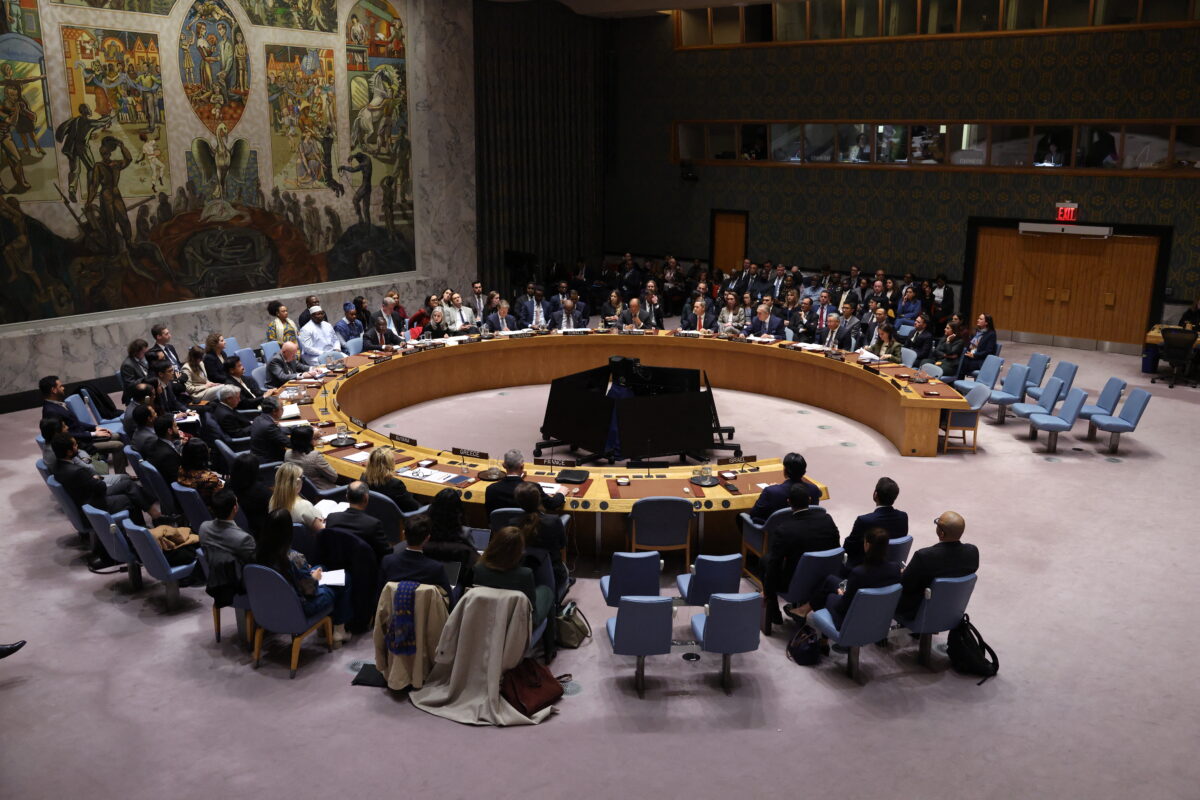
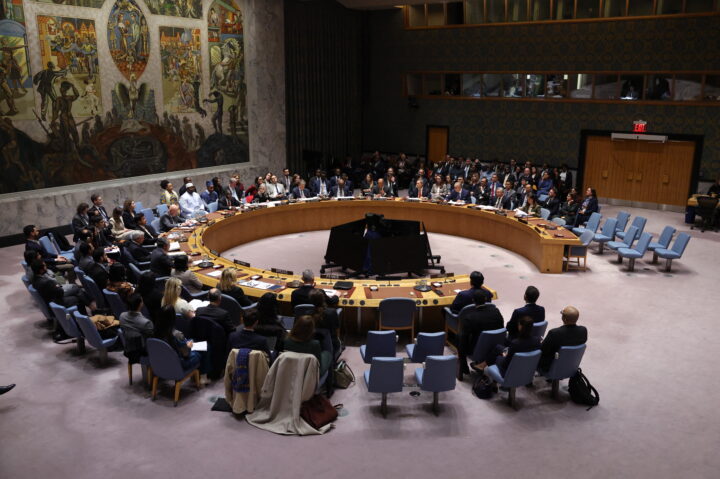
Ambassadors and representatives to the United Nations meet at the U.N. Security Council to vote on a U.S. resolution on the Gaza peace plan at the U.N. Headquarters in New York City, Nov. 17, 2025.
The U.N. Security Council adopted a U.S.-led resolution on Monday backing President Donald Trump’s peace plan for Gaza, including the creation of an international security force, in a move that could boost efforts to advance into the next phase of the Israel-Hamas ceasefire.
“Congratulations to the World on the incredible Vote of the United Nations Security Council, just moments ago, acknowledging and endorsing the BOARD OF PEACE,” Trump posted to Truth Social following the vote. “This will go down as one of the biggest approvals in the History of the United Nations.”
In the first phase of Trump’s 20-point peace plan, originally presented in September, the Israel Defense Forces have partially withdrawn to a “yellow line” dividing Gaza, while Hamas has returned all of the living hostages and all but three of the deceased hostages’ bodies.
However, the plan has faced significant roadblocks, and questions remain about the feasibility of implementing the following phases, including effectively disarming Hamas and determining who will govern Gaza.
Monday’s vote follows coordinated diplomacy between Washington and Arab partners aimed at reviving momentum behind the U.S. plan, including hosting a summit in Sharm El Sheikh, Egypt, last month and issuing a joint statement of support last week.
With the adoption of the resolution, the U.N. showed a rare consensus on Gaza — 13 countries voted in favor and none against, with Russia and China abstaining. Experts told Jewish Insider that moving to the second phase of the plan now becomes more plausible — even if challenges remain.
“The vote on the U.S.-drafted resolution is incredibly significant,” said Dana Stroul, a senior fellow at The Washington Institute for Near East Policy, who added that it provides “an international legal framework for the international stabilization force to deploy in Gaza, which is required for certain countries to send forces, like Indonesia.”
Prior to the vote, the White House has had difficulty recruiting countries to provide troops for the security force.
“What is being proposed is an enormous logistical feat, not to mention a high-risk environment where a terrorist organization is still active, the civilian population is in desperate need of humanitarian aid and local security, and Israeli forces remain on the ground,” said Stroul. “Foreign governments are concerned about their forces being attacked by Hamas, or being caught in the middle of Israeli security operations, and want clarity on the command and control, important details like logistical support and lodging, and the specifics of the actual mission.”
A key hurdle will be defining the role of the stabilization force. David May, a senior research analyst at the Foundation for Defense of Democracies, said there has been confusion over whether the ISF would “maintain the peace or enforce it.”
Jonathan Ruhe, a fellow at the Jewish Institute for National Security of America, echoed the importance of determining the role such a force would play in Gaza.
“The ISF likely will have lots of participants if the mission is limited to non-kinetic roles like aid distribution, border security, guarding camps, etc., all of which are important,” said Ruhe. “But Hamas thinks it won the war, and it won’t give up without a real fight. Phase 2 will be difficult for everyone if Israel has to do all this heavy lifting, so the success of Trump’s plans depends heavily on resolving the question of who, other than Israel, will actually enforce the peace?”
With the terror group still active in Gaza, few countries have been willing to risk sending soldiers into a conflict that “doesn’t involve them,” according to May.
“Without foreign forces on the ground, the options are either hoping that Hamas will disarm itself and give up its governance position, or leaving Israel to resume military options to do the disarming,” said Stroul.
At the same time, Hamas has sought to deter the implementation of the next phase — which calls on the group to relinquish its arms and governing authority.
“Hamas blew by the 72 hours for returning all hostages, living and dead, and continues to attack Israeli forces,” said May, referring to commitments the terror group agreed to in the first phase of the ceasefire. “Hamas always tests the limits of agreements with Israel, and it has little incentive to carry out a ceasefire plan that ultimately calls for the terrorist group’s destruction.”
“It should not be a surprise that a terrorist organization will try a variety of means to survive, from inflicting violence against Palestinians outside the yellow line to intimidating them into submission, insisting on distinguishing between different kinds of weaponry it may be willing to relinquish to appear reasonable, or attempting to present itself as a legitimate representative of the Palestinian national dialogue,” said Stroul.
Even as Washington and Arab governments moved the plan forward diplomatically, Israeli Prime Minister Benjamin Netanyahu and right-wing members of his government reiterated their opposition to a Palestinian state over the weekend, a stance that contrasts with the resolution, which contains language on creating “a pathway to Palestinian self-determination and statehood.” This wording was also present in the original plan released by Trump and agreed to by Netanyahu.
“The rhetoric coming out of Netanyahu’s right-wing coalition this weekend is incredibly ill-timed and will fuel those looking to blame Israel for failure to move from Phase 1 to Phase 2 of the plan,” said Stroul. “By appearing to renege on this issue, Netanyahu is setting himself to be on the opposite side of the Palestinian question from Trump, and risking serious daylight between the U.S. and Israel on Gaza at a high-risk moment.”
May said the inclusion of the clause “may have helped make the resolution more palatable to the other Security Council members,” but added that it will likely be out of the question for Israel moving forward.
“Following the popular support among Palestinians for the Oct. 7 atrocities, a Palestinian state on Israel’s borders is a nonstarter for most Israelis,” said May. “It is not worth it for Israel to risk the stabilization of Gaza on the lip service paid to a two-state solution that is dead in the water for most Israelis.”
Leading up to the vote, Russia had presented a counterproposal that diverged from the U.S. draft resolution in advocating that the West Bank and Gaza be joined as a state under the Palestinian Authority.
“This is really Russia seeking any way to assert influence in an attempt to make itself relevant,” said Stroul. “Moscow sees anything that keeps the U.S. tied down in the Middle East in a state of conflict, in tension with its longstanding allies and partners, as beneficial.”
Ruhe said Russia’s counterproposal was an attempt to throw “wrenches in America’s gears.”
“Russia was conspicuously absent from the Egypt peace summit, so this is one way Moscow tries to reassert itself,” said Ruhe. “The U.S. decision to mention a pathway to a Palestinian state probably owes more to our partners’ priorities than to Russian pressure, though Moscow certainly will try to claim this as a win anyway.”
The next part of Trump’s proposal also includes the increased entry of humanitarian aid into Gaza and the rebuilding of critical infrastructure. However, like other key elements of the plan, experts said it remains contingent on Hamas’ presence.
May said the full recovery of Gaza will remain incomplete “until Hamas is disarmed and there are troops on the ground to keep the peace.”
“No one is willing to start reconstructing Gaza if Hamas is still active on the ground,” said Stroul. “This is the fundamental choice for Hamas: it can choose to disarm and stay in Gaza, or receive amnesty and leave. But if it insists on having a say in the future governance of the Strip, then nothing beyond humanitarian aid will flow into Gaza; Palestinians will have no prospects for rebuilding their lives; and the potential for a return to open conflict rises.”
Reports indicate the move could come as soon as Thursday, after talks in Geneva ended with little progress on rolling back the Iranian nuclear program
Kay Nietfeld/picture alliance via Getty Images
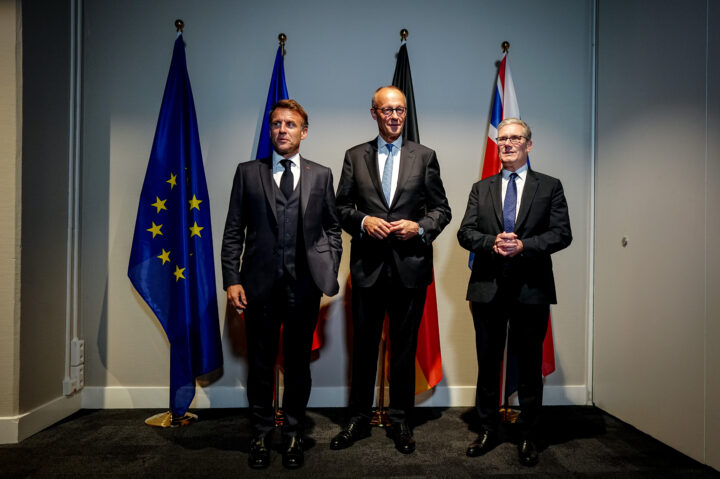
French President Emmanuel Macron (l-r), German Chancellor Friedrich Merz (CDU) and Keir Starmer, Prime Minister of Great Britain, meet in The Hague at the delegation hotel on the sidelines of the NATO summit for trilateral talks in the E3 format.
France, Germany and the U.K. are poised to reinstate snapback sanctions on Iran in the next several days, after talks held in Geneva this week aimed at scaling back Iran’s nuclear program reportedly concluded with little progress.
The three countries — known as the E3 — sent a letter to the U.N. Security Council earlier this month outlining “ongoing concerns regarding the lack of assurances as to the exclusively peaceful nature of Iran’s nuclear program” and Tehran’s ongoing violations of the 2015 Joint Comprehensive Plan of Action, to which the E3 countries are still parties despite the U.S. withdrawal in 2018.
The countries threatened to reinstate snapback sanctions by the end of August 2025 if “no satisfactory resolution” to the issue was reached before then.
The mechanism to trigger snapback sanctions at the UNSC expires in October, at which point any attempt to adopt new UNSC sanctions could face vetoes from Russia and China. However, the E3 and U.S. are looking to start the process before Russia assumes the UNSC presidency in October, giving it the power to delay the imposition of snapback sanctions — a process that takes 30 days to complete — until its expiration date.
The foreign ministers of the E3 and Iran met in Geneva earlier this week to discuss a diplomatic solution that would see Iran roll back its nuclear program without additional sanctions, which reportedly ended with little progress made.
A senior European diplomat told Axios on Wednesday that it would take a “diplomatic miracle” to prevent the reinstatement of snapback sanctions, with the European nations poised to trigger the mechanism as soon as Thursday.
Secretary of State Marco Rubio held a call with the E3 foreign ministers on Wednesday, during which all of the officials “reiterated their commitment to ensuring that Iran never develops or obtains a nuclear weapon,” State Department Principal Deputy Spokesperson Tommy Pigott said.
U.S. lawmakers have repeatedly pressed for the E3 to trigger the snapback mechanism.
In a letter, GOP senators urge France, Germany and U.K. to utilize the snapback provision in UNSC Resolution 2231

Al Drago-Pool/Getty Images
Ranking member of the Senate Foreign Relations Committee U.S. Sen. Jim Risch (R-ID) speaks during a Senate Foreign Relations Committee hearing on April 26, 2022 in Washington, DC.
A group of Senate Republicans sent a letter to French, German and U.K. officials this week urging them to immediately reimpose U.N. Security Council sanctions on Iran for the regime’s violations of the 2015 nuclear deal and the Treaty on the Non-Proliferation of Nuclear Weapons.
Six GOP senators, led by Sen. Jim Risch (R-ID), chairman of the Senate Foreign Relations Committee, urged French Foreign Minister Jean-Noël Barrot, German Federal Foreign Minister Johann Wadephul and U.K. Foreign Secretary David Lammy to utilize the snapback provision in UNSC Resolution 2231, which would reimpose all the sanctions lifted on Iran as part of the 2015 deal in response to any violations of the agreement.
“Initiating the snapback process would be the right — and long overdue — move and would deny Iran the resources it uses for its terror agenda. The 2015 deal flooded Iran with cash while allowing it low-level enrichment, a clock to simply wait out, no limitations on ballistic missiles, and nothing to rein in terror proxies. Years down the line, the sanctions relief Iran received from this deal directly funded Iran’s terror proxies and led to Hamas’ October 7 attack on Israel,” the senators wrote.
“Iran’s ejection of the International Atomic Energy Agency from its facilities marked the latest in a long chain of violations to Iran’s nuclear commitments. These actions confirm what we have known all along: the Iranian nuclear program is not civilian; it is the pursuit of a bomb to destroy Israel and threaten U.S. national security interests in the region. The international community must not tolerate this activity any longer,” they continued.
The letter was co-signed by Sens. Ted Cruz (R-TX), Pete Ricketts (R-NE), John Cornyn (R-TX), Steve Daines (R-MT) and Bill Hagerty (R-TN).
French Foreign Minister Jean-Noel Barrot warned on Tuesday that the E3, the European countries party to the 2015 Iran nuclear deal known as the Joint Comprehensive Plan of Action, will trigger the snapback mechanism, reimposing all U.N. sanctions, if a new agreement is not reached.
The senators encouraged the recipients of their letter to go beyond simply initiating the snapback sanctions, which takes 30 days and would likely need to be completed before Russia takes over the presidency of the UNSC in October, the same time that the snapback mechanism is set to expire.
“The decision to initiate the snapback process is only the beginning. The UNSC must fully process and formally re-instate UN sanctions without delay. This will take several weeks, and the October expiration of the snapback mechanism is looming. Furthermore, once sanctions are back in place, we must commit to their enforcement. Chinese purchases of Iranian oil and illicit oil smuggling through third countries have long violated existing U.S. secondary sanctions. Once UN sanctions return, all member countries will have a duty to crack down on this illegal activity,” the group wrote.
“President Trump has instituted a maximum pressure policy to bring Iran to the negotiating table. It is our sincere hope that our allies will stand side by side with America as we counter Iran’s threat to regional and global security for good,” they continued.
Mechanism to bring back U.N. sanctions expires in October

Press Association via AP Images
French President Emmanuel Macron, Germany's Chancellor Friedrich Merz and Prime Minister Sir Keir Starmer at a hotel prior to an E3 meeting on the sidelines of the NATO summit in The Hague, Netherlands, Tuesday June 24, 2025.
France, Germany and the U.K. will bring back sanctions on Iran via the U.N. Security Council if a nuclear deal is not reached by the end of August, French Foreign Minister Jean-Noel Barrot warned on Tuesday.
Barrot said that the E3, the European countries party to the 2015 Iran nuclear deal known as the Joint Comprehensive Plan of Action, will trigger the snapback mechanism, reimposing all U.N. sanctions, if a new agreement is not reached.
The Trump administration hopes to reach an agreement with the Islamic Republic to stop any uranium enrichment in Iran after Israeli and American strikes on Iran’s nuclear sites last month, aiming to prevent Tehran from rebuilding its severely damaged nuclear program.
“France and its partners are … justified in reapplying global embargoes on arms, banks and nuclear equipment that were lifted 10 years ago,” Barrot said on the way to a meeting with EU foreign ministers in Brussels. “Without a firm, tangible and verifiable commitment from Iran, we will do so by the end of August at the latest.”
The snapback mechanism expires in October and takes 30 days to activate, such that the end of August is the last chance to impose U.N. sanctions that cannot be vetoed by Russia and China, Iran’s allies on the Security Council. Moscow is slated to assume the presidency of the U.N. Security Council in October and could try to obstruct the move if it is not completed before then.
The E3 reached the shared policy in a phone call with Secretary of State Marco Rubio on Monday, according to Axios.
Barrot’s statement also came after reports in Arabic and Iranian media that Germany planned to activate snapback sanctions this week, which the German Foreign Ministry denied to Jewish Insider. A German official confirmed that his country shares France’s position.
Earlier this week, Tehran threatened a “proportionate and appropriate response” if the E3 snaps back sanctions, a move Iranian Foreign Ministry Spokesman Esmaeil Baqaei claimed “lacks any legal, political or moral justification.”
“European parties are constantly trying to use it as a tool in violation of their fundamental obligations,” he added.
Please log in if you already have a subscription, or subscribe to access the latest updates.
 Continue with Google
 Continue with Apple