




















































Officials are investigating a possible connection between the attacks
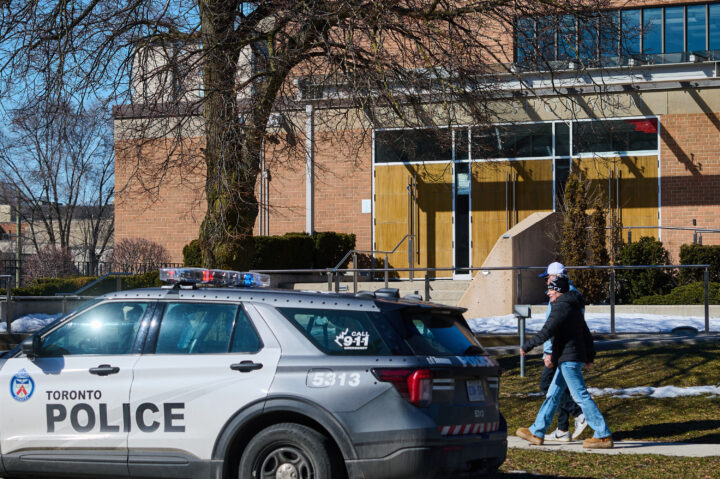
Sammy Kogan/The Canadian Press via AP
Pedestrians pass by a police car parked outside Shaarei Shomayim synagogue in Toronto, Sunday, March 8, 2026.


 Add JewishInsider on Google
Two Toronto-area synagogues were damaged by gunfire late Friday and early Saturday following an earlier shooting at another area synagogue last week.
Officials are investigating a possible connection between the shootings, the latest of which occurred outside of Shaarei Shomayim Synagogue and The Beth Avraham Yoseph of Toronto (BAYT) synagogue over the weekend. No one was injured in either incident.
In a message to congregants, Rabbi Daniel Korobkin, senior rabbi of BAYT, called the shooting “an appalling and cowardly act of evil,” adding that it left damage to the building’s front doors. BAYT — one of the largest Orthodox synagogues in North America — is located in the city of Vaughan’s Thornhill neighborhood, a heavily Jewish Toronto suburb.
Korobkin praised several Canadian politicians, including MPP Laura Smith, Vaughan Mayor Steven Del Duca, MP Melissa Lantsman and Vaughan City Councillor Gila Martow, for “working tirelessly with all levels of government, the intelligence community, and York Regional Police, who are in the midst of conducting a thorough investigation.”
He told members that they should continue to “attend minyanim, shiurim and other communal activities with renewed vigor and resolve.”
According to Toronto police, multiple shots were fired at the front doors of Shaarei Shomayim at 12:03 a.m. on Saturday — less than an hour after the BAYT shooting. Shaarei Shomayim is located in North York, about three miles from Thornhill.
Prime Minister Mark Carney called the attacks “an assault on the rights of Jewish Canadians to live and pray in safety.”
The attacks come after another Toronto synagogue was shot at last Monday night, causing damage to the building’s exterior. Toronto Police Service said that there were several bullet holes in the front windows of Temple Emanu-El in North York. No injuries were reported, but some people were inside the building at the time of the attack, following a Purim celebration.
At a press conference on Sunday, Noah Shack, the CEO of the Centre for Israel and Jewish Affairs, the advocacy arm of Jewish Federations of Canada-UIA, said that the country is “at a crossroads” following the three shootings.
“This gunfire didn’t come from nowhere,” said Shack. “Over the last two years, our Jewish community has been subject to increasing incidents of hate, intimidation, harassment and violence.”
Israel’s Ministry for Diaspora Affairs and Combating Antisemitism found a 670% increase in antisemitic incidents in Canada in 2024.
Toronto Police Chief Myron Demkiw said at the press conference that there are ongoing investigations. He promised a “relentless” pursuit to hold suspects accountable.
Mayor Olivia Chow called the shooting ‘an unacceptable act of antisemitism and intimidation’ amid heightened concerns to Jewish communal safety
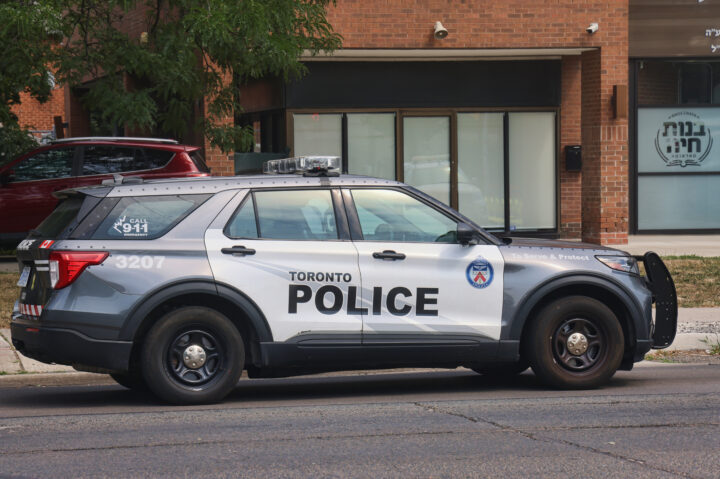
Creative Touch Imaging Ltd./NurPhoto via Getty Images
A Toronto police vehicle parks outside a Jewish school in Toronto, Ontario, Canada, on August 16, 2025.
A Toronto synagogue was shot at Monday night, causing damage to the building’s exterior, according to police.
Toronto Police Service said that there were several bullet holes in the front windows of Temple Emanu-El in North York. No injuries were reported.
The shooting occurred shortly before 11pm, as some people remained inside the building following a Purim celebration, a source with knowledge of the incident told Jewish Insider. Officers found “multiple shell casings at the front entrance of the synagogue, evidence of gunfire and damage to the building,” Toronto Police Deputy Chief Robert Johnson said during a Tuesday afternoon press conference. No information about the suspect or the type of firearm used has been confirmed, Johnson said.
“This is being investigated as a targeted incident” by the Integrated Gun & Gang Task Force and Hate Crime Unit, a police spokesperson told JI.
Toronto Mayor Olivia Chow called the shooting “an unacceptable act of antisemitism and intimidation.”
“We will not tolerate antisemitic hate in our city. Toronto Police are investigating and will increase their presence in the area to keep the community and congregants safe,” Chow said. “Toronto’s Jewish community has the right to practice their faith without fear, intimidation or violence.”
“The synagogue I attended as a boy and youth, where I was bar mitzvah’d and received my primary Jewish education, now under gunfire in once-peaceable North York, Ontario,” David Frum, senior editor at The Atlantic, wrote on X.
In response to the shooting, the Jewish Security Network of Greater Toronto, which is part of Toronto’s Jewish federation, said in a statement that it advises “the community to exercise heightened vigilance and awareness at this time.”
The shooting came as Jewish communities worldwide are on increased alert amid U.S.-Israeli operations against Iran. Earlier this week, security groups warned of potential risk to Jewish institutions globally by attackers motivated by the events.
Canada has seen a particularly egregious rise in antisemitism since the Oct. 7, 2023 Hamas terrorist attacks in Israel. So far in 2026, 22 antisemitic occurrences have been reported in Toronto, representing approximately 62% of all reported hate crimes, according to police.
Israel’s Ministry for Diaspora Affairs and Combating Antisemitism found a 670 percent increase in antisemitic incidents in the country in 2024.
Paul Moshe Reichmann, the Orthodox Jewish real estate developer who made and lost billions of dollars while transforming the skylines of Toronto, New York and London, died on Friday in Toronto. He was 83.
From the New York Times
Mr. Reichmann and his brothers, Albert and Ralph, led Olympia & York, their family’s real estate development firm, which counted among its greatest projects the World Financial Center in Lower Manhattan and Canary Wharf in London’s East End. At their apex in 1990, the Reichmanns held about 8 percent of New York City’s commercial office space, more than twice as much as their closest rival, the Rockefellers.
Paul Reichmann, a tall, soft-spoken man who dressed in black suits, white shirts and dark ties, was clearly the family business strategist and chief decision-maker. He and his family were lavish contributors, mostly to Orthodox Jewish causes; they donated up to $50 million a year to yeshivas, synagogues and hospitals around the world.
The strains of commerce and religious orthodoxy were often inseparable in the family’s ventures. For example, Olympia & York closed its construction sites on the Jewish Sabbath, paying overtime for Sunday labor, and during the Jewish religious holidays, as well as Christian ones.
At the height of his business career, Mr. Reichmann sometimes spoke wistfully of the Talmudic studies and religious school building projects he undertook as a young man.
Paul Reichmann was born in Vienna on Sept. 27, 1930, the fifth of six siblings. His parents, Samuel and Rene, were Orthodox Jews who had moved from rural Hungary to Vienna, where they owned a prosperous egg export business. But Nazi Germany’s annexation of Austria in 1938 forced the family to flee to Paris.
Two years later, when the Nazis overran France, the Reichmanns fled to Tangier, Morocco, where Samuel Reichmann became a successful currency trader.
When anti-Jewish riots broke out across the Middle East after the 1956 Arab-Israeli War, the Reichmanns uprooted themselves again, this time going to Canada. The family settled in North York, a suburb of Toronto, where Samuel and his sons, Paul, Albert and Ralph, started a small company producing tiles and other building material, which they called Olympia Tile. In 1958, it became the springboard for Olympia & York, which would erect close to 100 buildings in the Toronto area over the next 15 years.
From Bloomberg
In 1949, Paul Reichmann devoted himself to studying the Talmud in the U.K. and Israel. In 1952 in Israel he met Lea Feldman, who later became his wife.
From 1953 to 1956, he worked in Casablanca as the unpaid educational director of Ozar Hatorah, an American-sponsored group that runs schools for Orthodox Jews, according to Bianco. Reichmann later called that time “the most interesting years of my life.”
From the Toronto Star
Paul Reichmann was among the greatest land developers in history. Reichmann, who died Friday morning in Toronto at 83, was also among this country’s outstanding philanthropists.
It is unlikely that those of my generation, raised in Toronto in the 1960s and 1970s, will see Reichmann’s like again. With uncommon audacity, persistence and real estate acumen, Reichmann reshaped the skylines of Toronto, New York and London.
Faith and Fortune: The Reichmann Story from Handel Productions on Vimeo.
Please log in if you already have a subscription, or subscribe to access the latest updates.
 Continue with Google

 Continue with Apple