














































































Armed Services Committee chair Roger Wicker broke his silence on Thursday, warning the deal would make Iran’s Obama-era payoff ‘look like a pittance’

Tom Williams/CQ-Roll Call, Inc via Getty Images
Senate Armed Services Committee Chairman Roger Wicker (R-MS) arrives for a confirmation hearing in Dirksen building on Tuesday, May 13, 2025.


 Add JewishInsider on Google
Senate Republicans continued on Thursday to air concerns about the U.S. memorandum of understanding with Iran, in some cases fueled further by Vice President JD Vance’s comments dismissing the effectiveness of U.S. sanctions and lambasting Israeli government officials who have objected to the deal.
Sen. Roger Wicker (R-MS) — the chairman of the Senate Committee on Armed Services — issued a statement ripping into the agreement, saying he’s “concerned [it] negotiates away the victories of Operation Epic Fury in ways that are completely out of step with the president’s goals.” Wicker had for days told reporters he was “withholding comment” on the MOU.
He said that, even though the $300 billion reconstruction fund outlined in the deal is not coming from U.S. taxpayer money, it “would make Iran’s payoff under President [Barack] Obama’s 2015 deal look like a pittance by comparison” and that it “would be an error to force Israel to stand down against Hezbollah.”
He said he also opposes any sanctions relief or unfreezing of funds for Iran “in exchange for Iran’s mere agreement to negotiate for another 60 days. The Iranian regime has not renounced its ultimate goal — ‘Death to America, Death to Israel.’ The regime will invest every penny it receives to further that aim.”
But Wicker pointed ultimate blame for the final shape of the deal at the “intermediaries,” rather than Trump himself.
Wicker told reporters he expects to hear from Vance about the deal but that no briefings have yet been arranged or scheduled.
Reiterating a stance he expressed a day prior, Sen. Ted Cruz (R-TX) said, “History demonstrates giving billions of dollars to theocratic lunatics who want to kill you is an exceptionally bad idea. So I hope we don’t do that.”
Asked about the comments by Vance — a potential candidate in the 2028 GOP presidential primary — Cruz, who mounted his own presidential bid a decade ago and is rumored to be considering a 2028 run, said, “I think the vice president can speak for himself.”
Sen. Thom Tillis (R-NC) said that he plans to go through the agreement in detail to compare it to the 2015 Joint Comprehensive Plan of Action because “what we don’t want to do is repeat that mistake.”
Tillis rejected Vance’s comments that sanctions have not been effective. “You’ve seen all kinds of their behavior changes in reaction to sanctions,” Tillis told Jewish Insider. “To suggest it’s not working would suggest that broadly sanctions don’t work, and we all know that that’s just factually incorrect.”
He told JI that “clearly any sanctions that are subject to congressional approval, he needs to come to Congress. Pretty straightforward. They covered that on ‘Schoolhouse Rock.’”
Tillis, who is retiring, also called the deal a “very important moment” for Vance. “It’s definitely a two-edged sword. Coming up short’s probably not good for him, but it could be a great achievement for him.”
Sen. Mike Rounds (R-SD) told JI he hadn’t heard Vance’s comments on sanctions, but he said that “it seems to me that there are billions of dollars that have been held from Iran, which has not gone to terrorist activities, and I think that is a good thing. So, with regard to that, it clearly had an effect. Whether or not it was completely effective is debatable.”
Rounds said he was concerned that Israel was not a party to the negotiations but “there’s an expectation somehow that there would be a limitation on activity going on in Lebanon that we’re not involved with at all, but that Israel is.”
He emphasized that “the Israeli government has a right to defend its people” from the yearslong ongoing attacks from Hezbollah, “and I don’t see that necessarily correctly addressed within this original memorandum. Perhaps there’ll be more meat on it in an actual agreement.”
The senator said he’s unsure whether the Iran Nuclear Agreement Review Act, which blocks the lifting of sanctions or unfreezing of funds for a congressional review period on any deal pertaining to Iran’s nuclear program, would be applicable, or what legislative steps would be involved if it were.
“We need to learn more about what [Trump’s] intent is and how permanent the two parties expect this to be,” Rounds said. “There’s a lot of questions we don’t have answers to yet, but it’s early in the process.”
He raised concerns about how the agreement would be enforced “particularly if you release all of their funds immediately, they’re allowed to do with it whatever they want. In the past, they’ve used that to fund terrorist activities. The first one that comes to mind is Hezbollah, which sits in Lebanon right now and has been attacking Israel relentlessly for years.”
Sen. John Cornyn (R-TX) said that “everything I’ve heard about it causes me concern” and he believes the president agreed to the deal because he was “concerned about the midterm elections and gas prices and blockage of the Strait of Hormuz.”
“This gets that open, but I think he’s had to pay a very deal price to get that done, and I think we should be clear-eyed and realistic that this isn’t going to persuade the Iranian regime to go in peace,” Cornyn, who is retiring after being defeated by a Trump-backed primary challenger, said.
He said that the steps taken by U.S. military operations to degrade Iran’s ballistic missile program and military-industrial base and delay its nuclear program were positive, but “I think we ought to be realistic about where we are. It’s temporary. It’s certainly not a permanent solution.”
Cornyn said he does not believe that Trump was joking when he said on Wednesday that he would blame Vance if the deal goes awry, and that the outcome of the deal might affect Vance’s prospects in the 2028 presidential race.
Cornyn said he expects that Congress, in its oversight role, will be examining the release of sanctions and whether the administration has the ability to lift those sanctions unilaterally.
Sen. Tom Cotton (R-AR), the Senate Intelligence Committee chair who also had not yet commented on the deal, said on Thursday that he has “concerns” over the MOU, warning that “certain aspects of this deal are a step in the wrong direction.”
The Arkansas senator told Fox News’ “The Story with Martha MacCallum” that Trump “deserves enormous credit for making Iran weaker than it’s been in decades, and we need to make sure that we don’t squander the leverage that we’ve built.” Cotton said he wished that the president “had continued with Project Freedom when it was announced a couple months ago.”
He also called on Trump to “use our military to force the Strait open and to keep it open, in addition to reimposing the blockade in the event that “Iran doesn’t keep its end of the bargain.”
Cotton pointed to the immediate lifting of sanctions on Iran’s oil exports, suggesting the funding would go toward malign activities, and raised concerns about the long-term control of the Strait of Hormuz.
“There’s certain parts of this memorandum that are a bit vaguer about Iran’s ability to access up to $100 billion of frozen funds or whether Iran can impose tolls on the Strait of Hormuz after two months,” Cotton said. “We’ll need more explanation there. I hope President Trump won’t allow those things to happen.”
Sen. Joni Ernst (R-IA) said that lawmakers had “very serious problems” with the JCPOA and the administration will need to come explain the deal because “I don’t want to see JCPOA 2.0.”
Sen. Lisa Murkowski (R-AK) told JI that she expects to find out “a lot more about the real details and particulars in these next 30 days.”
The Alaska senator said Congress needs “to make sure that the way that the president and the United States are interpreting this is in sync with how Iran is interpreting this, and I’m not certain yet that we’re at that place.”
Murkowski said “they can’t tell me” how the sanctions relief and reconstruction funding will work “so I certainly have a lot of questions that have yet to be resolved, but I also appreciate that the agreement allows for this next 30 days to work through reaching it.”
Asked about Trump’s suggestion on Wednesday that he wasn’t opposed to Iran possessing ballistic missiles, Murkowski replied, “That wasn’t helpful.”
Murkowski responded affirmatively when pressed on if those types of comments from the president and senior administration officials gave her pause about what the final agreement could look like.
Sen. Jim Justice (R-WV) said that “if we don’t have absolute assurances” that Iran can never obtain a nuclear weapon “then we lose,” though he said that “there’s still work to be done” in further negotiations.
“If it were to come to pass that we still have all kinds of concerns and no assurances and everything else, then it’s not good at all,” Justice said. “We have to have control one way or another” of Iran’s nuclear materials.
He said he couldn’t address disputes with Israel about the deal directly but said “the Israelis have been wonderful allies, and we’re going to stay arm-in-arm with them, period.”
Democrats, meanwhile, continued to lambast the agreement.
Sen. Richard Blumenthal (D-CT) told JI the administration is “desperate” and “flailing” and criticized the exclusion of Israel from the negotiations given that it continues to face attacks from Hezbollah, from which he said it must defend itself.
He said the agreement’s reliance on the U.N. as an enforcement and verification mechanism also hurts Israel.
“How can Israel trust the U.N.? Working with Israel is simply not in their toolkit. With the hundreds of billions of dollars provided, the unfreezing of sanctions immediately, the lifting of the freeze on assets, I don’t know how Republicans who attacked us with the JCPOA are going to handle that,” Blumenthal said. “This is a regime that continues to call the United States ‘the Great Satan.’ I don’t know what they’re thinking.”
And, he argued, the agreement effectively requires nothing of Iran: “I know the vice president’s line has been, ‘They only get the benefit of the bargain if they keep their side of it,’ but there is no side of it for them. They’re under no obligations here. It keeps the status quo for nuclear arms, lifting sanctions, lifting the freeze on assets, the $300 billion dollars.”
Sen. Chris Coons (D-DE) called the deal “appalling, flawed, pathetic failure” but “the inevitable conclusion of a combination of never making the case to the American people, flawed strategic provision, lack of grasp of the regional dynamics. How many ways can I say bad, bad, bad.”
On the issue of sanctions, Coons told JI, “President Trump cut a horrible deal where he is giving to Iran an enormous amount of released assets that have been frozen, sanctions relief that will generate tens of billions, if not hundreds of billions, and this reconstruction fund In combination, this is a massive infusion of cash to the mullahs and the IRGC. History shows the mullahs will not primarily use this money to build health clinics and schools.”
He said that Vance’s criticisms of Israeli officials are part and parcel of his efforts to sell an unsatisfactory agreement.
“I think JD Vance has been tasked with trying to sell a really bad deal and he is being as aggressive as he possibly can in knocking down one of the more obvious critics — a country that has a lot to lose,” he added. “If their opposition to the JCPOA was in any way principled, then they have to criticize a deal that’s worse than the JCPOA.”
Coons pointed responsibility for countering the deal toward Republicans, emphasizing that Iran will use the funding it receives under the deal for malign purposes. The Delaware senator said that there are “some things” Congress can do including conduct oversight of the congressional sanctions that the deal seeks to lift.
Sen. Cory Booker (D-NJ) echoed colleagues in describing the agreement as an “unconditional surrender” by the U.S. ‘because we get nothing from this deal.”
“All the specific benefits go to Iran. We get vague promises for potentially in the future hundreds of billions of dollars,” Booker said. “We’re allowing an extreme, terrorist supporting regime, that’s more extreme than when we began this, that chant ‘Death to America,’ to have more resources to do more things. So this is perhaps one of the biggest presidential blunders and failures in the last 20 years.”
He said that whether Senate Republicans stand firm and refuse to allow the administration to lift sanctions requiring congressional approval “is going to be the big test.”
“Will they just roll over and lay down for him, or will they stand up and provide the kind of checks, balances, oversight, and accountability when it comes to Iran, that they should be doing?” Booker asked. “They have a lot of levers to pull on the Republican side, where they right now control the Senate and control the House.”
He did not address what Democrats plans’ or role might be.
In the House, pro-Israel Democrats are also outraged by the deal and vowed not to support when it comes before Congress, which they said it must under INARA.
Rep. Josh Gottheimer said he is “totally dumbfounded by this agreement, and, like many, in a state of disbelief,” adding that the U.S. “got nothing” and “not one core objective was meaningfully met.”
He predicted that the next phase of the deal will never come about, and said the U.S. is “selling out Israel” and “kowtowing to Hezbollah terrorists, by tying Israel’s hands in Lebanon.”
Rep. Brad Schneider (D-IL) called it a “surrender agreement” and an “unacceptable capitulation without achieving any of our objectives” that will “facilitate the rebuilding” of Iran’s military and support for proxy groups.
“Unless the agreement is changed to actually close and permanently block Iran’s path to nuclear weapons, I will vote against it,” Schneider said.
Intelligence Committee Chair Tom Cotton said that Clayton’s scheduled Wednesday afternoon confirmation hearing would go on as scheduled unless Clayton doesn’t show up
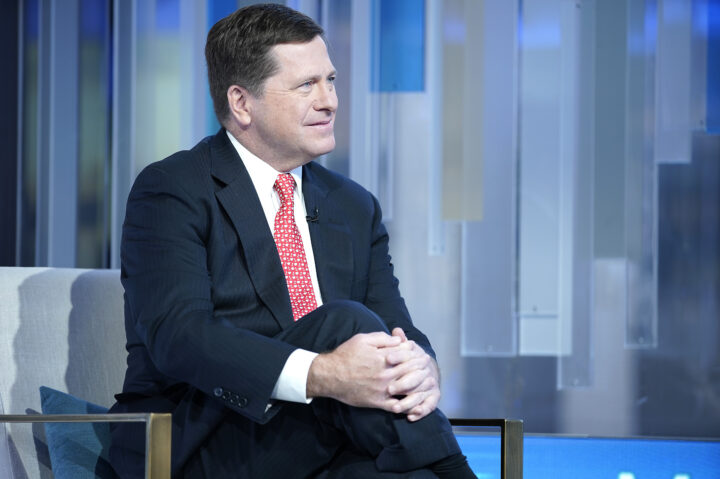
Photo by John Lamparski/WireImage
Jay Clayton appears on "Mornings With Maria" on Fox Business in 2020. At the time, Clayton was serving as chairman of the SEC.
President Donald Trump upended an expedited effort to confirm Jay Clayton as director of national intelligence before the end of the week with a Wednesday morning Truth Social post announcing that he was “cancelling” Clayton’s planned confirmation hearing later that afternoon — but Sen. Tom Cotton (R-AR), the Intelligence Committee chairman, insisted the hearing would go on as scheduled unless Clayton fails to appear.
Though Trump doesn’t have the ability to unilaterally cancel a Senate hearing, he could instruct Clayton not to appear as scheduled. Senate lawmakers were rushing to confirm Clayton before the end of the week to prevent federal housing chief Bill Pulte from serving as acting DNI, a choice lawmakers on both sides of the aisle view as problematic and unqualified for the role.
“Jay Clayton is a pending nominee before the Intelligence Committee. We will proceed with his hearing as scheduled unless the president directs him not to appear or withdraws his nomination,” Sen. Tom Cotton (R-AR) said on X following Trump’s post.
Republicans have been trying to clear a path to rapidly confirm Clayton before Pulte is set to take over as acting DNI on Friday.
Confirming Clayton and blocking Pulte from the DNI role would also unlock Democratic support for renewing federal foreign surveillance authorities under Section 702 of the Foreign Intelligence Surveillance Act (FISA), which lapsed last week amid Democratic opposition.
Sen. Mark Warner (D-VA), the vice chair of the Intelligence Committee, lambasted the “extraordinary display of dysfunction from a president who seems determined to turn America’s national security into a political bargaining chip.”
“At every turn, the president has injected more uncertainty into a process that should be focused on one thing: keeping the American people safe,” Warner continued. National security cannot be governed by social media post. The president’s latest intervention only underscores a simple reality: the biggest obstacle to resolving these issues has not been Senate Democrats or Senate Republicans. It has been the chaos and confusion coming from the White House itself.”
Trump asserted that “Dumocrats broke the Deal” on FISA and Pulte, and also demanded that James McDonald, who Trump said he would nominate to replace Clayton as U.S. attorney for the Southern District of New York, be confirmed before Clayton is confirmed for DNI.
But McDonald’s nomination hasn’t yet been transmitted to the Senate, according to congressional records.
Trump also indicated that he would veto the FISA renewal unless Republicans attach the SAVE America Act, which aims to impose new national voter ID and proof of citizenship requirements at the ballot box and limit mail-in and online voter registration, to it — a proposal that cannot pass the 60-vote threshold in the Senate.
“To add a slight bit of intrigue but, for the Good of the Nation, and the People of our Country, I will not approve FISA without THE SAVE AMERICA ACT going along with it,” Trump said. “Not complicated, actually, the Republicans fell into a trap.”
Five people are in custody after the FBI disrupted a plot that allegedly involved explosive-laden drones, a sniper team, and a plan to storm the White House gate
Jeff Bottari/Zuffa LLC
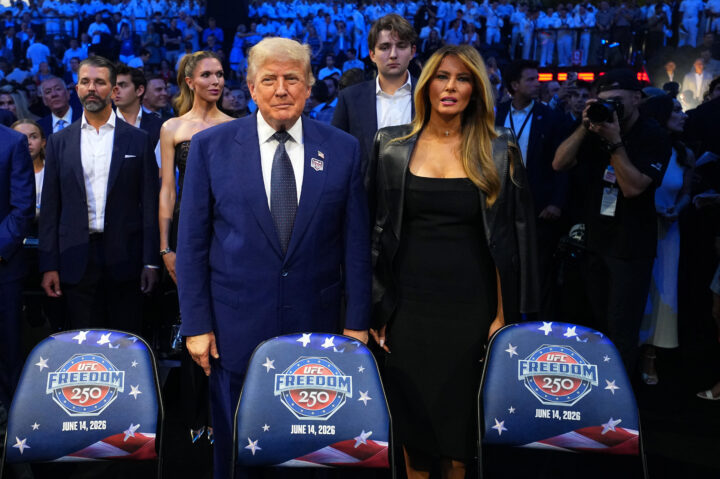
U.S President Donald J. Trump, First Lady of the United States Melania Trump attend the UFC Freedom 250 event on the South Lawn at the White House on June 14, 2026 in Washington, DC.
The FBI announced on Tuesday that it had disrupted a sophisticated attack targeting the UFC fight on the White House lawn on Sunday, with Fox News reporting that one suspect allegedly told investigators that the attack was targeting “capitalist elites,” “billionaires” and politicians who received donations from AIPAC.
FBI Director Kash Patel said on X that multiple individuals outside the D.C. area were in custody in connection with the attack in what he said was a multi-state operation. Fox News reported that five arrests had been made and 23 people were identified as being involved.
In an announcement, the Department of Justice said that the investigation is still ongoing and that arrests were carried out in Ohio, Missouri, Nebraska and California.
According to a criminal complaint released by the DOJ, one of the suspects, Tycen Proper, “appeared to identify potential US Congressional targets due to their support for the American Israel Public Affairs Committee (AIPAC), noting donations the members previously received from AIPAC” and identified several specific leaders he planned to focus on because they “were supportive of Israel.”
The targets included Sens. Marsha Blackburn (R-TN), Tom Cotton (R-AR), Shelley Moore Capito (R-WV) and Jim Justice (R-WV), Rep. Carol Miller (R-WV) and West Virginia state Del. Tristan Leavitt.
According to the complaint, another one of the suspects identified Israeli Prime Minister Benjamin Netanyahu, who some claimed would be attending the fight, as another primary target, alongside President Donald Trump, Vice President JD Vance and Elon Musk.
According to Fox News, the attack plot called for attacking buildings near the event using explosive-laden drones, forcing an evacuation from the UFC event into the path of a sniper team, followed by an attempt to storm the White House gate.
Fox News reported that authorities have identified no foreign connection to the attempted attack.
‘The rumored 60-day ceasefire — with the belief that Iran will ever engage in good faith — would be a disaster,’ said Senate Armed Services Committee Chairman Roger Wicker

Drew Angerer/Getty Images
Sen. Ted Cruz (R-TX)
Hawkish Senate Republicans expressed outrage on Saturday over the reported terms of a U.S. ceasefire deal with Iran, calling the agreement a defeat for the U.S. filled with major concessions to the Iranian regime.
“I am deeply concerned about what we are hearing about an Iran ‘deal,’ being pushed by some voices in the administration,” Sen. Ted Cruz (R-TX) said on Saturday.
Cruz said that Trump’s decision to strike Iran was correct and “the most consequential decision of his second term, but said that ending the war on the reported terms would be a failure.
“If the result of all that is to be an Iranian regime — still run by Islamists who chant ‘death to America’ — now receiving billions of dollars, being able to enrich uranium & develop nuclear weapons, and having effective control over the Strait of Hormuz, then that outcome would be a disastrous mistake,” Cruz continued.
He said that he is “pray[ing] the early reports are wrong” but said the fact that former Biden administration Iran envoy Rob Malley praised the reports is “not encouraging.”
“President Trump believes in peace through strength, and his strong leadership has already made America much safer,” Cruz said. “He should continue to hold the line, defend America & enforce the red lines he has repeatedly drawn.”
Sen. Lindsey Graham (R-SC) said that ending the war along the proposed terms would be conceding that there is no military solution to defeating Iran.
“If a deal is struck to end the Iranian conflict because it is believed that the Strait of Hormuz cannot be protected from Iranian terrorism and Iran still possesses the capability to destroy major Gulf oil infrastructure, then Iran will be perceived as being a dominate force requiring a diplomatic solution,” Graham said.
He said that such an outcome would shift the balance of power in the region and “be a nightmare for Israel.”
“Also, it makes one wonder why the war started to begin with if these perceptions are accurate. I personally am a skeptic of the idea that Iran cannot be denied the ability to terrorize the Strait and the region cannot protect itself against Iranian military capability,” Graham continued. “It is important we get this right.”
Sen. Tom Cotton (R-AR), who chairs the Senate Intelligence Committee, shared Graham’s post.
Sen. Roger Wicker (R-MS), the chairman of the Senate Armed Services Committee, had urged Trump on Friday to ignore advisors urging an agreement with Iran, and encouraged the administration to return to war so as not to leave behind a legacy of weakness.
“The rumored 60-day ceasefire — with the belief that Iran will ever engage in good faith — would be a disaster,” Wicker said Saturday. “Everything accomplished by Operation Epic Fury would be for naught!”
Meanwhile, other congressional Republicans are expressing support for the administration’s approach.
“President Trump is the ONLY one who could have gotten Iran — the world’s largest state sponsor of terrorism — to the negotiating table,” House Speaker Mike Johnson (R-LA) said. “We are greatly encouraged to learn a PEACE DEAL in Iran is underway — and look forward to learning more about the specifics. Under President Trump’s leadership, our nation is stronger, more respected on the global stage, and safer than ever before.”
Rep. Randy Fine (R-FL) said he’d spoken to the White House about the proposed deal and expressed support for it.
“President Trump will land this deal and end the conflict on his terms,” Fine said. “The Mullahs will never have a nuclear weapon.”
Former Secretary of State Mike Pompeo also lambasted the reported deal’s terms, calling it “straight out of the Wendy Sherman-Robert Malley-Ben Rhodes playbook: Pay the IRGC to build a WMD program and terrorize the world,” referring to the 2015 Iran nuclear deal struck by the Obama administration. He also called for a return to war.
Pompeo’s post faced furious backlash from White House Communications Director Steven Cheung, Trump advisor Alex Brusewitz and Rep. Anna Paulina Luna (R-FL).
Sen. Lindsey Graham: ‘I look forward to the architects of this proposal, the Vice President and others, coming forward to Congress and explaining how a negotiated deal meets our national security objectives’

Office of Sen. Lindsey Graham (R-SC)
Sen. Lindsey Graham (R-SC) and Sen. Tom Cotton (R-AR) hold a joint press conference on Iranian nuclear negotiations at the U.S. Capitol on May 8, 2025.
Despite skepticism over the terms and reports of ongoing Iranian strikes, several prominent hawkish Republicans are voicing support for President Donald Trump’s fragile two-week ceasefire agreement with Iran.
Sen. Lindsey Graham (R-SC), among the most prominent backers of the war in the Senate, said in a post on X that a “diplomatic solution to end the reign of terror in Iran is the preferred outcome” but said he has concerns about the supposed 10-point plan presented by Iran, which would require the lifting of all U.S. sanctions on Iran, among other steps.
U.S. officials, including Vice President J.D. Vance, said the U.S. did not agree to that version of the deal, but that at least three versions of the Iranian proposal have circulated. White House press secretary Karoline Leavitt said Wednesday that the original 10-point plan proposed by Iran was “fundamentally unserious” and was “literally thrown into the garbage by President Trump and his team.”
“I look forward to the architects of this proposal, the Vice President and others, coming forward to Congress and explaining how a negotiated deal meets our national security objectives in Iran,” Graham said.
He added that all of Iran’s enriched uranium must be turned over to the United States and that Iran cannot have any enrichment capacity.
“To those who say, Iran needs to save face by having a small enrichment program, I’m not remotely interested in providing face-saving cover to a regime that murders its own people, beats a 16-year-old girl to death for not wearing a headscarf appropriately, and is dripping in American blood,” Graham said.
Sen. Ted Cruz (R-TX) said on his podcast that he believes Trump was prepared to follow through on his threats against Iran, but agreed to hold off in response to Pakistan’s mediation efforts and Iran’s agreement to reopen the Strait of Hormuz as he had demanded.
“Many of the military objectives have been accomplished. The military has been degraded almost out of existence,” Cruz said, though he acknowledged that it doesn’t take much for Iran to disrupt trade in the Strait of Hormuz. “There’s virtually no military left. It’s like four guys with a slingshot sitting on the back of a camel.”
But Cruz said he would be skeptical that the ceasefire would hold if Iran’s attacks on its neighbors continued.
He said his definition of success in Iran would be taking away Iran’s ability to kill Americans and innocent people in the region and its ability to become a nuclear power. He said that full regime change is the responsibility of the Iranian people, not the United States.
Responding to a post by Trump about the agreement and the damage to Iran’s nuclear program, Senate Intelligence Committee Chairman Tom Cotton (R-AR) said, “President Trump has always been crystal clear: there must be no uranium enrichment for Iran. And he’s absolutely right. That was a central flaw in Obama’s disastrous deal. Because the only reason Iran would demand to enrich uranium is to build a nuclear weapon.”
He didn’t address the substance of the ceasefire deal itself.
Sen. Kevin Cramer (R-ND) praised Trump’s execution of the war and the ceasefire, saying that the war had shown that the U.S. is the strongest nation and has the strongest military on the planet.
“He has made it clear – Iran will not get a nuclear weapon. And so, it’s really through his efforts that the U.S. not only secured a temporary ceasefire but more importantly, they obtained a commitment from Iran to reopen the Strait of Hormuz,” Cramer said in a statement. “That has been his short-term goal in recent days, and it’s an important goal that affects a lot of people, not just the United States but our Middle East friends and certainly Europe.”
He called on other allies to step up — and predicted they would following the ceasefire agreement. But he also urged continued caution.
“Now we have to keep our eyes wide open obviously, it’s not like the Iranian regime is good for keeping its word, but in my mind, this is a pretty good breakthrough,” Cramer continued. “I’m grateful for President Trump’s unwavering dedication to defending our country and holding our adversaries accountable, and frankly, holding some allies accountable as well. I certainly hope they learned from this lesson.”
Other senior Republicans haven’t commented on the ceasefire agreement yet.
Off Capitol Hill, some prominent right-wing voices who have had the president’s ear are taking a different view of the deal.
Conservative commentator Mark Levin emphasized that Iran violated the ceasefire deal shortly after it was signed. He accused Iran of trying to use the negotiations to “blackmail us and Israel” to allow Hezbollah to continue its attacks on Israel and divide the U.S. and its allies.
“The 2-week ceasefire is being violated right now by the Iranian-Nazi regime. Missiles are being fired into Israel and perhaps other countries in the region. Are they able to defend themselves?” he said on X. We have the right man as president, and I bet he’s furious about this.”
“But this will be the question throughout — that is, do we expect the Iranian regime to honor a deal, how will we monitor it, and how will we enforce it. These will all be very difficult issues to resolve,” he continued.
Responding to the 10-point Iranian proposal, Levin said simply, “Uh oh.”
Far-right influencer Laura Loomer said on X the deal is “a negative for our country” and “we didn’t really get anything out of it.”
Under the Iran Nuclear Agreement Review Act, passed in response to the Obama administration’s negotiations with Iran in 2015, any agreement pertaining to Iran’s nuclear capabilities must be submitted to Congress for its review, and Congress has the ability to vote to block any such agreement.
In spite of the ceasefire, Democrats are continuing to agitate for Trump’s removal from office and plan to pursue war powers resolutions to force an end to the war.
In a Dear Colleague letter on Wednesday, House Minority Leader Hakeem Jeffries (D-NY) said that Democrats plan to attempt to pass a war powers resolution during a pro-forma session on Thursday by unanimous consent — an effort that is likely to fail.
Jeffries also said that Rep. Jamie Raskin (D-MD), the ranking member of the House Judiciary Committee, and committee Democrats plan to hold a briefing on Friday on “Trump administration accountability and the 25th Amendment” — indicating that the doomed push to remove Trump from office has backing from the top echelons of the Democratic Party.
Senate Minority Leader Chuck Schumer (D-NY) said that Democrats are planning to force a vote on a war powers resolution next week, the fourth since the war began on Feb. 28, when the Senate returns from its own recess.
The Arkansas senator said there is ‘substantial evidence’ that ‘confirms CAIR has deep ties to terrorist organizations’

Anna Moneymaker/Getty Images
Sen. Tom Cotton (R-AK) speaks with reporters after attending a closed-door, classified briefing for Senators at U.S. Capitol Building on February 14, 2023 in Washington, DC.
Sen. Tom Cotton (R-AR) is urging the Trump administration to investigate the Council on American-Islamic Relations’ (CAIR) alleged “ties to terrorist organizations like Hamas and the Muslim Brotherhood” and consider revoking the group’s 501(c)(3) nonprofit status.
Cotton, who chairs the Senate Intelligence Committee, announced on Tuesday that he had sent a letter to IRS Commissioner Billy Long requesting he look into “recent news and longstanding evidence” demonstrating CAIR’s reported terrorist connections.
“CAIR purports to be a civil rights organization dedicated to protecting the rights of American Muslims. But substantial evidence confirms CAIR has deep ties to terrorist organizations,” Cotton wrote.
The Arkansas senator pointed to CAIR being “listed as a member of the Muslim Brotherhood’s Palestine Committee” in the “largest terrorism-financing case in U.S. history,” as well as the group’s executive director Nihad Awad saying he was “happy to see” the Oct. 7 terror attack in a November 2023 speech.
Awad characterized Hamas’ Oct. 7 terror attacks in Israel as Gazans “break[ing] the siege, the walls of the concentration camp.”
“Government exhibits from the trial revealed that CAIR’s founders participated in a meeting of Hamas supporters in Philadelphia, where they discussed strategies to advance the Islamist agenda in America while concealing their true affiliations,” Cotton said, referring to CAIR’s participation in the 1993 Philadelphia Meeting, a gathering of top Hamas officials trying to find a path forward after the Oslo Accords. “These connections are not mere historical footnotes.”
“The Internal Revenue Code requires that 501(c)(3) organizations operate exclusively for charitable, educational, or religious purposes, and are prohibited from providing material support to terrorism. The IRS has broad authority to examine whether an entity’s operations align with its exempt purpose. Tax-exempt status is a privilege, not a right, and it should not subsidize organizations with links to terrorism,” he continued.
Cotton went on to request that the IRS “immediately investigate CAIR’s compliance with section 501(c)(3), including a review of its financial records, affiliations, and activities.”
Reached for comment on the letter and Cotton’s allegations, a CAIR spokesperson told Jewish Insider, “Tom Cotton’s baseless demand that the IRS target a nonprofit organization based on debunked conspiracy theories is a political stunt straight from the McCarthy era and an un-American tactic carried out to shield the Israeli apartheid government from criticism.”
But a number of skeptical lawmakers — mainly congressional Democrats — expressed concern the attack could spark a wider war
Office of Sen. Lindsey Graham (R-SC)
Sen. Lindsey Graham (R-SC) and Sen. Tom Cotton (R-AR) hold a joint press conference on Iranian nuclear negotiations at the U.S. Capitol on May 8, 2025.
Many of the highest-ranking Senate Republicans, along with leading pro-Israel Democrats, expressed support for Israel’s preemptive strikes on Iran, but a number of skeptical lawmakers — mostly Democrats — expressed concern that the strikes could set off a broader war in the region.
Sen. Tom Cotton (R-AR), the chairman of the Senate Intelligence Committee said, minutes after reports of the operation began, “Proud to stand with Israel.” Sen. Lindsey Graham (R-SC) soon followed, saying, “Game on. Pray for Israel.”
Cotton later added that “We back Israel to the hilt, all the way,” adding that if “the ayatollahs harm a single American, that will be the end of the ayatollahs.”
House Speaker Mike Johnson (R-LA), said “Israel IS right—and has a right—to defend itself!”
Sen. Jim Risch (R-ID), the chair of the Senate Foreign Relations Committee said, “We stand with Israel tonight and pray for the safety of its people and the success of this unilateral, defensive action.”
“I am also praying for the brave U.S. service members in the Middle East who keep America safe — Iran would be foolish to attack the United States,” Risch continued.
Senate Majority Leader John Thune (R-SD) emphasized that Iran has been trying for years to wipe out Israel, and that it had just been found in violation of its nonproliferation obligations. He called for efforts toward peace and warned Iran against attacking American troops.
“Today, Israel has determined that it must take decisive action to defend the Israeli people,” Thune said. “The United States Senate stands ready to work with President Trump and with our allies in Israel to restore peace in the region and, first and foremost, to defend the American people from Iranian aggression, especially our troops and civilians serving overseas. Iran should heavily consider the consequences before considering any action against Americans in the region.”
Sen. Rick Scott (R-FL) said, “I ask every American to join me in praying for the safety of U.S. personnel in the Middle East and the safety and success of Israel as it takes action against a leading state sponsor of terrorism and our shared enemy, Iran.”
Rep. Mike Lawler (R-NY), the chair of the House Foreign Affairs Committee’s Middle East subcommittee, also expressed support for Israel’s preemptive strike.
“Having just visited the region two weeks ago, I support Israel’s decision to preemptively strike Iran and dismantle its nuclear program,” Lawler said. “Iran cannot have nuclear weapons — a position the US and our allies have held for decades. Peace through strength.”
House Majority Leader Steve Scalise (R-LA) said that Iran’s refusal to dismantle its nuclear program is a danger to the U.S. and an existential threat to Israel. “Tonight Israel is taking action to defend itself, and we stand with Israel. Our prayers are with them and all American personnel in the region.”
Rep. Elise Stefanik (R-NY), the administration’s former nominee to be U.S. ambassador to the United Nations, said, “The U.S. stands strongly with our ally and partner Israel.”
“May God Bless Israel & the brave IAF [Israeli Air Force] soldiers as they protect their national security and the world’s safety,” Stefanik said. “I know President Trump’s top priority is protecting the American people, our brave U.S. service members, and our national security by ensuring the full dismantlement of Iran’s nuclear program to ensure they can never develop a nuclear weapon.”
Sen. John Cornyn (R-TX) said, “Israel has an unquestionable right to defend itself” and that he is “proud to stand with Israel.”
Sen. Ted Cruz (R-TX) said that Iran had “given President Trump the middle finger” on demands to dismantle its nuclear capacity. Israel is acting to defend themselves, and we should stand with them.”
Sen. John Fetterman (D-PA) said that he supports the attack and “Our commitment to Israel must be absolute.”
“Keep wiping out Iranian leadership and the nuclear personnel,” Fetterman said. “We must provide whatever is necessary — military, intelligence, weaponry — to fully back Israel in striking Iran.”
Rep. Debbie Wasserman Schultz (D-FL) said: “If Israel’s strikes set back Iran’s nuclear program, we’ll all be safer,” adding that the U.S. must protect U.S. citizens and personnel and “must support Israel’s defense.”
Rep. Ritchie Torres (D-NY) said that “Israel is not the aggressor. It is defending itself against an existential threat that long predates the present preemptive strike. The true aggressor is the Islamic Republic and its empire of terror — an empire stained with the blood of innocent Israelis.”
Rep. Greg Landsman (D-OH), also noting that the International Atomic Energy Agency had just declared Iran to be in violation of its nonproliferation obligations, said that “Israel is justifiably defending itself and its people.”
“Diplomacy has been given every opportunity, but the Iranian regime refuses to give up their nuclear ambitions,” Landsman said. “There will be peace when Iran no longer has a nuclear program, a civil one sure, and their terror armies dismantled.”
Rep. Josh Gottheimer (D-NJ) said, “I fully stand with the people of Israel and support her right to defend herself against Iran’s nuclear and terror programs.”
Rep. Rick Crawford (R-AR), the chair of the House Intelligence Committee, emphasized that the U.S. was not involved in the strikes. He pointed blame toward Iran but also called for steps to wind down the conflict quickly.
“I will say I regret that we have come to this breaking point. However, under no circumstance can Iran get its hands on a nuclear weapon,” Crawford said. “A nuclear Iran would only embolden our adversaries and not only pose an undeniable threat to Israel, but also the United States and our Arab allies.”
“Iran pushed the world to this point through its blatant, relentless destabilizing behavior. Israel and others in the region have every right to take the actions needed to defend themselves,” Crawford continued. “I commend the Trump Administration for its tireless efforts to bring peace and stability to the region. I am hopeful a remedy is reached sooner rather than later to stabilize this situation before the stakes get any higher.”
A number of congressional Democrats — and one notable isolationist House Republican — are expressing concern that the strikes will spark a broader war in the region and several described the strikes as designed to sabotage U.S. nuclear negotiations with Tehran.
Sen. Jack Reed (D-RI), the top Democrat on the Senate Armed Services Committee, condemned the strikes as a “reckless escalation that risks igniting regional violence.”
“These strikes threaten not only the lives of innocent civilians but the stability of the entire Middle East and the safety of American citizens and forces,” Reed said. “While tensions between Israel and Iran are real and complex, military aggression of this scale is never the answer.”
He called on both Israel and Iran to “show immediate restraint” and the Trump administration to push for “diplomatic de-escalation before this crisis spirals further out of control.”
Rep. Warren Davidson (R-OH), a Republican aligned with the isolationist wing of the party, also appeared to decry the strikes.
“I’m sad to say but some members of Congress and US Senators seem giddy about the prospects of a bigger war,” Davidson said, appending an emoji of a bandaged, frowning face.
House Minority Leader Hakeem Jeffries (D-NY) stopped short of praising or criticizing the Israeli attack, while blaming President Donald Trump for failing to bring peace to the Middle East and calling for de-escalation.
“I’m hopeful that cooler heads will prevail in the Middle East and the situation is de-escalated,” Jeffries said. “We certainly believe that Iran should never be allowed to become nuclear capable. They are an enemy not just to Israel, but to the United States and to the free world. But we also want to see a reduction in hostilities.”
Sen. Andy Kim (D-NJ) said the strikes appear aimed at undermining U.S. negotiations with Iran, which were scheduled to continue this weekend in Oman.
“Iran should know that any targeting of U.S. forces and personnel stationed across the Middle East in retaliation for Israel’s actions would be a grave mistake. I urge the Trump administration to ensure that the protection of our personnel is our top priority,” Kim said.
“Conflict should always be a last resort, especially when diplomacy is ongoing. This decision by [Israeli Prime Minister Benjamin] Netanyahu to go against American efforts and go alone in strikes puts American and Israeli lives on the line. We should do everything we can to stop this moment from spiraling into a wider conflict and bring parties back to the table to ensure that Iran does not obtain a nuclear weapon.”
Sen. Chris Murphy (D-CT) also described the attack as a sabotage of the nuclear talks and said it shows that world leaders do not respect President Donald Trump. He added in a statement, “we have no obligation to follow Israel into a war we did not ask for and will make us less safe.”
Sen. Elizabeth Warren (D-MA), a progressive Israel critic, said the strikes were “deeply disturbing.”
“I don’t agree often with the Trump administration, but I think here it’s important to say we need more negotiation, we need deescalation,” Warren said. “We need to get to a deal.”
Rep. Greg Casar (D-TX), who chairs the Congressional Progressive Caucus, emphasized that the Trump administration needs congressional approval to bring U.S. troops into “Netanyahu’s war.”
“Netanyahu’s reckless strike risks provoking a wider war and pulling in the United States,” Casar said. “Trump must oppose Netanyahu’s escalation and pursue a diplomatic path to deal with Iran’s nuclear program. “
In the House, Republicans are moving ahead on a series of investigations into the matter

Kevin Dietsch/Getty Images
Sen. Lindsey Graham (R-SC) talks to members of the media as he makes his way to the Senate chamber at the U.S. Capitol on April 23, 2024 in Washington, DC.
Senate Judiciary Committee Republicans penned a letter to Sen. Dick Durbin (D-IL) on Thursday to request that he hold a hearing on how the uptick in antisemitism on college campuses is violating the civil rights of Jewish students.
The letter was led by Sen. Lindsey Graham (R-SC), the top Republican on the committee, and signed by every Republican who serves on the panel, including Sens. Chuck Grassley (R-IA), John Cornyn (R-TX), Thom Tillis (R-NC), Ted Cruz (R-TX), Tom Cotton (R-AR), Josh Hawley (R-MO), John Kennedy (R-LA), and Marsha Blackburn (R-TN). They urged Durbin, who chairs the committee, to convene a hearing “on the civil rights violations of Jewish students” and “the proliferation of terrorist ideology — two issues that fall squarely within this Committee’s purview.”
“With this current state of inaction, it is incumbent upon this Committee to shed light on these civil rights violations,” the group wrote. “This Committee owes it to Jewish students, and all students who attend universities with modest hope of having a safe learning environment, to examine these civil rights violations.”
“Our committee should examine why more is not being done to protect the civil rights of innocent students across America,” they added. “We must also examine the threat to national security posed by the proliferation of radical Islamist ideology in the academy. These pressing issues demand our immediate attention.”
A spokesperson for Durbin did not immediately respond to JI’s request for comment on the letter, which came the same day as a missive from Sen. Bill Cassidy (R-LA) to Sen. Bernie Sanders (I-VT) requesting a similar hearing before the Senate Health, Education, Labor, and Pensions Committee.
Cassidy, the top Republican on the Senate HELP Committee, sent a letter to Sanders on Thursday urging him to convene a hearing in his capacity as committee chairman on the uptick in antisemitism on college campuses.
Cassidy’s letter, first obtained by Jewish Insider, marks the second time in six months that the Louisiana senator has written to Sanders requesting that he allow for a full committee hearing “on ensuring safe learning environments for Jewish students, as required by the Civil Rights Act of 1964.” Cassidy released a statement last week re-upping his call for a hearing, though he told JI that effort got no response.
“It is our duty to ensure federal officials are doing everything in their power to uphold the law and ensure students are not excluded from participation, denied the benefits of, or subject to discrimination at school based on race, color, or national origin,” Cassidy wrote to Sanders. “In the six months since my last letter requesting a hearing, the situation has only gotten worse.”
While Republicans have generally been more vocal about their concerns on the issue of antisemitism on college campuses, there have been bipartisan calls for action in the upper chamber.
Sens. Jacky Rosen (D-NV) and James Lankford (R-OK) have also asked Sanders to hold a hearing on antisemitism on college campuses in his capacity as HELP chairman. Similar to Cassidy, they have also not heard back from the Vermont senator.
Separately, Sens. Rick Scott (R-FL) and Roger Marshall (R-KS) requested a Senate Homeland Security and Governmental Affairs Committee hearing on Washington, D.C., Mayor Muriel Bowser’s response to protests at The George Washington University’s campus this week.
The duo penned a letter on Thursday to Sen. Gary Peters (D-MI), who chairs the committee, requesting he bring in Bowser and D.C. Metropolitan Police Chief Pamela Smith to testify on their respective responses to university requests to bring DCMP onto campus to clear out an anti-Israel encampment, requests Bowser denied.
On the House side, where Republicans are in the majority, House Speaker Mike Johnson (R-LA) launched a chamber-wide effort to address all elements of the campus unrest.
Rep. Virginia Foxx (R-NC), who chairs the Education and Workforce Committee, revealed that in addition to her ongoing probes, she will have the presidents of three other schools testify next month on their responses to protests and instances of antisemitism on their campuses. The presidents of the University of California, Los Angeles; the University of Michigan; and Yale University will be brought in to testify before Foxx’s committee on May 23.
Rep. Cathy McMorris Rodgers (R-WA), chair of the Energy and Commerce Committee, noted that her panel “oversees agencies that dole out massive amounts of taxpayer funded research grants… We will be increasing our oversight of institutions that have received public funding and cracking down on those who are in violation of the Civil Rights Act.”
House Judiciary Committee Chairman Jim Jordan (R-OH) said that his panel was reaching out to the State Department and Homeland Security Department to find out “how many students on a visa have engaged in the radical activity we’ve seen now day after day on college campuses.”
Please log in if you already have a subscription, or subscribe to access the latest updates.
 Continue with Google

 Continue with Apple