














































































‘I’m not an investment advisor, but you can see that if you were not in Israel in the past two years, you probably missed out, if Israel was not part of your portfolio,’ Seffy Zinger, chair of the Israel Securities Authority, told JI

Patrick T. Fallon / AFP via Getty Images
Laurence D. Fink (R), co-founder, chairman and CEO of BlackRock, speaks next to Milken Institute chairman Michael Milken during the 29th annual Milken Institute Global Conference at the Beverly Hilton in Beverly Hills, California on May 5, 2026.


 Add JewishInsider on Google
LOS ANGELES — The Israeli financiers, investors and entrepreneurs who attended last week’s Milken Institute Global Conference in Beverly Hills almost couldn’t make it. Just weeks earlier, after all, the country’s airspace had been largely closed as war raged with Iran.
But aside from their slight fear that the fragile ceasefire would fall apart and leave them stranded in the United States, the Israelis who participated in the marquee conference of global finance brought an upbeat attitude about Israel’s economy, even two-and-a-half years into near-constant war that began with Hamas’ Oct. 7, 2023, attacks.
“When the war began, I think none of us — none of the regulators in Israel, and almost none of the players or the investors in Israel — thought or believed that after two-and-a-half years of war, Israel would show such growth, such resilience,” Seffy Zinger, chair of the Israel Securities Authority, told Jewish Insider in an interview. (The ISA is Israel’s equivalent of the U.S. Securities and Exchange Commission.)
Zinger was at Milken to spread the message that global financiers should consider investing in the Israeli economy, and in particular the Tel Aviv Stock Exchange, despite the doom-and-gloom headlines about the Middle East.
“I’m not an investment advisor, but you can see that if you were not in Israel in the past two years, you probably missed out, if Israel was not part of your portfolio. So I think Israel is becoming a very interesting place economically,” he said.
The shift away from Israel in American politics did not appear to be reflected at this gathering of global business elites: Natti Ginor, a managing director at Jefferies and the bank’s head of Israel investment banking, pitched Israel at the conference as a financial capital in the Middle East. Blackstone’s Tel Aviv-based senior managing director, Yifat Oron, was also there talking about her work leading the firm’s investments in Israel.
“When we are talking to investors and the big players, what I see is a lot of interest in Israel, and I think the economy and the numbers speak for themselves,” said Zinger.
Dror Barak traveled to Los Angeles from Israel to meet developers and investors from across the Middle East, including Saudi Arabia, the United Arab Emirates and the Palestinian territories. He is the founder of Align Capital, an infrastructure-focused private equity firm that is working on projects related to IMEC, the India-Middle East-Europe Economic Corridor — a planned project meant to further economic cooperation across wide swathes of the world. Its development has stalled since the Oct. 7 terror attacks and the ensuing war, but behind the scenes, progress is being made.
“The war, I don’t like to say it, but with all the bad things it also pushed us toward a new era of cooperation,” Barak told JI last week. “The war made us on the same side. It’s the first time in history that we, the UAE [and] Saudi are on the same side. We are all against, publicly or less publicly, Iran. With the United States, of course. So this is a very, very, very dramatic thing, and it’s changed dramatically the nature of our relationship.” IMEC has been floated as an alternative for global shipping amid turbulence in the Strait of Hormuz.
Barak acknowledges that Israel’s reputation has suffered: “Yes, it’s an issue,” he said. But he argued that the work of investing in cross-regional infrastructure must happen, even if the geopolitical situation remains unresolved.
“I’m not waiting for the American public to dedicate my direction, and I’m not waiting for [Israeli Prime Minister Benjamin Netanyahu] or [President Donald Trump] to do some peace,” said Barak. “We promote Arabs and Jews working together. So everywhere that you are looking, I think that we are doing the right thing — the right thing for Israel, the right thing for the region and the right thing for the global politics that want to support the right forces.”
Last year was a banner one for Israeli startups, and the country’s GDP rebounded last year after slowing in 2023 and 2024. But challenges remain. Bentzion Levinson, founder and CEO of Heven AeroTech, an American company with a large Israeli workforce, said there were times that more than one-third of his employees were out of the office doing reserve duty in the Israeli military.
“To this day, we have an average of 10 to 20% of our employees in reserves, around the clock. So I think it’s a challenge. But challenges build strength,” Levinson told JI in Los Angeles. His company’s creation of pioneering long-range stealth drones has driven contracts with the U.S. military and earned a unicorn valuation.
“A lot of things are taking a toll on families [and the] personal, but I think people are strong and they realize that there’s no other choice,” said Levinson. “I think it’s gonna be a decade of significant growth in Israel, especially in the defense tech world … it’s a challenge, but I think the Israeli people can overcome it.”
Zinger, the ISA chair, was attending Milken with his chief of staff, who spent nearly 400 days serving in the reserves after Oct. 7. Responsibilities got juggled; some days the staffer would work three days and do reserve duty for two days. There was no choice but to adapt. And that flexibility, Zinger argued, is part of why Israel’s economy has performed better than anyone expected during the war.
“I think this is part of the strength of the Israeli community and society, exactly these kinds of things, and of course, without that strength, the performance that we see could not have happened,” said Zinger. “It’s something that I think we learn how to live with.”
Trump, Netanyahu to meet in White House in two weeks after Israeli prime minister’s U.N. speech
Screenshot
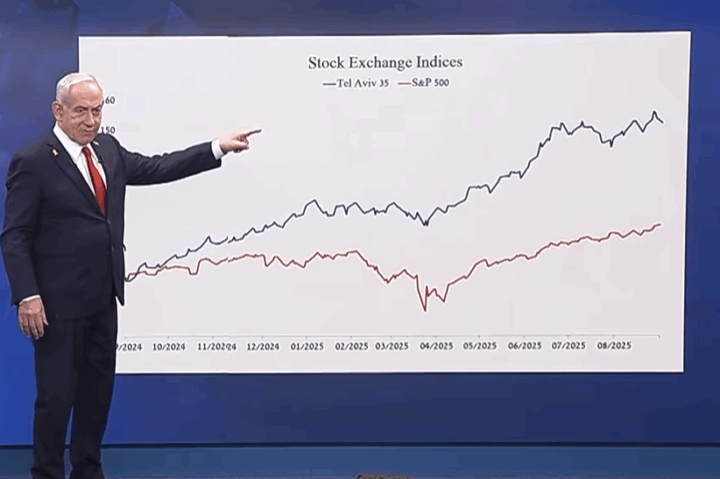
Israeli Prime Minister Benjamin Netanyahu holds a press conference on the Israeli economy on Sept. 16, 2025.
Israeli Prime Minister Benjamin Netanyahu clarified his remarks that Israel’s economy may “need to adapt to … autarkic characteristics” on Tuesday, after a dip in the Tel Aviv Stock Exchange.
Netanyahu made his original comments at a conference held by the Israeli Finance Ministry on Monday, where he said that “Israel is in a sort of isolation,” and that he hates the idea that Israel will have to behave like an autarky, or self-reliant economy.
“I believe in the free market, but we may find ourselves in a situation where our arms industries are blocked. We will need to develop arms industries here — not only research and development, but also the ability to produce what we need … There’s no choice,” he said, adding that Israel will need to be “Athens and super-Sparta.”
Israeli markets dropped in response, and business and industry leaders came out against Netanyahu’s remarks, saying that “an autarkic economy will be a disaster for Israel,” and “this vision … will make it hard for us to survive in a developing globalized world.”
A day later, Netanyahu called a press conference to do damage control amid the widespread concern in Israel, clarifying that his comments were specific to the Israeli defense industry.
In the defense industry, he said “there are limitations that are not economic, but political.”
“If there’s one lesson from this war, it is that we want to be in a situation where we are not limited. We want to defend ourselves by ourselves and with our own weapons,” Netanyahu stated. “We are going to produce an independent arms industry that is very strong that can withstand any political constraints.”
Israel will “build a defense industry that will match the best in the world,” he added. “You saw some — not even all — of it in the 12-day war with Iran.”
The prime minister also talked about Israel working on technology for underground warfare.
Netanyahu said western European countries implementing arms embargoes against Israel are “pressured by minorities in which some are very extreme,” as well as “advanced propaganda against us.”
Netanyahu said that his intention in the speech at the Finance Ministry was to tell its workers that “we are aiming for security independence and I asked them to cut bureaucracy.”
“Within that [speech], there was a misunderstanding,” he said.
“A concentrated, closed market is not what I usually like,” he said. “I turn to the markets. But we are using all of the means needed to create a strong defense industry.”
Netanyahu expressed “full faith in Israel’s economy.”
“Israel’s economy is very strong,” he said. “It has amazed the whole world in recent decades and more than amazed the world in the last two years, in which we are fighting a war. … Against all predictions, the shekel is stronger than it was before the war … Unemployment is at a historic low. In recent months, there is a large flow of investors in the Israeli economy.”
Netanyahu presented graphs showing the Tel Aviv Stock Exchange rising at a higher rate than the S&P, that the shekel is strong against the dollar and GDP per capita is rising, that Israel’s debt to GDP rate is lower than that of the U.S. and the average for advanced economies, and that Israel is second in the world — after the U.S. — in receiving foreign investments for research and development.
“I don’t underestimate the attempts to economically isolate us, but the world wants the products that Israel makes,” he added, mentioning artificial intelligence and cybersecurity. “This is the health, the vibrancy of Israel’s economy. This is a very powerful economy, an economy of 10 million people, but very gifted people.”
In the press conference, Netanyahu also said he had spoken on the phone with President Donald Trump several times since Israel’s strike aimed at Hamas leaders in Qatar last week, including one in which the president invited him to the White House.
Netanyahu said he will be meeting with Trump in Washington on Sept. 29.
Following the press conference, Yair Lapid, Israel’s opposition leader, said that Netanyahu “lost contact with reality.”
“You cannot run a market when there is no trust in the government and no trust in the prime minister,” Lapid said. “On Netanyahu’s watch and that of the current government, Israel’s credit rating was lowered for the first time in history, and then it happened again. There is a sharp reduction in Israeli exports. There is a sharp decrease in investment from abroad. High-tech, the engine of the market, is in an unprecedented crisis.”
Please log in if you already have a subscription, or subscribe to access the latest updates.
 Continue with Google

 Continue with Apple