
























































The actor is dating Jewish music executive Scooter Braun, who has been involved in post-Oct. 7 Israel advocacy

Instagram/StandWithUs
Sydney Sweeney with freed Israeli hostages Noa Argamani and Avinatan Or


 Add JewishInsider on Google
Actor Sydney Sweeney met with freed Israeli hostages Noa Argamani and Avinatan Or, posing for a photo with the pair that began circulating on social media on Tuesday.
The photo of the three was shared by the Jewish advocacy group StandWithUs on its X and Instagram accounts. It is unclear when or where the meeting took place.
While the social media posts did not divulge how the get-together was organized, Sweeney, one of Hollywood’s biggest young actors, has been dating Jewish investor and music executive Scooter Braun, who has become friends with Argamani since her rescue from Hamas captivity in Gaza in June 2024.
Braun has become more involved in pro-Israel activism since Hamas’ Oct. 7, 2023, attacks on Israel, helping finance and organize the exhibition, “06:29 am: The Moment Music Stood Still,” a traveling exhibit honoring the victims of Hamas’ massacre at the Nova music festival. His friendship with Argamani first made headlines in September 2024, when Braun brought her to the Global Citizen Festival in New York to help her advocate for the release of the remaining hostages in Gaza, including Or, her boyfriend. (Or was eventually released in October 2025.)
Sweeney has largely avoided discussing political matters publicly. Most recently, she initially refrained from weighing in as the controversy swirled last summer surrounding her American Eagle’s “great jeans” ad campaign, which used a double entendre that drew accusations of promoting eugenics.
The actor made headlines in November after she declined to apologize to those offended by the ad. “When I have something to say, you will hear from me,” Sweeney told GQ at the time.
“I knew at the end of the day what that ad was for, and it was great jeans,” she continued, explaining that the situation “didn’t affect me one way or the other.”
Sweeney ultimately decided to speak out last month amid continued backlash to the ad and her decision to stand by it. She told People Magazine that she views herself as a person who “leads with kindness” and wanted to clarify her opposition to hatred.
“Anyone who knows me knows that I’m always trying to bring people together. I’m against hate and divisiveness,” Sweeney said. “In the past my stance has been to never respond to negative or positive press but recently I have come to realize that my silence regarding this issue has only widened the divide, not closed it.”
Blumenthal: ‘Our bipartisan effort seeks to strengthen measures to bring long overdue justice to families whose cherished art was brazenly stolen by the Nazis’

J. Scott Applewhite/AP Photo
Sen. John Cornyn, R-Texas, center, is flanked by Senate Judiciary Committee Chairman Dick Durbin, D-Ill., left, and Sen. Richard Blumenthal, D-Conn., at the Capitol in Washington, Thursday, Nov. 14, 2024.
Sens. John Cornyn (R-TX) and Richard Blumenthal (D-CT) introduced bipartisan legislation last week aimed at eliminating loopholes used by museums and other stakeholders to continue possessing Nazi-looted artwork that Jewish families have been trying to recover.
Introduced on Thursday, the Holocaust Expropriated Art Recovery (HEAR) Act would expand on Cornyn’s 2016 legislation of the same name, which was passed at the time by unanimous consent, by ending the Dec. 31, 2026, sunset date on the original bill and strengthen the existing procedural protections to ensure that victims’ claims are not dismissed due to non-merit-based factors such as time constraints.
“The artwork wrongfully ripped from Jewish hands during the Holocaust bears witness to a chapter in history when evil persisted and the worst of humanity was on full display. I’m proud to introduce this legislation to support the Jewish people and Holocaust survivors by helping them recover art confiscated by the Nazis that they are rightfully owed and give them the justice and restitution they deserve,” Cornyn said in a statement.
“The theft of art by the Nazi regime was more than a pilfering of property — it was an act of inhumanity. Our bipartisan effort seeks to strengthen measures to bring long overdue justice to families whose cherished art was brazenly stolen by the Nazis,” Blumenthal said.
Many families of Holocaust victims in the U.S. who have located artwork from deceased relatives and sued to recover those items face the deadline at the end of next year before the statute of limitations sets in. Thousands of stolen works of art remain unreturned to their rightful owners from the Nazi plunder, and there are scores of ongoing cases to resolve disputes over ownership of those items.
“Unfortunately, many museums, governments, and institutions have contradicted Congress’ intent and obstructed justice by stonewalling legitimate claims, obscuring provenance, and employing aggressive legal tactics designed to exhaust and outlast Survivors and their families. Rather than embracing transparency and reconciliation, too many have chosen to entrench and litigate, effectively preserving possession of stolen works rather than returning them to their rightful owners,” a press release for the bill states.
Sens. Thom Tillis (R-NC), Cory Booker (D-NJ), Marsha Blackburn (R-TN), John Fetterman (D-PA), Eric Schmitt (R-MO) and Katie Britt (R-AL) co-sponsored the bill, which was endorsed by a number of Jewish organizations including Agudath Israel of America, the American Jewish Committee, Anti-Defamation League, Jewish Federations of North America, StandWithUs and World Jewish Congress, among others.
“This legislation helps to right a historic wrong committed during one of the darkest chapters in history. By eliminating unnecessary legal obstacles, the HEAR Act establishes a clear path to restitution for Holocaust survivors and their families, ensuring that art and cultural property stolen by the Nazis can finally be returned to their rightful owners,” Tillis said.
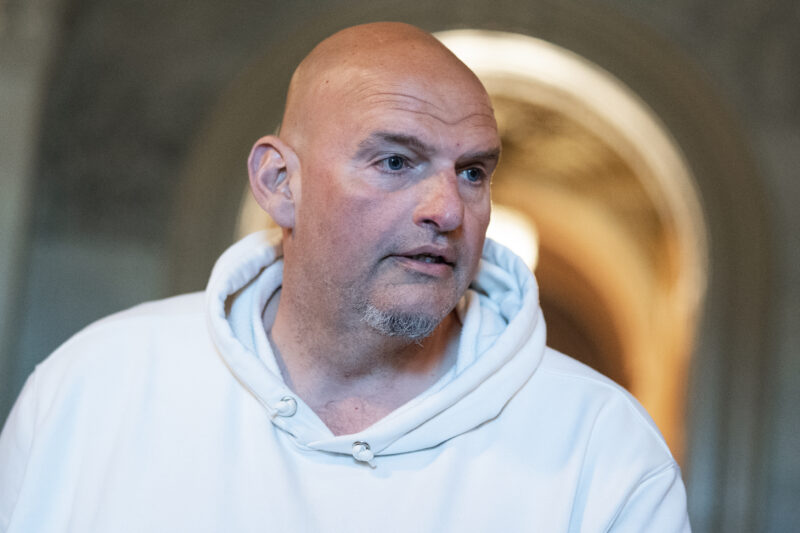
Fetterman said in a statement, “Eighty years after the Holocaust, we have a moral responsibility to do right by the victims of these atrocities and their families. I’m grateful to join my colleagues from both sides of the aisle in introducing the HEAR Act to help return artwork stolen by the Nazis to its rightful owners.”
Please log in if you already have a subscription, or subscribe to access the latest updates.
 Continue with Google
 Continue with Apple