














































































The Democratic congresswoman said AIPAC supporters are ‘good Americans who care about democracy and freedom’
Finn Gomez/Getty Images
Rep. Haley Stevens (D-MI) speaks to the press after casting her ballot at Baldwin Public Library on Aug. 4, 2026 in Birmingham, Michigan.


 Add JewishInsider on Google
Rep. Haley Stevens (D-MI) dismissed the notion on Wednesday that campaign spending in her favor by AIPAC’s super PAC backfired in her failed bid for U.S. Senate, and defended the pro-Israel group as Jewish Americans participating in the democratic process.
Stevens, who lost the Michigan Democratic Senate primary to Abdul El-Sayed last week, has faced scrutiny from progressive Democrats over her support for Israel and the role of AIPAC in supporting her campaign. Following her primary loss, Stevens endorsed El-Sayed, who is now facing former Rep. Mike Rogers (R-MI) in the November general election.
Asked by CNN’s Pamela Brown whether AIPAC’s involvement ultimately hurt her campaign, Stevens remained firm.
“No, I don’t,” Stevens said. “I mean, I think that there [were] a lot of people talking about it, and they didn’t love it because maybe they don’t understand what the group is. AIPAC is a group of six million Jewish Americans, a lot of Jewish moms whose kiddos spend time in Israel.”
“They’re scared, just like a lot of people are scared, for a variety of different reasons here in America,” she continued. “They’re really good Americans who just care about democracy and freedom.”
Stevens said she remains “proud of the campaign I have run,” as well as the “friendships and relationships” she maintains within AIPAC, asserting that the pro-Israel lobbying group, “just like some of the other large groups, is going to continue to exist.”
“Obviously, I don’t work for the organization, so in terms of how they pitch themselves and sell themselves, that — I will leave that to them,” Stevens said, noting that “a lot of people are deeply frustrated that [Israeli Prime Minister Benjamin] Netanyahu has failed to give us peace.”
The congresswoman emphasized, however, that AIPAC was not the only outside entity involved in the primary, noting that “a bunch of Democratic money got involved, too” and that “Abdul also had super PACs and outside monies and all that going on.”
Addressing whether Jewish voters might still harbor concerns over El-Sayed, despite her decision to rally behind him, Stevens acknowledged that “there’s going to be a private and personal decision made by Michigan’s Jewish community.”
“I deeply respect and cherish the relationship that I have with Michigan’s Jewish population. I am a Zionist Democrat. I’m saying that live on CNN. I’m standing by the Jewish community,” Stevens said.
However, Stevens emphasized that Michiganders ultimately “don’t want to see this seat go to a Republican.”
“He’s [El-Sayed] going to do a ton more for healthcare than Mike Rogers ever will. He will stand up for women’s health as well,” Stevens. “And he has rejected socialism, which I appreciate.”
The results paint a picture of a Democratic Party deeply divided, with older voters, Black voters and Jewish voters forming the centrist coalition
(Christian Gooden/St. Louis Post-Dispatch via Getty Images)
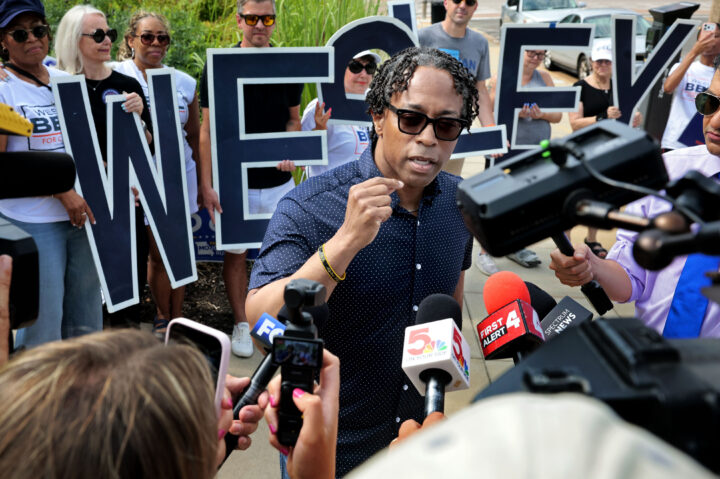
U.S. Rep. Wesley Bell speaks to media outside the Mid-County Branch public library on Tuesday, Aug. 4, 2026, before voting in Missouri's primary elections.
Rumors of the demise of the mainstream, pro-Israel wing of the Democratic Party turned out to be somewhat exaggerated: The Michigan Senate race between Rep. Haley Stevens (D-MI) and Abdul El-Sayed is a lot closer than polls suggested, while Rep. Wesley Bell (D-MO) romped to victory over his anti-Israel opponent, with the help of pro-Israel, Jewish supporters.
Bell’s sweeping 22-point victory in a rematch over former Rep. Cori Bush (D-MO) was an early election night highlight for Jewish and pro-Israel groups, which poured money and organizing efforts into ensuring the virulently anti-Israel Bush didn’t get a chance to return to Congress. AIPAC’s super PAC spent over $3 million on ads attacking Bush as corrupt and extreme, resources which likely played a key role in Bell’s landslide margin.
There were some other silver linings for the moderate side of the Democratic Party on Tuesday night: Michigan state Sen. Jeremy Moss won comfortably to succeed Stevens despite facing attacks over his pro-Israel record from his opponents. And Rep. Adam Smith (D-WA), the moderate ranking member of the House Armed Services Committee who faced harassment and threats over his longstanding pro-Israel record, won a clear majority of the vote against far-left challengers in Washington state’s all-party primary.
But there were plenty of warning signs about the changing ideological direction of the Democratic Party, as we’ve previously seen in deep-blue congressional districts across the country. Despite Stevens’ closer-than-expected showing, she still trails El-Sayed even after winning endorsements from top Democratic officials (including Gov. Gretchen Whitmer) and being the beneficiary of tens of millions in outside spending led by AIPAC’s ad blitz.
Meanwhile, Rep. Shri Thanedar (D-MI), seen as a reliable pro-Israel ally, is trailing against DSA-aligned challenger state Rep. Donavan McKinney, who ran on an anti-Israel platform.
And in the battleground Michigan 7th District, left-wing activist William Lawrence prevailed with a plurality of the vote, largely because of a split between his two moderate challengers. Running in a district President Donald Trump carried in 2024, Lawrence will find his ideological baggage a major vulnerability as he tries to unseat freshman Rep. Tom Barrett (R-MI).
The results paint a picture of a Democratic Party deeply divided, with older voters, Black voters and Jewish voters forming the centrist coalition, which is facing an insurgency from the left made up of younger voters, white progressives and Arab Americans.
What should be most concerning for the Jewish community is that virulently anti-Israel candidates are making inroads in the affluent, college-educated suburbs — areas where such views would have been politically toxic not long ago.
Stevens only narrowly won her home base of suburban Oakland County — the center of the state’s Jewish community — and lost badly in affluent Kent County, spanning the city of Grand Rapids. It underscores the point that the base of the DSA movement is among fairly well-off white voters.
But on the other side, there are plenty of red flags for El-Sayed after his underwhelming primary performance. El-Sayed struggled with Black voters, who make up the core of the party’s voting base. He got romped in the state’s rural counties. And El-Sayed’s overconfidence and the campaign’s grandiose expectations were undercut by the race’s close margin, and he didn’t get to enjoy a celebratory moment in the media spotlight on Election Night.
For AIPAC, which poured over $30 million into the Michigan Senate race, this is merely the first round of a lengthy battle against El-Sayed. If El-Sayed ends up prevailing, expect the pro-Israel advocacy group to remain actively engaged in the race as attention pivots to a general election with former Rep. Mike Rogers (R-MI) as the GOP nominee.
‘We DO NOT endorse Haley Stevens,’ Pux Taphouse said, claiming it has ‘advocated and continue[s] to call for a Free Palestine’
Finn Gomez/Getty Images
Rep. Haley Stevens (D-MI) speaks to the press after casting her ballot at Baldwin Public Library on Aug. 4, 2026 in Birmingham, Michigan.
A Michigan cider brewery where Rep. Haley Stevens (D-MI) hosted a campaign event the night before the state’s Senate primary election issued a statement saying they regretted hosting the event, citing Stevens’ support for Israel.
Pux Taphouse, which is located in Grand Rapids, said in an Instagram post on Monday that they did not know the event was being hosted by the Stevens campaign, only that they had been told it was “a private women’s Dem event.”
The event featured Stevens alongside Rep. Hillary Scholten (D-MI), former Sen. Debbie Stabenow (D-MI) and Jessica Mackler, president of EMILYs List. Some protesters stood outside the event, using bullhorns to accuse Stevens of supporting genocide in Gaza.
“We are heartbroken as we pride ourselves on being not only a queer friendly space but also have advocated and continue to call for a Free Palestine,” the Instagram post from the brewery stated. “We DO NOT endorse Haley Stevens.”
The message calling out Stevens and pledging not to host her for any future events comes amid a broader effort in some liberal cities and businesses to not welcome supporters of Israel. In June, a Brooklyn coffee shop wrote on Instagram that it would refund a recent purchase by Rep. Dan Goldman (D-NY) and ban him from returning because of his views on Israel.
A spokesperson for Stevens did not immediately respond to a request for comment.
Please log in if you already have a subscription, or subscribe to access the latest updates.
 Continue with Google

 Continue with Apple