








































































In Jerusalem and in Washington, officials expressed skepticism about the prospect of Hamas voluntarily relinquishing its weapons
Ohad Zwigenberg/AP
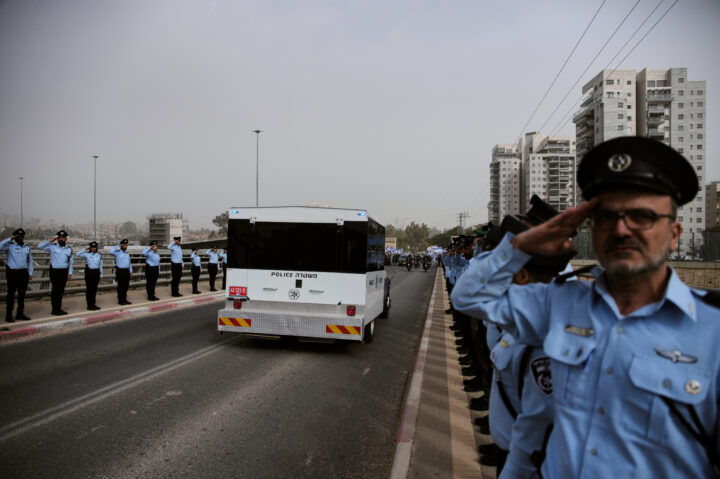
Police officers salute as a convoy carrying the coffin of Ran Gvili, the last hostage whose remains were recovered from the Gaza Strip, passes through Matzliah in central Israel on the way to his funeral, Wednesday, Jan. 28, 2026.


 Add JewishInsider on Google
A major chapter has ended in the war that began when Hamas invaded Israel on Oct. 7, 2023, with the burial of Ran Gvili, the final hostage whose remains were returned earlier this week from Gaza and buried today in his southern Israel hometown of Meitar.
Yet thousands of Israelis continue to be called up for reserve duty and the final aim of the Gaza war — disarming Hamas and demilitarizing Gaza — has yet to be achieved.
At the World Economic Forum in Davos, Switzerland, last week, President Donald Trump said that “many countries say we really want to” disarm Hamas, and his advisor Jared Kushner presented the administration’s plan for the next steps in Gaza, which include the destruction of “heavy weapons, tunnels, military infrastructure, weapons production facilities and munitions” in Gaza in the next 100 days. Under the plan, only members of the police appointed by the Palestinian technocratic committee would be able to hold weapons, but Hamas is reportedly seeking to have 10,000 of its members, whom Israel regards as terrorists, remain in the police force.
At the same time, Kushner’s slide deck was much more focused on the “New Gaza,” complete with Dubai-esque futuristic skyscrapers, than it was on the details of how to get Hamas to give up its weapons. “There is no Plan B,” Kushner said regarding Gaza’s future.
In Jerusalem and in Washington, officials expressed skepticism about the prospect of Hamas voluntarily relinquishing its weapons, and whether the International Stabilization Force described in the Gaza ceasefire deal will be up to the task of confiscating those weapons.They view Israeli military action in the Hamas-controlled half of Gaza as the likely scenario.
Israeli Energy Minister Eli Cohen, who sits on the Security Cabinet, told Kan Bet radio that while Israel is heaving “a great sign of relief with the return of the hero Ran Gvili … the central thing in stage two [of the Gaza ceasefire] is disarming Hamas and demilitarizing Gaza.”
“The chance that [Hamas] will give up its arms willingly or that the international force being put together now will do the work, in my opinion, is not high,” Cohen said. “That’s why in the framework of talks between Israel and the U.S. … a timeline was established, meaning that if the international force succeeds, then good, but if it goes according to my estimation … then the State of Israel will ensure Hamas disarms. … We are determined to finish the job.”
Sen. Lindsey Graham (R-SC) called in a post on X for Trump to “allow Israel to finish the job,” saying that “as to Hamas, nothing has changed. … They don’t seek peace. They only seek destruction. … This has gone on too long.”
Jonathan Ruhe, fellow for American strategy at the Jewish Institute for National Security of America, noted to Jewish Insider that the International Stabilization Force meant to deploy to Gaza as part of the ceasefire “still lacks a clear mandate, or the troops to fill it out.”
“Because Hamas won’t disarm peacefully, Arab and other Muslim countries consistently refuse to put their forces in harm’s way or risk causing collateral damage to Palestinian civilians,” Ruhe said. “The U.S. needs to adapt its strategy, which remains stuck on convincing Hamas to give over its weapons. Hamas thinks it won the war. … An emboldened and well-armed Hamas steadily undermines Trump’s plan of convincing international partners to invest their money and political capital in the hard work of building a new Gaza.”
Matthew Shea contributed to this report.
With Gvili’s return, no Israeli hostage — living or deceased — is being held in the enclave for the first time since 2014

Amir Levy/Getty Images
Israeli tanks stationed near the border with the Gaza Strip on September 17, 2025 in southern Israel.
The IDF announced on Monday that it had uncovered the remains of deceased hostage Ran Gvili at a Muslim cemetery in eastern Gaza City and would be bringing them back to Israel for burial — recovering the final hostage of the Gaza war and marking the first time since 2014 that no Israeli captive, alive or deceased, is being held in the enclave.
Gvili, a 24-year-old member of the Israeli Police Special Forces, died in combat while protecting Kibbutz Alumim in southern Israel during the morning of the Oct. 7, 2023 terrorist attacks. His body was then abducted by Hamas and taken into the Gaza Strip where he was buried by the terrorist group.
Dentists and forensic experts deployed to the cemetery were able to identify Gvili’s remains after the IDF had tested hundreds of bodies, according to The Times of Israel. In return, Israel is prepared to hand over at least 15 Palestinian bodies to Gaza’s Health Ministry.
“Following the completion of the identification process by the National Institute of Forensic Medicine, in cooperation with the Israel Police and the Military Rabbinate, IDF representatives informed the family of the deceased hostage Sergeant First Class Ran Gvili, that their loved one has been identified and will be returned for burial,” the IDF said in a statement.
Addressing members of the Knesset on Monday, Israeli Prime Minister Benjamin Netanyahu declared, “My friends, members of the Knesset, a short while ago we returned Ran Gvili, a hero of Israel. I commend the commanders and soldiers of the IDF and the ISA [Shin Bet intelligence agency] for the perfect execution of this sacred mission … We all wore the [hostage] pin, and now that the mission is complete, the time has come to remove it.”
Israeli President Isaac Herzog also thanked those “involved in the operation,” adding that the people of Israel are “moved to tears” and removed his own yellow hostage pin in a video.
“Finally, Ran has been returned home to his family in Israel,” said Herzog. “After many difficult years, for the first time since 2014, there are no Israeli hostages in Gaza. An entire nation prayed and waited for this moment.”
Hamas had held several Israeli hostages for over a decade, including Avera Mengistu and Hisham al-Sayed, who crossed into the Gaza Strip in 2014 and 2015, respectively, and were held alive by the terror group, as well as the remains of IDF soldiers Hadar Goldin and Oron Shaul, who were killed during the 2014 war between Israel and Hamas. All four were returned to Israel in the aftermath of Oct. 7, either through hostage-release deals or recovery efforts by the IDF.
Prior to Gvili’s return, Hamas had been accused of intentionally delaying the release of the Israeli hostages in order to prolong its survival and gain leverage. However, Trump told Axios that the terrorist group helped locate Gvili’s remains.
“[Hamas] worked very hard to get the body back,” Trump said in an interview on Monday. “They were working with Israel on it. You can imagine how hard it was.”
Hamas spokesman Hazem Qassem said that the recovery of the final hostage body proves the group is committed to the terms of the Gaza ceasefire.
“The discovery of the body of the last Israeli captive in Gaza confirms Hamas’s commitment to all the requirements of the ceasefire agreement in the Gaza Strip, including the prisoner exchange,” Qassem said in a statement. “Hamas will continue to adhere to all aspects of the agreement, including facilitating the work of the National Committee for the Administration of Gaza and ensuring its success.”
White House Special Envoy Steve Witkoff announced earlier this month that President Donald Trump’s Gaza peace plan is moving into Phase 2, a shift from a ceasefire and hostage release to the demilitarization of Hamas and reconstruction of the Gaza Strip — a pivot that could be accelerated by the recovery of the last hostage.
Senate Minority Leader Chuck Schumer (D-NY) said in a statement to Jewish Insider, “At long last, after 843 days, the body of Ran Gvili, the last Israeli hostage held by Hamas, is home. It has taken far too long, but finally, all those who fought of the release of hostages can breathe a sigh of relief.”
“I will never forget meeting with the hostage families for the first time in Israel just days after Oct. 7. They have fought bravely and tirelessly for the return of hostages and did not give up until every single hostage was brought home. Today my heart is with all of the hostages, their families, and those who advocated for their return who can finally begin on the path to recovery and healing,” Schumer continued.
Sen. Lindsey Graham (R-SC) also expressed relief for Gvili’s return on social media, noting that the former policeman “epitomizes the heart and soul of Israel.”
“It is with joy and deep sadness that the body of Ran Gvili has been recovered by the Israeli government, allowing him to go home and receive a dignified burial,” Graham wrote. “He fought like a tiger and to the death, taking terrorists down with him. His love for Israel, the one and only Jewish state, consumed his being, and he made the ultimate sacrifice.”
Ted Deutch, CEO of the American Jewish Committee, also welcomed Gvili’s return in a post on X, adding that “healing can begin.”
“This is the moment we’ve prayed and fought for over the last agonizing 843 days,” Deutch wrote. “I’ve come to know so many families of the hostages over the past two years and I hold them all in my heart today.”
Please log in if you already have a subscription, or subscribe to access the latest updates.
 Continue with Google

 Continue with Apple