































Ian Hurd’s appointment to the search committee drew criticism from some of the school’s Jewish alumni
Vincent Alban for The Washington Post via Getty Images
Northwestern University in Evanston, Ill. on Saturday, October 5, 2024.
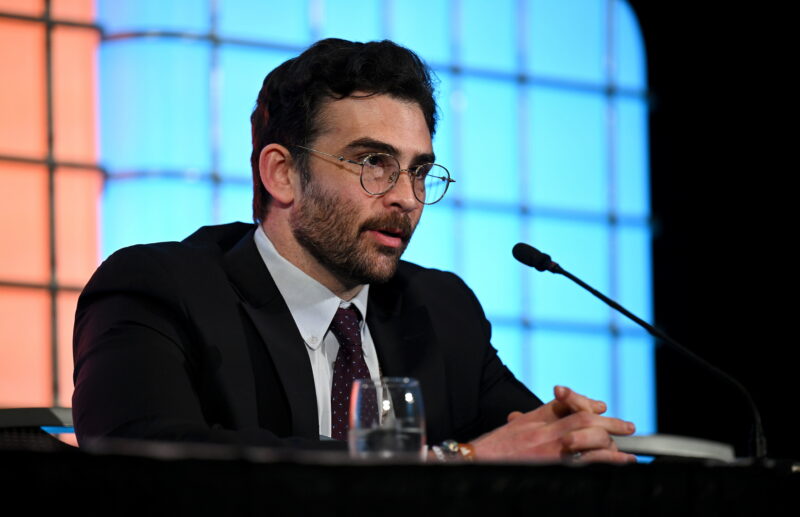
A Northwestern University professor who supported the anti-Israel encampment on the Evanston, Ill., campus and is married to the founder of the university’s chapter of Educators for Justice in Palestine was tapped to join a new presidential search committee, the school announced last week.
Ian Hurd, a professor of political science and president of the faculty senate at Northwestern University, is listed on Northwestern’s website as an “expert on the Middle East.” As Faculty Senate president, Hurd has played an influential role in shaping faculty responses to campus protests, academic freedom disputes and university governance questions.
During this period, faculty leadership — including the Senate — was widely criticized by Jewish students, parents and advocacy groups for failing to condemn antisemitic conduct, for blurring distinctions between political speech and discriminatory harassment and for prioritizing faculty and activist concerns over student safety and civil rights compliance.
The search committee is tasked with making a recommendation to the board of trustees for selecting the school’s next president. The search comes following President Michael Schill’s resignation in September, amid widespread controversy over the school’s handling of antisemitism during his tenure.
During the anti-Israel encampment that overtook Northwestern’s campus in April 2024 — in which Jewish students were surrounded by mobs and told to “go back to Germany and get gassed” — Hurd signed an open letter with 171 faculty members backing the encampment.
Schill was heavily scrutinized by Jewish leaders for overseeing the Deering Meadow agreement, a controversial pact made with anti-Israel encampment participants in the spring of 2024, that allowed students to protest the war in Gaza until the end of the school year so long as tents were removed, and encouraged employers not to rescind job offers for student protesters. The document also allowed students to weigh in on university investments — a major concession for students who had demanded the university divest from Israel.
The Illinois private university agreed to end its commitment to the agreement last month as part of a $75 million settlement with the federal government to restore federal funding that was frozen earlier this year over allegations that administrators failed to address campus antisemitism.
Hurd praised Schill’s capitulation to demonstrators in a May 2024 interview with the Daily Northwestern, saying he was “really proud of how NU handled the situation.”
Hurd’s wife, Elizabeth Shankman Hurd, who is also a professor of political science at Northwestern, was among the founders of the NU chapter of Educators for Justice in Palestine, a faculty-staff network established in December 2023 aligned with NU Students for Justice in Palestine. Shankman Hurd signed the October 2023 faculty letter that downplayed the Hamas attacks in Israel and also helped circulate multiple faculty statements opposing Northwestern’s antisemitism task force, even as Jewish students reported harassment and exclusion from campus spaces.
Hurd’s appointment to the search committee drew criticism from some of the school’s Jewish alumni. “The antisemitic encampment at Northwestern occurred in April 2024, immediately before Ian Hurd was elevated into senior faculty leadership. At the time, Hurd was a leading figure in the Faculty Senate and publicly defended the administration’s response,” Michael Teplitsky, president of the Coalition Against Antisemitism at Northwestern and an alum of the school, told Jewish Insider.
“That sequence is not incidental — it is disqualifying,” continued Teplitsky. “Northwestern is under federal civil rights scrutiny precisely because its leadership normalized antisemitic conduct and chose negotiation over enforcement. Elevating a faculty leader who publicly endorsed that approach into a gatekeeping role for selecting the next president signals continuity, not reform. It raises profound concerns about judgment, civil rights enforcement, and whether the university is capable of the governance reset that Jewish student safety and federal compliance now plainly require.”
Hurd “brings an obvious bias to this committee, likely put in there as the most respectable proxy for the anti-Zionist faculty cohort,” Rich Goldberg, a senior advisor at the Foundation for Defense of Democracies who holds bachelor’s and master’s degrees from Northwestern, told JI.
“His decision to sign the faculty letter [in support of] the pro-Hamas encampment should be disqualifying. Now is certainly the time to double down on accountability for what Northwestern has agreed to, not pretend everything is rosy because of [the settlement with the Trump administration] and [former President Michael] Schill’s resignation,” said Goldberg.
Hurd did not respond to a request for comment from JI on Monday.
Yael Nativ’s application to return as a dance professor was rejected after the department chair told her ‘things are very hot’ at the university since the Oct. 7, 2023, attacks and Gaza war
GETTY IMAGES
This photo was taken from the top of Sather Tower on UC Berkeley campus.
As part of a settlement reached on Wednesday, the University of California, Berkeley acknowledged it discriminated against an Israeli former professor, and offered remedies for the situation, two years after the school disinvited her from teaching a course on Israeli dance, Jewish Insider has learned.
Dance professor Yael Nativ filed a lawsuit against the UC Board of Regents in August, claiming that she was the victim of discrimination under California law. Nativ, a visiting professor who taught a course on contemporary Israeli dance in 2022 and reapplied for the 2024-25 school year, alleged that her application to return was denied due to her Israeli nationality and the climate on campus following the Oct. 7, 2023, terrorist attacks in Israel and ensuing war between Israel and Hamas. Nativ was represented in the suit by the Louis D. Brandeis Center for Human Rights Under Law.
Under the agreement, UC Berkeley Chancellor Rich Lyons issued a personal apology to Nativ. She was also granted $60,000 in monetary damages and was invited by the university to teach the course she “successfully” taught during a previous semester at UC Berkeley — during a semester of her choosing. According to a joint statement from UC Berkeley and the Brandeis Center, “UC Berkeley publicly acknowledges the violation of [its] policy against discrimination with regard to Dr. Nativ and commits to rigorously enforce this policy to prevent recurrence.”
The UC Berkeley Office for the Prevention of Harassment and Discrimination opened an investigation into Nativ’s case last year following her complaint. After a probe that lasted several months, OPHD concluded that she had faced discrimination based on national origin. The recent settlement, however, is the first time the university offered steps to address the mistreatment.
The lawsuit alleges that months after Nativ sent in her application, she received a WhatsApp message from the chair of the department of theater, dance and performance studies, SanSan Kwan, saying she was under pressure from faculty not to bring anybody from Israel or hold courses related to Israel.
“[M]y dept cannot host you for a class next fall. … Things are very hot here right now and many of our grad students are angry. I would be putting the dept and you in a terrible position if you taught here,” Kwan wrote, according to the lawsuit.
“It’s a shame that this [incident] required us to file a lawsuit, because it was a pretty straightforward case of discrimination,” Paul Eckles, senior litigation counsel at the Brandeis Center, told JI. Even though OPHD already ruled in Nativ’s favor, Eckles said there was still a need to “get [the university] to take some action.”
A separate lawsuit against UC Berkeley, also filed by the Brandeis Center on behalf of Jewish groups in November 2023, remains under litigation. That lawsuit alleges that the university violated its own policies and federal civil rights laws by allowing discrimination, harassment and physical violence against Jewish students and faculty. Incidents cited include an attack against a Jewish student draped in an Israeli flag by protesters who struck him with a metal water bottle and the distribution of e-mails to Jewish students calling for their gassing and murder. The complaint, filed in San Francisco federal court, was among the first against a major university after the Oct. 7 attacks and ensuing Israel-Hamas war, with similar discrimination lawsuits following at universities nationwide.
Professor Eric Cheyfitz, who is Jewish, has been involved with Students for Justice in Palestine and was a faculty advisor to the school’s Jewish Voice for Peace chapter
Matt Burkhartt/Getty Images
A man walks through the Cornell University campus on November 3, 2023 in Ithaca, New York.
Cornell University placed a professor with a history of anti-Israel activism on leave this week following his attempt to exclude an Israeli student from participating in his course on Gaza, Jewish Insider has learned.
A Cornell spokesperson told JI that “a complaint was filed” against Eric Cheyfitz, a professor of American studies and humane letters, “who admitted to actions that violated federal civil rights laws and fell short of the university’s expectations for student interactions.”
“Based on the findings of this investigation, the faculty member is not teaching this semester and significant disciplinary action is being recommended,” the spokesperson said. A source familiar with the course told JI that Cheyfitz informed the Israeli student that he was not welcome in the class. Cheyfitz did not respond to a request for comment from JI.
Cheyfitz, who is Jewish, was previously involved with Cornell’s Students for Justice in Palestine chapter and has served as a faculty advisor to the campus chapter of Jewish Voice for Peace. He began teaching the course, titled “Gaza, Indigeneity, Resistance,” last spring semester.
The course description states that the class aims to teach students how to “analyze Indigenous perspectives on political, social, and environmental systems,” in the context of a “global war against an ongoing colonialism,” as well as explore themes such as “Indigeneity,” “Resistance,” “SettlerColonialism,” and “Genocide” in both “international law and Indigenous contexts.”
Three weeks after the Oct. 7, 2023 attacks in Israel, Cheyfitz also offered a “teach-in” titled “Gaza, Settler Colonialism, and the Global War Against Indigenous People.”
In May, Cornell President Michael Kotlikoff objected to the course. “Cornell courses should provoke thought and present multiple viewpoints, rather than transmit pre-formed views of a complex conflict, and I personally find the course description to represent a radical, factually inaccurate, and biased view of the formation of the State of Israel and the ongoing conflict,” Kotlikoff wrote in an email to faculty member Menachem Rosensaft after he raised concerns about the class.
Rosensaft, an adjunct professor of law at Cornell Law School, told JI on Friday that he is confident Cornell administration is “doing everything in their power to see to it that no Cornell students, including Israeli and Jewish students, are discriminated against, harassed or otherwise abused.”
The disciplinary action against Cheyfitz comes as some have criticized Cornell for its decision to allow Professor Russell Rickford, who in 2023 called the Oct. 7 terrorist attacks “exhilarating” and “energizing,” to return to Cornell earlier this year as an associate professor of history following a leave of absence. In an interview with JI in March, Kotlikoff said Rickford was allowed back because his statements were “not in [the] classroom and we have no evidence of Professor Rickford doing anything in the classroom.”
Cornell’s ongoing talks with the Trump administration to restore hundreds of millions in federal funds that were cut over an alleged failure to address campus antisemitism are currently stalled.
At a Capitol Hill hearing, Georgetown’s president announced Brown was placed on leave after calling for Iran to conduct a ‘symbolic strike’ against a U.S. military base
Celal Gunes/Anadolu via Getty Images
Georgetown University students take part in a campus protest against the Israel-Gaza war in Washington on April 25, 2024.
Jonathan Brown, a tenured Georgetown University professor who came under fire last month for a social media post in which he called for Iran to conduct a “symbolic strike” on a U.S. military base, has been placed on leave and removed as chair of the school’s Department of Arabic and Islamic Studies, Georgetown University interim President Robert M. Groves said Tuesday at a congressional hearing.
“Within minutes of our learning of that tweet, the dean contacted Professor Brown, the tweet was removed [and] we issued a statement condemning the tweet. Professor Brown is no longer chair of his department and he’s on leave, and we’re beginning a process of reviewing the case,” Groves said in response to a question from Rep. Virginia Foxx (R-NC) at a House Education and Workforce Committee hearing on campus antisemitism.
One day after the U.S. struck Iranian military targets in June, Brown posted on X: “I’m not an expert, but I assume Iran could still get a bomb easily. I hope Iran does some symbolic strike on a base, then everyone stops.”
Last month, a university spokesperson said that Georgetown administrators were reviewing Brown’s conduct and that Georgetown was “appalled” by his comments.
Brown, until recently the chair of the university’s Department of Arabic and Islamic Studies and Alwaleed bin Talal chair of Islamic civilization in the School of Foreign Service, has a lengthy history of anti-Israel commentary on social media.
A profile listing Brown as chair of Islamic civilization was still active on Georgetown’s website during the hearing.
Dr. Rupa Marya frequently targeted Jewish and Israeli colleagues and students on her social media posts
Smith Collection/Gado/Getty Images
Front entrance at the Parnassus Heights campus of the University of California San Francisco (UCSF) hospital in San Francisco, California, January 5, 2017.
A University of California, San Francisco, medical school professor whom Jewish colleagues allege has routinely posted antisemitic content on social media during the Gaza war has been fired by the university, more than a year after concerns about her behavior first surfaced.
Dr. Rupa Marya worked at UCSF for 23 years, beginning as a resident before becoming a professor of internal medicine and a regular lecturer on social justice topics. With an active social media presence, Marya began posting about Israel’s war against Hamas soon after the Oct. 7, 2023, terror attacks. Her posts included attacks targeting Jewish and Israeli colleagues and students.
In a federal lawsuit filed against UCSF this week, Marya alleged that the university violated her constitutional free speech protections by firing her in a retaliatory fashion over posts published on her personal account, which Marya claimed the university wilfully misconstrued. She asserted that “neither her views nor her posts are antisemitic.”
In January 2024, Marya published a blog post attacking by name a Jewish colleague who had urged a hospital antiracism task force not to issue a statement calling for a ceasefire, saying it would empower Hamas. She had been criticizing him on social media for weeks. (Marya’s account on X, once a very active home for her commentary, has since been disabled.)
Marya also published a thread on X arguing that Zionism should not be present in medicine, calling it a “structural impediment to health equity.”
“There are so many Jewish doctors who don’t espouse an ideology of supremacism and justification of land theft, apartheid and genocide. They are not the issue here,” she wrote in January 2024. “The issue is Zionist doctors who will sit in an ‘antiracism task force’ meeting” — a clear reference to the doctor she later named in her blog — “and try to stop brown doctors who want to issue a Ceasefire statement by saying that a ceasefire would be a bad thing (read: let’s keep killing brown people in Gaza).”
This post from Marya earned a rebuke by the university — UCSF posted on social media soon after about a “tired and familiar racist conspiracy theory … stating that ‘Zionist’ doctors are a threat to Arab, Palestinian, South Asian, Muslim and Black patients, as well as the U.S. health system.” The university called it a “sweeping, baseless and racist generalization” that “must be condemned,” and identified the trope as antisemitism.
In September 2024, Marya announced that she had been suspended from her faculty position. The news came after she had raised concerns about an Israeli student attending the medical school. Students are “asking if he participated in the genocide of Palestinians in the IDF before matriculating into medical school in CA,” she wrote. “How do we address this in our professional ranks?” She was fired in May, nine months after her suspension.
A UCSF spokesperson declined to comment.