














































































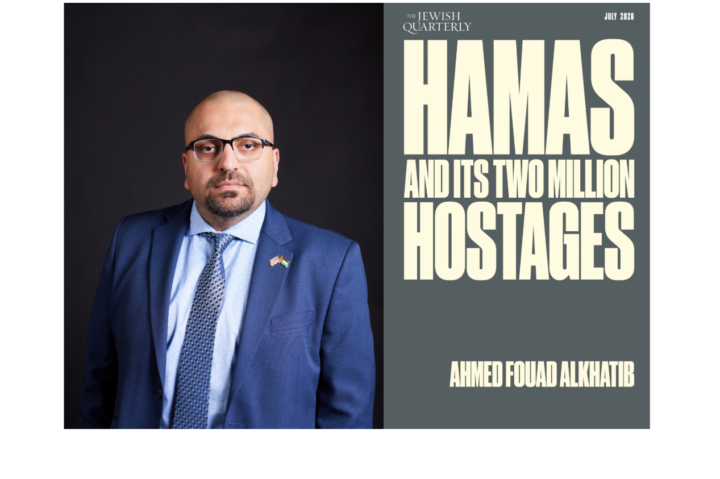
Ahmed Fouad Alkhatib, a Gaza native who lost 33 family members in Israeli airstrikes, argues in his new book that Hamas bears primary blame for Palestinian suffering and political stagnation


 Add JewishInsider on Google
Ahmed Fouad Alkhatib, who lived in the Gaza Strip from the age of 10-15, describes himself as an advocate for the Palestinian people. Since the Oct. 7, 2023, Hamas-led terror attacks in Israel, 33 of Alkhatib’s immediate and extended family members have been killed. But in his latest book, Hamas and Its Two Million Hostages, Alkhatib argues that Hamas — rather than Israel — bears primary responsibility for the suffering and political stagnation of the people of Gaza.
Alkhatib is a resident senior fellow at the Atlantic Council, where he directs Realign for Palestine, a project focused on pragmatic, nonviolent Palestinian advocacy. There, he denounces Hamas and advocates for Palestinian statehood alongside a secure Jewish state.
On Friday, Alkhatib spoke with Jewish Insider about his new book, his experiences growing up in Gaza and his outspoken criticism of Hamas. He also discussed the backlash he has faced from within his own community and why he believes that, ultimately, the terrorist group will have no role in the enclave’s future.
This interview has been condensed and edited for clarity.
Jewish Insider: What inspired you to write Hamas and Its Two Million Hostages, and what does your book add to public debate on this issue that isn’t already out there?
Ahmed Fouad Alkhatib: I wanted to weave in elements of my personal story with Gaza’s contemporary history, and add a human dimension to what I felt was Hamas’ devastating impact on the Palestinian people, their destructive role in setting back the Palestinian national project and the radicalization of the society.
I felt that there’s a consistent gap in the discourse from a Palestinian self-interested point of view. Even though many Palestinians and Arabs and Muslims will tell you privately how devastating Hamas is, there’s a disconnect in the discourse outside of Gaza versus inside Gaza — where you’ll find a ton more willingness to speak out, not just because of the consequences of Oct. 7, but because of the totality of the last 20 years of their rule.
One of the things that’s really frustrating is how there is this persistent narrative that Gazans are all Hamas, Gazans support Hamas. It’s very difficult for the other side, for the Israelis and the pro-Israel folks, to see the humanity of Palestinians because they so fundamentally believe that Gaza is inseparable from Hamas. Nevertheless, I argue and maintain that directly and indirectly, Hamas has taken Gaza captive and is holding 2 million people as hostages.
For the pro-Palestine folks, the goal is to burst the bubble of Hamas, which has been getting normalized since Oct. 7, getting called “resistance” or at best receiving token critique. It’s like a check the box: “Oh, I’m not with Hamas, but let’s keep going on Israel, and Israel this and everything is Israel’s fault.” At its worst, it’s actually been lionizing Hamas — refusing to call for the release of hostages, refusing to acknowledge the pain and suffering they’ve caused for the Palestinian people … Hamas has been a disaster. It has destroyed the seams of the Palestinian society and the fabric, and it’s been part of this devolution.
I also made it a short book deliberately for the average casual reader … I wanted to target a lot of younger audiences … because with the avalanche of new entrants to the scene since [Oct. 7], you have people that quite simply don’t know about Hamas, about the Palestinian people or about Gaza. I believe the theme of this book is that within the imbalance of power dynamics between Israel up here and the Palestinians down here, believe it or not, there is plenty of space for Palestinian agency, responsibility and accountability. That’s not blaming the victims or self-hatred — that’s actually the first step to empowering the Palestinians.
JI: You reflect in the book on your own experiences and those of your family in Gaza. How did these experiences shape the way you approach this book, and how did they shape your understanding of Hamas? Did you find that other Gazans shared your sentiments?
AFA: Well, in some ways, my lived experiences are very central to where I’ve arrived. My family are very devout Muslims and committed Palestinians. My family grew up in a Gaza context, and they were not immune to some of the broader trends. So on one hand the family context was helpful and relevant, and on the other hand it was not necessarily responsible for where I’m at right now because my family was kind of an average lower middle class that engaged in this topic. Very educated, but also not the most politically engaged. Very independent, very willing to stay clear and interested in staying clear from Fatah, from Hamas, from all the other different factions, and I think that was very key.
I remember the hope and optimism of the tail end of the Oslo [Accords] years in the ’90s — flying into Gaza’s airport, these shiny new Palestinian passports, the Palestinian airlines, the cell phones, the industrial zone, the kind of renaissance and the sense of hope and optimism and the march toward statehood. In the midst of all of that, Hamas’ counter-narrative was, “Oh no, the Palestinian Authority and the [Palestine Liberation Organization] sold out, they gave up 78% of historic Palestine, and we are going to bring you something better.”
And I just remember being like, “What’s there that’s better than the opportunity to travel freely, an airport, an incoming seaport, the beginning of the symbol of sovereignty and statehood?” On top of all of that, Hamas said, “We’re going to bring you the whole of Palestine from the river to the sea,” but then said, “Oh, by the way, we need to take this detour so let’s go burn a bar that has liquor, let’s control how women dress, let’s make the society more Islamist.” I distinctly remember [saying to] my parents and my uncles, “This is a detour that has nothing to do with negotiating a better outcome or achieving better results for the Palestinians.”
I tell the story of one time going to a summer camp that turned out to be a Hamas summer camp, and neither my family nor I knew that. I must have been 11, and I just remember being like,
“What is any of this?”
There was a very robust pushback against Hamas and against this trend, but parts of the society ultimately either acquiesced or essentially had no option but to go along because Hamas moved the Overton window — including for the moderate and secular Palestinian Authority and [former PLO and PA leader Yasser] Arafat, who had to accommodate Hamas and incorporate elements of Islamism and resistance culture. That is the theme I try to convey: Hamas slowly and gradually shifted the Overton window of what’s acceptable discourse, not just for itself, but for the entirety of Palestinian society, its national project and its political atmosphere.
JI: You talked to CNN earlier this week about what you described as the “troubling persistence of support” for Hamas among some Palestinian activists and diaspora communities, noting that 44% of American Muslims told Pew Research that they support Hamas. Why does support for Hamas persist in these activist circles, and how do you reverse that trend?
AFA: There are many Palestinians, Palestinian Americans, Muslim Americans and Arab Americans who, when you speak to [them] privately, will tell you that Hamas is a gift to the far right in Israel, that Hamas is gross, that Hamas is disgusting. They don’t want to live under a regime that resembles Hamas — they want to live a normal life. But when you step back in a communal dynamic — whether it be the clergy, elements of the community in academia or parents who are guilt-ridden — you have sociological factors and identity crises that contribute to this trend.
Then there is a much more sinister element: elements of academia, journalism and the “social justice” far left who are not Palestinian or Arab or Muslim, who have concocted a variety of frameworks for how you see these conflicts. They want to map out Israel and Palestine to existing frameworks in domestic discourse around immigration, abortion rights, LGBT issues and Black Lives Matter.
You have modern-day anti-Zionism regularly devolving into antisemitism, and a departure from the broad framework of two peoples, two states. Right now, it is very much so a “river-to-the-sea” eliminationist discourse. Israel is seen as an extension of the United States — whether due to the presence of Ashkenazi Jews that are white-presenting, even though half of Israel are Mizrahi Jews of essentially brown origin and darker origin from Arab lands and from the Middle East, whether it be Israel’s founding being considered a purely European Zionist-led colonial project and not something that has anything to do with Jewish peoplehood and heritage and connection to the land, and so there are just these overly simplistic narratives that are not conducive to productive dialogue.
Part of this support for Hamas is an overcorrection to what people felt was an effort by parts of the pro-Israel community to suppress legitimate critique of Israeli actions. But when the pendulum swung, it didn’t swing toward narrow, targeted advocacy for Palestinian freedom and self-determination next to a safe, secure, recognized Jewish Israel. It swung to, “No, actually, we need resistance to eliminate the Zionist entity.”
Hamas very much so cared about the public relations war and narrative warfare because it thought this level of activism would not only delegitimize Israel, but also coerce Israel into stopping the war. Neither happened. Palestinian suffering was irrelevant to a lot of these communities, because they didn’t react when I and many others in Gaza were saying what was necessary for this suffering to end: closing the page on Hamas taking 2 million people as hostages in its suicidal jihadi nihilism.
JI: Have you faced criticism from within your community for placing so much attention on Hamas in your book rather than Israel, and how are you navigating that?
AFA: It is very frequently that I face critique. People say that I’m obsessed with Hamas, that I’m a nutjob, I’m a Zionist, I’m paid by Israel. Now they’ve shifted to saying that I’m a traitor and a sellout.
I see no shortage of people talking about what Israel has done and what Israel is doing right now in Gaza — including Prime Minister [Benjamin] Netanyahu, whom I acknowledge potentially worsened this situation through direct support for Hamas via Qatari funding. I have no illusions about the fact that Israel bears responsibility in worsening multiple aspects of the discourse, whether it be not empowering the Palestinian Authority, the aggressive expansion of settlements or the recent activities under the current coalition.
My goal is not to simply repeat what people who are even smarter than I am are out there talking about, often speaking in circles to their own choirs. I want to address a gap — and a significant one at that. That gap is that my family and tens of thousands of Palestinians would still be alive had Hamas simply kept its terrorists at home on Oct. 7.
Hamas is treated as an extra on a movie set when it needs to be one of the main antagonists in this whole film. Hamas is a central player in this whole devastation that has befallen Gaza. I see the rightward shift in Israeli society that everybody talks about all the time as inseparable from Hamas and what it did in Gaza and the suicide bombings and what it did to radicalize the Palestinian people in Gaza and in the West Bank.
JI: What do you believe Hamas will look like in the years ahead? Do you believe it is possible for Gaza to have a future without Hamas — and one that is different for both sides of this conflict?
AFA: I don’t believe there can be any coexistence with Hamas. I think they need to be effectively banned from the scene. When people say Hamas can’t be defeated, it absolutely can be defeated. I don’t care about Hamas’ ideology per se. The Nazi ideology lives on all these years. Al-Qaida is alive and well after [Osama] bin Laden. ISIS is alive and well, even though they don’t theoretically control mass territories like they once did.
What I care about is three metrics through which you can judge and assess Hamas’ ability to remain relevant and be defeated: Do they control territory? Do they have an executive force on the ground that can have a monopoly on violence and force and act as an administrative body? And do they control resources — financial, taxation, access to aid and incoming resources, or smuggling? In those three metrics, Hamas has been significantly rolled back.
More likely than not, it is my belief that Hamas is going to be largely irrelevant in Gaza. Hamas is not going to govern like it once did. The days of Hamas reigning supreme and controlling Gaza are over. Hamas may try to remanufacture itself as a political body, as a political entity, but in terms of controlling Gaza like it once did, I see that as incredibly unlikely. Their inventory of weapons and arsenal is very finite. They’re not smuggling weapons like they once did, and a lot of their supplies, workshops and spaces have been destroyed and rolled back. Whether it be through disarmament, Israeli elimination or decay — I think Hamas’ arsenal is going to recede to where it not only no longer constitutes a threat to Israel, but it no longer is adequate to entirely rule the Gaza Strip.
My concern is that Hamas is moving to Turkey. The Turks might be trying to help them reinvent themselves as a political organization. If they enter Palestinian elections, will they then further ruin democratic life? Will they evolve their so-called armed resistance narrative into something that can introduce political stalemate?
Right now, largely speaking, Hamas, Israel, the Board of Peace, the Trump administration and regional and international partners are in agreement over the next steps as far as disarmament, which is a prerequisite to get any kind of withdrawal or reconstruction happening in Gaza. However, now we’re in a space where the disarmament issue is actually logistical in nature. Logistics can make or break a war, a campaign or an effort, and right now, logistically, the disarmament plan is just — it’s not there. It’s not there. That’s what concerns me.
The leading House Democrat said U.S. policy in the Middle East ‘has to change’ and is ‘unsustainable’ but would be ‘broadly inclusive’ in its new iteration
Anna Moneymaker/Getty Images
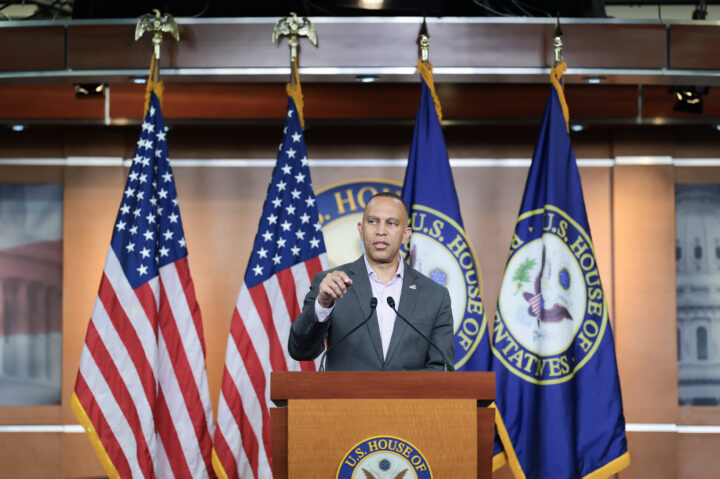
House Minority Leader Hakeem Jeffries (D-NY) speaks during a news conference at the U.S. Capitol Building on July 13, 2026 in Washington, DC.
House Minority Leader Hakeem Jeffries (D-NY) said on Thursday that should Democrats regain control of the House in the upcoming midterm elections, the party will adopt a “broadly inclusive” but fundamentally new approach to policy on Israel.
Jeffries’ comments follow a historic, highly divisive floor vote on Wednesday where nearly half of House Democrats broke with him to support an amendment cutting off $3.3 billion in U.S. foreign military aid to Israel. The amendment to the 2027 State Department appropriations bill, introduced by Rep. Thomas Massie (R-KY), ultimately failed, but laid bare a continuing erosion of support for Israel within the Democratic caucus.
“The situation relative to the United States’ relationship with Israel, the Palestinian people and policy in the Middle East has to change because the current status quo is unsustainable,” Jeffries said at a press conference. “Our approach will be one that is broadly inclusive … [and will include] dialogue across the entire spectrum of the House Democratic Caucus and then be able to land on the highest common denominator, but being guided by the effort to actually create a just and lasting peace between Israel and the Palestinian people.”
House Minority Leader Hakeem Jeffries said that should Democrats retake the House, the party will adopt a “broadly inclusive” but fundamentally new approach to policy on Israel.
— Jewish Insider (@jewishinsider) July 16, 2026
"The situation relative to the United States' relationship with Israel, the Palestinian people and… pic.twitter.com/AELh50as7i
Jeffries outlined that the future Democratic approach will be “anchored in several different principles,” including a renewed commitment to a two-state solution.
“[It will include] Israel’s right to exist as a Jewish and democratic state and homeland for the Jewish people, and at the same time, pressing the urgent need to establish an independent Palestinian state that allows the Palestinian people to live with dignity, respect, and self-determination — and that needs to be dealt with urgently.”
Jeffries also noted that the Democratic Party under his leadership will support all necessary measures to allow for the “prosperity” of the Palestinian people and the alleviation of “suffering,” including calling for a surge of humanitarian assistance into Gaza.
“It means not just the reconstruction of Gaza, but the modernization of Gaza and investing, along with our partners in the Gulf states and moderate Arab nations, in a path toward prosperity for the Palestinian people,” Jeffries said. “Hamas needs to be disarmed and completely removed from power, and we need to deal with the out-of-control settler violence that the Netanyahu administration has allowed to take place in the West Bank, and perpetrators of that violence should be sanctioned and criminally prosecuted.”
Still, Jeffries noted that Israel remains a valuable ally.
“[The Democratic policy approach also includes] recognizing that Israel is an ally of the United States of America in the fight against terrorism, whether that’s Iranian-backed proxies, Hezbollah, Hamas or the Houthis,” Jeffries said.
The AAG is the latest professional association to face calls from its members to adopt a boycott of the Jewish state
Mike Kemp/In Pictures via Getty Images
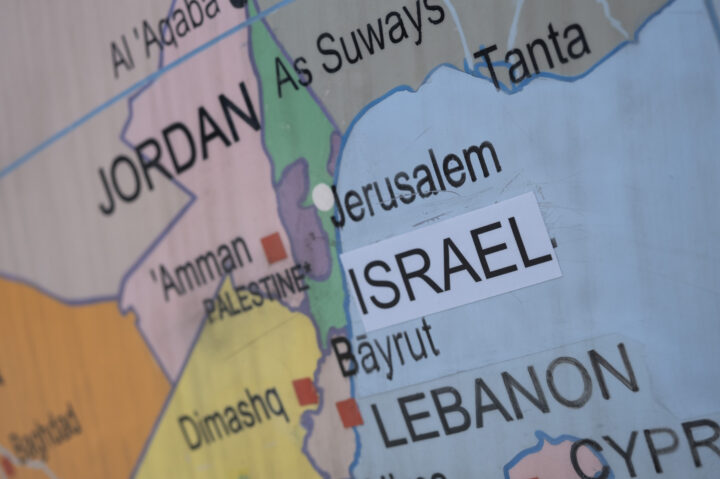
Israel on the public art sculpture The World Turned Upside Down by artist Mark Wallinger on June 10, 2024 in London, U.K.
The American Association of Geographers became the latest professional association to face pressure to adopt a boycott of Israel after a recent member petition urged the association “to endorse the campaign for an academic boycott of Israeli academic institutions.”
The campaign also calls for “financial disclosure and divestment of any AAG funds invested in corporations or state institutions profiting from the ongoing oppression of the Palestinian people.”
A special member meeting is scheduled for Oct. 3 to move toward a vote on the resolution after the group behind the petition succeeded in reaching the required 10% of member signatures. An AAG spokesperson told Jewish Insider that the organization has “no statement or resolution about Israel-Palestine.” AAG did not respond to a follow-up inquiry asking which Israeli institutions the association currently invests in.
“I was absolutely shocked,” Liora Sahar, an Israeli-American member of AAG, told JI.
Sahar, a geospatial expert with a PhD from Georgia Tech, said that she first noticed anti-Israel rhetoric within the association at this year’s annual meeting, held in Detroit in March.
“I was deeply disturbed by the inclusion and promotion of sessions that allowed for inflammatory, biased and harmful rhetoric, far removed from academic rigor or geographic inquiry,” said Sahar.
“Sessions, organized by a group calling itself ‘Geographers for Justice in Palestine,’ centered not on scholarly exploration, but on academic boycott and divestment campaigns. These are political actions, not scientific ones, and they directly undermine the values of academic freedom and open discourse.”
Sahar, who attended the conference virtually, said that she came across a session titled “Dismantling the Palestine Exception” as well as six other “related abstracts [that] accused Israel of ‘ethnic cleansing’ and a ‘U.S.-enabled genocidal war.’”
“It had nothing to do with geography,” she said. Geographers for Justice in Palestine’s “entire goal was to get 10% of the AAG membership to sign the petition.”
The Anti-Defamation League urged the AAG to reject the resolution in a statement, highlighting “its divisive impact on academic communities and violations of AAG’s own ethical guidelines. We have previously expressed concerns about similar issues at AAG meetings and are ready to help AAG understand the potential harm of this resolution before the meeting.”
The campaign comes as members of other professional associations have also called for the adoption of academic boycotts of the Jewish state, a movement that has gained momentum in the aftermath of the Oct. 7, 2023, terrorist attacks and the ensuing Israel-Hamas war.
Last September, for example, the American Association of University Professors reversed course and dropped its longtime opposition to academic boycotts. Faculty members on several campuses soon after started implementing non-official boycotts of Israel by not assigning articles written by Israeli scholars, refusing to invite Israeli academics to conferences and declining to write study abroad letters for students wishing to spend a semester in Israel.
Please log in if you already have a subscription, or subscribe to access the latest updates.
 Continue with Google

 Continue with Apple