














































































‘Mike stands with Israel and he stands up to antisemitism,’ Montebello Deputy Mayor Stacy Caridi said in a statement
Bill Clark/CQ-Roll Call, Inc via Getty Images
Rep. Mike Lawler (R-NY) leaves the House Republicans' caucus meeting at the Capitol Hill Club in Washington on Tuesday, May 23, 2023.


 Add JewishInsider on Google
A second local Jewish Democratic official in New York’s Hudson Valley announced on Monday that she is endorsing Rep. Mike Lawler (R-NY), in part citing his record on antisemitism and Israel policy.
Montebello, N.Y., Deputy Mayor Stacy Caridi, who has known Lawler since he was a state assemblyman, said in a video for Lawler’s campaign, “Mike stands with Israel and he stands up to antisemitism. He calls it out when it comes from the right and he calls it out when it comes from the left. I’m putting my community ahead of my party and supporting a candidate who works for all of us.”
Caridi also emphasized that Lawler has deep roots in the district and has delivered federal funding to help improve the district.
Lawler is facing veteran Cait Conley, a Democrat, in a highly competitive reelection race in a blue-leaning district. Ally Chemtob, who serves on a town council in Lawler’s district, backed him last month.
Conley has also campaigned as a moderate pro-Israel Democrat, and has a background in Middle East and counterterrorism policy.
“I’ve known Stacy since my days in the Assembly, and she has always put the people of Montebello first,” Lawler said in a statement, while highlighting his bipartisan record. “Safer streets for families in Ramapo and its villages were worth fighting for in Washington, and I’m proud we secured that funding. Stacy judges people by their work, regardless of party, and her support means a great deal to me. I’m going to keep earning that trust from voters of every party across this district.”
Matthew Kozma, under secretary for intelligence and analysis, spoke at a briefing for the Secure Community Network, a leading Jewish security organization

Emily Elconin/Getty Images
Members of Hatzalah of Michigan, a Jewish volunteer emergency medical service survey the area near Temple Israel following reports of an active shooter on March 12, 2026 in West Bloomfield, Michigan.
Extensive security “preparations, training and practice” that had taken place prior to an attack on a Detroit-area synagogue earlier this month “greatly helped to dramatically mitigate what could have been so much worse in Michigan,” a Trump administration intelligence official said on Tuesday.
During a security briefing webinar hosted by the Secure Community Network, a leading Jewish security organization, ahead of the Passover holiday, Matthew Kozma, under secretary for intelligence and analysis at the Department of Homeland Security, called for continued vigilance “given the threat that’s stemming from Iran, particularly in the Middle East, but also here at home.”
He said that Americans should remain cautious of threats from “malicious actors, particularly ones encouraged by or empathetic to Iran,” as two upcoming events in the country — the 2026 FIFA World Cup and America’s 250th anniversary — bring an influx of visitors into the U.S.
The briefing was held during what Michael Masters, CEO of SCN, described as “an elevated threat environment from Iran and its proxies,” ahead of the start of the Passover holiday next week.
Since the U.S.-Israeli war with Iran started nearly one month ago, Jewish institutions have seen a surge in attacks, including the one targeting Temple Israel in West Bloomfield Township, Mich. — one of the country’s largest Reform congregations — and three shootings outside of Toronto synagogues.
Masters said SCN monitored over 8,000 direct calls for violence against the Jewish community in North America over a six-day period this month, marking a 137% increase over the average tracked and “the highest number we’ve ever tallied in that timeframe.”
Oakland County, Mich., Sheriff Michael Bouchard, who was on the scene following the Temple Israel attack, shared with attendees that he himself has been the target of death threats for supporting the Jewish community.
Still, Bouchard doubled down on his support. “Something that I’ve said before, and I believe, is that if you target our Jewish community, we’re going to stand in front of them to protect them. And we’re coming for you.”
The briefing concluded with Eric Fingerhut, CEO of the Jewish Federations of North America, calling for “more resources at this time.”
“Temple Israel was one of the best, most secured buildings, having spent a significant amount of money of their dues budget and of their donors’ budgets on security, and yet we need additional levels of security,” Fingerhut said. “Our federations are committed to generating those additional resources, bringing those resources to our communities. But in addition, I have to mention that it’s the government’s responsibility, first and foremost, to protect its citizens in their places of worship, in their places of communal gathering.”
Last week, in a letter to the leaders of the House Appropriations Committee, a bipartisan group of 150 House members asked the committee to provide $1 billion in funding for the Nonprofit Security Grant Program in 2027, a massive expansion of the program that marks the first time lawmakers’ request aligns with the $1 billion that some Jewish groups have been advocating for. The program received $274.5 million in funding in 2025, but that funding has still not been distributed, according to the letter, which cited delays at FEMA, and lawmakers have not been provided customary data about supplemental funding rounds awarded last year.
“We need more resources and support from the government,” continued Fingerhut, who announced that JFNA will hold an advocacy fly-in in Washington in mid-May.
“We will be visiting every member of Congress, asking them for their support. We’ll be visiting the members of the administration, as well … to make sure that [they] know that every one of us has the right in this country to practice our faith and to gather together as a community in safety and security.”
JCRC of Greater Washington CEO Ron Halber: ‘It’s difficult when two-thirds of our community is voting for a political party whose base is hostile to Israel’
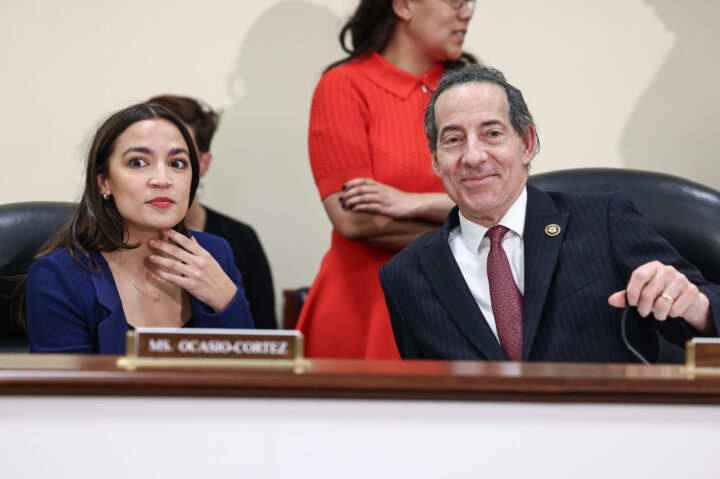
Jemal Countess/Getty Images for Court Accountability
Rep. Jamie Raskin (D-MD) chats before a roundtable discussion on Supreme Court Ethics conducted by Democrats of the House Oversight and Accountability Committee at the Rayburn House Office Building on June 11, 2024 in Washington, DC.
Ron Halber, the CEO of the Jewish Community Relations Council of Greater Washington, strongly criticized Rep. Jamie Raskin (D-MD) over his recent decision to support legislation that seeks to severely restrict U.S. aid to Israel, casting the congressman’s move as part of a troubling pattern that has sparked concern among pro-Israel activists in his Maryland district.
“Jamie’s signing on that legislation was extremely disappointing,” Halber said in an interview with Jewish Insider on Tuesday, referring to the Block the Bombs Act, a bill led by far-left lawmakers that would place unprecedented new conditions on U.S. weapons transfers to Israel.
Raskin, who became a co-sponsor of the bill earlier this month, has not issued any statement regarding his decision.
“It unfortunately follows his signing on to other similar letters and a vote against additional arms to Israel last year, which really raised a lot of people’s eyebrows,” Halber, who said he considers Raskin a friend, told JI.
Halber said that he had spoken with Raskin, one of the most prominent progressive Jewish lawmakers in Congress, three times over the last two days, asking him to withdraw his name from the bill and instead issue a statement expressing the concerns about the war in Gaza that had motivated him to back the controversial legislation.
Raskin said he would be considering the request and indicated he was “not opposed to Israel using arms in other theaters” outside of Gaza, according to Halber, who described “a very honest and frank conversation” about the bill, which was introduced in May in response to the worsening humanitarian crisis in the war-torn enclave.
While he acknowledged that Raskin is “pulled by both being a leader of the Progressive Caucus and by his own progressive Zionism,” Halber said that the legislation represents “a bridge too far” for the pro-Israel community. The bill effectively amounts to an arms embargo on Israel, he said, arguing that it “seeks to unilaterally disarm one of our closest allies” as Israel defends itself on multiple fronts.
“I’m hoping that Jamie will take his name off the bill and use a statement to express his concerns,” Halber told JI, noting that the congressman has also fielded messages from several Jewish leaders leaders in his Montgomery County district who have aired objections. “If he doesn’t, we will be disappointed, but that’s his decision to make and he has to live with the ramifications of his decision,” Halber added. “I don’t see how that helps him.”
Natalie Krute, a spokesperson for Raskin, declined multiple requests for comment about his decision to back the bill, and did not immediately respond to JI on Tuesday regarding his recent conversations with Halber.
Halber’s private engagement with Raskin, who joined 32 other lawmakers in supporting the bill, underscores the challenges that mainstream Jewish groups are now facing as even some of the most reliable defenders of Israel in the Democratic Party shift away from reflexively backing the Jewish state, amid growing outrage over the crisis in Gaza.
“It’s difficult when two-thirds of our community is voting for a political party whose base is hostile to Israel,” Halber said of the waning support for Israel among Democrats. “I think a lot of my colleagues are also finding this a very difficult era,” he added.
Halber said he had also recently spoken with Sen. Angela Alsobrooks (D-MD) after she faced scrutiny from Jewish leaders this month for voting in favor of Sen. Bernie Sanders’ (I-VT) resolutions to block some U.S. arms sales to Israel, despite vowing to oppose such efforts during her Senate campaign last year.
“I’m convinced that her vote was more about sending a message of moral outrage to the Israeli government about the number of children who are malnourished in Gaza,” he said of their discussion, adding he was “a little more forgiving” in assessing her decision because it had coincided with a surge of media coverage about the humanitarian crisis in Gaza.
Alsobrooks was among 27 Senate Democrats, the majority of the caucus, who voted earlier this month to block shipments of U.S. aid to Israel — marking a dramatic turn against the Jewish state for the party. “While I didn’t like that Democratic senators voted” for the resolutions, “it was understandable, and they knew it wasn’t going to pass,” Halber said on Tuesday. “The question is, if it was going to pass would they have supported it — and I hope not.”
Even as the Block the Bombs bill is also not expected to pass, Halber indicated that he viewed Raskin’s move as a more egregious offense, calling it a “safe way” to register discontent with Israel’s conduct in Gaza that nevertheless “went too far” for his heavily Jewish district.
“Obviously, he’s trying to maintain a leadership position within the House Progressive Caucus,” Halber said of the congressman’s thinking. But on his home turf, “there are a lot of” constituents who do not support imposing sweeping new conditions on Israel, he told JI.
Still, Halber suggested that his lobbying to convince Raskin to withdraw his name from the bill is part of a broader effort to “push back against” the growing influence of what he called the “radical left,” whose views on Middle East policy he described as a “huge danger” to Israel’s continued security in the region.
“Once the war comes to an end, the whole Jewish community is going to have to re-strategize,” Halber said of the challenges ahead as his organization and others like it reckon with their traditional approach to engaging on such issues. “We have a lot of work to do with young people and with Democrats and independents.”
The war in Gaza “is going to impact Israel’s image for years to come,” Halber predicted. “Hopefully, once the media isn’t covering it every day, we can provide more context about what happened” and help “rebuild” Israel’s reputation among skeptical voters.
Please log in if you already have a subscription, or subscribe to access the latest updates.
 Continue with Google

 Continue with Apple