













































































The vote was the latest defeat by anti-Israel activists within the Democratic National Committee
Alex Wong/Getty Images
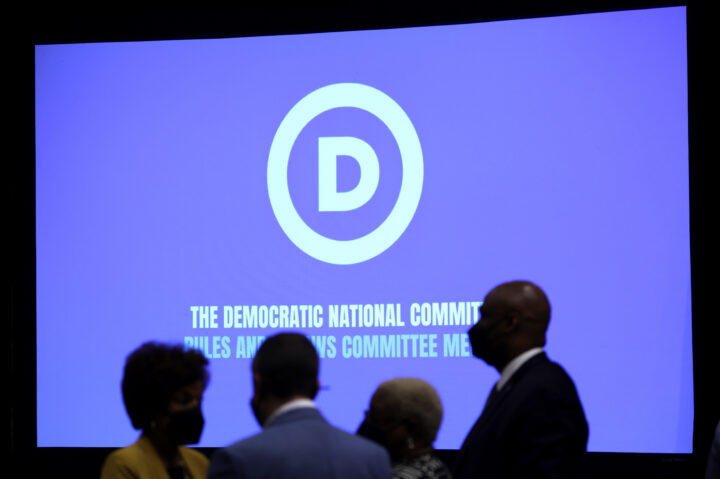
Committee members wait for the beginning of a meeting of the Democratic National Committee’s Rules and Bylaw Committee in Washington, DC


 Add JewishInsider on Google
Democratic Party activists on Thursday voted to reject a measure that criticized the involvement of AIPAC in Democratic primaries and the American political system.
The resolution was debated during a meeting of the Democratic National Committee’s Rules Committee at the DNC’s New Orleans meeting. Committee members were considering new policy resolutions, including one introduced by a Florida activist that took aim at AIPAC and the group’s “undue influence over democratic debate and policymaking.” It was voted down in a voice vote.
“The DNC made clear today that all Democrats, including millions who are AIPAC members, have the right to participate fully in the democratic process,” AIPAC spokesperson Deryn Sousa told Jewish Insider.
Jewish Democratic advocates who were in the meeting room praised the decision.
“We’re pleased that the resolution that wrongly singled out AIPAC was defeated, and that the other anti-Israel resolutions failed to move forward. These measures would be a gift to Republicans, would further fracture our party and do nothing to bring Israelis and Palestinians closer to peace,” Democratic Majority for Israel CEO Brian Romick, who attended the meeting, told JI after the vote.
Halie Soifer, the CEO of the Jewish Democratic Council of America, said the group agrees with the goal of getting dark money out of politics but that AIPAC should not be targeted explicitly.
“We agree with the rejection of dark money in politics — a topic covered in another more expansive resolution adopted by the committee — but also believe that singling out any individual organization is both unproductive and unnecessarily divisive,” Soifer, who also attended the meeting, told JI.
Earlier in the meeting, the committee voted to support a measure “condemning the influence of dark money in the 2026 Democratic primary elections” that called out the artificial intelligence and cryptocurrency industries.
The vote by the DNC’s resolutions committee comes as the Democratic Party faces growing internal strife about its long-standing support for the U.S.-Israel relationship, as some party activists seek to push the group to the left. A new Pew Research Center poll released this week revealed that 80% of Democrats and Democratic-leaning independents have an unfavorable view of Israel — an increase from 69% who said the same last year.
Two other resolutions that touched on Israel-related issues were referred to a working group on the Middle East that DNC Chair Ken Martin created last summer to help smooth over some of the party’s fissures on the Israeli-Palestinian conflict.
One of these referred to Israel’s actions in Gaza as a genocide and called for conditioning U.S. military aid to Israel, and the other called for de-escalation in Iran and Gaza. A third resolution on the Middle East, condemning the U.S. missile strike that hit a girls’ school in Iran and killed at least 165 people, passed.
Democratic insiders expressed skepticism that the resolutions would pass as written, but called anti-AIPAC targeting within the party concerning

Al Drago/Bloomberg via Getty Images
Democratic National Convention (DNC) at the United Center in Chicago, Illinois, US, on Thursday, Aug. 22, 2024.
The Democratic National Committee’s resolutions committee is set to consider resolutions condemning AIPAC and Israel at its upcoming meeting next week in New Orleans — a sign of the continued and growing discord in the party over Middle East policy.
It’s unclear at this point how great of a chance the resolutions stand of passing in their current form, but they are emerging as the AIPAC brand has been tarnished inside the Democratic Party.
The resolution targeting AIPAC, described in a resolution packet obtained by Jewish Insider as a “Resolution On Electoral Integrity, Transparency, And Limiting The Influence Of Corporate Money In Democratic Elections,” specifically calls out the pro-Israel group for its spending.
“The use of massive outside spending to support or oppose candidates based on their positions regarding international conflicts or foreign governments raises concerns about undue influence over democratic debate and policymaking, potentially constraining elected officials’ ability to represent the views of their constituents including the American Israel Public Affairs Committee (AIPAC) spending approximately $14 million in a single Illinois Democratic primary,” the resolution reads.
It goes on to accuse “corporate money PACs” of also weighing in against “candidates who have advocated for Palestinian human rights, ceasefire efforts, or changes to U.S. foreign policy.” It states that opposition to such spending should be part of the party’s 2028 platform. Though the rest of the resolution is generally aimed at condemning dark money and independent spending in primaries, AIPAC is the only group singled out by name.
AIPAC and the DNC declined to comment on the resolution.
The resolution was submitted by a DNC delegate from Florida who pushed a resolution last year calling for an arms embargo and a suspension of U.S. aid to Israel, which was ultimately rejected by the same panel. At DNC Chair Ken Martin’s direction, the DNC set up a working group to discuss Israel-related issues.
In addition to the AIPAC resolution, another resolution highlights accusations of genocide against Israel and suggests that Israeli military units are in violation of U.S. arms sales laws, requiring a suspension or conditioning of arms transfers. A third condemns U.S. and Israeli military operations against Iran and its partners, and calls for conditions on U.S. aid to Israel.
Democratic insiders took differing views on whether the resolutions — particularly the one relating to AIPAC — are likely to pass in their current form.
Halie Soifer, the CEO of the Jewish Democratic Council of America, emphasized that any of the 44 members of the resolutions committee can introduce resolutions. She said that the fact of a resolution being introduced doesn’t mean that it will be considered by or adopted by the full DNC. Resolutions are debated and can be amended by the resolutions committee before they are voted on.
“What you’re seeing here doesn’t reflect a position that’s been adopted by the DNC. It reflects one person[’s] — who filed these resolutions — views,” Soifer said. “I don’t expect that these resolutions will be adopted as they’re drafted.”
Soifer argued that, though there’s “broad concern” about dark money across the U.S. political system, targeting AIPAC in particular doesn’t serve the goal of combating the issue as a whole.
“There are many ways to express such concern, I don’t think solely identifying one organization — especially not in this incredibly difficult moment when such a singling out can be viewed as potentially antisemitic — I don’t think that that is effective,” Soifer said.
A DNC official told JI that the resolutions committee is required by DNC bylaws to consider all resolutions as long as they are compliant with DNC rules, that the committee considers dozens of resolutions at each meeting — totaling more than a hundred in the last year — and that the resolutions are not legally binding. If the resolutions committee votes to advance a resolution, it is then voted on by the entire DNC.
Manny Houle, a Democratic pro-Israel strategist in Minnesota, said that he also doesn’t see the AIPAC resolution going forward because it lacks “teeth” — the DNC “can’t tell candidates where they can and cannot raise money … that’s not our purview.” He also emphasized the diversity of DNC delegates, many of whom do not have an intensive focus on AIPAC or the Middle East.
He also lamented that some Democratic activists seem “hyper-focused on something that doesn’t impact [the day-to-day lives of Americans] and [something] they have very little knowledge on, but they have big emotions for,” referring to the situation in the Middle East. But he also predicted the party will ultimately come together around a nuanced position of supporting allies and opposing Iranian aggression while also opposing “needless war.”
But another senior Jewish Democrat, speaking to JI on condition of anonymity, predicted that an anti-AIPAC resolution of some form could move forward, pointing to discontent and frustration among Democratic insiders over AIPAC’s spending to block former Rep. Tom Malinowski’s (D-NJ) special election primary bid earlier this year, as well as its involvement in Democratic primaries in Illinois.
“I think anyone who is surprised by this sort of potential action by the DNC hasn’t been paying close attention to how AIPAC has been seen within the Democratic Party, especially after their relatively recent decision to get actively involved in Democratic primaries,” the Jewish Democrat said. “The Democratic Party is going to respond when outside groups try to manipulate primaries.”
The Jewish leader said that AIPAC has alienated even some Democrats who were previously aligned with or had donated to AIPAC through its recent political maneuvering, potentially putting more fuel on the fire.
At the same time, the leader urged the party to “go out of their way to ensure that they were not singling out AIPAC for any other reason than it was actively involved in Democratic primaries, which of course other outside forces were too. It’s totally legitimate to criticize a pack in a way that you would criticize any other PAC or outside organization trying to influence Democratic primaries.”
Joel Rubin, a Democratic strategist, former senior J Street official and former Jewish liaison for Sen. Bernie Sanders’ (I-VT) presidential campaign, emphasized that he’s worked at odds with AIPAC at many points in his career, but said he is nonetheless concerned about the singling out and targeting of the group.
“Anytime you single out a specific organization where … at least half of the members are Democrats, and you say they’re banned, you’re opening up a litmus test Pandora’s box that is not going to be easily shut. It’s just bad politics,” Rubin said. “There are ways to criticize — as there should be — an organization’s views and even their electoral efforts without putting forward a resolution of policy of the party that is creating a dynamic that will only further alienate Jewish Democratic voters, period.”
Jewish Americans, he emphasized, have been a core constituency to the Democratic Party for decades, as voters, organizers and fundraisers, and the specific targeting of AIPAC “is a great way to kick out perhaps the most loyal voting bloc from the party.” He said that the effort “plays right into the Republicans’ hands.”
And, Rubin noted, the DNC has no ability to control which candidates run in Democratic primaries, from whom they accept contributions or how AIPAC and its supporters spend their money.
He also predicted that some Democratic activists would treat the resolution, and rejection of AIPAC, as an organizing tool and litmus test for Democratic candidates going forward, regardless of whether this particular resolution is approved.
“It’s going to take leadership amongst people to say, ‘This is not how we treat people in our party. This is not what we do. And if we have a problem with AIPAC and the way they use dark money and the way they have Republican donors go through in a sort of stalking horse, we should call that out and point that out every single time,’” Rubin said. “But that does not mean every single dollar that AIPAC uses … is solely Republican.”
Please log in if you already have a subscription, or subscribe to access the latest updates.
 Continue with Google

 Continue with Apple