









































































The Maryland Democrat campaigned alongside Abdul El-Sayed this week, while withholding criticism of antisemitic streamer Hasan Piker
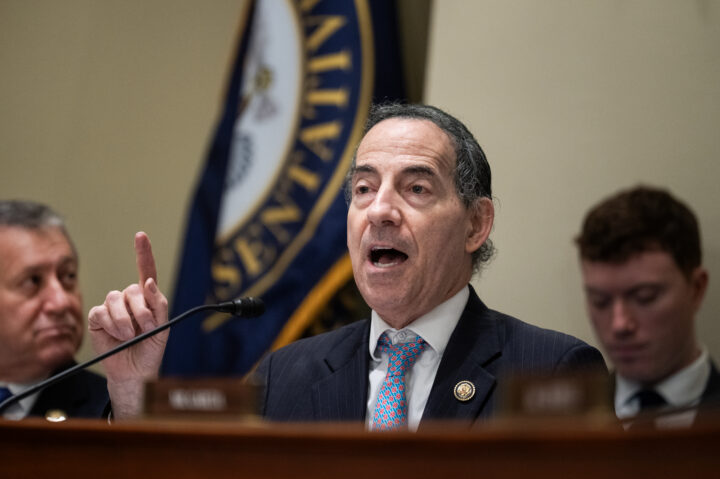
Tom Williams/CQ-Roll Call, Inc via Getty Images
Rep. Jamie Raskin (D-MD) speaks during the House Administration Committee hearing on June 10, 2026.


 Add JewishInsider on Google
For years, Rep. Jamie Raskin (D-MD) has been viewed by his Jewish constituents as an ally in fighting antisemitism and as generally supportive of Israel, despite his deep disagreements with the Netanyahu government and current U.S. policy in the Middle East.
The congressman has maintained a good relationship with many of the Jewish constituents in his suburban Washington district with the largest share of Jewish voters in Maryland, even as he’s backed numerous measures restricting U.S. aid to Israel, which has drawn backlash from prominent Jewish community figures.
But a recent broadside against the Trump administration’s investigations into antisemitism, in which Raskin cited whistleblower reports to describe the investigations into Harvard, Brown and Columbia universities as fabricated and predetermined, is generating new tensions with some community members.
Raskin also spent Wednesday on the campaign trail boosting Michigan Senate nominee Abdul El-Sayed, whose virulent anti-Israel views and associations with an antisemitic streamer have made him persona non grata throughout much of Michigan’s Jewish community.
Rabbi Stuart Weinblatt, the CEO of the Zionist Rabbinic Coalition who leads a synagogue in Raskin’s district, said that the letter from Raskin regarding his investigation into the campus antisemitism efforts was “disappointing” in light of the extent of intimidation targeting Jewish students on campus. Weinblatt said he saw the administration’s policies as a good-faith effort to support Jewish students and disrupt those who have isolated and harassed them.
He said he’s concerned that Raskin’s letter could undermine both the federal tools to protect students as well as lead some people to believe that the problem of campus antisemitism was overstated.
“We have an administration that wants to try to do something, to help protect and defend Jewish students, to help to make them feel safer and more secure,” Weinblatt said. “It would be unfortunate and tragic to be limiting their ability to be able to do that.”
He said that, if Raskin believes — as he said he does — that campus antisemitism is a serious problem to be addressed, he should articulate how that should be done in lieu of the Trump administration-led probes.
“Congressman Raskin has a history of being committed to pursuing issues related to justice and fairness, and so I think it’s unfortunate that he — as a member of Congress who is identifiably Jewish — is taking this action, because I think many Jews are concerned about the environment on college campuses and would look to our Jewish members of Congress to help,” Weinblatt continued.
But, he acknowledged, any action should be taken in a way that is legal, appropriate and measured, and should be done in accordance with the applicable laws.
Some federal courts have also raised objections to the administration’s efforts, finding that the funding cuts targeting Harvard were unconstitutional and that the administration had overstated its case against the university.
In a lengthy statement to Jewish Insider, Raskin emphasized that antisemitism on campus is a real problem that schools must address. But he said that the government levying unjustified penalties helps no one.
“Universities have a duty, under federal law, to prevent and address harassment and discrimination on their campuses and they should be held to account if and when they fail to do so,” Raskin said. “But when the government ignores the actual facts found by its investigators and resorts instead to levying major financial penalties on our universities despite the facts and the law, everyone loses, especially the actual victims of antisemitism and racism.”
He said that the government cannot legally penalize chosen targets without or in spite of an investigation “no matter how just may be its stated cause.”
“Throughout history, Jews have often suffered as the designated scapegoats of these perverted forms of justice,” he continued.
The Washington Jewish Week called Raskin’s efforts wrongheaded, arguing in an editorial published Thursday that the congressman is “making a mistake” by focusing on re-investigating the investigations, rather than trying to address the antisemitism itself.
“Raskin instead describes the administration’s investigations as ‘fake,’ a ‘pre-baked frame-up operation’ and a ‘sham,’” the editorial continues. “Those are sweeping conclusions to announce before conducting an investigation supposedly intended to determine what happened. … The House Judiciary Committee should be strengthening [the civil rights investigatory] system, not conducting another round of political theater about who weaponized government first.”
The editorial argues that Raskin should be putting his energy toward “showing America how to address [campus antisemitism] properly.”
Raskin previously criticized the administration’s efforts to shutter parts of the Department of Education’s Office for Civil Rights, a move he said endangered efforts to fight antisemitism, among other forms of discrimination.
Raskin, citing the whistleblower testimony, said in his statement to JI that the administration had “used fabricated and disproven claims of antisemitic discrimination as a cudgel, even in cases where the targeted school’s own Jewish students, faculty, and rabbis applauded and praised the university’s positive and proactive responses to incidents of antisemitism or intolerance” and “ignored Jewish voices and the on-the-ground facts found by investigators.”
He said that in doing so, the administration, rather than his probe, undermined legitimate efforts to combat antisemitism and sent a public message that the problem of campus antisemitism is not a real one.
“If we lose public confidence in the integrity of government investigations and the government’s respect for the facts, we will lose the effectiveness of our anti-discrimination laws,” Raskin said. “This is why everyone, but especially the actual victims of antisemitism and racism, have every reason to stand by the rule of law and the central importance it places on actual facts rather than allegations and suppositions.”
Ron Halber, the CEO of the Jewish Community Relations Council of Greater Washington, took a more sympathetic view of Raskin’s efforts, even while underscoring that colleges and universities have failed to protect Jewish and pro-Israel students and that he’s glad that they are being investigated and held accountable.
But he also expressed concerns about some of the penalties the Trump administration imposed, particularly stripping funding from the schools, and said that if Raskin has evidence that the cases were pre-determined, those issues should be investigated.
“If there are cases where nothing was found and the universities were punished, first of all, it’s illegal, it’s unethical and Jews do not want antisemitism being used as a weapon to further other political goals. We want open, objective investigations,” Halber said. “If a university did not act properly and protect their Jewish students, we want them to be held accountable and punished accordingly.”
He said that if some of the investigations do prove to have been faulty, that would also cast doubt on other investigations that may have found more credible evidence. “It doesn’t help us get to the bottom of [the campus anti-Israel protests and administration responses] if the investigations themselves are flawed.”
Kenneth Marcus, the CEO of the Brandeis Center for Human Rights Under Law, which has represented Jewish students in legal action against various colleges and universities, dismissed the Raskin letter as the result of a disgruntled former Department of Justice employee, who filed a whistleblower complaint because she did not align with the administration’s efforts to combat antisemitism.
“It is no secret that the career ranks of the Justice Department contains some long-time employees who do not share the current administration’s values or priorities. The federal government has a legal obligation to enforce Title VI to protect Jewish students as vigorously as it does with other groups,” Marcus said. “After years of paying insufficient attention to anti-Semitism, it is a welcome relief that the Justice Department has finally made it a priority.”
He argued that the administration’s investigations were evidently necessary, as well as overdue.
“No one can deny the seriousness of the problem at institutions like Harvard and Columbia. The question isn’t so much why this administration has responded forcefully to the problem at these campuses but rather why wasn’t it done sooner,” Marcus continued.
On the campaign trail with El-Sayed this week, Raskin was also asked — as a widely regarded figure among liberal Jews — about his pitch to Jewish Democrats concerned about El-Sayed. He emphasized in response that Democrats’ efforts must be focused on defeating President Donald Trump and GOP candidates for Congress.
Raskin visited Ann Arbor on Wednesday to campaign for El-Sayed, also joining Rep. Debbie Dingell (D-MI). Many prominent Jewish Democrats in the state say they’re agonizing over the general election, torn between their party loyalty and their concerns about El-Sayed and his allies.
“The Democratic Party is a very big tent,” Raskin said. “It’s a very big tent because there are a lot of people in it, and they’re just like — you know, any big family Thanksgiving dinner, there can be arguments and people jostling, and there’s unruliness. But fundamentally, we all believe in democracy, in freedom, and the progress and prosperity of our people.”
He said that the election is a “referendum about the future: Will we have democracy or will we have autocracy? This is our chance to cut this reign of lawlessness and terror in half in this election.”
Raskin also praised El-Sayed’s career in public health and said that he would be critical to making health care more affordable in the Senate, but didn’t directly address the concerns that members of the Jewish community have raised about the nominee.
He also did not address a question from JI about influencer Hasan Piker — whom various other leading Democrats have condemned this week — and his ties to El-Sayed.
Meanwhile, Rep. Haley Stevens avoided a question about receiving support from pro-Israel donors, while Abdul El-Sayed blamed rising antisemitism on white supremacy
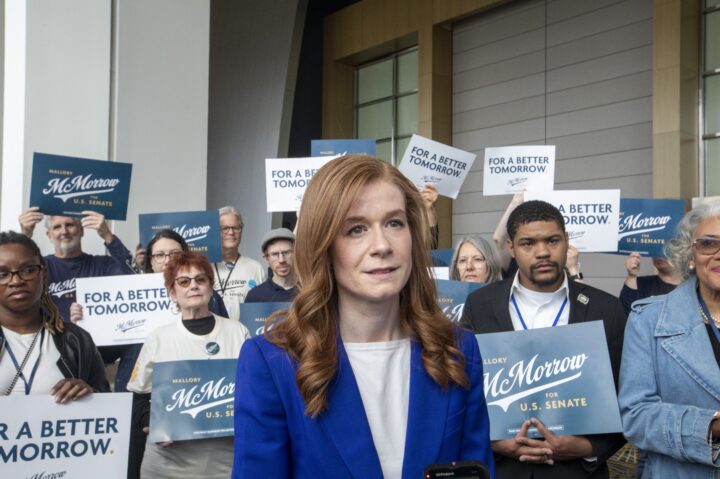
Jim West/UCG/Universal Images Group via Getty Images
Mallory McMorrow, a candidate for U.S. Senate, campaigns at the Michigan Democratic Nominating Convention
State Sen. Mallory McMorrow offered a straightforward answer when asked at a debate on Thursday, alongside the other two Democrats vying for an open Senate seat in Michigan, whether there is an antisemitism problem in the Democratic Party.
“There is,” said McMorrow. She told the story of an attendee at last month’s Democratic Party convention in Detroit who yelled an antisemitic slur at her Jewish husband, in front of their young daughter.
“That is terrifying. We need to be able to state very clearly that what the Netanyahu government is doing is wrong, that the violence needs to end, that we need to bring about long-term peace and security for Palestinians and for Israelis, and that turning that into not an anti-Netanyahu, but an anti-American Jewish message is dangerous,” McMorrow said, earning applause from the room.
The other two candidates — Rep. Haley Stevens (D-MI) and former public health official Abdul El-Sayed — did not directly address the question about Democrats.
Stevens condemned “rising political violence and extremism,” including the attack at Temple Israel in West Bloomfield, in her district, which she said was carried out by a “homegrown terrorist.” She described herself as a lawmaker who is “leading on combating antisemitism in a bipartisan way. That does not have to be a partisan thing.”
El-Sayed said he understands discrimination because he has faced it himself. He blamed antisemitism in the U.S. on white supremacy.
“I know that antisemitism and Islamophobia tend to go hand in hand, and the real issue when it comes to either of them is the scourge of white supremacy,” he said, while arguing that respecting American Jews does not require supporting Israel.
The Democratic primary for the open Senate seat in Michigan is one of the most contentious in the country, and antisemitism has become a major issue, alongside U.S. foreign policy and support for Israel. It is perhaps the most high-profile seat where debates about the role of AIPAC might actually have an impact on the outcome.
Stevens, a longtime ally of the pro-Israel group, was the early frontrunner in the race but has faced attacks from her opponents for not criticizing AIPAC.
Presented with an opportunity on Thursday in a primary debate to help voters understand why she continues to receive support from the pro-Israel advocacy group, Stevens chose not to speak about the group at all.
“You take money from AIPAC. Walk us through what that money means and what it buys, and maybe what it doesn’t,” one of the debate’s moderators asked Stevens, as part of a question about how much influence individual donors have over their decisions.
“Michiganders are frustrated because we have not done comprehensive campaign finance reform. Mike Rogers will not vote for comprehensive campaign finance reform like I have in the House of Representatives,” Stevens said, referring to former Rep. Mike Rogers (R-MI), the expected GOP nominee for Senate. “We squarely need to put people at the front of our agenda.”
She also said she is “deeply proud to have grassroots support coming from grocery clerk workers to retired teachers to factory workers and the like,” and named some of the politicians who have endorsed her, including former Rep. Brenda Lawrence (D-MI), former Sen. Debbie Stabenow (D-MI) and former Gov. Jennifer Granholm.
When asked about her views on foreign policy, Stevens attacked President Donald Trump for the “harmful and ridiculous” steps he took to pare back U.S. humanitarian aid abroad, and pledged to focus on peace.
“We need to see the United States work with our allies to achieve lasting peace between Russia and Ukraine, between the people of Israel and Palestine and of course between China and Taiwan,” said Stevens. “But when you remove the tools from our tool kit, you fail this country and you fail us, to allow us to work alongside our allies.”
Both McMorrow and El-Sayed used Thursday’s debate to remind voters that they do not accept donations from AIPAC. (AIPAC has not made an endorsement in the Senate race, but it has encouraged its supporters to donate to Stevens’ campaign.)
“I have not taken a dime of corporate PAC donations. I have not taken a dime of AIPAC donations,” said McMorrow, who is endorsed by the progressive Israel advocacy group J Street.
El-Sayed, who regularly accuses Israel of genocide and has said he struggles with the question of whether Israel has the right to exist as a Jewish state, slammed Stevens for taking AIPAC supporters’ donations.
“Let me tell you what absolutely would not shape my perception [of foreign policy]: it’s AIPAC money,” said El-Sayed.
William Daroff, CEO of the Conference of Presidents, to Van Hollen: ‘Labeling American Jews as apologists when they challenge you is not discourse. It is a smear’

Joe Raedle/Getty Images
Rabbi Susan Shankman (L) hugs Ron Halber, the Executive Director of the Jewish Community Relations Council of Greater Washington, as they gather together at the Washington Hebrew Congregation during a vigil for Israel on October 09, 2023 in Washington, DC.
Several major Jewish organizations rallied around Ron Halber, the CEO of the Jewish Community Relations Council of Greater Washington, after a spokesperson for Sen. Chris Van Hollen (D-MD) attacked Halber as an “apologist for the Netanyahu government” and unrepresentative of his community.
The Van Hollen spokesperson’s comments came in response to remarks by Halber to reporters in which Halber said that many in the Maryland Jewish community feel “betrayed” by the senator and that he has failed to show empathy for Israel and the Jewish people.
The JCRC’s Board of Directors, in a statement late Thursday, offered Halber, who has led the group for nearly three decades, its full support, and applauded his work.
“Recent personal attacks leveled against [Ron] by Sen. Chris Van Hollen are undignified, unwarranted, and untrue. Ron and his leadership team have our full backing and support,” the board said in a statement. “In a time marked by division and discord, political leaders should model respectful behavior and discourse. We are deeply disappointed that Sen. Van Hollen chose instead to malign Ron and our organization, but we are heartened by the outpouring of support from so many partners and friends. They know what we know: Ron and the JCRC support not only Jewish families, but the millions of people who live in the DMV.”
William Daroff, the CEO of the Conference of Presidents of Major American Jewish Organizations, said he’s known, worked with and respected both Halber and Van Hollen for decades, and that Van Hollen has been his representative for much of that time.
“That is why I am stunned, offended, and frankly angry at Senator Van Hollen’s personal attack on Ron,” Daroff said on X. “Ron is a respected communal leader who has spent decades serving Maryland Jews, advocating for security, and giving voice to a community that is anxious and afraid in this moment of rising hostility.”
He said that Halber’s criticism was “not partisan” and was at its core a call for empathy for Israeli lives, Israel’s security dilemmas and the “vulnerability so many Maryland Jews feel today,” but was “met instead with derision.”
“We can disagree about Israeli policy. We can debate strategy and tone. But labeling American Jews as apologists when they challenge you is not discourse. It is a smear. It cheapens the conversation at a time when Jewish anxiety is real and rising, and when we need leaders who hear us rather than dismiss us,” Daroff said. “Our community deserves respect. We deserve empathy. We deserve partnership grounded in good faith. We will speak up for those expectations.”
The Jewish Federation of Greater Washington, another major D.C.-area Jewish umbrella organization, also offered support for “the vital role Ron Halber and the JCRC of Greater Washington play in advocating for Israel, Jewish safety, belonging, and connection across Greater Washington.”
“Ron has worked tirelessly for years to build a stronger Jewish community and Greater Washington region,” the organization continued. “At a time of extreme divisiveness in our society, our public officials should not be contributing to these divides through personal attacks.”
AIPAC said the statement by Van Hollen’s team was “shameful.”
“Disagreeing with you, Senator, doesn’t make American Jews apologists for a foreign leader,” the group said on X. “Resorting to this tired and toxic trope only reflects the shallowness of the Senator’s arguments.”
The Jewish Federations of North America, the umbrella group that represents hundreds of Jewish communities and groups around the country, said in a statement that it “stand[s] with our esteemed colleague Ron Halber … following the deeply troubling personal attack leveled against him.”
“Ron and [the JCRC of Greater Washington] understand and speak for their community, and their well-documented concerns should be listened to and addressed on the merits,” JFNA continued. “We are grateful to all the public officials in the Greater Washington DC area who are engaged in productive conversations and collaborations with the Jewish community.”
Yehuda Kurtzer, the president of the Shalom Hartman Institute, called the statement “unconscionable” and said Halber deserves an apology from Van Hollen.
“Politicians need to have thicker skins in responding to criticism, especially when it is directed at them by respected representatives of minority communities. That’s part of the job,” Kurtzer said on Facebook. “Van Hollen has the right to cut off contact with the organized Jewish community even though I think that’s a toxic political choice. But he should not respond publicly like this.”
He added that, “to characterize a pro-Israel view as an apologetic for a foreign government is to evoke unfounded suspicion of foreign interference and to cast the[m] as therefore ‘un-American.’ This is dangerous stuff and politicians shouldn’t do it.”
Halber’s counterparts in other parts of the country have also rallied to his defense. “The contempt with which [Sen. Van Hollen] showed for Ron, the DC JCRC, and the Jewish community is unacceptable. He needs to apologize,” Tyler Gregory, the CEO of the Bay Area JCRC, said.
Jeremy Burton, the CEO of the Boston JCRC said that “Labeling American Jews as ‘apologists’ just because you disagree with them & their (our) attachment to the Israeli people is unacceptable” and also called on Van Hollen to apologize.
Amy Spitalnick, who leads the Jewish Council for Public Affairs, lamented both Van Hollen’s attack on Halber as well as New York Jewish figures’ criticisms of Mayor-elect Zohran Mamdani.
“We can’t even engage without resorting to ad hominem attacks. A Senator’s office calls a respected Jewish community professional an ‘apologist for Netanyahu.’ Multiple leaders call the Mayor-elect an ‘enemy of the Jewish people,’” Spitalnick said. “Countering antisemitism and hate, protecting democracy, advancing peace and security for Israelis and Palestinians all require us to engage — not disparage and smear — even and especially when we disagree. This is all so dangerous.”
Rabbi Yaakov Menken, executive vice president of the Coalition for Jewish Values, said that “This was a display of bigotry unbecoming a US senator. [Van Hollen] owes the entire community, and especially [Halber], an apology.
Though he did not address the situation or the senator directly, Democratic Maryland Gov. Wes Moore — who addressed a JCRC legislative breakfast the same day as Halber and Van Hollen’s comments and offered praise and thanks to Halber — also reaffirmed his partnership with the D.C. JCRC in an X post on Thursday.
“There’s no higher goal for me than ensuring people feel safe where they live, work, and worship. That’s why our administration is fully committed to combating antisemitism in all its forms, and why I’m proud to announce that my upcoming budget proposal will preserve historic funding for hate crime protection grants,” Moore said, alongside a photograph from his speech in front of a JCRC banner. “Thank you to @JCRCgw for your partnership in this work.”
Eileen Filler-Corn, the Jewish and Democratic former speaker of the Virginia House, said on Facebook that she’s “offended by the personal attack directed at Ronald Halber,” describing him as a “respected leader in our Jewish community” and an “essential” advocate for the community.
“We can and should have healthy debates about the Israeli government and disagreement is part of a vibrant democracy, but labeling American Jews as ‘apologists’ for Netanyahu simply because they express support for the State of Israel is unacceptable, unproductive and entirely out of line,” Filler-Corn said. “Our community is hurting. We are being targeted and antisemitism is surging. At a moment like this, personal attacks on those who advocate for our safety and dignity do nothing but deepen the pain.”
Van Hollen does have some defenders in the Jewish community. Hadar Suskind, the CEO of the left-wing Israel advocacy group New Jewish Narrative, praised Van Hollen’s engagement since the Oct. 7, 2023, terror attacks and with the war in Gaza.
“Chris has always been there for his Jewish constituents and in support of the people of Israel,” Susskind said on X. “But you know what, like the majority of Marylanders, including Jewish Marylanders, he disagrees with many of the policies and actions of the Netanyahu government. And he is 100% right to do so and to say so.”
“As American Jews who care about Israel we should want all of our elected officials [to] do what Senator Van Hollen is doing, speak the difficult truths that need to be told and support a better future for Israelis and Palestinians,” he continued. “The days of demanding that elected officials ‘pick a side’ and show loyalty to ‘one team’ are over.”
Please log in if you already have a subscription, or subscribe to access the latest updates.
 Continue with Google

 Continue with Apple