














































































The real impact is likely the ‘special strategic partnership,’ as the countries are calling it, that bolsters Israel's global position at a time when many of the Jewish state's traditional partners have turned away
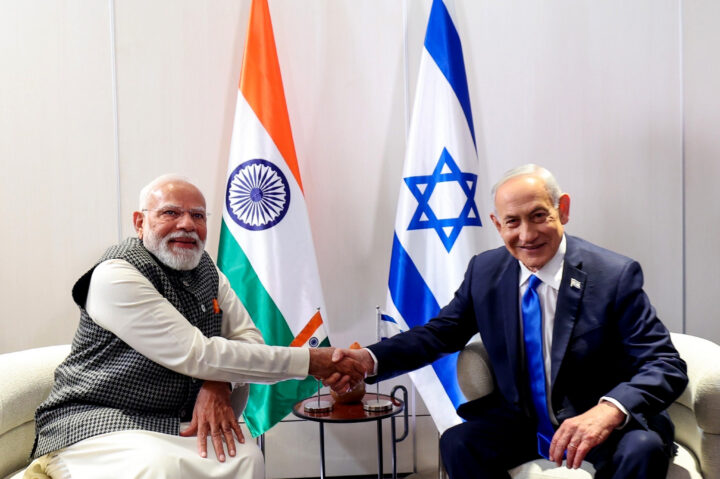
(Press Information Bureau (PIB)/Anadolu via Getty Images)
Indian Prime Minister Narendra Modi meets with Prime Minister of Israel Benjamin Netanyahu in New Delhi, India on February 25, 2026.


 Add JewishInsider on Google
Indian Prime Minister Narendra Modi’s visit to Jerusalem this week was an important geopolitical moment for Israel.
The biggest tangible outcome of the visit is that, according to Indian media, Israel plans to transfer Iron Dome and Iron Beam missile-defense technology to India, as part of a defense deal reaching as much as $8 billion-$10 billion. The governments only officially acknowledged “significant growth made in defense cooperation … both in scope and scale.”
As for confirmed deliverables, Israel launched expedited free-trade negotiations with the world’s most populous country and fastest-growing economy. The governments released a nine-page statement announcing agreements in a range of areas, including mineral exploration, AI, agriculture, cultural exchange and recruitment of up to 50,000 Indian workers to Israel in the next five years — fulfilling a major need for Israel, which revoked most work permits for Palestinians after the Oct. 7, 2023, attacks.
But the real impact is likely greater than any specific agreement. It’s the alliance on display between Israel and India — a “special strategic partnership,” as the countries are calling it — that bolsters Israel’s global position at a time when many of the Jewish state’s traditional partners have turned away.
Lauren Dagan Amoss of Bar-Ilan University’s Begin-Sadat Center for Strategic Studies and a leading India analyst in Israel, characterized Modi’s speech to the Knesset as “a threshold moment … designed to justify an upgrade from cordial relations to a partnership with strategic depth and deliverables. … The message was aimed at external stakeholders … especially Washington, the Gulf states, and the broader economic-technological community … rather than treating Israel as a standalone bilateral track.”
That dovetails with Israeli Prime Minister Benjamin Netanyahu’s remarks at a Cabinet meeting on Sunday, where he described his vision of a “hexagon of alliances around or within the Middle East. This includes India, Arab nations, African nations, Mediterranean nations (Greece and Cyprus), and nations in Asia that I won’t detail at the moment.” That “hexagon” creates “an axis of nations that see eye-to-eye on the reality, challenges, and goals against the radical axes, both the radical Shia axis, which we have struck very hard” — i.e. Iran — “and the emerging radical Sunni axis,” meaning Qatar, Turkey, and perhaps India’s historic adversary Pakistan, which signed a defense pact with Saudi Arabia less than six months ago.
Modi’s visit came as the world is watching the U.S. and Iran to try to understand if a military conflict is on the way, and while he did not make any specific reference to the Islamic Republic or nuclear weapons, the Indian leader spoke about terrorism, of which Iran is the leading state sponsor. Modi spoke about Israel and India both having “endured the pain of terrorism for a long time,” and said that “countering terrorism requires sustained and coordinated global action, because terror anywhere threatens peace everywhere. That is why, India supports all efforts that contribute to durable peace and regional stability.”
At a time of acute security needs for Israel, the Indian prime minister showed his understanding of Israel’s “security ethos,” Dagan Amoss wrote, and Modi signaled a shift towards deepening the countries’ defense ties, “from a procurement-centric logic to a capability-building approach: industrial integration, supply-chain resilience, and strategic connectivity through corridors, critical infrastructure, and technology as an enabling platform rather than one-off transactions.”
In an interview with JI, Amb. Reuven Azar says joint manufacturing ‘means that, during times of need, we can supply things to each other, unlike what happened [with other countries] during the war’
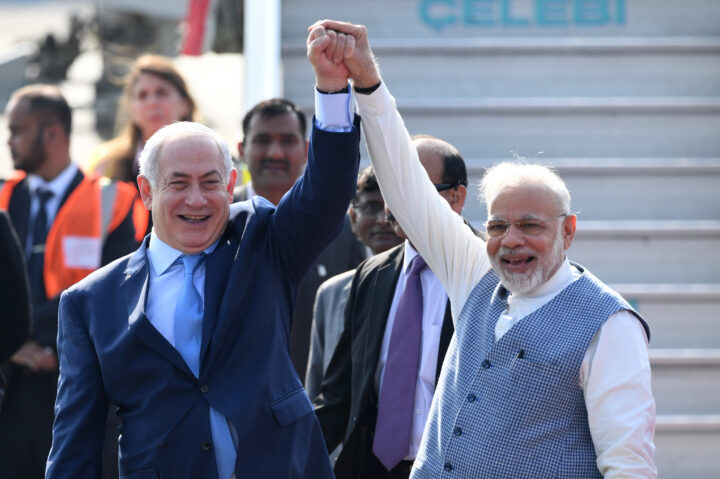
PRAKASH SINGH/AFP via Getty Images
Indian Prime Minister Narendra Modi (R) and Israeli Prime Minister Benjamin Netanyahu pose for photographers after Netanyahu arrived at the Air Force Station in New Delhi on January 14, 2018.
Indian Prime Minister Narendra Modi is set to arrive in Israel on Wednesday to address the Knesset and head an innovation event in Jerusalem, as part of what Israeli Ambassador to India Reuven Azar told Jewish Insider is an “upgrade” in relations between the countries “to a new, strategic level.”
The visit of the head of the world’s most populous nation, whose relations with Israel have grown stronger since Modi became prime minister in 2014, has important implications for the Jewish state’s security, geopolitics and trade, Azar said.
Modi last visited Israel eight years ago. At the time, a photo of the Indian leader and Israeli Prime Minister Benjamin Netanyahu wading barefoot in the Mediterranean Sea during a visit to a desalination plant went viral.
His trip this week, during which he will address Israel’s Knesset, comes amid rising tensions across the Middle East — and as Israelis prepare for a potential attack from Iran.
India has been the Israeli defense industry’s largest customer in recent years, with arms sales totaling $20.5 billion during 2020-2024. The countries have reportedly closed deals worth $8.6 billion since the beginning of 2026.
During his visit, Modi plans to sign an “updated security agreement to allow the private sector to work on more sensitive products when it comes to joining production,” Azar, who has been Israel’s envoy to India since September 2024, said. “The updated protocols will allow us to work on more sensitive technology. It will create a lot of action.”
Netanyahu and leading Israeli defense figures have spoken about moving toward greater self-sufficiency in arms manufacturing. Delhi has long had a “Make in India” campaign to increase local production, requiring Israeli arms companies to open production lines in India in order to sell to the country, and the agreement means that joint production “will get a significant upgrade, because we are expanding both the scope and range of technologies we can apply,” Azar said.
“Both Israel and India want to be more independent and self-reliant when it comes to production and less reliant on foreign supply. Producing things together means that, during times of need, we can supply things to each other, unlike what happened during the war [in Gaza] … in which we had interruptions in supply from different countries,” Azar said.
Economically, Israel and India are working on a free-trade agreement, and hope to expand their cooperation on emerging technologies, as well as large infrastructure projects. Azar said that he worked to bring Indian companies to bid on tenders relating to the ongoing Tel Aviv Metro subway project, and that 15 have already applied.
The U.S. has long expressed concern about security risks related to Chinese companies working on major infrastructure projects in Israel. Companies from India, which views China as an adversary, have been considered as a potential competitive alternative.
Though Azar, a former deputy national security advisor for foreign policy, served as head of the Israel-U.S.-China Internal Task Force Israel’s Foreign Ministry at the beginning of the decade, he declined to comment on that aspect, preferring to focus on Israel-India bilateral relations.
With regard to the India–Middle East–Europe Economic Corridor (IMEC), a trade route meant to pass through Israel, among other countries in the region, and compete with China’s Belt and Road Initiative, Azar said that “we need to wait for the right geopolitical moment to make it happen. … It needs to happen, but evidently, it won’t now.”
“Currently, there is some movement of merchandise, but to see it become massive, we need some change in Saudi Arabia,” Azar said.
Saudi Arabia and the U.A.E., both points on the IMEC route, are facing increased tensions between them. Riyadh has pointed some of its ire at Jerusalem, and has been growing closer to India’s historic foe, Pakistan.
Azar was enthusiastic about an Israeli Cabinet decision approved on Sunday in which Israel plans to allocate over $48 million to cooperation with India in a variety of spheres. Half of the funds come from individual government ministries seeking the cooperation, and the other half was specially allocated by the Finance Ministry.
“The most important is upgrading research and development with funds from the Israel Innovation Authority, and academic cooperation. Israeli universities are all over India now, getting into agreements to exchange students and transfer technology and innovation offices. They feel very welcome in India,” he said.
Asked if that means India has become an alternative to much of the West, where Israeli academics have faced hostility in recent years, Azar said that India and Israel “don’t have challenges in this realm and continue working together to discover the joint resilience so needed in times of war.”
At the same time, he added, “it’s important for any country to diversify. We feel we have so much in common with India, which is a rising force in the world. It’s natural, and it’s not only Israel. Last week, 20 heads of state and 50 foreign ministers went to an AI summit in India. … Everybody is chasing India now.”
Though India-Israel relations were worse before Modi’s rise, Azar said they have the potential for longevity.
“We are now building the pillars of relations that are going to last,” he said. “We are trying to get bipartisan support. There is a lot of support for Israel, not just in [Modi’s Bharatiya Janata Party]. The general public feels it, and we have a high appreciation of that. There are some parties, like the communists, that are more critical, but I think this relationship is going to last.”
Please log in if you already have a subscription, or subscribe to access the latest updates.
 Continue with Google

 Continue with Apple
