














































































More than 40 clergy members called on Superintendent Thomas Taylor to require antisemitism-specific teacher training and consequences for hateful social media posts
Sarah L. Voisin/The Washington Post via Getty Images
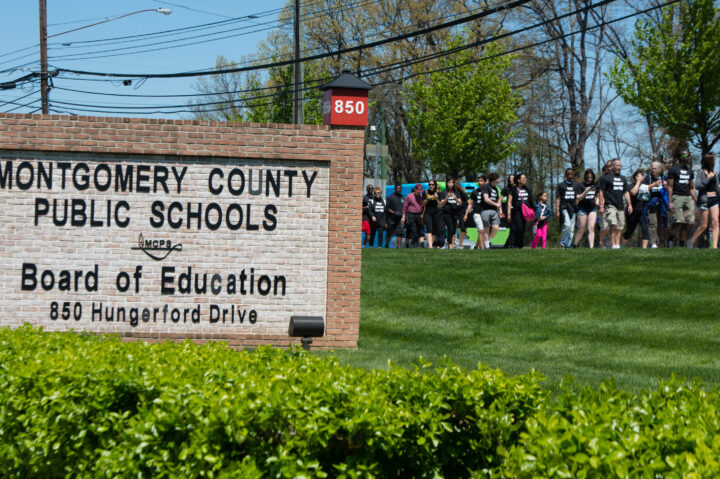
Montgomery County Public Schools building on April 27, 2014.


 Add JewishInsider on Google
More than 40 rabbis and cantors in Montgomery County, Md., warned in a letter Monday that public school leaders have failed to address a rising tide of antisemitism in local classrooms, urging officials to implement new teacher training and stricter social media rules.
In the letter, addressed to Montgomery County Public Schools Superintendent Thomas Taylor, the clergy — representing dozens of Montgomery County synagogues across denominations — wrote that they are “alarmed that the lack of a meaningful response by MCPS has led to an increase in the normalization of antisemitic attitudes, language and behaviors in our schools.” They called on the district to incorporate specific antisemitism training previously suggested by the Jewish Community Relations Council of Greater Washington, including implementing teacher training specific to antisemitism and enforcing consequences for hateful social media posts.
The letter was organized by the JCRC after rabbis expressed concern following an antisemitism town hall that Taylor held at Temple Beth Ami in Rockville last spring, the organization told Jewish Insider.
Incidents in recent months, according to the JCRC, include inflammatory anti-Israel messaging at Olney Elementary School’s cultural night; “Heil Hitler” gestures and speech occurring at middle school events; and “physical threats and harassment directed toward Jewish students at multiple schools.”
In May, the JCRC called out the uniquely high rate of antisemitic incidents in the school district, which is just outside of Washington, D.C.
According to the Anti-Defamation League, Maryland is ranked 5th in the nation for school-based antisemitism, and 84% of those incidents are in Montgomery County, which is home to more than 35 active synagogues and has the largest Jewish population in the state.
The rise of antisemitism in the county extends beyond school based incidents. Montgomery County recorded 121 antisemitic incidents in 2025. By comparison, neighboring Fairfax County, Va., recorded 49 antisemitic incidents during the same period in 2025, according to the ADL.
MCPS did not respond to a request for comment from JI about the letter.
While all three of the leading candidates have denounced Jewish hate, progressive Will Jawando has taken a more hostile stance towards Israel, leading his opponents Andrew Friedson and Evan Glass to jockey for the more moderate vote
Kayla Bartkowski/Getty Images
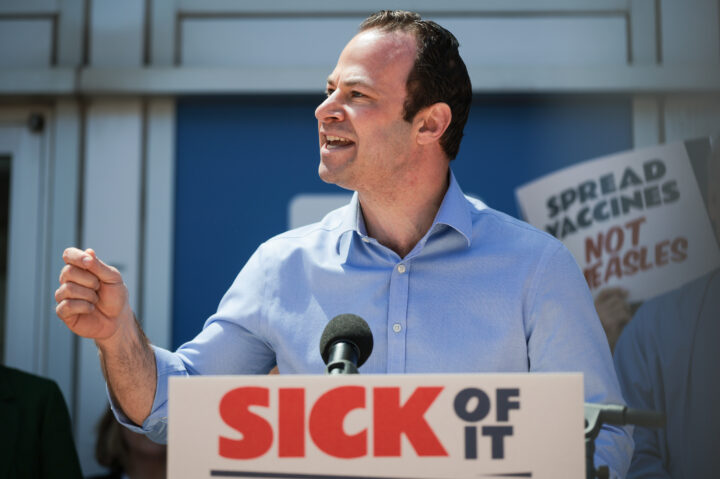
Montgomery County Council Member Andrew Friedson speaks during Sen. Angela Alsobrooks (D-MD) "Sick Of It" rally against the Trump administration's health care policies on May 10, 2025 in Bethesda, Maryland.
Ahead of Tuesday’s primary election for executive of Montgomery County, Md., progressives have largely broken for Montgomery County Councilmember Will Jawando, leaving the more moderate Councilmembers Andrew Friedson and Evan Glass to jockey for the remaining undecided voters.
In a tight three-way race, the vote of the Jewish community — which is, according to a source familiar with the race, expected to account for more than one-fifth of primary turnout in the county with Maryland’s largest Jewish population — could be especially critical. Jewish leaders have raised the alarm on antisemitism in the deep-blue county — which saw the highest rate of incidents in the state in 2025 — and the particular issue of antisemitism in the area’s public schools.
Ron Halber, CEO of the Jewish Community Relations Council of Greater Washington, told Jewish Insider that Jawando, Glass and Friedson “have all denounced antisemitism during their eight-year terms in the council” and said he hopes that other community leaders “awake from their slumber” to speak out against hate without needing to be prompted by the Jewish community.
“As County Executive, I will work with our Jewish leaders and faith leaders and leaders of all our communities to ensure that we protect our diversity,” Glass told JI, while Friedson said being executive would give him “a greater bully pulpit,” in addressing antisemitism in schools.
Earlier this month, the advocacy group EndJewHatred sent a letter to school district officials, including Jawando, who is chairman of the county council’s education and culture committee. The group called for the district to adopt the International Holocaust Remembrance Alliance’s working definition of antisemitism and to adopt lesson plans to address current trends in antisemitism.
In a forum hosted by the JCRC last month, all three candidates pledged to address the rise of antisemitism within the local K-12 school system if elected as executive.
All of the front-runners voted in favor of the IHRA definition when it was adopted unanimously by the council in 2022, after months of community protests, two postponements and a council session disrupted by audience protest.
But “people who are running in this race were not helpful in that effort,” Friedson told JI. A Jewish communal activist said that “Will has stood up against antisemitism, but even if you review the way he spoke before the IHRA vote definition was taken, he was conflicted.” Jawando had said he thought the council “missed an opportunity here to find common ground.”
Rabbi Adam Raskin of Congregation Har Shalom in Potomac, Md., just outside of Washington, was in the council chamber the night the IHRA resolution passed, part of a cohort of Jewish leaders convened by the JCRC to help shepherd it through. “He encountered a tremendous amount of resistance,” Raskin said of Friedson.
Friedson himself said he had “experienced quite a bit of antisemitism as part of that conversation,” telling JI that “there was a screaming crowd in the council chambers as we were taking this up, and it was heartbreaking to me.” Jewish day school students were in attendance when “other members of the community were screaming.”
“We need to ensure the safety of our Jewish residents, and we also need to ensure that everyone has the right to peacefully protest,” Glass said of the IHRA unrest.
During his time in office, Friedson has championed the county’s Nonprofit Security Grant Program, a relatively rare local initiative designed to supplement the federal program, which has been criticized for failing to meet the needs of faith-based institutions. Jewish groups have been among the top beneficiaries of the Montgomery County program, which saw nearly $1.2 million has been awarded across 90 institutions in Fiscal Year 2026.
“Colleagues did not agree with me at first, including the colleagues who are running in this race,” Friedson told JI, “and I regrouped and was able to work together with Asian American leaders” on the initiative.
Glass, the first openly gay Jewish person elected to the county council, frequently leads with his Jewish identity on the campaign trail. His signature initiative on these issues is the Anti-Hate Task Force, a body he convened as council president that consists of a variety of identity-based cohorts, including one Jewish-specific. A source familiar with Glass’ campaign said he joined a synagogue after announcing his run for county executive.
Friedson and his family, meanwhile, are “three-generation members” of Har Shalom, according to Raskin. He has previously served on the boards of Jewish Council for Public Affairs and Hillel Maryland. “Andrew is motivated first and foremost by a sense of justice that was forged by his Jewish identity,” Raskin told JI, “both growing up in this synagogue and growing up with Jewish teachings and values.”
One Jewish activist who’s reached out to all three regarding collaboration on issues of antisemitism shared that Glass’ staff has been fairly responsive, especially in comparison to Jawando’s team.
While the candidates have all spoken out against antisemitism, they hold diverging views on Israel. Jawando is supported by several anti-Israel organizations, including the Council on American–Islamic Relations, the Working Families Party and Our Revolution, as well as the Montgomery County Educators Association union, which Jewish leaders have condemned for its hostility towards Israel. The Jews United for Justice Campaign Fund also endorsed Jawando, after JUFJ fought to strip Israel-related language from the IHRA resolution.
Jawando did not respond to JI’s request for comment on the race.
In vetting candidates, “several organizations in their questionnaires specifically ask about foreign policy in Israel,” Friedson told JI. “They ask about support for Israel. They ask about all kinds of different things that are completely unrelated to the roles of county executive and county council,” he continued.
In September, Jawando made a statement against funding the Maryland Israel Development Center, an organization promoting bilateral trade and economic development. In emails with Saqib Ali, a former Maryland delegate-turned-activist in favor of the Boycott, Divestment and Sanctions movement, Jawando’s chief of staff wrote: “Will has committed to vote against any future funding for this organization.”
Jawando later clarified his position, saying, “We should never use Montgomery County tax dollars to support the development or production of offensive weapons,” declaring intent to look into how MIDC funds are used.
Around the same time, Jawando joined then-County Executive Marc Elrich on an economic development trip to China, subsidized by the Montgomery County Economic Development Corporation.
MIDC received roughly $47,206 from Montgomery County in Fiscal Year 2026, out of the county’s nearly $8 billion budget.
Glass has been deliberate about drawing a boundary between local governance and foreign policy pressures that have seeped into the race. “I do not support all the actions that [Israeli Prime Minister] Benjamin Netanyahu has taken, and that’s okay,” he told JI. “I’m running to be county executive, not secretary of state.”
The three leading Democratic candidates agreed that the county can do better dealing with anti-Jewish hate
Robb Hill for The Washington Post via Getty Images
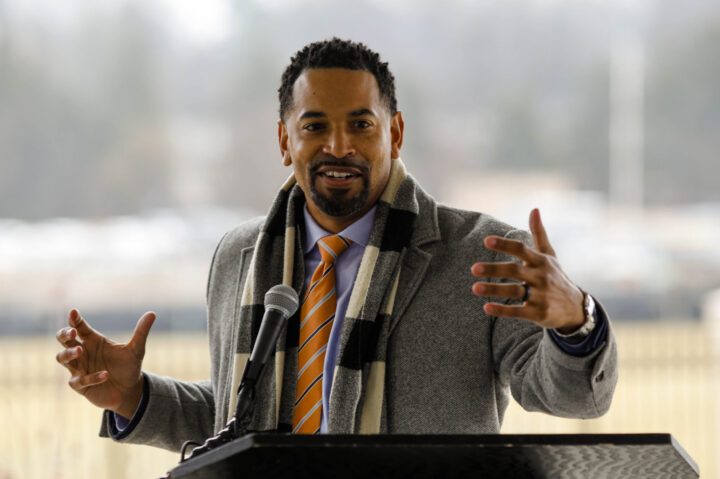
Will Jawando, of the Montgomery County Council, speaks at the dedication of the Phil Alperson Way on February 25, 2022.
The three leading Democratic candidates in the race for executive of Montgomery County, Md., pledged to address the rise of antisemitism within the local school system, while some noted their disappointment that the school board has yet to adopt a Jewish group’s recommendations for doing so.
As the June 23 primary approaches, the Jewish Community Relations Council of Greater Washington hosted a forum on Monday in which the group’s CEO, Ron Halber, asked Councilmembers Andrew Friedson, Evan Glass and Will Jawando how each would address rising antisemitism in Montgomery County’s K-12 schools if elected as executive.
Earlier this month, the JCRC called out the uniquely high rate of antisemitic incidents in the school district and called on the district to incorporate specific antisemitism training. Montgomery County, which is just outside of Washington, D.C., is home to more than 35 active synagogues and has the largest Jewish population in the state.
“I am disappointed that MCPS has not accepted that [training]. I will continue to urge them to do so,” said Jawando, the most progressive Democrat in the race. “There is some Holocaust and antisemitism education happening but we need to start it earlier, in middle school.”
Jawando said as county executive, he would create a Jewish community advisory board and dedicated Jewish liaison to work with schools.
Friedson called for “much better coordination between the school system, county government, JCRC and ADL to ensure better communication and coordination, and ultimately the training to avoid incidents.”
“That’s been offered” to MCPS, continued Friedson. “It has not been fully accepted, which continues to be a major frustration for all of us.”
Glass acknowledged that for years, “most of the antisemitism” in the area has come from schools. “The county executive has to use the bully pulpit to call out hate whenever they see it, wherever it is and for whomever it is pointed at.”
“I will continue to make sure that MCPS does better, either in their appointed leadership and also in their elected leadership.”
The question came at a fraught time for the district — located just outside of Washington, D.C. — as a new report from the Anti-Defamation League showed that Maryland ranked ninth in total antisemitic incidents nationwide in 2025, two-thirds of which occurred in Montgomery County. Among the top ten states with total incidents, Maryland ranked first in the percentage of incidents occurring at K-12 schools, at 34%.
Jawando, who has positioned himself as the most progressive of the candidates, has been critical of the Maryland Israel Development Center, which promotes relations between Maryland and Israeli businesses. “We should never use Montgomery County tax dollars to support the development or production of offensive weapons, whether that’s bombs or munitions or anything else. For me, that’s a nonstarter and I will always oppose it. That’s one reason my office is looking into exactly how MIDC funds are used,” he told the Montgomery Perspective last year.
Friedson, who has positioned himself as the most moderate among the Democratic candidates, has campaigned on a pro-business platform focused on job growth as the county faces slower economic expansion than some of its D.C. metro neighboring counties.
Both Friedson and Glass are Jewish and have longstanding ties to the county’s Jewish community.
Outside of the public school system, Montgomery County has experienced a surge in antisemitic vandalism targeting Jewish institutions.
All three candidates running to replace term-limited County Executive Marc Elrich also said they would retain the local Nonprofit Security Grant Program, one of the few outside of the federal program, in the county budget. Halber and other Jewish leaders have called for increasing NSGP funding in Montgomery County.
‘Too many Jewish students and educators at too many MCPS schools continue to face too many threats,’ said COO Guila Franklin Siegel
Sarah L. Voisin/The Washington Post via Getty Images
Montgomery County Public Schools building on April 27, 2014.
The leading Jewish advocacy group representing the Washington, D.C., area is raising the alarm on a uniquely high rate of antisemitic incidents in Maryland’s Montgomery County public school system.
Guila Franklin Siegel, chief operating officer at the Jewish Community Relations Council of Greater Washington, said Tuesday that the JCRC is receiving “significantly higher” reports of antisemitism out of MCPS, located just outside of Washington, than others in the region.
Montgomery County’s public school system is the largest school district in the state and hosts a sizable Jewish student population.
The statement comes amid a new report from the Anti-Defamation League showing that Maryland ranked ninth in total antisemitic incidents nationwide in 2025, two-thirds of which occurred in Montgomery County. Among the top ten states with total incidents, Maryland ranked first in the percentage of incidents occurring at K-12 schools, at 34%.
“While the details vary, these incidents reveal a harsh truth: too many Jewish students and educators at too many MCPS schools continue to face too many threats,” said Franklin Siegel, whose statement came the day after JCRC leadership met with MCPS Superintendent Thomas Taylor and his senior management team.
Incidents in recent months include anti-Jewish and anti-Israel graffiti on school walls, most recently at Greenwood Elementary School last weekend; inflammatory anti-Israel messaging at Olney Elementary School’s recent cultural night; “Heil Hitler” gestures and speech occurring at middle school events; and, according to JCRC, “physical threats and harassment directed toward Jewish students at multiple schools.”
Franklin Siegel said MCPS and JCRC leadership discussed “progress on the steps MCPS needs to take to protect Jewish students, educators, and staff.”
“Our messages were simple: MCPS must establish a zero-tolerance policy on antisemitism and other forms of hatred and bias; train and empower administrators and teachers to correctly identify and respond to antisemitism; and rigorously enforce disciplinary codes, making it clear that anyone who engages in antisemitic or other hateful behavior will face meaningful consequences,” Franklin Siegel said.
MCPS said it “will be in compliance with recently adopted state law requiring anti-bias training for school educators and staff” starting in August, according to Franklin Siegel.
The school district also committed “to improv[ing] school participation rates in JCRC’s gold-standard Student to Student and Holocaust speakers’ programs” and to “drafting specific guidelines for culture and international nights. The district must ensure these events are safe and educational for all students and families, not political battlefields,” she added.
But Franklin Siegel called on the school district to go further in protecting Jewish students.
“MCPS should follow the lead of other schools in our area by incorporating specific antisemitism training as well,” she said. “More lessons about Jewish history beyond antisemitism and the Holocaust should be included in its curricula. And given that bias incidents are so often connected to the proliferation of hate speech online, MCPS also needs to discipline students who harass and bully Jewish students on social media accounts, even when those accounts are not formally affiliated with schools. The district has that authority, and principals must enforce it.”
MCPS, which serves over 156,000 students, did not respond to a request for comment from Jewish Insider.
Signs outside the Conservative congregation in Olney, Md., were spray-painted with a swastika and an antisemitic slur
Courtesy of Shaare Tefila
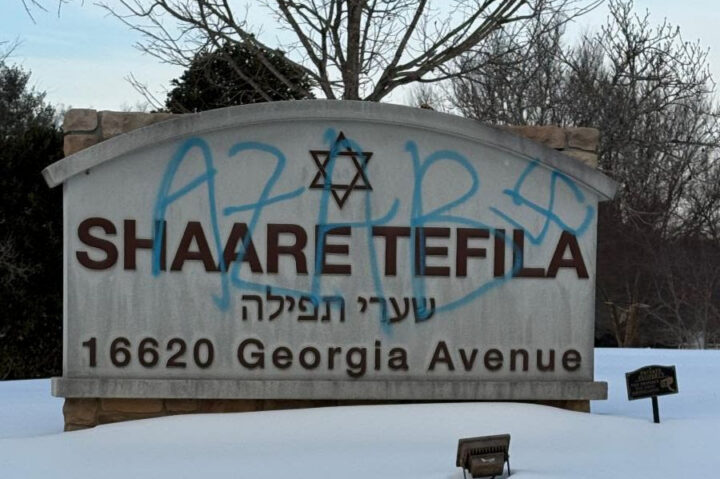
Congregation Shaare Tefila in Olney, Md. was defaced with antisemitic graffiti on Feb. 10, 2026.
A synagogue in Montgomery County, Md., a suburb of Washington, was defaced with antisemitic graffiti on Tuesday.
A swastika, the word “genocide” and the phrase “AZAB,” an acronym standing for “All Zionists Are Bastards,” were spray-painted on street signs and banners outside of Shaare Tefila, a Conservative congregation in Olney. The graffiti covered large signs outside of the synagogue that read “Hate Has No Home Here” in several languages below a heart shaped American flag and another that read “We Support Israel.”
Ron Halber, CEO of the Jewish Community Relations Council of Greater Washington, called the act “outrageous.”
“While it is fortunate that no one was physically hurt, it is yet another sad reminder that antisemitic incidents have become common occurrences throughout our region,” said Halber. He added that local officials and police officers responded “immediately.”
Halber called for increased Nonprofit Security Grant Program funding to applicants in Maryland and specifically to Montgomery County, which has the largest Jewish population in the state.
“This funding has quickly become an absolute necessity for our community. Policymakers must sustain and build on these investments for our safety,” he said. “Let this incident serve as another reminder: antisemitism always fails. Our Jewish community will never be intimidated into silence, and we will forever be proud to support Israel.”
The book imparts the lesson of teaching children there are consequences for taking things that don’t belong to them
Sarah L. Voisin/The Washington Post via Getty Images
Montgomery County Public Schools building on April 27, 2014.
A book that centers on Palestinian identity is drawing controversy from some Jewish parents in the Montgomery County, Md., public school system after it was assigned to first grade students as required classroom reading, Jewish Insider has learned.
The book,“Tunjur! Tunjur! Tunjur! A Palestinian Folktale,” written by Margaret Read MacDonald, aims to convey a message to children that there are consequences for taking things that don’t belong to them. It tells the story of a woman who “prayed to Allah” for a child and received a pot as her child. The pot, too young to know right from wrong, had a tendency to steal honey from the marketplace and jewels from the king — until she got caught. As punishment, she was filled with muck. “I hope you’ve learned your lesson,” the pot’s mother tells her. “You cannot take things that do not belong to you.”
While the book does not mention Israel, local Jewish leaders and parents voiced concern that the required book’s subtext sends an anti-Israel message to elementary schoolers and that the reference to “Allah” does not belong in a public school setting.
A syllabus notes that students can receive supplemental reading materials if “any instructional material conflicts with your family’s sincerely held religious beliefs.”
The book’s lesson that “‘you cannot take things that do not belong to you’ echoes activist rhetoric that falsely casts Israel as an oppressor and the Jewish people as imperialist rather than indigenous,” Dana Stangel-Plowe, chief program officer at the North American Values Institute, a nonprofit that monitors antisemitism in K-12 schools, told JI.
“It reinforces a false narrative that erases the historic Jewish connection to Israel. It sends a troubling message to Jewish families during a time of rising antisemitism,” Stangel-Plowe told JI.
Not all Jewish communal leaders agreed that the book was problematic. Guila Franklin Siegel, chief operating officer of the Jewish Community Relations Council of Greater Washington, argued that Jewish families should embrace the book.
“If the only complaint about this book is that it’s sharing a Palestinian folktale that teaches children not to take things that don’t belong to them, I can’t see what the problem with the book is,” Franklin Siegel told JI. “It will be a shame if Jewish people wind up objecting to books only because they have protagonists who happen to be Palestinian.”
“There may well be books and materials that do misinform students about the Israeli-Palestinian conflict, and we always monitor that work,” said Franklin Siegel. “If we turn this into a back and forth where parents are requesting opt-outs for any material that they don’t see eye-to-eye with, we’ll wind up in a situation where we’re seeing a significant number of students whose parents are requesting opt-outs for things like Holocaust speakers.”
Meanwhile, Margery Smelkinson, a parent of four MCPS students, told JI that she would have preferred the district find a children’s book that teaches not to steal “without causing controversy.”
“The real problem is that MCPS chose a book that even requires an opt-out form — why not just pick another book?”
Smelkinson called on the school district to prioritize helping students get up to speed in reading, math and science instead of “creating more barriers to learning.”
“I’m concerned and curious if my child was introduced to [similar rhetoric] last year,” Diana Tung, the parent of an MCPS second grader and kindergartener, told JI. “I assume in a public school setting there’s going to be pretty diverse spiritual beliefs [but] the context of the tale itself [concerns me]. The themes should be taught using a different folktale, I’m pretty confident there are plenty.”
“Books and materials approved to be available for use in classrooms, beyond being in alignment with curriculum standards, are selected to be representative of our very diverse community,” Christopher Cram, a spokesperson for the suburban Washington school system, which is the 15th-largest school district in the country and educates a significant number of Jewish students, told JI. “Students and families expect to be able to see themselves in the materials we use.”
The school system has faced several antisemitic incidents since Hamas’ Oct. 7, 2023, terrorist attacks, leading to the school board president, Karla Silvestre, being subpoenaed to testify at a congressional hearing in May 2024. Weeks after the hearing, at least six MCPS school buildings — including three elementary schools — were vandalized with antisemitic graffiti.
The assignment of the Palestinian folktale as required reading comes two months after the Supreme Court ruled in Mahmoud v. Taylor that MCPS must allow parents to opt their children out of lessons and books that feature LGBTQ+ themes if the material conflicts with their religious beliefs.
Maryland Senate candidates Hogan and Alsobrooks decry antisemitic graffiti spree in Montgomery County

Wikipedia
Churchill High School in Potomac, Md., was one of the four schools in the area hit with antisemitic graffiti this week.
Four schools in Montgomery County, Md., which is home to a large Jewish community, were vandalized on Monday with antisemitic graffiti, prompting condemnations from both candidates in the high-profile contest to replace Sen. Ben Cardin (D-MD).
Police were called to four different schools in the area on Monday morning to respond to reports of antisemitic messages and iconography being spray painted on their respective properties. The calls were all made within a three-hour timespan, the first coming from Churchill High School in Potomac just before 6:30 a.m. Wootton High School in Rockville made the second call at 7:35 a.m., followed by Strathmore Elementary School in Silver Spring at 9:15 a.m. and Fallsmead Elementary School, also in Rockville, at 9:24 a.m.
One message read: “Israel Bombs Schools.” Another brandished Hitler’s name next to a swastika.
Montgomery County Police are investigating the incidents.
A Montgomery County Public Schools spokesperson said on Monday that, “A number of our schools were illegally vandalized with politically charged graffiti, antisemitic iconography (including swastikas), and, in some instances, anti-LGBTQ+ language.”
The spokesperson said that the school district was reaching out to parents to make them aware of the situation, adding that principals were asking staff to report such incidents and to offer “the supportive resources necessary to address the harm and anxiety these actions may have caused.”
“We are committed to maintaining a safe, inclusive environment where all students, staff, and caregivers feel safe, valued, seen, heard and have a sense of belonging. We firmly denounce divisive actions that perpetuate hate, inequality, and injustice against any person, family, or community. We must unite to recognize and embrace our differences and not let them divide us,” the MCPS spokesperson said.
The incident, which came one week after nearby Bethesda Elementary School was vandalized, was swiftly condemned by local leaders, including the two candidates in the state’s high-profile Senate race.
“Let’s call this what it is — antisemitic vandalism. These acts of hate have no place in Maryland. I will always stand with our state’s Jewish community, and fully support local authorities as they pursue the perpetrators of this abhorrent crime,” former Gov. Larry Hogan, the Republican nominee, wrote on X, formerly Twitter.
“Hate speech has no place in Maryland and will not be tolerated. I was deeply disturbed and saddened to hear that an individual defaced Montgomery County schools with antisemitic and anti-LGBTQ+ graffiti,” Prince George’s County Executive Angela Alsobrooks, the Democratic nominee, told Jewish Insider in a statement.
“Our schools are places where our children and our families can come together in learning – hate and vitriol do not belong, and these acts are disgusting. I am grateful to our law enforcement for their quick response, and know they will hold the perpetrators accountable.“To our Jewish friends, family, and neighbors and to our LGBTQ+ neighbors: you belong in Maryland. We will stand together against this hate,” Alsobrooks added.
Guila Franklin Siegel, chief operating officer of the Jewish Community Relations Council of Greater Washington, also denounced the vandalism, noting that it was the “second consecutive week” that Montgomery County schools were facing antisemitic attacks.
“It is no accident that the perpetrators of these incidents have defaced schools that are located in neighborhoods with high concentrations of Jewish residents and have significant numbers of Jewish students and faculty members,” Siegel said. “These schools are also blocks away from multiple synagogues. This pattern of behavior — in impact and almost certainly in design — targets Montgomery County’s Jews. In doing so, it causes tremendous harm not only to Israelis and Jews, but to our entire shared community.”
“We are confident that people of goodwill across all backgrounds and faiths will see these acts for what they are: hateful words designed to tear our communities apart rather than bring them together,” she added.
Please log in if you already have a subscription, or subscribe to access the latest updates.
 Continue with Google

 Continue with Apple