














































































Melissa Hernandez was backed by the United Democracy Project super PAC, which helped her draw closer to Aisha Wahab in the final count than some observers had initially expected
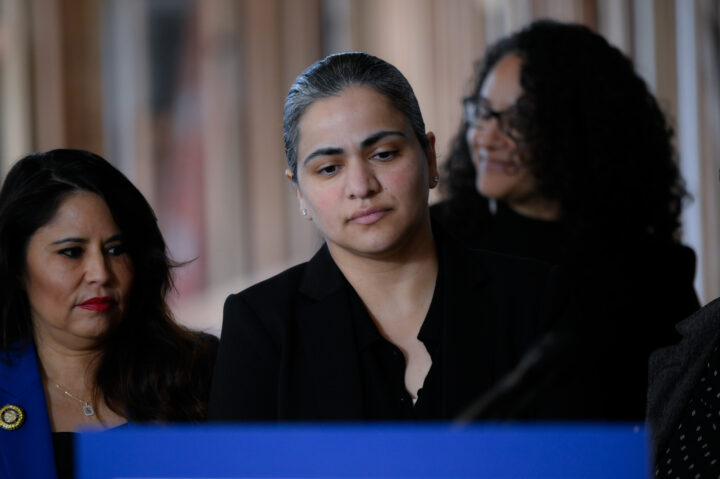
Tayfun Coskun/Anadolu via Getty Images
California state Sen. Aisha Wahab attends a press conference in Hayward, Calif., on March 2, 2026.


 Add JewishInsider on Google
Aisha Wahab, a progressive California state senator, narrowly defeated former local mayor Melissa Hernandez in a special election in California’s 14th Congressional District, and will replace former Rep. Eric Swalwell (D-CA) in the House.
Hernandez was backed by more than $2.5 million in spending from the AIPAC-linked United Democracy Project super PAC, among other outside groups, which helped her draw closer to Wahab in the final count than some observers had initially expected.
Ultimately, Wahab finished with 53% to Hernandez’s 47%, pulling ahead after the two were neck-and-neck for much of the count. The two are set to face off again in November in the regular general election to serve out a full term in Congress.
The results are the latest stumble for UDP in a cycle where its track record has been decidedly mixed. UDP did not immediately respond to a request for comment on whether it intends to remain engaged in the district in the general election contest.
Wahab’s positions on Israel and antisemitism legislation had worried some leaders in the Jewish community, though another argued that she was not as extreme as members of the anti-Israel Squad. On her campaign website, Wahab included a page naming specific pro-Israel donors who were supporting Hernandez’s campaign.
“My record speaks for itself: I have consistently stood against antisemitism, supported the safety and security of Jewish communities, worked in partnership with Jewish colleagues, and defended Israel’s right to exist — while also maintaining that as an American elected official, I have both the right and the responsibility to question the policies of any foreign government and to speak out when innocent civilians are suffering,” Wahab said in a statement to Jewish Insider.
Over one-third of the vote remains to be counted in the too-close-to-call race
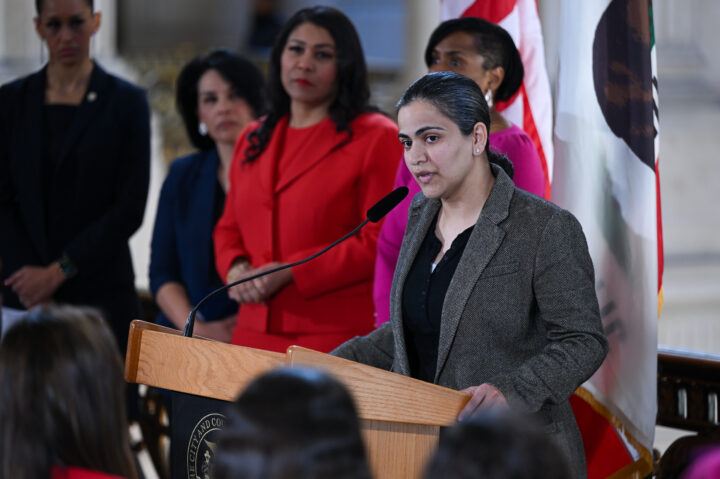
Tayfun Coskun/Anadolu Agency via Getty Images
State Sen. Aisha Wahab speaks during the Bay Area Abortion Rights Coalition (BAARC) and commemoration of the 50th Anniversary of Roe v. Wade event at the City Hall in San Francisco, California, on January 25, 2023.
Aisha Wahab, a progressive state senator from California, held a narrow lead on Wednesday over Melissa Hernandez, a moderate former local mayor, in the special election runoff for an East Bay House seat that drew a late surge of outside spending from AIPAC.
With 62% of the vote counted in Tuesday’s election, Wahab had 51%, leading Hernandez, at 49%, by just two points or 1,356 votes, according to the unofficial initial returns. The preliminary figures — with about 40,000 votes yet to be tallied — largely accounted for early mail ballots. Experts said that the late mail and Election Day votes would, in the coming days, paint a clearer picture of the direction of the race.
The early count suggested Hernandez benefited in part from the district’s estimated 73,000 Republican voters, whom AIPAC’s super PAC, United Democracy Project, had courted in the closing stretch of the race to help boost her campaign.
Wahab, the first Afghan American and Muslim to serve in the California state Senate, was viewed as the favorite, after she finished with double-digit leads over Hernandez in the special and the regularly scheduled primary elections. Hernandez won just 17% in the top-two special primary, trailing Wahab by more than 25 points. But two Republicans on the ballot tallied about 25% — indicating the GOP vote was likely to swing heavily to the more moderate Hernandez in Tuesday’s election.
The runoff in California’s progressive-leaning 14th District, which could take several days to be tallied, will decide who completes the remainder of former Rep. Eric Swalwell’s (D-CA) term, after he resigned from Congress amid sexual abuse allegations that he has denied.
The race had flown under the radar until UDP and other allied groups began spending for Hernandez, drawing national attention to the increasingly bitter contest. In just over two weeks, UDP invested nearly $2.5 million in the runoff. UDP’s spending — which appears to be its final investment before the general election — came after the group had failed to thwart Abdul El-Sayed, the far-left Democratic nominee in Michigan’s costly Senate race.
Some Jewish community leaders and Democratic strategists who followed the East Bay contest had questioned UDP’s last-minute decision to spend in the primary, seeing Wahab as practically unbeatable.
Still, one Democratic strategist told Jewish Insider before the election that outside polling had shown a tighter race than expected, suggesting that UDP had seen a plausible path to victory that was borne out in Tuesday’s results.
“We made a race that wasn’t close when we started into a nail-biter,” Patrick Dorton, a spokesperson for UDP, said in a brief statement to JI on Wednesday.
UDP’s spending also drew opposing expenditures from J Street, the progressive Israel advocacy group, and American Priorities, a new anti-Israel super PAC created to counter AIPAC — both supporting Wahab.
In a statement on Wednesday, American Priorities said it expected Wahab would prevail “once every ballot is counted.”
“Aisha Wahab ran a great campaign and she is leading today because voters in this district know her and trust her,” the group added, while accusing UDP and its allies of spending “millions trying to buy a different outcome.”
In contrast with the Michigan Senate primary and other Democratic races this cycle, Israel and Middle East policy were not among the top issues of debate in the runoff, despite some key differences between the candidates.
Wahab criticized Hernandez for having “denied the genocide in Gaza,” for example, and during a recent interview with the antisemitic streamer Hasan Piker expressed support for the Block Bombs Act — which would impose restrictions on weapons sales to Israel.
One Jewish leader who met with Wahab, however, told JI she was “not someone who wants to see Israel disappear” and had expressed interest in developing a “strong relationship with the Jewish community.” He raised concerns that UDP’s attacks could end up pushing Wahab to more hostile positions on Israel policy.
“My record speaks for itself,” Wahab said in a statement to JI before the runoff. “I have consistently stood against antisemitism, supported the safety and security of Jewish communities, worked in partnership with Jewish colleagues, and defended Israel’s right to exist — while also maintaining that as an American elected official, I have both the right and the responsibility to question the policies of any foreign government and to speak out when innocent civilians are suffering.”
No matter the outcome of Tuesday’s runoff, the two candidates will face off again in the general election this November for a full two-year term.
UDP’s latest ad blitz came in the immediate wake of Michigan’s bitter Democratic Senate primary earlier this month, where the group spent over $30 million on a failed effort to thwart Abdul El-Sayed
Tayfun Coskun/Anadolu Agency via Getty Images
State Sen. Aisha Wahab speaks during the Bay Area Abortion Rights Coalition (BAARC) and commemoration of the 50th Anniversary of Roe v. Wade event at the City Hall in San Francisco, California, on January 25, 2023.
As primary election season comes to an end, AIPAC is closing out its involvement in a dramatic cycle with an unexpected foray into a low-profile California House race on Tuesday where Israel has not been among the top issues.
In the last two weeks, AIPAC’s super PAC, the United Democracy Project, has spent nearly $2.5 million in an effort to defeat Aisha Wahab, a progressive state senator competing in a special election runoff against Melissa Hernandez, a moderate Democrat who serves on the Bay Area Rapid Transit board and is the former mayor of the East Bay city of Dublin.
The aggressive maneuver, which appears to be AIPAC’s last investment before the general election, has raised eyebrows among some Jewish leaders and Democratic strategists in the state, who see Wahab as favored to replace disgraced former Rep. Eric Swalwell (D-CA) in California’s 14th District, despite the flood of recent attacks against her from UDP and other allied groups.
Still, one Democratic strategist who is familiar with the runoff said that outside polling has shown a tighter race than some observers are predicting.
In the special election primary, Wahab claimed first place with 43%, while Hernandez had just 17% of the vote. But two Republican candidates on the ballot also tallied about 25% of the vote, with the GOP vote likely to swing heavily to the more moderate Hernandez.
UDP’s latest ad blitz came in the immediate wake of Michigan’s bitter Democratic Senate primary earlier this month, where the group spent over $30 million on a failed effort to thwart Abdul El-Sayed, a far-left former public health official who refused to recognize Israel’s right to exist as a Jewish state. (UDP is likely to return in the general election to help boost former GOP Rep. Mike Rogers, El-Sayed’s opponent, according to sources familiar with its plans.)
The narrow loss in Michigan marked a major blow for AIPAC, whose super PAC has seen mixed results overall in key Democratic House contests this cycle as its involvement runs the risk of backfiring in the party. While UDP notched some key victories in states including Maryland, Illinois and Missouri, the group has faced scrutiny even from some supporters for its strategy in picking other races, such as in New Jersey, where its involvement in one primary helped inadvertently elevate a fierce critic of Israel to a seat in the House.
Some Jewish leaders in the San Francisco Bay Area voiced puzzlement over AIPAC’s engagement in the runoff, saying that its decision to target Wahab had backfired in the progressive-minded district — where she is using its attacks to rally supporters to her campaign while portraying Hernandez as a shill for the group.
One Jewish leader backing Hernandez who has met with Wahab, the first Afghan American and Muslim to serve in the California State Senate, said he feared UDP’s attack ads, which have not focused on Middle East policy, could drive her to embrace more hostile positions on Israel.
During the campaign, Wahab has accused Israel of genocide in Gaza and, in a recent interview with antisemitic influencer Hasan Piker, said she would support the Block Bombs Act, which would impose sweeping restrictions on weapons sales and transfers to Israel.
But the Jewish leader, speaking anonymously to address a sensitive issue, told Jewish Insider that Wahab is “not a member of the Squad,” supports a Jewish state as well as a Palestinian state and “wants a strong relationship with the Jewish community” — even as she has acknowledged disagreements on key issues that have stoked some tensions in the runoff.
“This is not someone who wants to see Israel disappear, and I’m worried this simplistic approach to the primaries is going to push someone like Wahab further away from the community,” the Jewish leader said of UDP’s spending. “There’s a general consensus among the East Bay political class that Wahab is the likely winner,” he said. “We’re all just scratching our heads and we’re not sure what they’re seeing here.”
A spokesperson for UDP declined to comment on its decision to enter the race.
Andrew Lachman, the former president of California Jewish Democrats, told JI that Wahab “has worked well with the California Jewish Legislative Caucus in the past, but the pressures are different when running for Congress because the state legislature does not do foreign policy.”
UDP’s new spending has been met by recent expenditures from J Street, the progressive Israel advocacy group, and American Priorities, a new anti-Israel super PAC created to counter AIPAC’s presence in Democratic primaries — both of which are backing Wahab.
“I hope I’m wrong,” the Jewish leader told JI. “I hope AIPAC is seeing something I’m not and that there is a chance.”
While Jewish community leaders expressed concerns about Aisha Wahab, one said they were skeptical that she was beatable and that the AIPAC spending risked further alienating the potential nominee
Tayfun Coskun/Anadolu via Getty Images
California state Sen. Aisha Wahab attends a press conference in Hayward, Calif., on March 2, 2026.
After a night of mixed results in Tuesday’s primary elections, AIPAC’s United Democracy Project super PAC is turning its eyes toward the special election runoff in California’s 14th Congressional District, where progressive state Sen. Aisha Wahab and moderate local mayor, Melissa Hernandez, are competing to replace disgraced former Rep. Eric Swalwell (D-CA).
Wahab entered the race as the heavy favorite and dominated the primaries for both the regular and special elections. In the special election primary, Wahab finished with 43% to Hernandez’s 17%, and led Hernandez 38%-17% in the regular primary. The special election runoff is set for Aug. 18.
Her record raises concerns for some members of the Jewish community — she has not been supportive of numerous priority bills and resolutions aimed at tackling antisemitism and has been a vocal critic of Israel, including describing the war in Gaza as a genocide and championing legislation in the state Senate on the issue.
UDP’s initial ad buy in the race totaled $1.2 million.
One of UDP’s ads accuses Wahab of being soft on crime — pointing to an amendment she led to a sex trafficking bill — and describes Hernandez as tough on crime and supported by police. Other pro-Hernandez groups are running with a similar message. Another highlights her background and work on affordability issues.
In a page on her website responding to attacks, Wahab’s campaign accused Hernandez of “relying on misleading attacks and AIPAC-linked dark-money PACs to tear Aisha Wahab down.” The page takes aim at Hernandez for having “denied the genocide in Gaza” — she declined to provide a yes-or-no answer on the subject at a candidate forum — and shared a spreadsheet naming all of the individual “AIPAC-linked donors” supporting Hernandez’s campaign.
“Wahab has accused Israel of committing genocide and has separately published the names of Jewish donors to her opponent on her website. She’s pretty extreme in her points of view on Israel,” UDP spokesperson Patrick Dorton told Jewish Insider. “It’s a race where Wahab is talking about ideological issues and Hernandez is talking about economic and affordability issues that are important to voters in the district.”
Bold America PAC, linked to the Congressional Hispanic Caucus, has spent more than $2 million so far attacking Wahab and supporting Hernandez. The group has taken some donations from an AIPAC-affiliated group. A new pro-Hernandez group, Safer Alameda County, has spent $51,000 so far.
Daniel Klein, the CEO of Jewish Silicon Valley — which is nonpartisan and does not take stances in elections — said that Jewish community leaders are paying close attention to the race, and he has heard significant concern about Wahab’s votes on major antisemitism legislation and her close relationship with state teachers’ unions, which have opposed antisemitism bills.
“That is, I think, creating some angst — or at least more attention to this race — amongst many members of the Jewish community and Jewish communal organizations,” he continued, relating conversations he’s had with members of the community. “These are pieces of legislation that are intended to protect our children, right? They should be fairly non-controversial.”
Wahab was one of three senators who voted against SB 1287, which required overhauls of campus codes of conduct to address antisemitic and anti-Israel demonstrations, and abstained from a floor vote on AB 715, which aimed to address antisemitism in K-12 schools.
Klein said he has not had the opportunity to meet with Wahab personally and is happy to meet with any elected leader. He said he had spoken with Hernandez, who seemed to him primarily focused on local issues and national partisan politics, rather than foreign policy, though he said that she seems to understand the Jewish community’s concerns about antisemitism and is receptive to hearing from the community.
“My record speaks for itself: I have consistently stood against antisemitism, supported the safety and security of Jewish communities, worked in partnership with Jewish colleagues, and defended Israel’s right to exist — while also maintaining that as an American elected official, I have both the right and the responsibility to question the policies of any foreign government and to speak out when innocent civilians are suffering,” Wahab said in a statement to JI.
Though she did not support the two bills mentioned by Klein, she has supported other priority legislation for the Jewish community in the state Senate. She also introduced a resolution in 2025 with Jewish state Sen. Scott Weiner calling for the release of hostages and an end to the humanitarian crisis in Gaza.
Another Jewish leader said Hernandez had attended various Jewish community events and generally has good relationships with the community but isn’t particularly involved with its issues. The district itself is not home to a sizable Jewish community.
Oleg Ivanov, executive director of StandWithUs Northern California, said, “We’re of course concerned that as a state senator, Aisha Wahhab has called Israel’s defense against the Hamas attack [on Oct. 7, 2023,] genocide. So we’re concerned that she is spreading this debunked blood libel about Israel, which we feel all that does is it makes Jews and Israelis here in her district unsafe. As we’ve seen in many cases, this kind of irresponsible language has led to direct violence against Jews and Israelis.”
Ivanov said he hasn’t had any interaction with Hernandez, but praised her for declining to describe the war in Gaza as a genocide. He also criticized Wahab’s opposition to antisemitism-related legislation.
But another Jewish leader in the district, who requested anonymity to speak candidly, said that the strong consensus among political observers in the area is that Wahab “pretty much [has] this in the bag, and that Hernandez is a lazy campaigner.” Other moderate groups that had looked at the district “just have not been impressed with Hernandez,” the leader continued.
The Jewish community, the leader said, doesn’t want Wahab to win, but that might already be a foregone conclusion.
“I’m not in principle against AIPAC getting involved in these kinds of primaries like some other people [are], but based on all the local knowledge that we’re hearing from politicos, it’s not a good use of time or money,” the leader said. “People are kind of scratching their heads — not because there aren’t concerns about Wahab … but let’s play where we can win.”
The leader said they’re also concerned that AIPAC’s involvement risks pushing Wahab further to left, describing Wahab currently as a less-than-ideal choice but necessarily aligned with the Squad — i.e., not opposed to Israel’s existence or outright at odds with the Jewish community.
The leader noted Wahab abstained on, rather than outright opposed, AB 715, one of the antisemitism bills. They also noted that Wahab’s family are refugees who escaped radical Islam in Afghanistan during the Soviet-Afghan war. Wahab has relationships with some Jewish community groups in the Bay Area, particularly social services organizations that have been involved in Afghan refugee resettlement work.
“I don’t like the idea that the pro-Israel community is jumping into a race they can’t win against the presumptive winner and potentially pushing her into the arms of the worst members of Congress,” the leader said. “I think that people need to play their cards carefully here. There’s shades of gray at play.”
Please log in if you already have a subscription, or subscribe to access the latest updates.
 Continue with Google

 Continue with Apple