














































































Shaheen, despite her famous last name, is narrowly trailing military veteran Maura Sullivan in New Hampshire’s congressional primary
Tom Williams/CQ-Roll Call, Inc via Getty Images
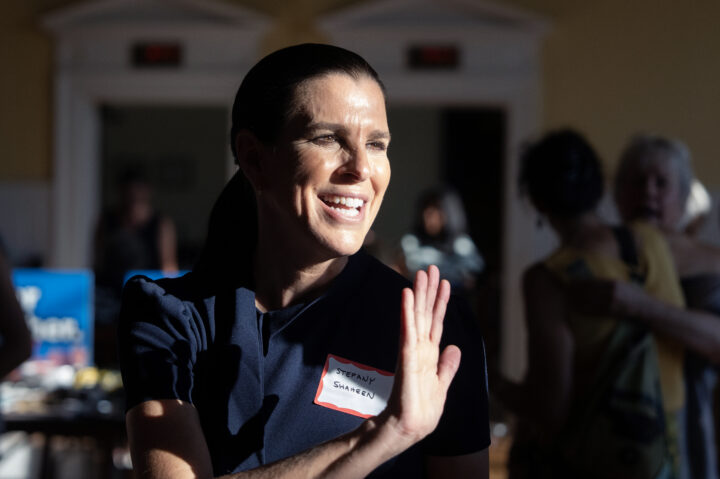
Stefany Shaheen, Democratic candidate for New Hampshire's 1st Congressional District, at City Hall in Dover, N.H., on August 13, 2026.


 Add JewishInsider on Google
Stefany Shaheen, the daughter of Sen. Jeanne Shaheen (D-NH), has been attacking AIPAC as a central message of her campaign in the closing days of her campaign.
But unlike some other Democrats who have used attacks against Israel to boost fortunes with the progressive base, Shaheen has fallen behind her primary opponent, military veteran Maura Sullivan, who holds a narrow lead in the latest public polling. Sullivan, who entered the race as a supporter of Israel, has also taken a more critical turn, supporting blocking at least some offensive weapons sales to the Jewish state.
Shaheen and Sullivan are the two leading Democratic candidates vying to succeed Rep. Chris Pappas (D-NH) in New Hampshire’s 1st Congressional District, and the race has turned increasingly acrimonious in the closing days of the campaign.
Shaheen, who went on air with an anti-AIPAC ad accusing Sullivan of receiving support from the pro-Israel group last month, has continued to double down with a new ad airing this week, shared by the New Hampshire Journal, which describes Sullivan as “bankrolled” by AIPAC, which the ad describes as “the powerful pro-Israel lobby aligned with Netanyahu,” alongside a photo of the Israeli prime minister.
The outlet noted that Shaheen has been leaning into her opposition to Israel aid in media interviews as well, and accused Sullivan of attempting to recast herself as a progressive in the closing stretch of the campaign.
Sullivan is circulating her own ad accusing Shaheen of “shameful” lies about Sullivan, including emphasizing that Sullivan “doesn’t take a dime from corporate PACs or AIPAC.”
In the ad, Sullivan accuses Shaheen of feeling “entitled” to the seat because of who her mother is.
The two again traded barbs during a Thursday evening debate, with Sullivan also facing criticism from several of the other candidates on stage.
“She has taken AIPAC-bundled donations more than she has raised from people who are in New Hampshire,” Shaheen claimed. “It matters because the voters deserve to know what her positions are.”
Sullivan responded that she does not have any support from AIPAC. “I have called for the cessation of the illegal encroachment on settlements in the West Bank. I’ve said that the U.S.-Israel relationship needs a reset, and I’ve been very, very clear that I would have voted with Bernie Sanders on a recent bill to not send offensive weapons to Israel,” she continued — a significant shift from her more pro-Israel stance earlier in the race.
Faced with continued accusations from Shaheen, Sullivan said that she had contacted Democrats across the country who have supported other in-state Democrats. “I think we can all agree that that’s great company. And let me be clear: I’m incredibly proud to have the support of people who have supported our senators and see leadership in me.”
A poll by Tavern Research released on Wednesday showed Sullivan holding a narrow lead over Shaheen, 33%-27%, even after Shaheen secured the endorsement of Sen. Maggie Hassan (D-NH) in late August. University of New Hampshire and St. Anselm College polls also showed Sullivan with a narrow lead as of mid-to-late August. Shaheen had previously led in surveys in the district.
Andrew Smith, the director of the University of New Hampshire Survey Center, told Jewish Insider that the race is still very much unsettled and in flux, and said that he sees a path to victory for progressive Carly Beriont as well, running in a more anti-establishment lane, after other progressive candidates dropped out, and as Shaheen and Sullivan focus their fire on each other.
Shaheen, given her family pedigree, and Sullivan, as a previous candidate for the seat, “have been engaged in Democratic politics for quite a bit of time, whereas Beriont is the outsider,” Smith said.
Smith said that early polling showing Shaheen leading was primarily due to name recognition, but that Sullivan has been able to close that gap before the primary. He emphasized that, in UNH’s most recent polling, the two are effectively tied and neither has pulled above 30%, “which says to me, as somebody who’s followed these races here in New Hampshire for 25, 30 years, it could go in a lot of different directions at the end.”
Smith called Shaheen’s anti-AIPAC attacks somewhat surprising, given that the issue hasn’t been particularly salient in New Hampshire in the past, but said other Democratic primaries elsewhere in the country have shown it to be effective. At the same time, he said that the state hasn’t seen many anti-Israel demonstrations, “so I don’t believe there’s that much of a movement there.”
Smith predicted that the winner of the Democratic primary will be the favorite in the general election, given the district’s Democratic lean, the unpopularity of President Donald Trump in the district and the underwhelming field of GOP candidates. Businessman Anthony DiLorenzo has emerged as the GOP favorite after winning Trump’s endorsement.
Stefany Shaheen, the daughter of Sen. Jeanne Shaheen, accused her congressional primary opponent of taking $300,000 in donations ‘bundled from AIPAC donors’
Tom Williams/CQ-Roll Call, Inc via Getty Images
Stefany Shaheen, Democratic candidate for New Hampshire's 1st Congressional District, at City Hall in Dover, N.H., on August 13, 2026.
Stefany Shaheen, the daughter of Sen. Jeanne Shaheen (D-NH) and a candidate for New Hampshire’s 1st Congressional District, launched a TV ad this week hitting her opponent for receiving support from pro-Israel donors.
The ad claims Maura Sullivan, a military veteran, has taken $300,000 in donations “bundled from AIPAC donors,” in addition to support from Jeff Bezos and a contractor for Immigration and Customs Enforcement. The attacks come even as Sullivan has shifted left on Israel policy issues during the campaign.
“Let’s show them New Hampshire’s not for sale,” the ad declares.
The donations referenced in the ad appear to be from individual donors who have previously contributed to AIPAC, referencing a story in the New Hampshire Union Leader. Despite the claims, AIPAC itself has made no endorsement and has not been directly involved in the race — although the grassroots pro-Israel group NORPAC did hold a fundraiser for Sullivan earlier this year.
“Maura has not received any money from AIPAC and would not accept its endorsement if offered,” Emmett Avery, a spokesperson for Sullivan, told HuffPost. Avery also said that Sullivan wants to see a “full reevaluation of the U.S.-Israel security relationship” and that the U.S. can no longer provide a “blank check for offensive weapons.”
Though Sullivan has outraised Shaheen $3.3 million to $2.2 million, limited public polling of the race had put Shaheen ahead until this week. The most recent poll, from St. Anselm College conducted, had the two at a statistical tie, with Sullivan at 26% and Shaheen at 24%. The survey suggests Sullivan is gaining ground — the same poll put Shaheen seven points ahead, 22-15%, in late June, with nearly 50% of voters remained undecided.
The stance expressed by Sullivan’s spokesperson is a shift from her position in an interview with Jewish Insider in 2025, when Sullivan said she would not support efforts to cut off U.S. aid to Israel, and emphasized the importance of the U.S.-Israel relationship even as she criticized the humanitarian situation in Gaza.
Shaheen has said she would have supported an amendment led by Rep. Thomas Massie (R-KY) to cut off $3.3 billion in U.S. aid to Israel in 2027 and her campaign has repeatedly hit Sullivan over alleged ties to AIPAC.
Emma Greenberg, a spokesperson for Shaheen’s campaign, accused Sullivan of being “beholden” to AIPAC and said that Shaeen “supported the Massie amendment to stop sending endless weapons to Netanyahu because she knows change is critical.”
Democrat Maura Sullivan, a military veteran running in a swing district, is aiming to succeed Rep. Chris Pappas in the House
Maura Sullivan for Congress
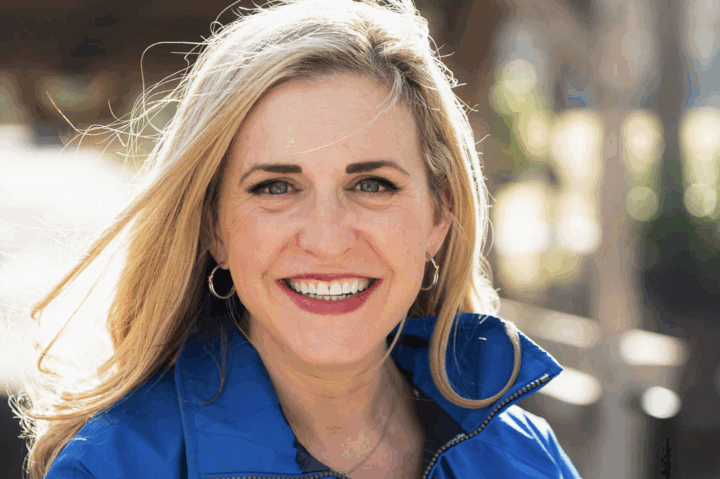
Maura Sullivan
Maura Sullivan, a Marine veteran who served in Iraq and later worked as a senior Defense Department official, is aiming to leverage that experience to win the New Hampshire congressional seat currently held by Rep. Chris Pappas (D-NH), who is running for the Senate. She’s also leaning on that background as she stakes out her positions on the conflict in the Middle East.
Speaking to Jewish Insider, Sullivan strongly criticized Israel for the humanitarian crisis in Gaza, saying it must take action to ensure more aid to the Palestinian people, but at the same time said that she would not support efforts to cut off U.S. aid to the Jewish state and affirmed her commitment to the U.S.-Israel relationship and the need to eliminate Hamas.
As a Pentagon official, Sullivan said she spent time in the Middle East on “allied reassurance tours,” visiting allies and meeting with top officials, such as Israeli Prime Minister Benjamin Netanyahu and Moshe Ya’alon, then Israel’s defense minister, to learn about Israel’s challenges and capabilities and “talking about the incredibly important relationship between the United States and Israel and strongly reaffirming the United States commitment to our ally Israel.”
“I’ll bring that perspective to the work I do in Congress and will greatly inform because I have that firsthand perspective, experience and knowledge,” Sullivan said, adding that she’d be seeking a spot on the House Armed Services Committee if elected.
“I’ve been very clear since the devastating, absolutely deplorable Oct. 7 attacks that Hamas perpetrated that Israel has the right to defend itself,” Sullivan continued. “I also want to be clear that the conditions in Gaza are inhumane, they’re deplorable and they must be improved immediately. … Hamas can be destroyed and significant aid can be let in at the same time. It’s a false choice to think that those two objectives cannot occur simultaneously.”
She said she has firsthand experience with humanitarian supply issues in a war zone, having served as a logistics and operations officer in Fallujah, Iraq, to move food and other supplies through what was at times an urban combat zone.
Doing so, she said, is “logistically complex” but also “doable” and “necessary.” She said the U.S. should apply “maximum pressure” on Netanyahu to increase aid, or provide aid directly if that fails.
Unlike growing numbers of Democrats in Congress, though, Sullivan said that she does not support efforts to cut off the U.S. supply of arms to Israel in response to the humanitarian situation in Gaza.
“I do not think that the answer in this conflict is to make Israeli civilians less secure due to the actions of their government,” Sullivan said. “In an effort to solve this conflict, the Israeli people need to have the ability to defend themselves against not only Hamas, but also other nefarious actors, [like] Hezbollah and … Iran.”
Sullivan added that she wanted to be clear that Hamas is a terrorist organization, its attack on Oct. 7, 2023, was the “catalyst behind all of this” and that it must return the hostages.
The pathway to a lasting peace, through a two-state solution, requires “eradicating Hamas,” she continued. “The Palestinians need to be able to live in a demilitarized state that they control, not Hamas, and the Israelis need to be able to live beside them in peace.”
Sullivan has visited Israel three times, including visiting extended family of her husband, who is Jewish, in Tel Aviv and Jerusalem. She described a visit to Yad Vashem, while she was a Pentagon official, as particularly “powerful and unforgettable.”
Sullivan said she saw during her time in Iraq that “leadership in Washington was totally out of touch” — on both sides of the aisle — with the actual situation on the ground, “and we were sent to a war we never should have been in without a plan to win and without the resources to succeed, in what was arguably the biggest foreign policy debacle this country has seen since the Vietnam War.”
That experience, she said, showed her firsthand the real consequences of decisions made in Washington. She expressed strong support for long-running efforts in Congress to repeal the Authorizations for Use of Military Force for Iraq and Afghanistan.
“Congress has to go on the record if we are going to declare war,” Sullivan said, asked about the U.S. military strikes on Iran. She urged the administration to prioritize the safety of U.S. troops and “resist any effort to drive the U.S. into another costly and deadly war in the Middle East.”
But, Sullivan continued, “Iran is the leading state sponsor of terrorism, relentlessly driving violence and chaos against the United States, Israel and our allies. A nuclear armed Iran would represent a direct and unacceptable threat to America’s national security, regional stability, as well as Israel’s very existence.”
Given Iran’s recent violations of the Nuclear Non-Proliferation Treaty, she said that “Israel is absolutely justified in taking action to dismantle Iran’s dangerous nuclear ambitions. No nation should be forced to stand by while its survival is threatened.”
Sullivan also served on the American Battle Monuments Commission, visiting gravesites of fallen soldiers around the world, which “greatly heightened my sense of the role of America in the world” and what the U.S. means to its allies.
The Marine veteran described the antisemitism crisis in the United States as particularly personal for her, given that her husband is Jewish and they are raising their children, ages 3 and 5, in an interfaith home.
“I understand these issues at a deep and personal level. Judaism was a first-date conversation for my husband and I,” Sullivan said. “My children are not yet old enough to talk to them about it, but it is something that we will need to address as a family.”
She said that she would be a “strong voice in Washington” against antisemitism and noted that it had recently hit close to home when a group of neo-Nazis marched on the state Capitol in Concord.
Sullivan leads the primary field in fundraising, having pulled in nearly $800,000 as of the end of the last quarter. Her leading Democratic primary challenge is Stefany Shaheen, the daughter of Sen. Jeanne Shaheen (D-NH) and a former Portsmouth city councilor, who raised $532,000 in the last quarter.
Carleigh Beriont, a Harvard professor and Hampton, N.H., selectwoman, entered the race in June, raising $162,000 that month. Multiple Republicans have filed to run for the seat, but none have reported raising any funds thus far.
Sullivan ran in the 2018 primary against Pappas, who is leaving the seat to run for the Senate. Sullivan won 30% of the vote in 2018 to Pappas’ 42%, before Pappas went on to win his first term in Congress.
The Marine veteran said that she believes that the Democratic Party and the country “needs new and different leadership,” and argued that her military background will make her more effective in holding the administration accountable.
Sullivan drew explicit comparisons between herself, and other female veterans running in swing districts, and the class of female national security leaders — including Sen. Elissa Slotkin (D-MI), Reps. Mikie Sherrill (D-NJ) and Chrissy Houlahan (D-PA) and former Rep. Abigail Spanberger (D-VA) — who helped Democrats win back the House in 2018.
She’s part of a group calling itself the Hellcats, which also includes New Jersey congressional candidate and Navy veteran Rebecca Bennett, that is trying to emulate their model.
If elected, Sullivan said she’d be the first female Marine ever elected to Congress.
She said she’s heard from voters in the 1st District, particularly veterans and small business owners who typically vote Republican, that they’re supporting her in part because of her military background.
She said her interest in public office was spurred by a family commitment to service as well — her grandfathers fought in World War II and her grandmothers were both involved in Jesuit education, as well as her own military service.
Coming back from Iraq, Sullivan felt a “very deep-seated obligation to commit my life to public service,” particularly because some of those she served with would not have that chance. “To live your life in a way that matters for something and for people way beyond yourself, something so much bigger than yourself — it was a transformational experience.”
Please log in if you already have a subscription, or subscribe to access the latest updates.
 Continue with Google

 Continue with Apple