














































































The Maine Democratic Senate candidate said, ‘It’s unfortunate that there are people here in Maine that don’t like to use that term only because they’re Jewish and what that means to them, with the Holocaust’

Joseph Prezioso/Getty Images
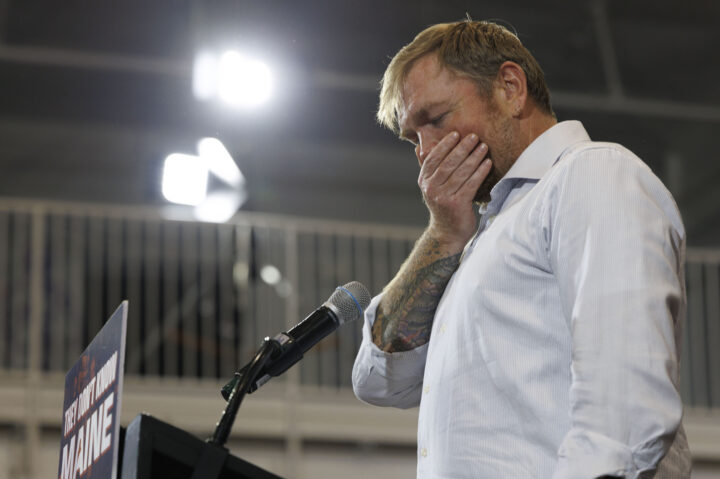
Maine Democratic Senate candidate Troy Jackson speaks at a town hall on September 13, 2026 in Biddeford, Maine.


 Add JewishInsider on Google
Maine Democratic Senate candidate Troy Jackson called it “unfortunate” that Jewish residents of Maine reject the labeling of the war in Gaza as a genocide in an interview with Portland’s NBC News affiliate released Tuesday.
“It’s unfortunate that there are people here in Maine that don’t like to use that term only because they’re Jewish and what that means to them, with the Holocaust,” Jackson said. “[Israel’s war in Gaza] fits that description and it is. It’s [an] unbelievable thing that’s happened there that people that are innocent are being murdered, and it is a genocide.”
Pressed on Hamas’ role in starting the war and killing innocent Israeli civilians, Jackson acknowledged, “You could argue the same thing for Hamas too.” He added: “There’s people that are wrong on both sides of this issue. But in the end, senseless murders, horrific murders are happening to both sides, and that has to stop.”
In a statement to Jewish Insider on Wednesday, Jackson said that he had misspoken and apologized for the comments, while maintaining his view that the war in Gaza is a genocide.
“I believe what’s happening in Gaza is genocide, and I also understand that word carries particular weight for many Jewish families given the Holocaust — the genocide of six million Jews. In trying to acknowledge that, I misspoke and made a generalization about Jewish Mainers’ views that doesn’t reflect what I meant to say,” Jackson said in the statement. “I apologize for the pain that caused.”
He continued, “Mainers hold a range of deeply considered views, and I promise I will always listen and work to approach these conversations with the care and respect they deserve. In the U.S. Senate, I’ll fight antisemitism and work for lasting peace and security for Palestinians and Israelis.”
Jackson said that the war in Gaza is the foreign policy issue he hears about the most from voters and is the most significant foreign policy challenge for the United States, beyond even the war in Iran.
During the interview, he repeatedly affirmed his view that the U.S. should not continue to send “blank checks” to the Israeli government, describing Prime Minister Benjamin Netanyahu as a “war criminal.” At one point, he said he did not want to continue sending “money” to Israel.
Jackson is facing Sen. Susan Collins (R-ME) in one of the most competitive Senate races of the cycle. A New York Times/Siena College poll released last week showed Collins narrowly ahead — one of the few battleground contests where the Republican nominee is leading.
Jackson, a former state Senate president, was the Democrats’ choice to replace Graham Platner on the ballot after the party’s original nominee withdrew from the race after facing allegations of rape and sexual abuse. Platner campaigned as a virulently anti-Israel candidate and faced controversy over a Nazi Totenkopf tattoo that he had for nearly two decades.
The unfolding situation in Maine comes amid a broader trend in American politics in which immoral or questionable behavior by one’s peers has at times been ignored or obfuscated to serve a perceived 'greater good'
(CJ Gunther/Getty Images)
Democratic U.S. Senate candidate Graham Platner speaks at his Primary Election event on June 9, 2026 in Blue Hill, Maine.
When an ex-girlfriend of Graham Platner told Politico in a story published on Monday that the Maine Democratic Senate candidate had raped her in 2021 after entering her home while heavily intoxicated, she said she did so because the response to a recent New York Times report on Platner’s past dubious behavior had focused on discrediting Lyndsey Fifield, one of the women who featured prominently in the story, over her ties to the GOP.
Jenny Racicot, a Democrat, hadn’t wanted to go public with the rape accusation (which she had shared off-record with the Times), in part because she and Platner were largely politically aligned. “One of the reasons I didn’t come forward sooner was, the huge moral conflict that I had between supporting his politics, but not supporting him as a person,” Racicot told Politico. “My part of the story [in the NYT] was just a read-over,” Racicot said. “And the story was Lyndsey, and the accusations of her being politically motivated.”
The unfolding situation in Maine comes amid a broader trend in American politics in which immoral or questionable behavior by one’s peers has at times been ignored or obfuscated to serve a perceived “greater good” of electing a political ally despite their failing moral standards.
In recent years, both major parties have increasingly tolerated conduct that would have once been considered disqualifying — even as the #MeToo movement briefly changed the nature of the discourse. Similar arguments have surfaced across political controversies over the last decade (including against President Donald Trump), with supporters of embattled candidates and officials insisting that policy positions outweigh personal conduct and dismissing allegations as politically motivated.
In a short span of time, the 2017 rallying cry of “Believe women” gave way to “Believe women whose politics align with ours” — a mindset that extended to the widespread denial of Hamas’ sexual violence during the Oct. 7, 2023, terror attacks and against the Israeli hostages kept in captivity in Gaza.
But yesterday’s Politico report, which prompted calls from Platner’s most prominent backers — including Rep. Ro Khanna (D-CA) and Sens. Elizabeth Warren (D-MA) and Ruben Gallego (D-AZ) — for him to end his bid, may mark the point at which previous defenses of the Maine Democrat become politically untenable.
Since shortly after the launch of his campaign, Platner — a virtual unknown before last summer — has faced numerous controversies, from his tattoo of an SS totenkopf to Reddit comments praising Hamas tactics to the revelation that he exchanged inappropriate messages with numerous women despite being married. The Wall Street Journal reported last month that Platner’s vetting process — normally a weeks-long process — took place in a matter of days, expedited by Platner’s top strategist and done at a fraction of the cost of a standard background check, which likely would have flagged at least some of these issues.
Yet none of those allegations proved politically fatal — and Platner ended up winning the Democratic primary with 72% of the vote. Platner’s defenders echoed the rhetoric of many of Trump’s early backers: that the party establishment had targeted him, that the media had unfairly covered the incidents and that a candidate’s positions, rather than their personal lives, should be on the ballot.
Unlike Trump, who was weeks away from his 2016 presidential victory when the infamous “Access Hollywood” tape leaked, Platner had only recently clinched his party’s nomination after Gov. Janet Mills ended her bid. He can still be replaced on the ballot, provided he exits the race by next Monday, though any new candidate will face a much more difficult battle against Sen. Susan Collins (R-ME) in what had been the Democrats’ best hope for a pickup and control of the Senate.
Now, the question is whether American politics still has a meaningful threshold beyond which partisan leanings give way to concerns about character and ethics — or whether that threshold has simply become much higher than it once was.
The Maine senator said she learned to reject anti-Jewish hate at a young age, inspired by her World War II veteran father and her mother who quit a sorority for excluding Jewish students

Mark Makela/Getty Images
Sen. Susan Collins (R-ME) addresses the press on Nov. 6, 2022.
Sen. Susan Collins (R-ME) reiterated her criticism of Maine Democratic Senate candidate Graham Platner and accused him and his supporters of antisemitism at an Orthodox Union event on Tuesday.
Speaking at the OU luncheon, Collins called out Platner for his Nazi tattoo, pointing to accounts by former romantic partners that he had described it as a Nazi symbol despite later denying that he knew what it was. She said that even though he covered up the tattoo on the campaign trail, “the stain remains.”
Collins also referenced comments from a Platner supporter who said she did not find the Nazi tattoo disqualifying but would find an Israeli tattoo to be a deal-breaker, which Collins said she found “even more distressing.”
She also repeated comments she made a day earlier on Fox News asserting that her support for Israel remains in spite of shifting political winds.
“Our support for Israel remains as strong as ever,” Collins said, to a standing ovation. “We must all stand with Israel. In my case, I learned that lesson at an early age.”
She said that her father, a World War II veteran, taught her from childhood the need to stand against evil. Collins said that her mother also taught her to reject antisemitism, noting that her mother quit her sorority in college after it rejected a fellow student because she was Jewish.
“The friendship that I share with the people of Israel is that which our true nation shares, a friendship that is anchored by common principles, a love of liberty and the courage to defend [them],” Collins said.
The GOP senator, who chairs the Senate Appropriations Committee, also said that a major priority for her this year is to make the U.S.’ defunding of UNRWA permanent. She said that it “should not have been a close call” to cut off U.S. funding to the agency after its employees were revealed to be involved in the Oct. 7, 2023 attacks on Israel, but that she had to “fight” to add and extend that provision in recent funding bills.
Collins said that the rise in antisemitism since Oct. 7 has “revealed … the oldest hatred is not only still alive, but sicker than ever. Tragically, the prognos is has only worsened since then.”
She praised David Greene, the president of Colby College, in her home state, which she said had not seen the anti-Israel demonstrations and encampments that plagued other colleges. Greene told her that “the key is, you do not negotiate, you do not allow this to occur,” she recalled.
She said Greene had also told her that the protests at other schools were directed by radical professors, graduate assistants and outside agitators, rather than grassroots activities.
Collins said a member of her own congressional staff was assaulted at an encampment at the University of Pittsburgh for carrying an American and an Israeli flag, and that no action was taken against his attacker — something she described as a pattern under the prior presidential administration.
“I think it shows how much we need to do to make sure that our students are [equipped] with the truth,” Collins said.
Sens. Elissa Slotkin (D-MI), Andy Kim (D-NJ), Jacky Rosen (D-NV) and Kevin Cramer (R-ND) also spoke at the OU event.
Former U.S. Ambassador to Japan Rahm Emanuel, on the Maine Senate candidate: ‘If he's the Democratic nominee, I'm going to help him if he wants my help, absolutely’
Andrew Harnik/Getty Images
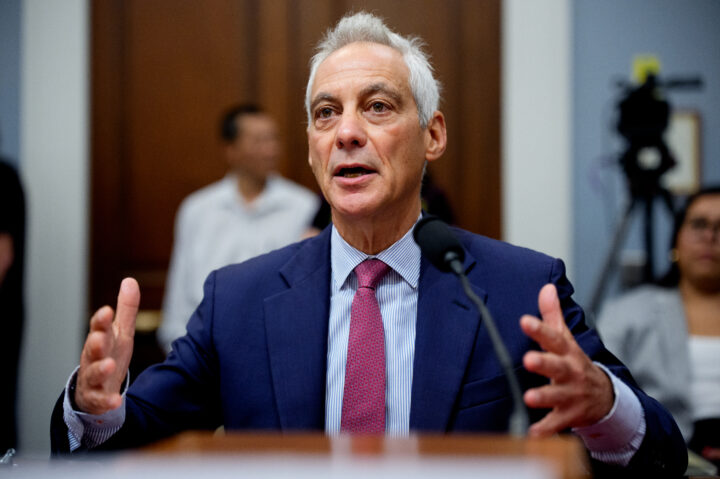
Former U.S. Ambassador to Japan Rahm Emanuel speaks on Capitol Hill on July 23, 2025 in Washington, DC.
Former U.S. Ambassador to Japan Rahm Emanuel, a likely Democratic presidential candidate, on Friday signaled his backing for Maine Democratic Senate candidate Graham Platner, who has drawn scrutiny over his far-left views and decades-old Nazi tattoo that he recently covered up.
“I would hope at this point in the process he understands what a Nazi symbol is,” Emanuel said. “He’s going to have to make his way. And the Democrats — he’ll be the nominee — should support his candidacy,” Emanuel told CNN’s Kasie Hunt.
Asked by Hunt if he was personally backing Platner, Emanuel said, “If he’s the Democratic nominee, I’m going to help him if he wants my help, absolutely.”
“You have to put an end to Donald Trump,” Emanuel added.
Emanuel, who served as mayor of Chicago from 2011-2019, later quipped about a meeting with New York City Mayor Zohran Mamdani, a vocal critic of Israel, after Mamdani’s election as mayor. “I told him when I first met him, I said, ‘I don’t know who’s going to hate this meeting more, my rabbi or AOC,’ but we had an honest meeting … an honest discussion about what to face as mayor,” he said.
Platner is now the expected Democratic nominee against Sen. Susan Collins (R-ME) after the Democratic establishment’s favored candidate, Maine Gov. Janet Mills, dropped out of the race on Thursday. Mills, despite holding a strong political track record, consistently trailed Platner in primary polling since launching her campaign.
Over the weekend, Platner’s campaign also drew support from another unexpected voice: far-right podcaster Tucker Carlson.
In a lengthy interview with The New York Times, Carlson said he “appreciated” Platner’s foreign policy views, and plans to meet with the candidate. “I appreciate how different [his foreign policy views] are from everybody else in his party,” Carlson said.
Please log in if you already have a subscription, or subscribe to access the latest updates.
 Continue with Google

 Continue with Apple