
























Many academics who have fought antisemitism in education said they have concerns towards Trump’s plan
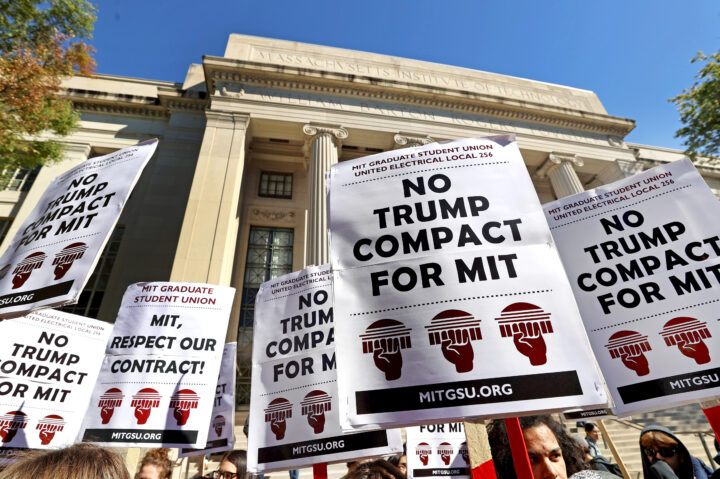
David L. Ryan/The Boston Globe via Getty Images
Signs at a MIT Grad Student Union press conference on October 10, 2025.


 Add JewishInsider on Google
As the Trump administration ratchets up its efforts to influence higher education, the latest White House proposal for colleges and universities is being met with skepticism from academics — even as its authors say its implementation should be a no-brainer.
That’s in reference to a White House document called the “Compact for Academic Excellence in Higher Education,” a 10-point plan that the federal government is asking universities to sign in order to get preferential treatment for the federal funds upon which many research universities rely.
If the schools don’t agree to the terms in the compact — which include commitments to end race-based hiring and admissions, limits on foreign enrollment and a pledge to foster greater ideological diversity — they risk losing billions of dollars.
The compact reflects an evolution of a familiar Trump administration argument: that America’s preeminent educational institutions have strayed from their mission, letting politics interfere with their raison d’etre as centers of academic excellence. Combating antisemitism on college campuses — a cause the White House has prioritized this year — provided President Donald Trump a foray into greater oversight of higher education. But there appears to be no direct line from that fight against antisemitism to the broader ideological framework in this compact, which makes only a passing reference to antisemitism.
A White House official who worked on the compact called it a “basic, basic easy low hurdle,” telling Jewish Insider that the document is “a nonpartisan, neutral concept.”
Many academics, including several who have spoken out against antisemitism and against universities’ handling of it in recent years, don’t agree.
“Fundamentally, the premise of the document is inconsistent with our core belief that scientific funding should be based on scientific merit alone,” Massachusetts Institute of Technology President Sally Kornbluth said last week, making MIT the first university to formally reject the compact.
The White House wrote to MIT and eight other campuses this month, giving them early access. Brown University joined MIT in rejecting the compact on Wednesday, but the other seven universities haven’t yet responded ahead of the Oct. 20 deadline.
With the compact, Trump is making the case that universities have a fiduciary responsibility to American citizens that they have not met, as academia has “lost its way,” according to the administration official.
“It’s for the taxpayers,” said the official, who requested anonymity to speak openly about a negotiating process that is mostly taking place behind closed doors. “This administration is here to support research … but at the same time we also can’t abdicate our responsibility to you and myself. There are a lot of people who are cutting checks to the IRS because that’s what they have to do, and they don’t even go to college.”
But where the Trump administration sees “good hygiene,” according to the official, many academics worry the compact’s far-reaching goals could amount to an overreach that impinges on free speech and academic freedom.
“It’s something that everybody’s talking about, and people are taking it very seriously,” said David Myers, a professor and the chair of Jewish history at the University of California, Los Angeles. “It really seems to touch upon one of the cardinal principles of university governance, which is autonomy and independence.”
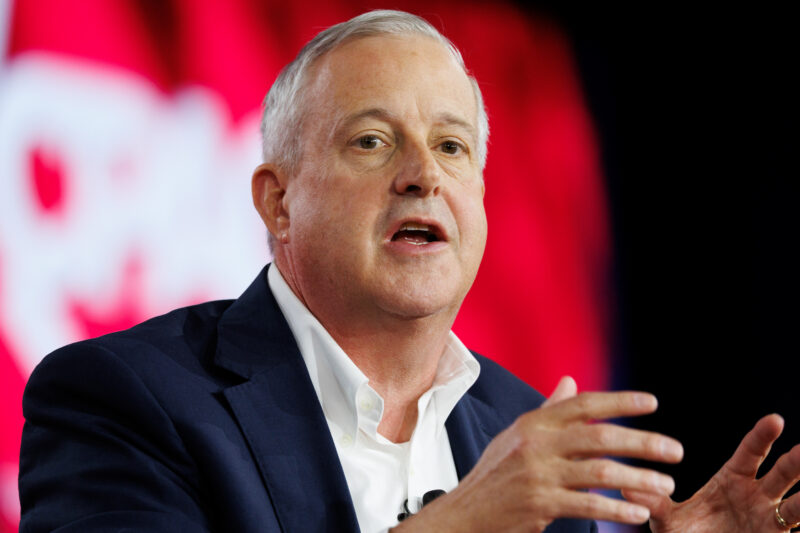
Menachem Rosensaft, an adjunct law professor who teaches about antisemitism and the Holocaust at Cornell University, called the compact “overkill, with a number of positive items in it, but overall problematic for any independent university of college.”
Rosensaft questioned how the compact addresses antisemitism, if at all: Antisemitism is only mentioned in a section about foreign students, which accuses those who are “not properly vetted” with “saturating the campus with noxious values such as antisemitism and other anti-American values.”
Academics concerned about antisemitism told JI that the Trump administration is right to point out that severe problems exist in higher education. But many are unsure how this compact will address the issues Jewish students face.
“I often wonder if a compact like this had come out of the Biden administration or a Harris administration, whether, from the faculty, there’d be that same kind of knee-jerk reaction [that] we have to oppose everything that comes out of the administration — when actually, when you read this line by line, there’s a lot of things we can agree with,” said Miriam Elman, a former political science professor at Syracuse University.
“If you look at certain things individually, they’re OK. I don’t have any problem with freezing tuition, for example, or with arresting grade inflation. I don’t have any problem with teaching [Western civilization]. The problem is that, as a whole package, it’s kind of the antithesis of what universities are meant to do,” said Norman Goda, a historian and professor of Holocaust studies at the University of Florida. “And if the addressing of antisemitism is one of the aims of this, then I don’t know how that is done.”
Miriam Elman, a former political science professor at Syracuse University, said that some of the immediate skepticism of the compact is likely due to politics. But that doesn’t alleviate all of her concerns.
“I often wonder if a compact like this had come out of the Biden administration or a Harris administration, whether, from the faculty, there’d be that same kind of knee-jerk reaction [that] we have to oppose everything that comes out of the administration — when actually, when you read this line by line, there’s a lot of things we can agree with,” said Elman, who is the executive director of the Academic Engagement Network, which fights academic boycotts of Israel.
“But we also are not naive. The Trump administration does have an agenda. It does have priorities, and it is wrapping those priorities into the fight against campus antisemitism. So there is a lot of concern.”
The compact appears to be primarily directed at undergraduate programs. Dr. Philip Greenland, a professor of medicine at Northwestern University, said his colleagues at the medical school are generally not worried about the compact in the way many humanities professors are. “It could affect the medical school in a secondary way: If Northwestern is drawn into this and doesn’t comply, we may never get our federal funding back,” said Greenland. The Trump administration froze $790 million in federal funding for Northwestern in April.
“Although the compact doesn’t seem to be talking about antisemitism, in the end, people will remember: How did the administration go after the universities?” said Pamela Nadell, the chair in women’s and gender history at American University and the author of a new book about antisemitism in America. “They said that they were promoting antisemitism.”
“I think it’s in some sense a good thing that it doesn’t call out, specifically, that this is about antisemitism,” Greenland continued. “What the compact seems to be more about is a claim, which is justifiable, that universities have become very, very ideological in one direction … People are claiming that the compact will deprive them of their free speech. But what that doesn’t recognize is that the current situation deprives other people of their free speech and their free expression.”
The Trump administration official told JI that the compact is “all-encompassing,” and argued that its broad mandate includes antisemitism — but not only that.
“It overlaps, but the compact isn’t a compact to stop antisemitism. It’s a compact to return to lawful academic excellence and a marketplace of ideas, [and] that includes eradicating antisemitism,” said the official.
Pamela Nadell, the chair in women’s and gender history at American University and the author of a new book about antisemitism in America, argued that the Trump administration’s earlier actions targeting antisemitism will come to be viewed as the pretext for what is now a much larger and more strategic rewriting of federal policy toward institutions of higher education.
“Although the compact doesn’t seem to be talking about antisemitism, in the end, people will remember: How did the administration go after the universities?” said Nadell. “They said that they were promoting antisemitism.”
Jason Miyares says AMP refuses to comply with demand for financial documents to scrutinize possible ties to terror

Julia Rendleman for The Washington Post via Getty Images
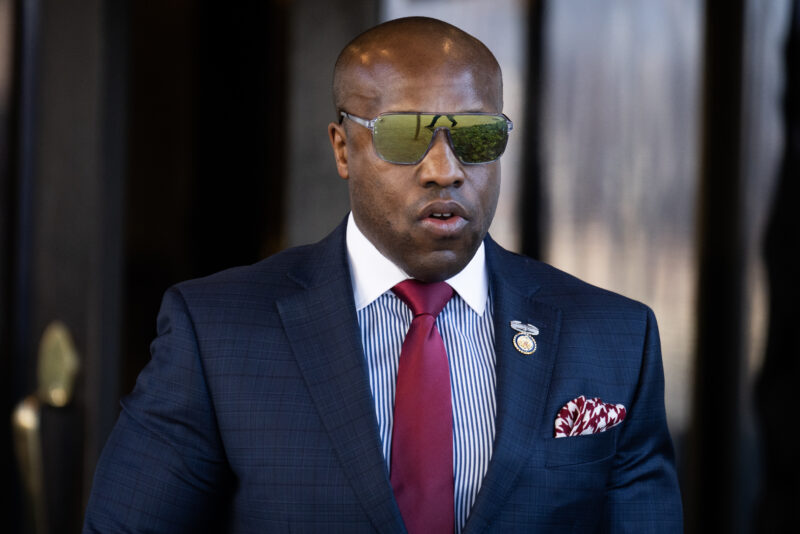
Virginia Attorney General Jason Miyares.
Jason Miyares, the attorney general of Virginia, announced this week that his office had filed a petition to enforce a judge’s order from last July that a pro-Palestinian advocacy group with alleged ties to Hamas turn over closely guarded financial records that could shed light on its donor network — which has faced growing scrutiny in the wake of the Oct. 7 Hamas terror attacks.
Miyares’ office said in a statement on Tuesday that American Muslims for Palestine (AMP), a nonprofit group headquartered in Virginia that he has been investigating in a probe of its fundraising operations, “has refused to comply” with a civil investigative demand for documents the group has long shielded from public view.
The petition “seeks AMP’s immediate compliance” with the demand, the statement said, reiterating that Miyares’ team has been requesting records as part of an ongoing investigation into allegations that the group “may have used” funds “for impermissible purposes, such as benefiting or providing support to terrorist organizations.”
In a major court ruling last summer, a Richmond judge rejected AMP’s effort to challenge the demand, ordering the group to “produce records” and denying its petition to narrow the focus of the probe, according to a statement from the attorney general’s office after the decision had been made.
But Miyares, a Republican who first launched his investigation shortly after Hamas’ attacks on Israel in October 2023, said that AMP has continued to drag its heels several months later.
“Despite the court denying AMP’s previous efforts to halt my investigation, they continue refusing to comply,” he said in a separate statement posted to social media on Tuesday, while calling the petition “necessary to ensure accountability and uphold the law.”
A spokesperson for his office did not respond to a request for comment on the investigation.
Christina Jump, an attorney for AMP, said that she was unable to comment on the petition because she had “yet to see the referenced enforcement action,” claiming the attorney general’s office had “issued a press release prior to making any effort to contact AMP — or its counsel — about this new step.”
Jump added that AMP had filed a “timely” appeal of the judge’s decision and made “requests for a stay of the enforcement,” accusing the attorney general’s office of attempting to “thwart” the group’s “right to utilize the full legal process,” which she called “both disappointing and premature.”
“We will continue to pursue all legal actions which AMP may rightfully pursue — and its appeal of the underlying decision remains actively pending,” she wrote in an email to Jewish Insider on Wednesday.
Founded in 2006, AMP describes itself as “a grassroots organization dedicated to advancing the movement for justice in Palestine by educating the American public about Palestine and its rich cultural, historical and religious heritage and through grassroots mobilization and advocacy.”
But in the wake of Oct. 7, the group has faced growing scrutiny over its involvement in anti-Israel protests on college campuses around the country and its financial backing of National Students for Justice in Palestine, members and chapters of which have voiced outspoken support for Hamas.
Top officials at AMP, meanwhile, were also once affiliated with a now-defunct group, the Islamic Association for Palestine, found liable for aiding Hamas.
The attorney general’s investigation is one of several legal challenges now targeting AMP’s records, which critics have long suspected of hiding illicit financial activity.
The group has insisted it has never supported or funded terrorism and that it does not send money overseas. Jump, in her email to JI, said “no court, in any jurisdiction, has ever found that AMP has done anything inappropriate regarding its fundraising. It has not.”
AMP’s fiscal sponsor, AJP Educational Foundation, took in more than $2.2 million in revenue in 2023, according to its most recent tax filings, which do not disclose the group’s donors.
In an interview with JI last September, Miyares — who has largely avoided commenting publicly on the active investigation — said that his office has been “aggressively in the process of using the legal system” to obtain additional records that AMP has fought to withhold.
“We have been relentless in that pursuit, and we will continue to be relentless,” he said. “Our job is to get to the truth.”
Please log in if you already have a subscription, or subscribe to access the latest updates.
 Continue with Google
 Continue with Apple