














































































Republican senators argued to JI that the war will ultimately be to the Gulf’s benefit, even if they’re feeling the pain now
Fadel SENNA/AFP via Getty Images
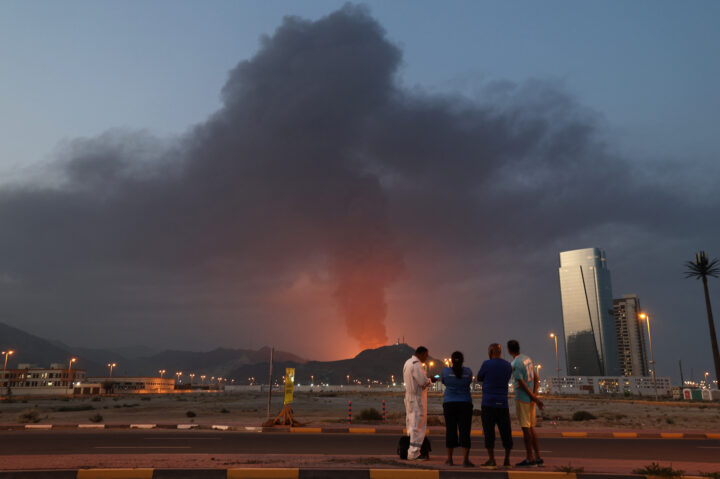
Foreign workers look at a tall plume of black smoke ascends following an explosion in the Fujairah industrial zone in the UAE on March 3, 2026.


 Add JewishInsider on Google
As Iran retaliates against the U.S. and Israel’s joint military campaign, findings have revealed that the United Arab Emirates — not Israel — has thus far faced the majority of Tehran’s missile and drone attacks.
Since the launch of the war on Feb. 28, Tehran has responded with widespread drone and missile attacks across the region, but it has been the UAE that has borne the brunt of the attacks. As of March 11, the UAE’s Ministry of Defense reported that its air defenses had “engaged” 268 ballistic missiles, 15 cruise missiles and 1,514 UAVs.
Iranian strikes have targeted American assets in the country, such as the U.S. consulate in Dubai, but also a range of civilian targets, including Dubai International Airport, where a drone attack wounded four people. Reports have indicated that Abu Dhabi has faced more than three times the number of Iranian drones and missiles launched toward Israel. The attacks come as Gulf allies are running short on missile interceptors.
Two Senate Republicans argued to Jewish Insider on Wednesday that, ultimately, the U.S. campaign against Iran will be to the benefit of the UAE and other Gulf allies, even if they’re feeling pain in the short term.
“It’s always something that we need to be aware of, and it is not an item to be ignored, but at the same time, you have to measure it with what Iran has left, and whether our offensive capabilities will continue to degrade their ability to actually inflict damage in that region,” Sen. Mike Rounds (R-SD) said, referring to the attacks on UAE and other allies and their reportedly dwindling interceptor stocks.
Iran’s offensive weapons “have limits as well,” Rounds continued, “and we’ve just got to do a better job of making sure that we go after their offensive capabilities.”
“Unfortunately we’re in the middle of a battle [that will decide if] the area [is] going to be safe or not,” Sen. Rick Scott (R-FL) said, adding that he believes the U.S.’ allies are supportive of the action the U.S. is taking. “Everybody would like to make sure Iran doesn’t have a nuclear weapon and they’re sick and tired of Iran’s antics. So I think it’s part of what you have to go through.”
Meanwhile, Sen. Chris Murphy (D-CT) pointed to the attacks on Gulf states as an argument against the war in general.
“These countries have limited interceptor stocks. This could get even uglier very quickly. Like everyone (except the White House) knew it would,” Murphy said on X.
Experts told JI that the UAE’s proximity to Iran, combined with its role as a global financial and commercial hub, makes it a particularly attractive target for Tehran. Even limited strikes can rattle international markets, disrupt tourism and investment and raise the economic stakes for countries aligned with Washington and pressure it to end the war.
“Iran is deliberately and disproportionately targeting the UAE partially because it is easy, given the UAE’s proximity to Iran, and more importantly, because it is an easy target that Iran knows will exact a global cost financially, and a military cost for the United States and the region,” Rachel Brandenburg, a senior policy analyst at the Israel Policy Forum, said.
“The UAE is home to significant global financial capital flows, international corporations, and tourists from far and wide,” she said. “Hitting the UAE is a relatively easy way for Iran to show that it can harm not only American and Israeli interests and assets, but also global interests.”
Brandenburg said that the UAE had been “counting on its diplomatic and economic relationship with Iran to insulate it from any retaliation against American or Israeli strikes” but “that, in fact, was not the case.”
Jonathan Ruhe, a fellow at the Jewish Institute for National Security of America, said that Tehran’s strategy is not only to broaden the conflict, but to interfere with the “Emirates’ success as a safe haven for economic activity,” in hopes that the UAE and other Arab countries “will pressure Trump to end the war as soon as possible.”
“Ironically, the UAE did such a good job creating a safe haven that now even the threat of a few drones can shock and scare away tourists, investors and shippers.”
Ruhe also noted that the UAE is an “easier military target” compared to Israel.
“Its [the UAE’s] air defenses are less battle-tested, and have less time to react to incoming projectiles than those in Israel, and, unlike Israel, it’s within reach of Iran’s short-range missiles,” Ruhe said. “Israel has already adapted to two-plus years of grueling conflict, so missiles and drones cause less disruption to normal life.”
However, experts noted that Tehran’s strategy could backfire, exposing the military promise of Gulf allies while potentially pushing them closer to defense cooperation with the U.S. and Israel. David May, a senior research analyst at the Foundation for the Defense of Democracies, said that the missile defense systems of Arab allies have “performed admirably in real-world conditions.”
“While Iran might have hoped that Gulf countries would beg the Americans to end the war, the opposite has happened,” May said. “The Gulf countries have condemned Iran and intercepted most of the drones and missiles, and the shared experience of being subjected to Iranian aggression has reminded them of the need for a regional defense architecture in line with the Abraham Accords.”
Ruhe also argued that Iran’s strategy “has backfired,” and echoed sentiments that it could create the conditions for cooperation that were not present prior to the start of the conflict.
“However and whenever this conflict ends, it’s creating new opportunities that, frankly, didn’t exist until Iran attacked the entire neighborhood,” Ruhe said.
‘You don’t have to drag him into anything. Donald Trump is the strongest leader in the world. He does what he thinks is right for America,’ Netanyahu said in his first interview since the operation began

SAUL LOEB/AFP via Getty Images
President Donald Trump shakes hands with Israeli Prime Minister Benjamin Netanyahu during a meeting in the Oval Office of the White House in Washington, DC, on April 7, 2025.
In his first interview since the U.S. and Israel launched their joint military campaign against Iran, Israeli Prime Minister Benjamin Netanyahu defended the timing of the operation’s launch and rebuffed the notion that he decisively pushed President Donald Trump to take action.
“The reason that we had to act now is because after we hit [Iran’s] nuclear sites and their ballistic missile program [in June 2025] … they started building new sites, new places, underground bunkers that would make their ballistic missile program and their atomic bomb program immune within months,” Netanyahu told Fox News host Sean Hannity on his show Monday night. “If no action was taken now, no action could be taken in the future.”
Without undertaking military operations, Netanyahu warned that Iran would be able to “target” and “blackmail America” and argued that Tehran could threaten the U.S. and Israel “and everyone in between.” He added that the moment was also opportune due to the Iranian regime being “at the weakest point that it’s been since it hijacked Iran from the brave Iranian people 47 years ago.”
When asked about allegations from critics of the operation that he had “dragged” the U.S. into a wider conflict with Iran, Netanyahu dismissed the notion, calling it “ridiculous.” He said that Trump made the decision on his own because he “understands” the threat Iran poses to the U.S.
“You don’t have to drag him into anything,” said Netanyahu. “Donald Trump is the strongest leader in the world. He does what he thinks is right for America.”
In comments Monday afternoon, both Secretary of State Rubio and House Speaker Mike Johnson (R-LA) suggested it was Israel’s determination to strike Iran, which would have prompted Iranian retaliation against U.S. assets, that necessitated U.S. preemptive action.
Netanyahu did not offer a timeline for how long he expects the joint operation to last; however, he emphasized that it will be “quick and decisive” and not an “endless war” as some critics have alleged.
“You’re not going to have an endless war,” said Netanyahu. “This is going to be a quick and decisive action, and we’re going to create the conditions first for the Iranian people to get control of their destiny, to form their own democratically elected government, which will make Iran different altogether. It may take some time, but it’s not going to take years.”
The prime minister argued that the current military confrontation is intended not only to neutralize an immediate threat but to reshape the region’s long-term trajectory, describing it as a potential “gateway to peace.”
“I think it changes the world,” Netanyahu said, arguing that dismantling Iran’s regime would remove what he called the Middle East’s primary driver of instability. “Iran has been the main engine of war over these years. Ninety-five percent of all the problems you see in the Middle East are generated by Iran and the worldwide terror network that they built.”
“When you take away Iran [Iranian leadership] — let the people of Iran have the opportunity to act and liberate themselves, free themselves from the work of this terror machine — you get a different future,” he added.
Rubio and Defense Secretary Pete Hegseth, however, have insisted that the U.S. objective in Iran is more constrained. The White House has asserted it is not seeking regime change, instead emphasizing that American action is narrowly focused on dismantling Tehran’s nuclear program, ballistic missile capabilities and naval assets.
Still, Netanyahu embraced a broader vision, suggesting that the fall of the Iranian regime would fundamentally reshape the region and open the door to normalization agreements and “many peace treaties” with Arab and Muslim-majority countries. He specifically pointed to Saudi Arabia as a potential partner.
“Saudi Arabia will have a lot to gain,” Netanyahu said. “All these countries around Iran are threatened by Iran. I think they [Arab countries] want to see this regime go down, even if they don’t publicly say that.”
“If Iran [Iranian leadership] is removed, that’s a great boon to Saudi Arabia, a great boon to these other countries, and I think peace between Israel and Saudi Arabia would be really possible — and probably very close — once this thing happens.”
Please log in if you already have a subscription, or subscribe to access the latest updates.
 Continue with Google

 Continue with Apple