














































































The new report from the hawkish think tank calls for the countries to sign one final 10-year MOU while focusing more on military cooperation and engagement
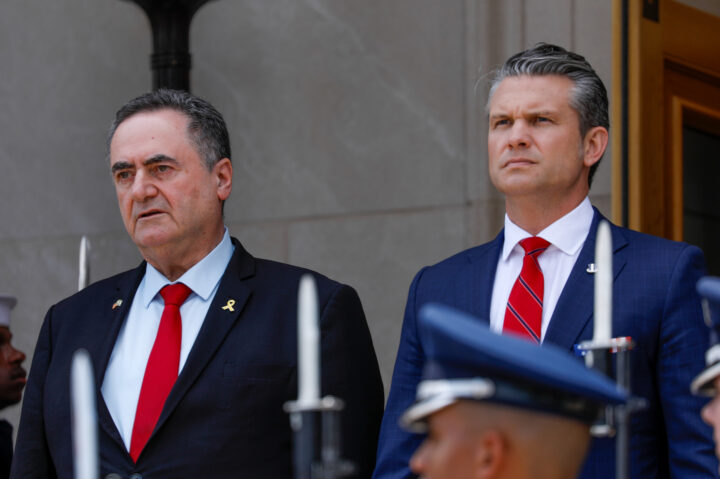
WASHINGTON DC, UNITED STATES - JULY 18 : U.S. Secretary of Defense Pete Hegseth (R) welcomes Defense Minister Israel Katz (L) during an official ceremony at the Pentagon in Washington, United States on July 18, 2025. (Photo by Yasin Ozturk/Anadolu via Getty Images)


 Add JewishInsider on Google
As Israel and the Trump administration negotiate the next U.S.-Israel memorandum of understanding, a new report from the Jewish Institute for National Security of America demonstrates how even among hawkish experts in Washington, the question is increasingly not how to preserve the traditional military aid model, but what should replace it.
The report, titled “Shifting the Center of Gravity: Transforming the U.S.-Israel Security Partnership,” recommends that the two countries sign one final 10-year MOU — a sea change for Israel supporters who previously wouldn’t have dreamt to advocate for the end of these kinds of agreements between Jerusalem and Washington, though they largely hope for it to be replaced with cooperative and enduring programs.
The report comes as Israeli Prime Minister Benjamin Netanyahu has himself championed the eventual end of direct U.S. aid to Israel and as elements of both parties become resistant to defense spending overseas, a new reality that is forcing a reassessment of how Washington can sustain its commitment to Israel without relying on the traditional aid model.
Blaise Misztal, JINSA’s vice president for policy, told Jewish Insider that the strategy is catered to “America’s benefit” and seeks to make the U.S.-Israel partnership “more effective for both countries.”
“Closer alignment and cooperation with Israel across military, technological and economic lines of effort will help make America safer abroad, more prosperous at home and one step ahead of its adversaries,” Misztal said. “One specific area where we believe this should happen immediately is with shifting the center of gravity of U.S. force posture in the Middle East to Israel.”
JINSA’s report calls for maintaining $3.8 billion in annual U.S. assistance through fiscal year 2038, while pairing that funding with a series of initiatives designed to deepen operational and strategic integration between the two militaries, including a larger U.S. military footprint in Israel, a permanent U.S. military presence at Israel’s Ovda Airbase, a deeper U.S.-Israeli defense industrial partnership and a limited U.S.-Israel mutual defense treaty (with a deliberately narrow threshold for activation).
At the center of JINSA’s proposal is an expanded U.S. military presence in Israel. Beyond Ovda Airbase, the report calls for expanding U.S. access to other Israeli air and naval bases and creating a forward CENTCOM headquarters in Israel for regional planning, mission command and oversight of U.S. forces, as well as establishing a U.S. prepositioned arsenal hub and expanding and modernizing the existing war reserve stockpile.
The strategy also envisions joint development and production of advanced weapons and critical munitions. It recommends formally incorporating Israel into the Trump administration’s Golden Dome missile-defense initiative and expanding U.S. procurement and coproduction of Israeli air- and missile-defense systems.
JINSA further recommends expanding intelligence sharing on Iran, its proxies and other shared adversaries, including China and Russia, while establishing a “Model Ally” status for Israel that would provide a framework for deeper joint research and development, co-production, reciprocal offsets and an updated assessment of Israel’s Qualitative Military Edge. The report argues that greater integration of the two countries’ defense industries would strengthen their respective industrial bases and supply chains.
The proposal would also elevate the political and military commitments underpinning the relationship. JINSA recommends deepening CENTCOM-led defense cooperation between Israel and key Arab states with the eventual goal of a limited, U.S.-led regional mutual defense arrangement conditioned on normalization with Israel.
“The question for policymakers is not what America owes Israel. It is what America gains from having Israel as an ally — and how much more both countries can gain by making that alliance stronger,” JINSA said in a statement accompanying the report.
The report argues that Israel’s recent cooperation with the United States in the war in Iran demonstrates the value of a more integrated partnership.
“Israel fought shoulder-to-shoulder with America, carrying an equal share of the combat burden and risk, with historic levels of joint planning, intelligence integration, and operational coordination, while hosting and protecting more than 100 U.S. military aircraft and thousands of American servicemembers,” the statement said. “It also deployed advanced air defenses and troops to help defend a U.S. partner, the United Arab Emirates.”
JINSA also points to Israel’s defense spending as evidence of its willingness to share the burden of regional security, arguing that the country’s defense spending of nearly 8% of GDP exceeds NATO’s new 5% benchmark and is roughly three times the share spent by many European countries.
The framework, which will replace the MOU when it expires in 2028, will aim to ‘gradually transition from aid to a completely reciprocal relationship’
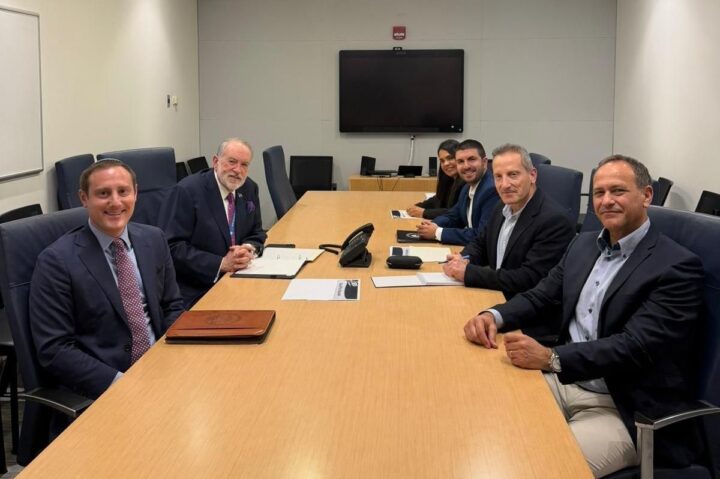
Israeli Ministry of Defense
Formal discussions begin between the Trump administration and the Israeli Ministry of Defense on a new security cooperation framework.
The Israeli Ministry of Defense and the Trump administration have launched formal talks on a “new security cooperation framework” to replace the current U.S.-Israel memorandum of understanding on military aid upon its expiration in 2028, the ministry said in a statement on Friday.
The Israeli team will be led by Defense Ministry Director-General Amir Baram and Israeli Ambassador to the U.S. Yechiel Leiter, while the U.S. team will be led by State Department counselor Daniel Holler and U.S. Ambassador to Israel Mike Huckabee.
The two sides held a formal inaugural meeting this week and have further discussions planned in both countries in the coming weeks, the ministry said, without specifying a timeline for when the talks might conclude.
The new agreement, according to the statement, is designed to “strengthen the IDF’s qualitative military edge through expanded joint investment in research, development, and co-production” as well as “deepen the U.S.-Israel partnership demonstrated during [the Iran war].”
The framework will also aim to “gradually transition from aid to a completely reciprocal relationship,” a goal Israeli Prime Minister Benjamin Netanyahu has championed in recent months.
Earlier this week, Netanyahu told CNBC’s Sara Eisen that he wants to start winding down U.S. aid to Israel “in the last two years of the Trump administration,” suggesting he may also be looking to alter the terms of the current MOU, which guarantees Israel $3.8 billion annually in military aid through FY 2028.
The secretary of state said Israel eventually wants be in a position where it can continue buying U.S. defense products without receiving ‘any sort of assistance’ in doing so
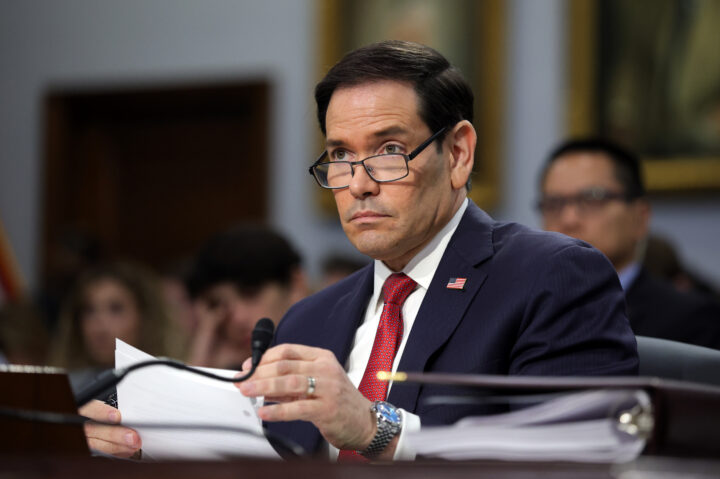
Kevin Dietsch/Getty Images
Secretary of State Marco Rubio testifies during a House Appropriations Committee hearing in the Rayburn House Office Building on June 02, 2026 in Washington, DC.
Secretary of State Marco Rubio confirmed that, as part of negotiations over the next U.S.-Israel memorandum of understanding covering military aid, the U.S. and Israel have been discussing an Israeli proposal to wind down U.S. military aid to Israel.
“What Prime Minister [Benjamin] Netanyahu and the Israelis have told us is they would like to set up a scenario where they wean off U.S. assistance the way they did with foreign aid a decade and a half ago,” Rubio said at a House Appropriations Committee hearing on Tuesday, referring to non-military, economic aid, which was phased out in 2007. “They’d like to go from the numbers they’re getting now to slowly less every year, until the number hits zero.”
He said that current MOU talks are at a “high level,” and that Israeli Ambassador to the U.S. Yechiel Leiter has been engaging with Rubio’s counselor and chief of staff on the issue, as well as with the Department of Defense.
And he said that the Israelis had made such a proposal “on a number of occasions over the last year” in private, which Netanyahu has since made public.
He said that nothing is finalized at this point, but that the Israelis want over the next 10 years to end in a position where they can continue to buy defense products from the U.S. but will not receive “any sort of assistance” in doing so.
Also at the hearing, Rubio blamed the stalled ceasefire and reconstruction effort in Gaza on Hamas’ intransigence. He said that, at this point in the ceasefire agreement, an international stabilization force should be going into Gaza, but “this requires the demilitarization of Hamas, which right now, they have not been willing to meet the conditions necessary.”
As originally conceived, the security force was set to be charged with demilitarizing Hamas, but there had been ongoing questions about whether states other than Israel would be willing to commit troops to that effort.
Rubio said that other U.S. partners in the region are also pressuring Hamas to proceed with demilitarization. He also said various donors and countries are coming forward to offer funds and investment for reconstruction, but none of that can begin until Hamas is demilitarized.
He also said that the administration continues to oppose any change in the status of the West Bank, and that moves by Israel to annex territory would complicate the U.S.’ ability to push the Gaza peace plan forward. He said the U.S. has shared its position on the issue with Israel as well.
Please log in if you already have a subscription, or subscribe to access the latest updates.
 Continue with Google

 Continue with Apple