














































































Moulton, who did not directly address Israel policy during the debate, named ending the Iran war as the most important thing that Congress can do in the current moment
Suzanne Kreiter/The Boston Globe via Getty Images
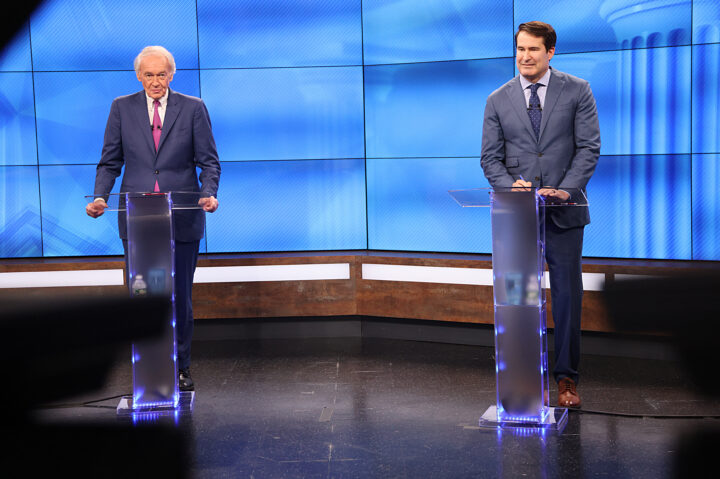
Sen. Ed Markey and Rep. Seth Moulton stand at lecterns ahead of their debate at WWLP-22News on July 8, 2026.


 Add JewishInsider on Google
Sen. Ed Markey (D-MA) touted his early support for efforts to block certain U.S. arms sales to Israel during a Senate debate on Thursday with Rep. Seth Moulton (D-MA), who is challenging the Massachusetts senator for his seat.
“Trump had Netanyahu’s back in his unbelievably unconscionable war against Gaza. And that’s why Bernie Sanders and I and Elizabeth Warren, we were [some] of the first 11 who voted against these 1,000-pound bombs going in against Gaza,” Markey said. “The man has no conscience. He has no wisdom whatsoever. He is endangering the United States, our national security, our standing in the world every single day that he’s allowed to sit in that Oval Office.”
Moulton did not directly address Israel policy during the debate.
Both candidates also focused significant time on condemning the war in Iran and expressing their opposition to it, while jabbing at each other over who has been the more effective opponent of the war.
Moulton named ending the Iran war as the most important thing that Congress can do in the current moment, taking credit for bringing a war powers resolution to the House floor.
Throughout the debate, Markey repeatedly attacked Moulton for voting, months before the start of the war, for a 2026 appropriations bill that included funding for the Defense Department. Moulton responded by repeatedly highlighting Markey’s past support for other defense appropriations bills, including during the Iraq war.
Moulton also criticized Markey for voting to confirm Secretary of State Marco Rubio, accusing him of doing so at the behest of Senate Minority Leader Chuck Schumer (D-NY), and highlighted his own national security experience and background.
Both candidates offered defenses of Diversity, Equity and Inclusion programs that have come under attack by the Trump administration, in part through the administration’s investigations into campus antisemitism.
“We absolutely should defend DEI. That’s part of our DNA. And what the Trump administration is doing is not conducting an honest campaign. They are demonizing universities. They are attacking blue states. They are attacking fundamental American values,” Moulton said. “Any decisions about DEI programs should be left to the institutions themselves,” he continued, praising the “amazing institutions,” including institutions of higher education, in the state.
“We’re only going to be a great nation if we tap the talents of every person in our country. That’s what DEI is all about: diversity and equity and inclusion for everyone, and that is what has made our country great,” Markey said.
The two voted for the first time last week in favor of blocking some U.S. arms sales to Israel
Brandon Bell/Getty Images
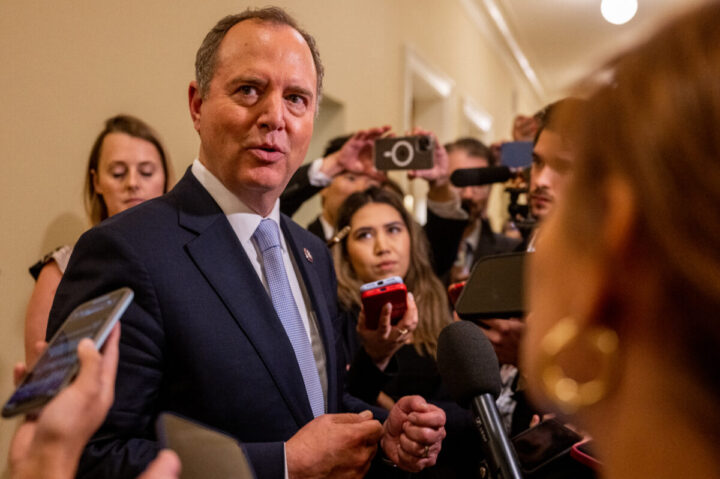
Rep. Adam Schiff (D-CA) speaks with reporters after closing remarks during the fifth hearing on the January 6th investigation in the Cannon House Office Building on June 23, 2022, in Washington, D.C.
Sens. Adam Schiff (D-CA) and Mark Kelly (D-AZ), who both voted for the first time last week in favor of blocking some U.S. arms sales to Israel, said that their future positions on such votes would be made on a case-by-case basis, determined by the specific sales in question and the circumstances surrounding the votes.
The two were somewhat surprising votes in favor of Sen. Bernie Sanders’ (I-VT) effort to block U.S. arms sales, having generally maintained pro-Israel records while in Congress.
“I was, and am, strongly opposed to the war in Iran, and I couldn’t justify voting against our own supplemental funding bills, which I plan to, and supporting funding for the same war in a JRD,” Schiff told Jewish Insider, referring to the Joint Resolutions of Disapproval to block specific arms sales to Israel. “I’ll evaluate each circumstance as they come.”
Kelly disputed the notion that his vote had flipped, saying, “I make these decisions based on what is the current situation, and what is the vote on — I don’t make these [decisions] in a vacuum.”
“This isn’t ‘yes’ or ‘no’ in any given moment, I’m always going to be looking out for Israel,” Kelly said. “And I think Israel is weaker, and the Israeli people are at further risk because of the current prime minister of Israel. He’s made a lot of mistakes, and he’s not operating in accordance with our values — but nor is our president. So I’ll look at every one of these [votes] based on what it is and what the current situation is.”
Asked whether his calculus would change if Israeli Prime Minister Benjamin Netanyahu were to lose the next election, he said that the decision is up to the Israeli people, “but I do not think Netanyahu has done Israel as a nation any favors.”
Please log in if you already have a subscription, or subscribe to access the latest updates.
 Continue with Google

 Continue with Apple