








































































Former CENTCOM head Gen. Frank McKenzie: ‘If you are sitting down at CENTCOM right now, you are satisfied with where you are’

Tolga Akbaba/Anadolu via Getty Images
A view shows explosions lighting up the skyline amid ongoing US-Israel attacks in Tehran, Iran, on March 25, 2026.


 Add JewishInsider on Google
Former U.S. Central Command head Gen. Frank McKenzie said Wednesday that the U.S. military is “in the heart of the plan” in its war against Iran, pointing to major military achievements against Tehran’s missile and military capabilities, while cautioning that the conflict remains a grinding, long-term campaign.
As the conflict between the U.S., Israel and Iran nears the one-month mark, officials say Iran’s capabilities have been severely degraded, while President Donald Trump has asserted that the war is nearly over and that its objectives have largely been achieved.
At the same time, reports indicate that Iran has rejected Trump administration proposals to negotiate an end to the conflict, while the Pentagon is deploying the military’s highly specialized 82nd Airborne Division to the Middle East — raising fresh questions about the trajectory of the war and the broader strategy.
During a webinar hosted by the Jewish Institute for National Security of America, McKenzie said the U.S. is “accomplishing the objectives that we set out. CENTCOM is executing a long-prepared campaign plan. This is not something that we’ve drawn up on the back of the envelope day-to-day. These are things that have been studied and refined for many years. If you are sitting down at CENTCOM right now, you are satisfied with where you are.”
McKenzie said one of the clearest indicators of success is that Iran has been unable to generate the kind of large ballistic missile salvos that U.S. military planners had long feared.
“Iran has not been able to mount massive volleys against Israel. Have they been able to fire some number of missiles against our targets? Yes, but not the massive volleys that we thought would make it hard for us to defend,” McKenzie said, attributing that in part to Iran’s own strategic miscalculation.
“The Iranians made a mistake in designing their ballistic missile force. They mistook hardening and burying for security,” McKenzie said. “The truth of warfare today is this: if you can see it, you can hit it. If you can hit it, you can kill it. And even if you dig yourself deep underground with these beautiful missile cities, that just makes it easier for us to strike and destroy these missiles wholesale rather than retail.”
Yaacov Ayish, former head of the IDF’s general staff, also said that “significant progress” has been made. He noted that Iran’s ballistic missile capabilities have subsided.
“When I’m thinking about the amount of ballistic missiles launched by the Iranians compared to what they had planned, I think they are in a very very bad place, and this is due to the fact that not only their command control capabilities were shattered since day one of this war, but also because we [the IDF] are, together with the U.S., hunting their launching capabilities.”
McKenzie said the U.S. is also making progress against Iran’s drone threat, though he acknowledged that it remains an evolving challenge. Throughout the conflict, Tehran has launched over 2,000 low-cost, easy-to-produce drones at targets across the Middle East.
“We are still absorbing how to employ and defend against drones, as is really everybody else,” he said. “The best way to do that is going to be by striking where the drones are manufactured, where they’re launched. The worst way to do it is to defend them in the terminal area.”
McKenzie also addressed the conflict over the Strait of Hormuz, where Iran has effectively blocked one of the world’s most critical oil routes. He said the U.S. has already struck Iran’s major naval assets and is now focused on “preparatory steps in order to clear” it.
“What that means is first clearing those craft, getting rid of Iranian submarines, looking at the fast-attack craft, the small cigarette-boat type vessels that can swarm out from the northern to the southern coast of Iran … to affect shipping in the region,” McKenzie said. “CENTCOM is busy on a program of doing that. I think there’s probably some days left ahead of work to finish that. But it’s progressing.”
He said Iran also retains a “large and capable stack of mines,” and suggested CENTCOM has likely been targeting both the mines and the vessels used to lay them.
“You don’t have to clear the whole Strait of Hormuz,” McKenzie said. “You’ve got to clear a route that you’re going to bring vessels through.”
Ayish noted that he sees “two ways to solve” the tension at the strait.
“One is the diplomatic channel that is under discussion between the U.S. and the Iranians via certain mediators, and there is the military option,” Ayish said. “When you are analyzing the achievements that were achieved, it seems like both options are viable, and I think the major reason for the Iranians to go into this negotiation is because they know that it’s very imminent. Both options are seriously on the table.”
When asked whether CENTCOM had failed to adequately prepare for what had unfolded in the strait, McKenzie rejected that premise.
“I’m not sure I’d agree with that assertion,” he said. “You build your plan off the forces that you have. We’ve always thought there’d be a struggle over this. The nature of warfare is you can’t get everything you want. Sometimes it takes a little while to get that. I think we’re working toward that end right now.”
McKenzie also declined to rule out the possibility of U.S. boots on the ground, an outcome many Democrats and some Republicans have strongly opposed.
“I think it’s certainly something we want the Iranians to worry about,” McKenzie said. “I would certainly leave that on the table, and then I wouldn’t share what I was going to do. I think we want them to be very worried about that.”
Meanwhile, while Ayish noted a goal of achieving “a situation that will allow a regime change in the future in Iran,” McKenzie said the U.S. is not directly pursuing regime change in Tehran, even if it could emerge as a consequence of the campaign, even as Trump told reporters Tuesday that regime change had already been achieved.
“The United States is not pursuing regime change directly. It may be a product of what we’re doing,” McKenzie said. “We’d like to get to a point where there’s going to be some entity in Tehran that will negotiate the objectives we want for this campaign, whether it’s a completely new regime or a version of this regime that is so affected by pressure that they’re willing to make these concessions.”
The Senate Budget Committee chair said he’d prefer to pass the supplemental through normal legislative procedures, rather than folding it into a reconciliation process

Photo by Kevin Dietsch/Getty Images
Sen. Lindsey Graham (R-SC) speaks during a news conference at the U.S. Capitol on July 30, 2021 in Washington, DC.
Sen. Lindsey Graham (R-SC) said Wednesday that he still hopes to pass supplemental military funding to support the war in Iran through regular legislative procedures, rather than incorporating it into an anticipated party-line budget reconciliation bill.
Graham, who chairs the Senate Budget Committee, which oversees reconciliation, announced on Wednesday that the committee would be pursuing a new reconciliation bill, to include funding for both the military and homeland security.
But asked by Jewish Insider whether he expects Iran war funding — the Pentagon has proposed an ask of more than $200 billion for the war — to be included in the reconciliation bill, as some Republicans have been discussing, Graham said he would still like to pass it through normal procedures.
“That might be difficult — hopefully we can do it through normal order,” Graham said.
Sen. Susan Collins (R-ME), who chairs the Senate Appropriations Committee, also previously expressed a preference for approving the funding through regular order, rather than reconciliation.
Both paths come with significant hurdles: With nearly all Senate Democrats opposed to the war and many opposed to additional funding, trying to pass the Iran war supplemental through normal procedures may run up against a Democratic filibuster.
But the reconciliation process, which only needs a 50-vote majority, would require near-unanimous support from House Republicans, something that may be difficult to rally on any reconciliation bill — regardless of the policy issues — but especially so when a handful of House Republicans have expressed opposition to or skepticism of the war effort.
Graham said Wednesday morning on X that the Budget Committee would “expeditiously move toward creating a second budget reconciliation bill.”
“The purpose of the second reconciliation bill is to make sure there is adequate funding to secure our homeland and to support our men and women in the military who are fighting so bravely,” Graham said. “President Trump and Leader [John] Thune [R-SD] are right to push for a second reconciliation bill to address the threats we face and keep our elections secure and fair.”
Even outside of the war-related funding, President Donald Trump is seeking a $1.5 trillion budget for the Pentagon for 2027, an increase of more than 50%. Some reporting around the ongoing talks to reopen the Department of Homeland Security has suggested that funding for immigration enforcement could be separated from the current funding debate and passed through reconciliation.
In an interview on CNN, Platner accused Israel of committing genocide and alleged that the Trump administration started the war to distract from the Epstein files

Sophie Park/Getty Images
Senate candidate from Maine Graham Platner speaks at a town hall at the Leavitt Theater on October 22, 2025 in Ogunquit, Maine.
Graham Platner, the progressive Maine Senate candidate, in a CNN interview that aired Sunday accused Israel of committing genocide and said the U.S. should cut off all aid, as well as dismissed concerns that bringing the Iran war to a halt would endanger U.S. forces in the region.
“I fundamentally believe that a nation that is committing a genocide should not be a place that we are putting money. We should be leveraging the fact that we have a lot of power in this relationship due to our funding,” Platner said in the interview. “We should be leveraging that to, frankly, get the Israeli government to stop behaving in such an utterly atrocious fashion.”
Platner said that he would vote against any further funding for the war in Iran, dismissing concerns that cutting funding for the war would leave U.S. forces in harm’s way, despite ongoing attacks by Iran.
“I’ve been very close to the realities of wars [in Iraq], and that was a war that never should have happened, and that we find ourselves here with another war that should not be happening, that is resulting in destruction and horror, all, frankly, on the taxpayers dime,” Platner said. “That is money that should be spent here in the United States, on schools, on hospitals, on infrastructure.”
He said that U.S. troops would not be in danger if Congress defunds the operation “because the troops should not be in harm’s way. End the war. Bring people home. Stop bombing. We started this thing, we can end it.”
Platner said he believes the Trump administration started the war to distract from revelations in the Epstein files because “Benjamin Netanyahu finally found a president that was sucker enough to launch the war that he’s been pushing for for 30 years.”
Delta and United Airlines aren’t listing any direct flights to Tel Aviv until the summer amid the war with Iran

Chen Junqing/Xinhua via Getty Images
A passenger walks at Ben Gurion International Airport near Tel Aviv, Israel, Oct. 31, 2023.
As the Iran war continues, major U.S. airlines have extended suspensions of direct flights to Tel Aviv, upending travel plans for thousands hoping to visit Israel for Passover, when the country typically sees a surge in visitors, and beyond.
As of Tuesday, United Airlines’ website shows direct flights from the New York region’s Newark Liberty International Airport to Israel, a route that usually operates multiple times daily, are unavailable through June 16. The only available flights from Newark to Tel Aviv’s Ben Gurion Airport are operated by Lufthansa, United’s partner, and require a layover in Frankfurt.
Lufthansa has suspended its flights to Israel through April 9.
United’s direct flights from Israel to Chicago O’Hare and Washington Dulles International Airport, which typically each run a few times a week, are also suspended.
The first available direct New York to Tel Aviv flight on Delta Airlines website is available June 1. When the Iran conflict initially began, Delta said it would suspend flights from New York’s John F. Kennedy International Airport until at least April 1. The airline had been planning to restart its Atlanta-Tel Aviv flights in April for the first time since the Oct. 7, 2023, terrorist attacks, but now has postponed those plans until Aug. 4.
American Airlines, which has not flown directly to Israel since Oct. 7, has delayed the resumption of its service to Tel Aviv until April 23, a spokesperson for the airline told Jewish Insider on Tuesday. It also suspended operations to and from Doha, Qatar, through May 7 due to tension in the region.
Before the conflict with Iran began, American Airlines announced plans to resume direct flights to Ben Gurion from John F. Kennedy starting on March 28, just days ahead of the Passover holiday. Tickets went on sale in October. The announcement, which made American the last of the major U.S. carriers to resume flights to Israel after Oct. 7, came weeks after Israel and Hamas agreed to a ceasefire in the Gaza war.
Throughout much of the war, the Israeli carrier El Al was the only reliable option for direct travel to and from the U.S., leading to a shortage of flights to meet travelers’ demands amid soaring ticket prices.
United and Delta both briefly resumed service between Israel and the New York area for short periods in 2024 after suspending all flights on Oct. 7. Both airlines fully reinstated flights earlier this year until the Iran war started.
In his resignation letter, Kent baselessly claimed Israel tricked President Trump into war with Iran and said U.S. operations in Syria were also 'manufactured by Israel'

AP Photo/Jenny Kane
Former congressional candidate and counterterrorism official Joe Kent speaks during a debate at KATU studios on Monday, Oct. 7, 2024, in Portland, Ore.
Joe Kent, director of the National Counterterrorism Center, resigned from his role on Tuesday over opposition to the war in Iran, baselessly alleging that Israel had coerced the United States into what he characterized as a misguided military conflict.
In a letter to President Donald Trump shared on social media, Kent, a former Green Beret who had reported to Director of National Intelligence Tulsi Gabbard, wrote that he “cannot in good conscience support the ongoing war in Iran,” claiming that the Islamic Republic “posed no imminent threat to our nation, and it is clear that we started this war due to pressure from Israel and its powerful American lobby.”
Kent, a hard-right former congressional candidate in Washington State who has pushed an isolationist foreign policy vision, has previously drawn scrutiny for promoting conspiracy theories, echoing pro-Russia messaging and associating with white supremacists and neo-Nazis, among other controversies.
During a failed House bid in 2022, Kent also said that accepting donations from pro-Israel lobbying groups like AIPAC puts Israel’s “interests ahead of ours” — invoking an antisemitic trope about foreign influence over American politics that is increasingly common on the far right.
Kent’s wife, Heather Kaiser, is a military veteran who has written for The Grayzone, an extremist outlet, authoring articles with its founder Max Blumenthal, a prominent conspiracy theorist who has published sympathetic coverage of Iran and spread misinformation about the Hamas terror attacks of Oct. 7, 2023.
In his letter, Kent claimed that Trump had been tricked into striking Iran by “high-ranking Israeli officials and influential members of the American media” who “deployed a misinformation campaign that wholly undermined” the president’s “America First platform and sowed pro-war sentiments to encourage war with Iran.”
“This echo chamber was used to deceive you into believing that Iran posed an imminent threat to the United States, and that should you strike now, there was a clear path to a swift victory,” Kent wrote to the president. “This was a lie and is the same tactic the Israelis used to draw us into the disastrous Iraq war that cost our nation the lives of thousands of our best men and women. We cannot make this mistake again.”
Kent, who served in Iraq, also claimed his first wife, Shannon Kent, a military cryptologist who died in an ISIS suicide bombing in Syria in 2019, had been killed “in a war manufactured by Israel.” Israel was not a member of the U.S.-led coalition combating ISIS at the time.
“I pray that you will reflect upon what we are doing in Iran, and who we are doing it for,” he concluded, telling the president that he can “reverse course and chart a new path for our nation” or “allow us to slip further toward decline and chaos.”
Karoline Leavitt, the White House press secretary, rejected Kent’s account. “As President Trump has clearly and explicitly stated, he had strong and compelling evidence that Iran was going to attack the United States first,” she wrote in a lengthy social media post.
She called Kent’s claim that Israel had duped Trump into joining the war “an absurd allegation” that “is both insulting and laughable,” arguing that “Trump has been remarkably consistent and has said for DECADES that Iran can NEVER possess a nuclear weapon.”
Speaking to reporters from the Oval Office on Tuesday, Trump said it was a “good thing” that Kent had resigned, calling him “very weak on security.”
“He said that Iran was not a threat. Iran was a threat. Every country realized what a threat Iran was. The question is whether or not they wanted to do something about it,” Trump added. “So when somebody is working with us that says they didn’t think Iran was the threat, we don’t want those people.”
Kent’s comments, which underscored deepening divisions in Trump’s MAGA coalition over the war, also drew criticism from Republican lawmakers.
Rep. Don Bacon (R-NE), a leading moderate voice in the House, accused Kent of fueling antisemitism. “Good riddance,” he said of Kent’s departure on social media. “Iran has murdered more than a thousand Americans. Their EFP land mines were the deadliest in Iraq. Anti-Semitism is an evil I detest, and we surely don’t want it in our government.”
House Speaker Mike Johnson (R-LA) said Kent’s claims about Israeli influence were “clearly wrong” and that “there was clearly an imminent threat” to the United States.
Sen. Lindsey Graham (R-SC) and Rep. Mike Lawler (R-NY) also criticized Kent’s letter and said they were glad to see him leave the administration — Lawler called him “a leaker who spent more time undermining our foreign policy than doing his job,” while Graham said, based on his claims, Kent “clearly … did not go to work enough.”
On the other side of the aisle, Sen. Mark Warner (D-VA), vice chairman of the Senate Intelligence Committee, said in a statement that Kent had been “right” to point out “there was no credible evidence of an imminent threat from Iran that would justify” an attack — even as he called Kent’s “record deeply troubling” and believed he “never should have been confirmed” to lead the counterterrorism office.
Meanwhile, Tucker Carlson, a close ally of Kent, praised his decision to resign. “Joe is the bravest man I know, and he can’t be dismissed as a nut,” Carlson told The New York Times on Tuesday.
The divide was evident in an exchange between a centrist and top advisor to Yair Lapid and a foreign policy advisor to AOC and former confidante of Bernie Sanders (I-VT)
Avi Ohayon/Government Press Office of IsraelWikimedia Commons/Palácio do Planalto from Brasilia, Brasil
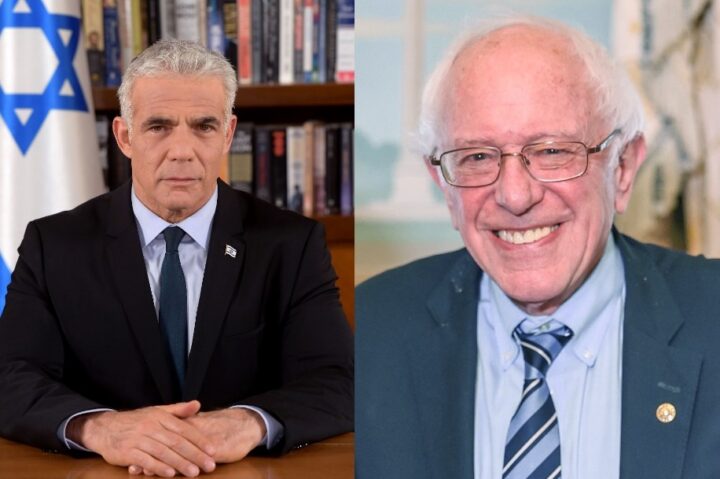
Israeli Opposition Leader Yair Lapid/Sen. Bernie Sanders (I-VT)
The ongoing war in Iran is highlighting a widening gulf between center and center-left voters in Israel and Democrats in the United States. While Democrats in the United States are mostly opposed to the war, Israelis are overwhelmingly supportive of the effort.
Recent polling from Israel has shown that 92.5% of Jewish Israelis and 81% of Israelis overall support the war
The divide was particularly evident in an exchange on X this week between Yair Zivan, a centrist and top advisor to Israeli Opposition Leader Yair Lapid, and Matt Duss, a foreign policy advisor to Rep. Alexandria Ocasio-Cortez (D-NY) and a former confidante of Sen. Bernie Sanders (I-VT), whose post prompted the exchange.
Sanders, on X, condemned the Israeli operations against Hezbollah in Lebanon, saying, “The U.S. cannot continue to be complicit in [Israeli Prime Minister Benjamin] Netanyahu’s wars.”
Zivan said in response that he was writing from a bomb shelter and that Israel “is under attack by fanatical terrorists who want to murder us,” arguing that Sanders’ “humanity never seems to extend to Israeli lives.”
Duss responded that Israelis are under fire “because your fanatical prime minister and my president launched a reckless and unnecessary war. Bernie is trying to stop it. What’s your boss doing?”
Zivan, who also edited a book on centrism, responded that the blame for the attacks lies with the “fanatical regime in Iran” and “fanatical terrorist organization in Lebanon sworn to our destruction (yours too if they could get to you),” rather than with Netanyahu.
He followed up later saying that war “should be a last resort” but is “sometimes … just and necessary.”
Zivan told Jewish Insider that most Israelis agree about the need to take on Iran.
“For us Israelis, this war is just and necessary. The vast majority of Israelis (left, right and center) understand the absolute necessity of removing the Iranian threat which is hanging over us,” Zivan said. After Hamas’ Oct. 7, 2023, attacks, “no one should expect us to wait until it’s too late to defend ourselves from terror. I think most of our friends in the U.S., on both sides of the aisle, understand the importance of what’s happening for Israel’s national security.”
Ilan Goldenberg, the senior vice president of J Street, which has strongly opposed the war in Iran, acknowledged the divide between Israelis and the American left in an op-ed last week — but argued that Israelis are mistaken in their outlook on the war.
“Just because the Israeli public supports the war doesn’t mean it’s a good idea or in Israel’s interest. [Seventy-two] percent of Americans supported invading Iraq in 2003. That didn’t make it a wise decision,” Goldenberg said. “Americans and Israelis see this conflict through very different strategic lenses. … because American and Israeli interests and perspectives are not perfectly aligned.”
Israelis, Goldenberg continued, see Iran as their primary geopolitical enemy and as the primary threat to their homeland, which is not the case for Americans. He argued that “aggressive” Israeli views are also being driven by the “trauma” of the Oct. 7 attacks, and that the set of acceptable outcomes from the war are different for Israel than for the U.S., for strategic reasons.
But with Iran maintaining various capabilities and continuing its attacks, other leading GOP senators say it would be premature to end the war now
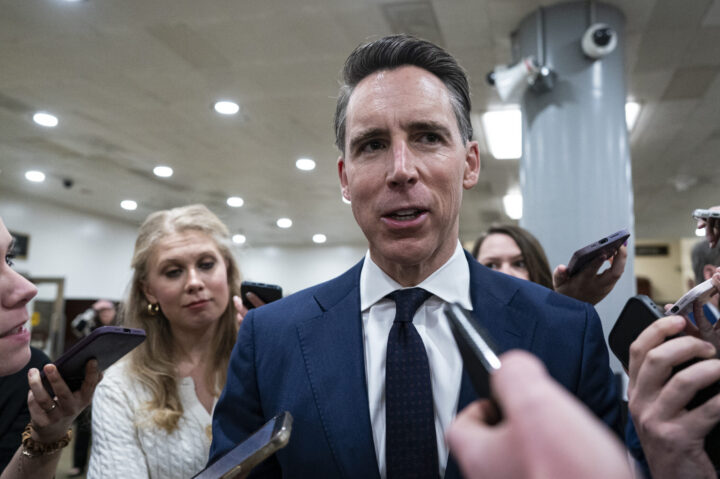
Al Drago/Getty Images
Sen. Josh Hawley (R-MO) speaks to reporters prior to the Senate Republicans weekly policy luncheon, in the US Capitol on March 25, 2025 in Washington, DC.
Both of Missouri’s Republican senators, Josh Hawley and Eric Schmitt, argued that the administration seems to have largely achieved its key objectives for the war in Iran — a posture that distinguishes him from most GOP colleagues and highlights subtle but emerging divisions among Republicans on the proper scope and duration of the war.
Pointing to comments by President Donald Trump saying that the war was substantially complete and that the U.S. had achieved its objectives, Hawley said on Fox News earlier this week, “I agree with what the president said last night. You look at all the success that we’ve had in the last 10 days. I mean, this thing is a victory. I think we should be hailing our military. We ought to be saying we’ve achieved our objectives here. … If this isn’t success, I don’t know what would be. … Now it’s time to declare victory.”
He also posited that Iran has nothing remaining with which to reconstitute its nuclear program — though the regime maintains a stockpile of enriched nuclear material which many experts argue cannot be fully secured without some form of on-the-ground presence.
Continuing a trend of making contradictory comments on the war’s timeline, Trump had said the same day that the U.S. could and would go much further in Iran, and that the U.S.’ aims could expand significantly.
Asked by Jewish Insider on Thursday about the metrics by which he was judging the success of the war, Hawley — who is one of the more prominent senators from the populist wing of the GOP — said he was referring to Trump’s own comments on the subject.
“I assume our overriding national security objective when it comes to Iran is to prevent them from getting nukes. And between our bombing last June and in the last … 12 days, I don’t know how they’re going to reconstitute their nuclear program anytime in, maybe, our lifetimes,” Hawley said.
“Our military has done an amazing job. I think it’s been an overwhelming display of force,” Hawley continued. “I know my Democrat colleagues, a bunch of them are saying, ‘This has accomplished nothing, nothing’s happened.’ It seems to me a lot has happened. And I think we should say that’s a good thing.”
Pressed on whether the war can be ended while Iran continues to fire missiles and drones at countries throughout the Middle East and is dropping mines in the Strait of Hormuz, Hawley said he would defer to Trump’s judgement on when to end the war.
“My point is just that I think the military has achieved a tremendous amount. It has ended [Iran’s] nuclear program for all intents and purposes. It has destroyed their navy. It has eliminated most of their ballistic missiles — those are good things,” he continued. “I’d be glad to take that [win].”
“Seems pretty good to me,” Hawley added.
Schmitt, who is also aligned with the populist wing of the party, likewise emphasized the progress the U.S. has made and pushed for a quick conclusion to the war.
“I know they’re way ahead of schedule. I’d look for a swift end to it,” Schmitt told JI. “I’m not interested in forever war in the Middle East, I don’t think the president is either. And I think that, again, they’ve laid out clear objectives and [are] making a lot of progress.”
Other Republicans are taking a distinctly different approach. Sen. Kevin Cramer (R-ND) told reporters on Thursday that “victory isn’t determined by declaration, it’s determined by the outcome.” He argued that the U.S. can’t and shouldn’t end the war prematurely.
“If you pull 90% of the weeds of our garden and you leave 10%, you’re going to have a weedy garden,” Cramer continued. “The last 10% are the hardest, in many cases.”
The North Dakota senator, who sits on the Senate Armed Services Committee, expressed surprise that the U.S. had not been better prepared to secure the Strait of Hormuz, calling it a potential “miscalculation” and saying that the attacks on ships in the critical waterway “could have been avoided.”
Sen. Lindsey Graham (R-SC), one of the most vocal supporters of the Iran war on Capitol Hill, said that he thinks there are “weeks more of this coming.”
“I don’t see this conflict ending today. I think the mission is to make sure they cannot regenerate, that they’re going to be beyond capable of building missiles to hit us, and they’ll never go back to the nuclear business,” Graham continued.
Also on Thursday, in a rare Senate floor speech, Sen. Mitch McConnell (R-KY), emphasized that the war against Iran cannot be decoupled from the global axis, including Russia and China, with which Iran is aligned.
Russia, McConnell emphasized, has reportedly been providing Iran with targeting intelligence. He criticized Special Envoy Steve Witkoff, who said earlier this week that he takes Russia at its word that it has not been doing that.
“I’ve warned successive presidents to take the Russian-Iranian axis, actually, more seriously,” McConnell said. He emphasized the supportive role that Ukraine has taken in helping to protect the U.S.’ allies in the Gulf, and criticized administration officials for not moving more quickly in pre-war discussions to acquire Ukrainian anti-drone technology.
He also urged lawmakers who oppose the war to nonetheless support an expected request for supplemental military funding as “an overdue opportunity to invest in urgent and strategic defense priorities.”
‘We don’t want to leave early. We want to finish the job and not have to return in two years,’ Trump said

Andrew Harnik/Getty Images
President Donald Trump speaks on stage at Verst Logistics on March 11, 2026 in Hebron, Kentucky.
President Donald Trump said on Wednesday that the United States has “won” the war in Iran, while warning that U.S. forces will continue the military operation until they “finish the job.”
Trump made the comments while discussing his administration’s efforts to reduce oil prices amid the war in Iran at a campaign rally in Hebron, Ky., on Wednesday to support Ed Gallrein, his endorsed candidate to take on anti-Israel and isolationist Rep. Thomas Massie (R-KY) in the contentious primary between the two men.
Trump noted that the International Energy Agency had “agreed to coordinate the release of a record 400 billion barrels of oil from various national petroleum reserves around the world, which will substantially reduce the oil prices as we end this threat to America and this threat to the world,” prompting him to then ask the crowd: “We don’t want to leave early, do we? We’ve got to finish the job.”
“After [Operation] Midnight Hammer [in June 2025], we left. We figured that’ll be the end of them for a while. But they started again. That’s why we gotta finish it,” Trump said. “We don’t want to go back every two years, and that’s because there will be some day when you don’t have me as president.”
“We’re not leaving until that job is finished, and it’s going to be very fast, but we’re not going to count on having competent presidents,” he continued.
The president ripped into Massie, who he described as “disloyal,” a “loser,” the “worst person” and a “disaster as a congressman” later on during his speech. Trump also touted Gallrein’s candidacy to represent Kentucky’s 4th Congressional District, describing the farmer and former Navy SEAL officer as “central casting” and a “tremendous war hero.” He also defended Gallrein’s decision to leave the GOP and register as an independent for a time because he returned to the party under the president’s leadership.
“He [Gallrein] said, ‘I came back because of the strength and wisdom that Donald Trump displayed, and I appreciate that,” Trump said. “Many people have joined and rejoined our party, but Massie did not, because he only votes no. He just votes no. Doesn’t matter. I could give him the best things in the history of a Republican voter, and he’d vote no. There’s something wrong with him.”
“We call him Rand Paul, Jr., he votes against everything. At least I like Rand a little bit,” referring to Sen. Rand Paul (R-KY), who frequently opposes the Trump administration on foreign policy.. “Rand votes against us all the time too, but at least he’s okay. I wouldn’t say the greatest.”
Massie broke with Trump throughout his first term, voting against the president’s priorities multiple times in Congress, though the two became serious political foes over the last year — after the Kentucky congressman voted against Trump’s tax cut legislation last year and began leading the charge to force the release of the Department of Justice’s files on the Jeffrey Epstein case. Their relationship deteriorated further as Massie became one of the most vocal GOP critics of Trump’s war in Iran.
Gallrein described Massie’s opposition to Trump’s actions in Iran as “unforgivable” in remarks to attendees at the rally.
“He’s even leading the Democrats to block the president while we are engaged in combat actions to save our nation and the world from the Iranians [getting] a nuclear weapon, while we have troops in harm’s way. Unforgiveable,” Gallrein said of Massie. “You deserve a congressman who stands united with you, the Republican Party and the president.”
Also in attendance were the leading candidates in the competitive GOP primary to replace retiring Sen. Mitch McConnell (R-KY) — former Kentucky Attorney General Daniel Cameron, pro-Trump businessman Nate Morris and Rep. Andy Barr (R-KY) — and boxer and influencer Jake Paul, whom Trump said he would endorse if Paul were to run for office.
President Trump is set to rally with Massie’s opponent this week

DANIEL HEUER/AFP via Getty Images
Rep. Thomas Massie (R-KY) speaks to reporters at the US Capitol on Washington, DC on November 18, 2025.
President Donald Trump is headed to Kentucky this week to rally with Ed Gallrein, his endorsed candidate to take on anti-Israel and isolationist Rep. Thomas Massie (R-KY) in the increasingly heated primary between the two men.
The campaign stop comes at a time when Massie has made himself the face of GOP opposition to the war in Iran — among the litany of other issues on which he has also broken with the president. Massie was one of two lead sponsors of a failed effort in the House last week to stop the war in Iran, while Gallrein said in a statement that the war was justified and would prevent further attacks on U.S. servicemembers and the nation.
In a ruby-red district, Massie’s opposition to the war could cost him politically, as polling shows Republicans have rallied strongly behind the administration and its efforts.
But Massie insists that Republicans will come to share his stance. And his district has stood behind him for years even as he broke with Trump throughout his first term. The primary will not be until May 19.
For its part, the Republican Jewish Coalition is taking aim at Massie over his opposition to the war in a significant ad campaign.
“America is at war with a fanatical regime that seeks nuclear weapons. American hero Ed Gallrein stands with President Trump, our country and our military,” the RJC ad states. “Thomas Massie? He stands with Iran and radical leftists in Congress, opposing Trump, just like he did on the border and taxes.”
The RJC has spent at least $2.8 million in the race thus far, in its latest attempt to take down one of the GOP’s loudest critics of Israel. Massie, for his part, is leaning into the attacks to drum up fundraising, reposting the RJC ad and saying the group “wants America to be mired in another forever war.”
A Trump-linked super PAC is also set to spend millions opposing the incumbent; that group’s ads have also highlighted Massie’s breaks with Trump on Iran, focusing on his opposition to the Operation Midnight Hammer strikes last summer.
Massie has framed the primary as a test of “whether the Global Military Industrial Complex and Israel’s government controls the United States” and said “the Israeli lobby has spent $5 million against me because I don’t support sending our troops to fight their war.”
He’s made no secret on the campaign trail of Trump’s antipathy towards him, offering a mocking Trump impression at a campaign launch event last month — apparently betting that his maverick tendencies will help, or at least won’t cost him, among his voting base.
Gallrein’s campaign has leaned into Massie’s perceived disloyalty to Trump, and his decision to side with Democrats and the far-left on a range of key priority issues, making that a central issue of his campaign.
Some Massie supporters are reportedly growing fed up with his breaks with Trump and his focus on high-profile controversial issues, with one Gallrein supporter complaining to NOTUS that Massie’s focus on releasing Department of Justice files on the Jeffrey Epstein case doesn’t help the individual in any way, or bring down costs, and another worrying that Massie’s antipathy toward Trump will deprive the district of essential services.
As of the end of 2025, Massie maintained a significant fundraising lead over Gallrein, $2.5 million to $1.2 million. Massie closed the year with $2 million cash on hand, compared to $933,000 for Gallrein.
Massie’s campaign has spent significantly on an ad blitz that aims to portray the Trump-backed Gallrein as “woke Eddie,” a supporter of diversity, equity and inclusion policies and gender-affirming surgeries for transgender youth.
The Arizona senator’s outspoken commentary has repeatedly placed blame for the military operation on Israel, leading one Jewish Democrat to pull her support

Tom Williams/CQ-Roll Call, Inc via Getty Images
Then-Rep. Ruben Gallego (D-AZ) in Rayburn Building on Capitol Hill on June 9, 2022.
With a series of pugnacious tweets and media appearances, Sen. Ruben Gallego (D-AZ) has made himself a face of the Democratic opposition to the war in Iran, issuing one of the first comments from a U.S. lawmaker opposing the effort in the early hours of Saturday morning.
Gallego’s outspoken commentary, which has repeatedly pinned blame for the operation on Israel — a notion that colleagues on both sides of the aisle have disputed — also coincide with Gallego’s endorsement of Graham Platner, the progressive Maine Senate candidate who has faced a series of scandals related to antisemitism.
The high-profile moves come as Gallego, who claimed victory in Arizona in 2024 even as President Donald Trump won the state, is seen by political observers as positioning himself for a 2028 presidential campaign — and as anti-Israel policies have become a litmus test for the progressive left.
“So Netanyahu now decides when we go to war? So much for America First,” Gallego said earlier this week, in response to comments by Secretary of State Marco Rubio that seemed to suggest that the timing of the war was dictated by Israel.
“What the f*** happened to America First?” Gallego wrote in another post, adding that the U.S. should have left Israel to go ahead with the operation alone.
Though some lawmakers emerged from a Monday briefing echoing that line, Rubio has since said his comments were misrepresented, and others on both sides of the aisle have denied that Israel forced the U.S. into the conflict.
“They’re following Netanyahu, who has literally told us … that he’s been trying to do this for 47 years. I know — I suffered the first attempt at this in 2005, and now America is suffering again because of it,” Gallego said on MS NOW this week, referencing his service in Iraq. “There’s a lot of ways that we can be supportive of Israel. There’s a lot of ways that we could defend Israel’s existence, its sovereignty. I’m 100% for that. We don’t need to go to war for them, especially when it’s a dumb war.”
He said that the U.S. should have threatened to withhold intelligence, support and munitions from Israel if it went ahead with an attack on Iran.
And he said on “Pod Save America” that the U.S. should have tried “calling Iran, saying ‘This is not us, we’re going to be staying out of this.’ No, we just decided that we’re going to let Netanyahu choose our wars. This is very disturbing to me.”
The Arizona senator also said he would not support funding to replenish U.S. munitions expended in the war, saying that Middle Eastern partners should be responsible.
“When the bill comes to pay for the replenishment of interceptors and munitions, the Middle Eastern countries that we have been protecting need to pay for it,” Gallego said on X. “We aren’t cutting more Medicaid, food stamps for protecting these countries in a war of choice and not in our interest.”
In a podcast appearance on The Bulwark this week, he also urged fellow Democrats to reject the war forcefully and wholeheartedly, without caveats or appeals to constitutional authority as other lawmakers have used to justify their opposition.
“Why are we spending all this money? All these countries in the Middle East have a lot of money. Why are we spending all this money?” Gallego continued, explaining questions he’s hearing from constituents. “These are the things that are very simple for people to understand. I think we should not be afraid to communicate that.”
Endorsing Platner, Gallego called him “the kind of fighter Maine hasn’t seen in a long time, someone who tells you exactly what he thinks, doesn’t owe anything to the special interests, and wakes up every day thinking about working families,” also referencing their shared history as veterans.
Platner most recently faced scrutiny for appearing on a podcast in January with an antisemitic conspiracy theorist of whom Platner said he was a “longtime fan.” Just before that podcast appearance came to light, Platner came under fire for retweeting a prominent neo-Nazi influencer. Platner also, for decades, had a tattoo that closely mirrored a Nazi emblem on his chest.
While Platner has claimed not to have been aware of the significance of the symbol, both Jewish Insider and CNN reported that Platner described the tattoo as a Totenkopf, a symbol used by an SS unit.
Gallego and Platner are both represented by the same consulting firm, Fight Agency, which has signed on a number of far-left candidates who have made opposition to Israel a central focus of their campaigns. Another one of the Fight Agency’s clients is New York City Mayor Zohran Mamdani, who the senator defended during his polarizing mayoral campaign.
Gallego, who has a Jewish child with his ex-wife, has spoken in the past about his concerns about antisemitism and its impacts on his own family. But pressed this week on Platner’s antisemitic ties, a Gallego spokesperson referred JI to an interview Gallego conducted on “Pod Save America” about the endorsement.
Asked about Platner’s appearance on and praise for the antisemitic podcaster, Gallego downplayed the situation, noting that many Democrats have appeared on Joe Rogan’s podcast, which has also spread antisemitic conspiracy theories.
“A working class man goes and has a conversation on a platform that is very similar to what Joe Rogan talks about … but everyone freaks out on this guy,” Gallego said. “Why? Because the establishment doesn’t want him. This is very simple … so they’re going to make sure that he looks bad.”
Gallego also said that Platner was “young and stupid” when he got the tattoo but argued that it was not clearly identifiable as a Nazi symbol, and that subsequent security checks and physicals did not identify the tattoo as a problem.
And he argued that Democrats are too focused on finding “perfect” candidates who are ultimately unable to appeal to voters.
The Arizona senator separately said on a Bulwark podcast this week, “I also endorsed Haley Stevens and Angie Craig, right? And, I was accused by the left of being in the pocket of Israel.” He said that he’s supporting people he believes can win general elections.
Arizona state Rep. Alma Hernandez, a Jewish Democrat and outspoken supporter of Israel, said she was surprised and disappointed by Gallego’s endorsement of Platner.
“It is a really hard one to justify. I, quite frankly, do not care if they are both veterans. There are plenty of veterans who are not complete bigots and jerks who you could endorse,” Hernandez told JI. “There is a woman who’s running, who is the governor, who has not had any history of being a bigot like this individual. I mean, for God’s sake, he has a Nazi tattoo.”
She added, “you can’t excuse and pretend that there is no pattern of bigotry and, quite frankly, just a real disregard for Democratic values” from Platner, pointing to offensive comments about people of color and women that the Maine candidate has made.
“I’m disappointed as an Arizonan, as a woman and as a Jewish woman,” Hernandez continued. “I think it says a lot about a person who’s willing to put their name behind someone like him.”
Hernandez said that, in response to Gallego’s support for Platner and his shifting stance and recent comments on Israel, she’s heard from other Jewish Democrats in Arizona who say they won’t support Gallego going forward.
In the House, Gallego was generally a supporter of Israel — and voted against the 2015 Iran nuclear deal — within what was at the time the mainstream of the Democratic Party, but was not particularly active on the issue.
The then-congressman appeared to take a more hawkish position during and immediately after his Senate race in 2024, leading an effort to expand U.S.-Israel counter-tunneling cooperation, supporting efforts to sanction the International Criminal Court, backing the redesignation of the Houthis as a foreign terrorist organization, strongly condemning Rep. Rashida Tlaib (D-MI) for including the phrase “from the river to the sea” in a video she posted and quickly urging the administration to freeze Iranian assets shortly after the Oct. 7, 2023 attacks, when other Democrats were slower to endorse that position.
He also said, through a spokesperson, that he would have opposed efforts earlier this year to block certain U.S. aid shipments to Israel that were supported by a majority of Senate Democrats. Gallego himself was absent for the vote, citing family duties as a new father.
But Gallego’s recent statements, particularly since the start of the Iran war, indicate a sharp tack in the opposite direction as he eyes a potential national campaign. Other potential 2028 Democratic candidates, like California Gov. Gavin Newsom, appear to be making a similar calculation.
Please log in if you already have a subscription, or subscribe to access the latest updates.
 Continue with Google

 Continue with Apple