


































































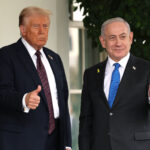

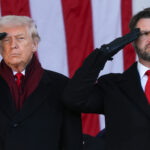

Several Democrats considering presidential bids have cast the Iran agreement as evidence of weak leadership, arguing that Trump has been outmaneuvered by Tehran
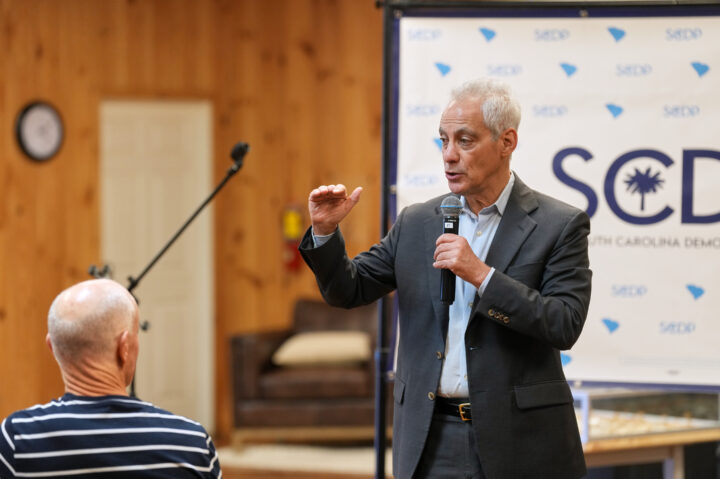
Meg Kinnard/AP
Former U.S. ambassador to Japan Rahm Emanuel speaks to voters as he participates in the South Carolina Democratic Party's "On the Road" series on Thursday, April 2, 2026, in Abbeville, S.C.


 Add JewishInsider on Google
Among the Democrats mulling a presidential run in 2028 — a group that is ideologically divided, each with their own diagnosis about what’s wrong with the Democratic Party and how to fix it — there was a unified reaction in February when President Donald Trump decided to attack Iran: opposition to a war they viewed as reckless and unconstitutional.
As those Democrats respond to the U.S.-Iran memorandum of understanding that Trump announced last week, another consensus is emerging, which holds that the deal is just another example of Trump’s ineffectual leadership — yet another instance, these Democrats argue, of Trump getting taken advantage of and undermining the American people.
“They’re negotiating a deal that, truthfully, every single detail we continue to hear just looks like the Iranians continue to do better than us. I think they should have been the one to write The Art of the Deal, not Donald Trump,” Maryland Gov. Wes Moore said in a TV interview on Tuesday.
Rahm Emanuel, the former U.S. ambassador to Japan, member of Congress and chief of staff to President Barack Obama, offered a similar quip at a recent Financial Times event after describing the deal as “the memorandum of misunderstanding.”
“While the president thinks he wrote a book called The Art of the Deal, they’re going to teach him a lesson, which is the Persian lesson: the art of the negotiation,” Emanuel said. “And he just got schooled, unbelievably.” He called the war with Iran “the single worst — and there’s a lot of competition for it — American national security mess that I’ve ever seen.”
The MOU offered immediate sanctions relief for the Islamic Republic and launched a 60-day window for nuclear negotiations.
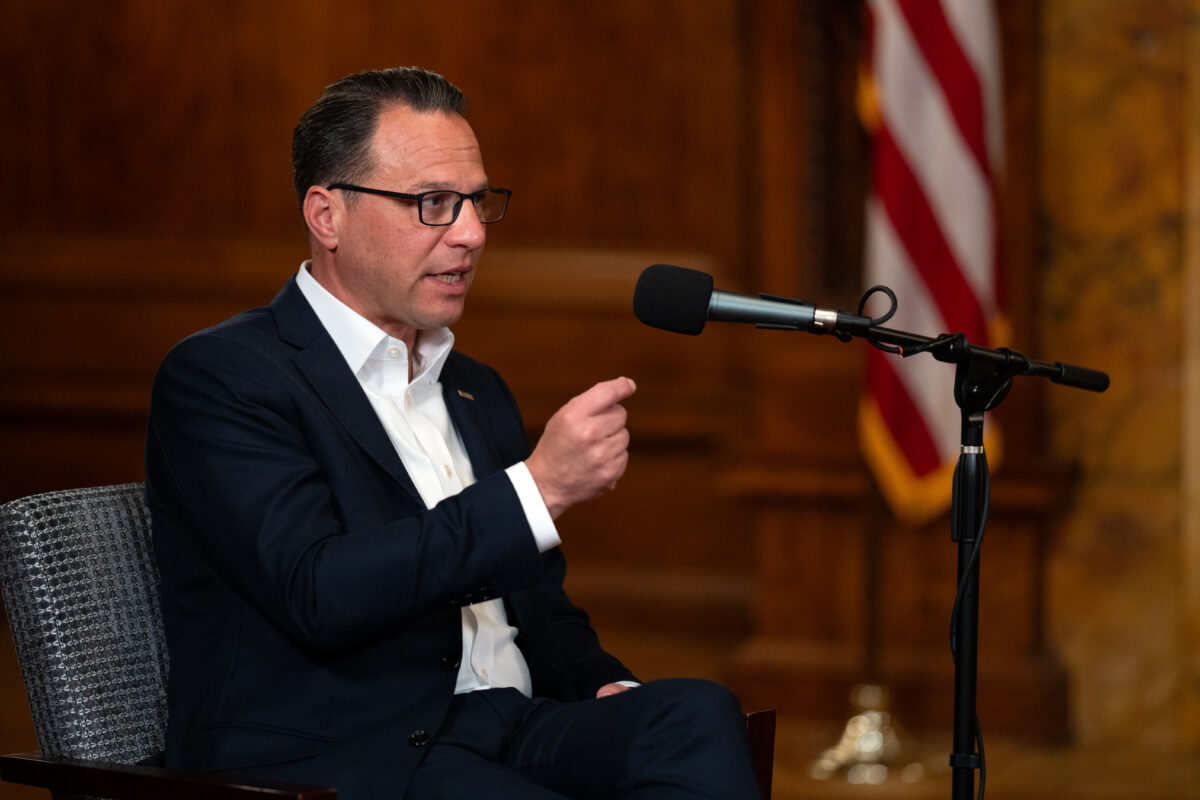
The 2028 contenders who have commented on the deal have generally done so without much detail. Pennsylvania Gov. Josh Shapiro criticized the agreement in an interview with CNBC on Monday, though he shared little in the way of specific critiques or concerns.
“I think what’s clear is the Trump administration, the president, specifically chose to enter this war and had absolutely no plan when he went in, and that’s why he’s got no idea how to get out,” said Shapiro. “The president created a mess, and now he’s dispatched JD Vance … to try and figure out a way out of it, and seemingly both of them are getting played by the Iranians.”
A spokesperson for Shapiro declined to comment further.
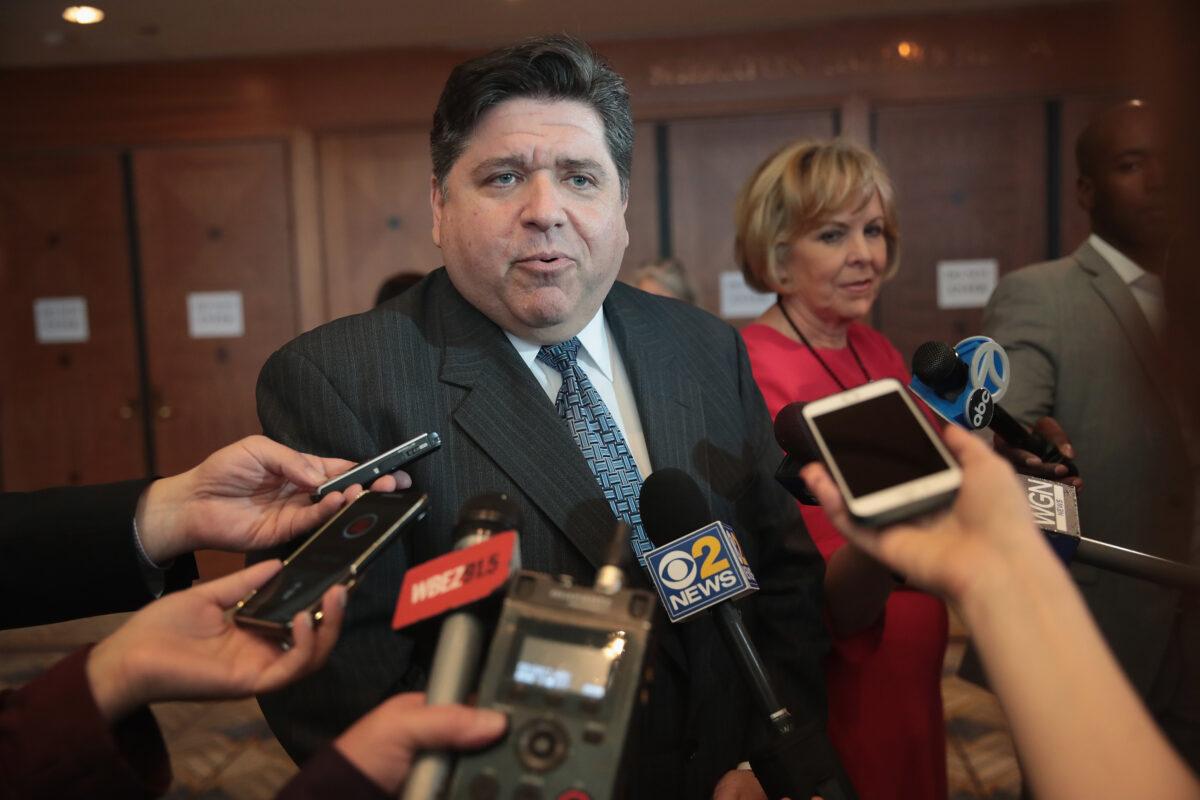
Illinois Gov. JB Pritzker has used the deal as a political talking point. He was asked by reporters on Monday and Tuesday to respond to a social media post where Trump called on Pritzker to seek his help in responding to gun violence in Chicago. In response, Pritzker referred to Trump’s Iran negotiations as a reason why he would never want to ask Trump for help.
“This is the president who wants to blame everybody else for algae that showed up at the Reflecting Pool in Washington, D.C.,” Pritzker told reporters during an event in Illinois on Tuesday, “the same president that thinks that after bombing Iran, that they should pick up the phone and call him, and indeed, who’s failing to put together an agreement that is anywhere near as good as the JCPOA [Joint Comprehensive Plan of Action], that was the agreement that he ripped up as president of the United States.”
Last week, he said at a Punchbowl News event that the deal sounds like it is “really just a cessation of hostilities and pushing off into the future negotiations about things.”
Some Democrats considering a 2028 run are avoiding the question entirely for now.
California Gov. Gavin Newsom, who on the day the U.S. began its campaign in Iran referred to the American actions as an “illegal, dangerous war,” has thus far not weighed on the MOU. Anthony Martinez, a spokesperson for Newsom, said that “Trump’s reckless war” has been costly to Americans. “That’s a bad deal for hardworking Americans, plain and simple,” Martinez said. He declined to comment on the MOU.
Kentucky Gov. Andy Beshear, Sen. Jon Ossoff (D-GA) and Rep. Alexandria Ocasio-Cortez (D-NY) have also criticized the war but so far refrained from discussing the agreement.
Most potential Democratic 2028 contenders view the Iran war as a hard-to-solve morass, with little offered in the way of alternatives to a war and deal that they oppose. Merely criticizing Trump for an unpopular war appears to be enough.
Shapiro acknowledged that he wants the U.S. to come out ahead in the war, but he said he doesn’t see how that will be possible with Trump leading the negotiations.
“I’m on Team USA. I want us to win, but this is the problem when you have a president who is just hell-bent on creating chaos around the world,” Shapiro said on CNBC. “What we need instead is steady-handed leadership, and we don’t have that right now.”
Pritzker pointed to the 2015 Obama nuclear deal as the best-case alternative, although that deal is now defunct.
“It’s a real question whether there’s any advancement at all of U.S. interests,” said Pritzker. “I think the question I think we’re all going to have to ask is, is this any better than the JCPOA that was already in place when Donald Trump tore it up in his first term?”
It was a line that former Vice President Kamala Harris, who is also mulling a presidential bid in 2028, echoed recently.
“This is a president who has proven himself to be entirely self-indulgent. And we will see what happens in the coming hours and days in terms of the negotiation. And really, it’s a concept of an agreement,” Harris said last week at a speech during a conference in Vienna. “Whatever is being negotiated, this president is going to declare victory, and we’ll end up where we were after the JCPOA and call that a victory.”
Far-left lawmaker Rep. Ro Khanna (D-CA), who has said he is considering a 2028 run, called the ceasefire between the U.S. and Iran “welcome news that Americans should support.” But he said it “delivers Iran a better deal” than the JCPOA that Trump “spent years ridiculing.” His message got a boost on X on Tuesday from former Secretary of State Tony Blinken.
“Wise words from my friend,” Blinken wrote.
Former Israeli Ambassador to the U.S. Michael Herzog told JI, 'President Trump, who has been a hero to many Israelis, is now openly criticized from within the Israeli government, including Netanyahu's close circle.'
Jack GUEZ / AFP via Getty Images
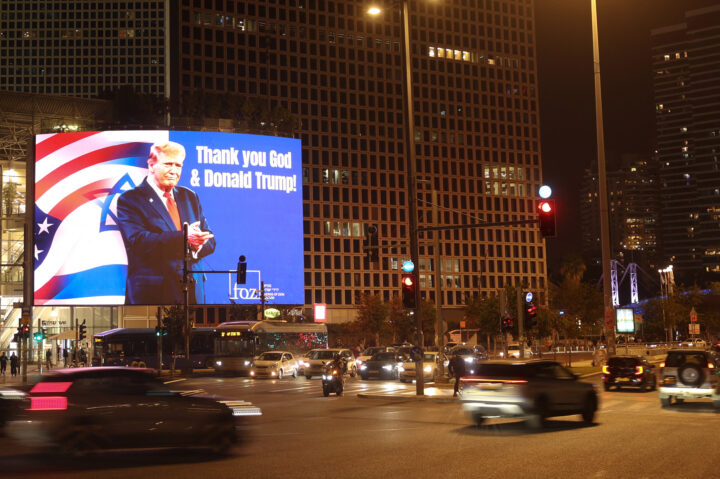
A billboard depicting an image of President Donald Trump with a message thanking him, is displayed on the side of a building in the Israeli coastal city of Tel Aviv on March 12, 2026.
The long love affair between Israelis and President Donald Trump, on the rocks over the last few weeks as the U.S. and Iran hammered out an end to the war, appears to be over, with humiliations mounting for Jerusalem. “I call all the shots,” not Israeli Prime Minister Benjamin Netanyahu, Trump said earlier this month. More recently, the Israeli leader’s bombing campaign in Beirut was “vicious,” Trump said. And perhaps most humiliating of all, Trump suggested that Syrian President Ahmad al-Sharaa could better take care of Hezbollah than the IDF.
The Israeli public — the spurned lover who once hailed the U.S. president with billboards hung in the center of Tel Aviv reading “Thank you God & Donald Trump” — is not taking it well. Former Israeli Ambassador to the U.S. Michael Herzog told JI, “President Trump, who has been a hero to many Israelis, is now openly criticized from within the Israeli government, including Netanyahu’s close circle.”
And this criticism is not only expressed behind closed doors. Channel 14, the popular right-wing outlet that promotes Netanyahu, has been criticizing Trump resolutely, with some of its anchors publicly cursing Vice President JD Vance and the president’s close advisors, White House Special Envoy Steve Witkoff and Jared Kushner.
It was not always this way. For most of the time since Trump reentered the White House in January 2025, he has been popular in Israel, with polls consistently showing high ratings for the American president.
For Israelis, Trump is the one who brokered the hostage-release agreement with Hamas; Trump is the one who made the strikes in Iran and the bombing of the nuclear enrichment facilities in Fordow and Natanz a reality; and Trump is the one who established the Abraham Accords and is willing to expand them, giving Israelis the chance to sunbathe in the UAE, and perhaps in other countries in the Gulf in the near future. And although some won’t admit it, many Israelis also like his tendency to speak very bluntly, and crudely: a president born in Queens, full of Israeli chutzpah.
In recent weeks, the attitude toward Trump among the Israeli public, and the Israeli leadership, has radically and rapidly changed. But this process began even before the signing of the memorandum of understanding with Iran. Over the past few months, time and again, Netanyahu has tried to convince Trump to resume strikes on Iran, only to be rejected. A source familiar with the discourse between the two leaders described to JI a situation that has played out repeatedly since April: the Israeli prime minister explains why only the military option is the correct approach to Iran, while Trump listens but prefers the diplomatic path.
And then Trump, in his typical fashion, says that Netanyahu will do whatever the U.S. president tells him to do — which has some degree of truth — but is not a good look for a prime minister seeking reelection. Trump has repeatedly criticized Israeli policy in Lebanon and publicly reprimanded Netanyahu for not being responsible enough. When the U.S. president once again floated the possibility that al-Sharaa should handle Hezbollah, which has fired thousands of rockets and drones toward Israel and most recently killed four Israeli soldiers overnight Thursday, the criticism in Israel escalated.
Trump had previously suggested that the Syrians take on Hezbollah, as reported by Kann earlier this week, during an official meeting between the Israeli and Lebanese ambassadors in April, though those in attendance were unenthusiastic about the idea. To understand the Israeli approach toward Trump’s suggestion, one can look at what the chairman of the Knesset Foreign Affairs and Defense Committee, Likud MK Boaz Bismuth, posted on X: “President Trump, we don’t trust the terrorist Jolani, we have Golani,” referencing a well-known IDF combat infantry brigade.
The opinion within the Trump administration has been made clear. “Trump is the only head of state in the entire world who is sympathetic to the nation of Israel at this moment and time,” Vance told reporters on Thursday. “If I was in the Cabinet of the Israeli government, I might not be attacking the only powerful ally that I have left in the entire world,” he said. “The problem for Israel is not Donald J. Trump. And anybody in Israel who thinks their biggest problem is the president of the U.S. needs to wake up and smell the reality of the situation that country is in.”
Yet now, after the agreement has been published, the criticism remains unchanged. An Israeli official told JI that the agreement raises several troubling signs, among them: the uncertainty over whether all enriched uranium will be removed from Iran, or only the high-level uranium; under the terms of the agreement, Iran, it appears, will be allowed to enrich uranium at a low level on its soil, meaning it can continue to operate centrifuges; and the issue of oversight is not explained.
“The second shocking thing here is the betrayal of the Iranian people. The second clause in the MOU agreement states that neither country will interfere in the internal affairs of the other. This means the Iranians can execute protesters, and nothing will be done to them,” the Israeli official said. “This entire war started because Trump said that ‘help is on the way,’ and that we would not allow tens of thousands of protesters to be shot and slaughtered. Beyond the concern that Iran will remain a nuclear threshold state, there is also a moral problem here.”
Avner Vilan, a former senior security official and Iran expert, also raised concerns about the agreement. “Iran is receiving a great deal of relief right now, but there is still a long way to go to reach an agreement in the nuclear field. This is an agreement that gives the murderous terror regime in Iran infinite immunity and incentives, allowing it to survive almost indefinitely, while recognizing the strategic significance of Hormuz,” he told JI.
Vilan also referred to the statements made by Trump in recent days that sparked concern within the Israeli defense establishment. Trump has legitimized Iran’s ballistic missile arsenal, and this, as Vilan points out, despite the fact that Israel defined this threat as an existential threat almost on par with the nuclear one. “This is more disturbing than the state of relations between Trump and Netanyahu, and of course, it doesn’t help that the president calls the State of Israel a ‘very small partner.’ At the beginning of the war, we were a ‘Model Ally.’ Not a small partner,” Vilan notes. “Israel’s point of strength for years was that the way to D.C. goes through Jerusalem. Today, that is no longer the case at all.”
“Israelis expected that the amazing military achievements the U.S. and Israel scored together would be translated into a strong, enduring diplomatic outcome focused on the nuclear issue,” says former Ambassador Herzog. “Instead, the U.S. opted out of the war with a general MOU that focuses on the Strait of Hormuz and the global economy, in return for releasing generous funds to Iran and postponing the core nuclear negotiations. There is little reason to believe that the Iranian regime will now agree to give up the nuclear option or change its orientation, especially as the U.S. military option is taken off the table.”
What looked like a year of celebrating blue, white and red cooperation has been fading more and more in recent weeks. The disappointment among senior Israeli officials is likely intensifying, due in part to the widespread praise that Trump has long received in Israel. It wasn’t for nothing that Trump said last month that he could run in the upcoming elections for prime minister in Israel and win. Even if he were on the ballot, with the thrill now gone, he wouldn’t stand a chance.
Please log in if you already have a subscription, or subscribe to access the latest updates.
 Continue with Google

 Continue with Apple