









































































Less than 24 hours before the expiration of his previous delay, Trump said he would pause the strikes ‘per Iranian government request’
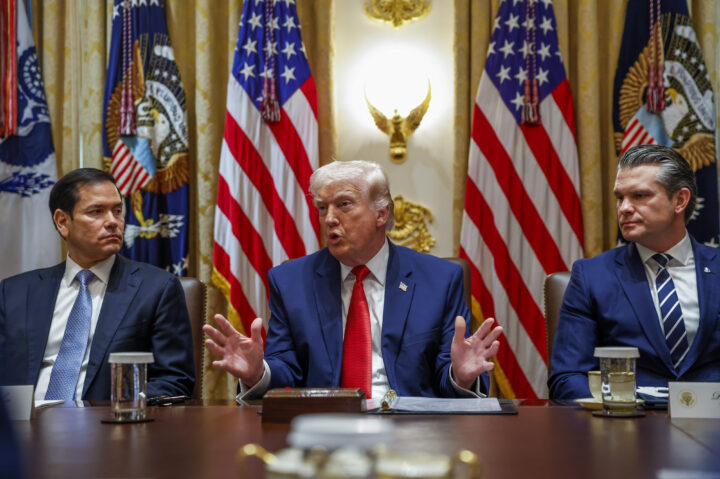
Will Oliver/EPA/Bloomberg via Getty Images
Secretary of State Marco Rubio, President Donald Trump and Defense Secretary Pete Hegseth during a Cabinet meeting at the White House in Washington, DC, US, on Thursday, March 26, 2026.


 Add JewishInsider on Google
President Donald Trump announced on Thursday afternoon that he would extend his pause on plans to strike Iran’s energy infrastructure, “per Iranian government request,” for an additional 10 days amid ongoing diplomatic negotiations to end the war.
Trump wrote in a post on his Truth Social platform that he is “pausing the period of Energy Plant destruction by 10 Days to Monday, April 6, 2026, at 8 P.M., Eastern Time.”
“Talks are ongoing and, despite erroneous statements to the contrary by the Fake News Media, and others, they are going very well,” Trump added.
The post comes a few hours after the president said that he wasn’t sure if he would follow through with his five-day delay, set to expire Friday, for strikes on Iran’s energy infrastructure, which he had pushed back at the start of diplomatic negotiations on Monday.
“I don’t know yet,” Trump said when asked by reporters if the strikes would still take place Friday. “It’s a day. In Trump time, a day, you know what it is? That’s an eternity.”
Trump made the comments while speaking to reporters at the opening of his first Cabinet meeting since launching the war in Iran.
He alleged that Iranian leaders “are begging to make a deal” to end the war while criticizing press reports alleging that he was looking for a diplomatic off-ramp to the conflict, saying he has not decided whether he’ll agree to a diplomatic settlement if one were reached.
“They are begging to make a deal. Not me,” Trump said of current Iranian leadership. “They’re not fools, they’re very smart actually in a certain way and they’re great negotiators. I say they’re lousy fighters, but they are great negotiators. They are begging to work out a deal. I don’t know if we will be able to do that. I don’t know if we’re willing to do that. They should’ve done that four weeks ago. They should’ve done it two years ago.”
“The reason they want to make a deal is they have been just beat to sh*t,” he said later on, touting the U.S. military operation as a success.
During the meeting, White House Special Envoy Steve Witkoff confirmed reports that the U.S. had presented Iran with a “15-point action list” as a starting offer in peace talks between the two countries. He also confirmed that Pakistan had been acting as a mediator for the U.S. and Iran.
“We will see where things lead, and if we can convince Iran that this is the inflection point with no good alternatives for them other than more death and destruction,” Witkoff said. “We have strong signs that this is a possibility.”
Witkoff said to Trump, “You’ve instructed us that your preference is always peace and that we should make that our priority. We have delivered that message, sir, along with the 15 points for peace. Finally, we have told Iran one last thing: don’t miscalculate again.”
Trump later revealed that the “present” Iran gifted the U.S. was allowing eight oil tankers through the Strait of Hormuz, which he said proved the U.S. was speaking with the “right people” in Iran with the authority to make such decisions.
“They said to show you the fact that we’re real, and solid and we’re there, we’re going to let you have eight boats of oil, eight boats, eight big boats of oil,” Trump said of the Iranians. “And I said, ‘Well, I guess they were right,’ and they were and they were real.”
Trump then said that Iran later allowed two additional vessels to travel through the strait, which he described as an overture from the Iranians to “apologize for something they said.”
Turning to Witkoff, the president then expressed hope that he hadn’t “screwed up” their diplomatic efforts by revealing the “gift.”
The Senate minority leader was pressed by MS NOW’s Joe Scarborough on his view of the U.S. and Israel’s war achievements

Samuel Corum/Getty Images
Senate Minority Leader Chuck Schumer (D-NY) makes a statement alongside House Minority Leader Hakeem Jeffries (D-NY) outside of the West Wing at the White House on January 17, 2024 in Washington, DC.
Senate Minority Leader Chuck Schumer (D-NY) did not directly address whether the degradation of Iran’s military infrastructure should be viewed as a positive outcome, instead emphasizing the war’s potential economic and geopolitical consequences.
Over the course of the past week, U.S. officials have indicated that Iran’s military capabilities have been severely weakened. President Donald Trump has described Iran’s military as “decimated,” and Director of National Intelligence Tulsi Gabbard testified at a congressional hearing this past week that the Iranian regime was “largely degraded.”
When asked by MS NOW’s Joe Scarborough on Monday’s edition of “Morning Joe” whether that degradation was a “good thing,” Schumer called the question “premature.”
“You can’t [answer that question] because it’s a premature question,” Schumer said. “What is going to happen in the next several months? Is it worth it? Will the world economy collapse?”
“I can ask that question,” Scarborough replied. “I’m simply asking on the military side: Is it good — regardless of whether we agree with going in or not — is it good that Iran’s military infrastructure has been seriously degraded?”
Schumer again asserted that it could not be answered without understanding the full implications of the current conflict.
“In all due respect, if you ask the American people, if you have the choice of degrading the military structure in Iran, but having gasoline be $6 a gallon and our economy falling into a deep recession where millions lose their job, what do you think?”
Schumer ultimately signaled agreement with that underlying point, while maintaining his broader concerns.
“The fact that the leader [Ayatollah Ali] Khamenei is gone, no one regrets that. The fact that Iran has less ability to create military trouble [is a good thing], no one disputes that. But you have to look at the consequences.”
Schumer argued that Congress would have had a clearer understanding of the potential economic and geopolitical consequences had lawmakers passed one of several war powers resolutions — an effort that has been voted down by House and Senate Republicans with several Democrats joining them on several instances within the past month.
“If Republicans had voted with us on the War Powers Act, all these questions would have been asked ahead of time instead of Donald Trump’s willy-nilly — one day yes, one day no,” Schumer said.
Please log in if you already have a subscription, or subscribe to access the latest updates.
 Continue with Google

 Continue with Apple