











































































The Congressional Leadership Fund scrapped a planned $6 million campaign against the pro-Israel Democrat days after Cook shifted the redrawn South Florida district to ‘lean Democratic’
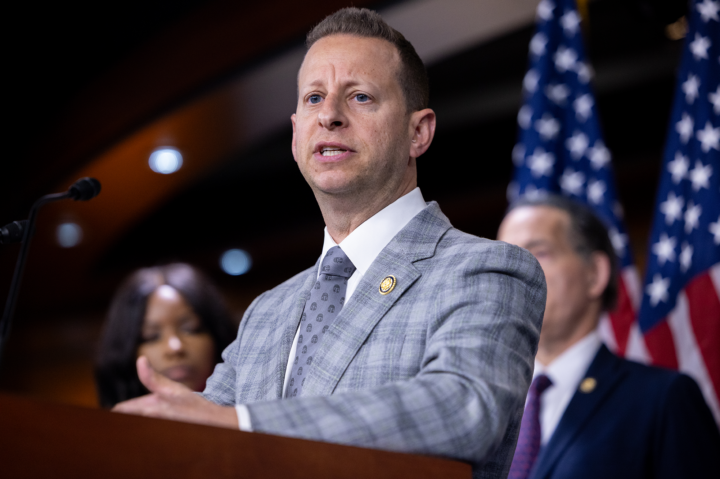
Nathan Posner/Anadolu via Getty Images
Rep. Jared Moskowitz (D-FL) speaks at a press conference on Capitol Hill on Sept. 8, 2025.


 Add JewishInsider on Google
The Congressional Leadership Fund, the super PAC affiliated with House Republican leadership, on Tuesday pulled its ads against Rep. Jared Moskowitz (D-FL), according to Punchbowl News, a sign that the moderate Democrat is favored to win.
Florida Republicans had redrawn the district, which includes a substantial Jewish population, to be more favorable to Republicans, hoping to boost former Boca Raton Mayor Scott Singer. CLF had been planning to spend up to $6 million in the district.
The Cook Political Report shifted the seat from a “toss-up” to “lean Democratic” last week, in a sign of Moskowitz’s strength. President Donald Trump won the redrawn district by nine points in the 2024 election.
Despite shifts in the electorate overall, Moskowitz has remained highly popular among the area’s Jewish community as one of the most outspoken pro-Israel Democrats in the House. Both candidates have sought to attract the Jewish community vote.
Moskowitz, who easily defeated a far-left Democratic challenger in the primary, entered the final stretch of the race with a substantial cash advantage over Singer, with $1.8 million on hand to Singer’s $560,000.
“Every election is up to the voters. As I continue to talk with them, they say the same thing about bringing down prices and the cost of living, protecting Social Security and Medicare, fixing our healthcare system, and continuing our fight against antisemitism,” Moskowitz said in a statement to Jewish Insider last week. “I am focused on the issues that matter most to the people of South Florida.”
Singer campaign spokesperson Michael Stwarka said that his campaign remains “very confident” in victory and asserted that Singer’s internal polling shows him leading the race.
“Voters are responding to Scott’s proven record. They are souring on Jared especially when they learn he passed zero bills in Congress, that he voted to keep Ilhan Omar on her committee assignment, and that he focused his time stock trading while in office instead of getting things done. His record of results is abysmal and doesn’t stand up when compared to Scott’s. The voters will reject Jared Moskowitz for his abysmal record on Nov. 3,” Stwarka said. “We are seeing that Scott’s messaging is working and that Jared Moskowitz’s unfavorables are going in the wrong direction.”
The district is one of a growing number of competitive seats abandoned by GOP leadership.
Rep. Brad Knott said he’s seen the rise in incidents targeting houses of worship accompanied by a ‘partisan application of laws from the prosecutor’s office’

Tom Williams/CQ-Roll Call, Inc via Getty Images
Rep. Brad Knott (R-NC) during a House Judiciary Committee hearing on Jan. 22, 2026.
Rep. Brad Knott (R-NC), the lead House Republican sponsor of the Right to Worship Act, a federal buffer zone bill to protect religious institutions from disruptive and threatening protests, said on Wednesday that the bill aims to give targeted worshipers a recourse particularly where prosecutors fail to step in or take action.
Knott, a former federal prosecutor, said in an interview with Jewish Insider that he got involved with the effort because of a spate of incidents targeting houses of worship of various religions around the country. “There’s really no secret that places of worship, especially traditional faith, have come under attack,” Knott said, pointing to incidents targeting Catholic, Christian and Jewish institutions.
He made repeated reference to demonstrations that have disrupted religious services at synagogues across the country, as well as to an incident in Minnesota where a group of anti-Immigration and Customs Enforcement demonstrators disrupted a church service, accompanied by journalist Don Lemon, who has been federally charged in the incident.
The North Carolina congressman said that he’s seen the rise in incidents targeting houses of worship accompanied by a “partisan application of laws from the prosecutor’s office” — leaving those targeted with little recourse if local and federal prosecutors declined to press charges.
The new bill would provide victims a recourse to sue those who disrupted their services in civil court, as well as provide prosecutors the option to file suit.
“When you look at the needs of the country, and the increasing partisanship of local prosecutors, this bill is needed for people who want to worship as they have for years and years and years in this country,” Knott said.
He offered the example of the Minnesota church case, where state officials declined to file charges, “strictly for political and partisan reasons. I don’t care if they’re on the right. I don’t care if they’re on the left. That is fully, fully inappropriate.”
He described such disruptions as a problem on both sides of the aisle, but also said that he sees more active and aggressive demonstrators from the anti-Israel and Black Lives Matter movement willing to disrupt sacred spaces.
The North Carolina congressman said he got involved with the issue to help protect both the rights to free speech and freedom of religion.
“If we lose those rights, if people become apathetic, if we allow the people who are disruptive to intimidate folks away from churches, away from cathedrals, away from synagogues, that’s a real problem and we start to lose the fabric of who we are as Americans,” Knott said. “Why else would I be in Congress but for trying to protect innocent people, trying to ensure that the constitutional standards and privileges we have are protected and maintained and to ensure that people who are bad actors are dealt with appropriately.”
Time is short to pass the bill before the end of the congressional session, particularly with many big-ticket items on the House’s agenda and almost no time remaining in session before the election. But Knott expressed optimism that the bill can rally strong support and pass this year, particularly as it is moving through the House and Senate in parallel.
Knott acknowledged that colleagues have approached the legislation with skepticism and concerns about potentially infringing upon the First Amendment but said that once it has fully been explained to them, each of the colleagues with whom he’s discussed the bill, particularly those with backgrounds in the law, have been onboard.
“If we have time to deliberate and explain it, I believe this bill could be very, very bipartisan and, if not unanimous, close to unanimous passage in both houses,” he said. “Every conversation I have had, people have gotten it. They’ve agreed … that makes sense.”
He emphasized that the bill contains robust protections for the First Amendment, specifically allows for peaceful protest within the buffer zone, does not address any specific content or faith, only addresses conduct that isn’t already covered by the First Amendment and involves civil penalties and requires proof of a “substantial disruption” with “specific intent” in order to win damages from a jury.
There are no immediate plans to move the bill forward in the House Judiciary Committee — although the Senate could also take the bill up first — but Knott said that House Speaker Mike Johnson (R-LA) is strongly supportive of the bill, and that he has discussed it with other members of GOP leadership, who have also been supportive and in some cases interested in joining as cosponsors.
“Whenever it’s explained, it gets momentum as a bill that meets the need of the day. And whenever that sentiment accrues, it should pass,” Knott said. “We’re working on it, and as soon as there’s an opening, again, whether it’s through suspension or the traditional committee markup, I think that we’ll do it.”
Knott was the initial House sponsor of the bill, and, in collaboration with outside advocates, came together with Rep. Tom Suozzi (D-NY), who was working on a separate buffer zone bill. In a recent Fox News interview, Knott praised Suozzi’s work on and contributions to the bill, as well as his help in securing Senate cosponsors, Sens. Ted Cruz (R-TX) and Elissa Slotkin (D-MI).
Please log in if you already have a subscription, or subscribe to access the latest updates.
 Continue with Google

 Continue with Apple