














































































Bacon, a moderate Nebraska Republican: ‘I reject the anti-Jewish and anti-Israel messaging. [Nebraska] is better than this’
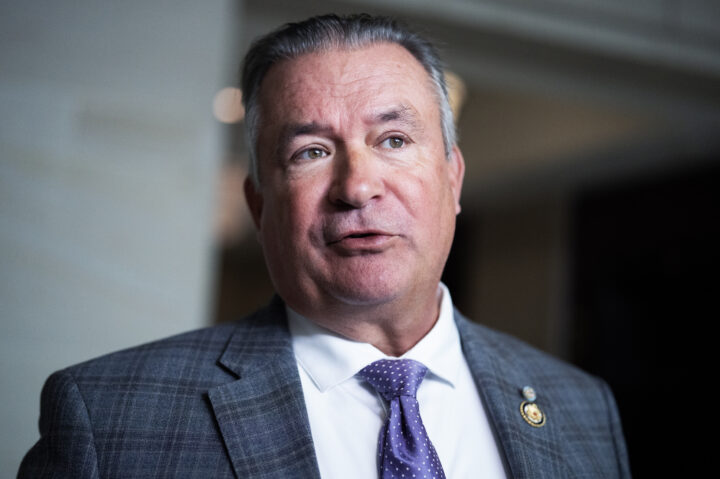
Tom Williams/CQ-Roll Call, Inc via Getty Images
Rep. Don Bacon (R-NE) talks with reporters in the Capitol Visitor Center on Wednesday, June 24, 2026.


 Add JewishInsider on Google
Rep. Don Bacon (R-NE), a co-chair of the House antisemitism task force, blasted independent Nebraska Senate nominee Dan Osborn over a new ad targeting Sen. Pete Ricketts (R-NE) for receiving support from AIPAC.
The ad, shared by the Osborn campaign on social media, features a narrator saying: “When it comes to war, Pete Ricketts knows whose side he’s on: AIPAC and defense contractors,” highlighting AIPAC donors’ support for Ricketts’s campaign.
At one point, the ad features an image of a grinning Ricketts in front of a building labeled “Hospital for Orphans & Puppies” being blown up by a bomb.
Bacon described the ad as antisemitic.
“I reject the anti-Jewish and anti-Israel messaging. [Nebraska] is better than this,” he said.
Osborn is running with the support of Democrats, and polling has shown a tightening race between him and Ricketts.
The retiring GOP Nebraska congressman has been vocal in calling out voices targeting Jewish donors for their political involvement.
The congressman said he’s confident Congress will pass the Jewish American Security Act by the end of the year
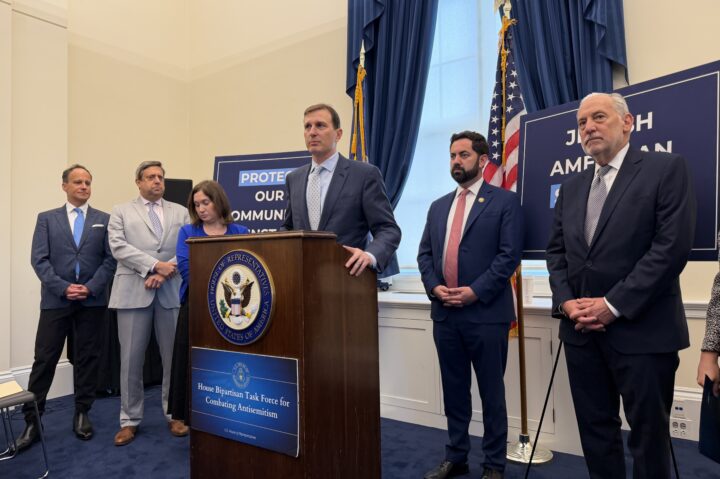
Marc Rod
Rep. Dan Goldman (D-NY) speaks at a press conference announcing the Jewish American Security Act being introduced in the House on June 10, 2026.
Rep. Dan Goldman (D-NY), the chair of the House antisemitism task force, argued in an interview with Jewish Insider on Wednesday that the Jewish community needs non-Jewish allies to help fight antisemitism, following a press conference introducing the Jewish American Security Act (JASA), a bipartisan and bicameral package aimed at tackling attacks on Jewish institutions, campus antisemitism and online antisemitism.
“It’s really important that we gain and bolster allies from outside the Jewish community, because ultimately antisemitism is hate, and hate is easily transferable, and history has taught us that,” Goldman said. “The way we are going to combat antisemitism is not just through Jewish advocacy but through a broad coalition of people who support the democratic value of equal rights and social justice, and so we’re excited that this bill can be a vehicle towards bringing people of all backgrounds together to fight.”
Though some in the Jewish community feel that they’ve been abandoned by longtime allies since the Oct. 7 attacks, Goldman argued that it’s important to continue to reach out to and cultivate allies, in part because “Jewish community is too small to do it ourselves, and we need allies.”
Asked whether there are groups outside the Jewish community supporting JASA, Goldman said, “Broadly speaking, I’ve had really meaningful conversations with a lot of leaders in other communities, and I think that there is a recognition that it is incredibly important to have a united front against hate.”
In spite of Congress’ now yearslong struggle to pass legislation to address the significant rise in antisemitism since Oct. 7, 2023, Goldman said he’s confident that Congress will pass JASA before the end of the year.
The New York congressman said that “part of the reason you see such widespread bipartisan support, and you see so many of the Jewish organizations supporting it, is because we worked very intentionally to streamline it into things that can get bipartisan agreement, so that we can actually get it passed.”
“I’m very optimistic that we are going to pass it this year, because of that broad bipartisan support and because there are no poison pills,” Goldman continued.
He said that the bill’s sponsors have spoken to leadership on both sides of the aisle about the bill, and have received support for it.
Rep. Mike Lawler (R-NY), the lead Republican cosponsor of the bill in the House, said at the press conference that, as a representative of one of the largest Jewish communities in the country, “this issue matters.”
“I am grateful for the local law enforcement agencies in my district that coordinate very closely with our synagogues and with our yeshivas to protect our Jewish students, but it is not enough. We need additional resources to ensure everyone’s safety in New York. We’ve seen firsthand why this program matters,” the lower Hudson Valley Republican said, referring to Nonprofit Security Grant Program funding. “As a practicing Catholic who goes to church, fact is, I can walk into my church without fear. I can walk into my church without passing a security guard stationed outside. Jewish Americans don’t have that luxury, and it’s outrageous, and it should anger each and every one of us.”
He said the bill would also improve protections for Jewish students “by ensuring colleges and universities have clear accountability and enforcement mechanisms” and “increas[ing] transparency and accountability for online platforms as antisemitic content continues to spread across the internet.”
Rep. Jared Moskowitz (D-FL), a cosponsor of the bill, said at the press conference, “This bill shouldn’t be necessary. It shouldn’t be necessary. We shouldn’t have to do this. We’re not doing this because it’s optional. We’re doing it because it is necessary.”
“If people stop trying to hurt Jewish kids in preschools, we won’t have to build walls around them. If people stop trying to blow up synagogues, then we wouldn’t have to have armed guards at every entrance, but we’re seeing all over the country now people going to synagogues to stage foreign policy protests,” Moskowitz said. “We see people in the street, Jews in the street, wearing a Jewish star, having to put that Jewish star away, and if they don’t, they’re accosted.”
He said he saw firsthand the impact and necessity of NSGP funding when he served as Florida’s director of emergency management, where he was responsible for administering those grants at the state level.
Rep. Laura Gillen (D-NY), another supporter of the bill, told JI that antisemitism is an issue she’s been focused on since she was on the campaign trail, and said that the bill tackles many issues she pledged to address as a candidate.
“It talks about putting pressure on social media platforms to moderate hate speech, because we know that that is the hotbed of what is stirring up these hateful feelings — where people hide behind their computers, they say vicious vile things, and they create a lot of false information out there in the universe,” Gillen said.
She added that the security funding increase proposed in the bill, which puts NSGP funding at $1 billion, is also critical. “We saw they got a little bit more of a bump in [the] homeland security [appropriations bill], but we need a [much] bigger bump. There is a tremendous need across my district, and it’s not even just synagogues or yeshivas, it’s also other places of worship.”
Also speaking at the press conference were Amy Spitalnick, CEO of the Jewish Council for Public Affairs; Nathan Diament, executive director of the Orthodox Union Advocacy Center; Eric Fingerhut, CEO of the Jewish Federations of North America; Rabbi Jonah Pesner, director of the Religious Action Center of Reform Judaism; Jessica Bernton, director of congressional affairs at the American Jewish Committee; Lauren Wolman, senior director of government relations and strategy at the Anti-Defamation League; and Elizabeth Cullen, director of government relations at Hadassah.
Israeli Ambassador to the U.S. Yechiel Leiter, also speaking at the event, highlighted college campuses as an epicenter of anti-Jewish hate

Matthew Shea
Rep. Don Bacon (R-NE) speaks at Israel Advocacy Day on Capitol Hill on May 5, 2026.
Rep. Don Bacon (R-NE), a co-chair of the House Antisemitism Task Force, warned on Tuesday that anti-Israel sentiment has moved from the political fringes to a “dominant” position within the Democratic Party and warned the same could happen to his own party.
“My colleagues across the aisle on the Democrat side, what I see right now is a very anti-Israel dominance on the Democrat side and that scares me because it used to be bipartisan,” Bacon said. “I got a lot of friends on the Democrat side that are pro-Israel, but right now the anti-Israel tone is dominant.”
“I see it in my primary back in Nebraska right now, where there’s two Democrats vying for the nomination and one is attacking the other for being pro-Israel,” said Bacon, who is retiring at the end of his term. “I don’t want to let that happen on my side of the aisle, and I’ve seen it grow on our side of the aisle.”
Speaking at a packed auditorium in the U.S. Capitol for Israel Advocacy Day, an event organized by pro-Israel evangelical Christian groups and featuring a lineup of largely conservative speakers, Bacon warned that “all parties are grappling” with antisemitism. The event brought more than 300 rabbis and pastors to Capitol Hill to advocate for support for Israel, combating antisemitism and supporting protections for Jewish and faith-based communities.
Bacon, who has also served on the U.S. Holocaust Memorial Council, noted that this sentiment is being fueled by social media misinformation, including claims that lawmakers support Israel for financial rather than moral reasons — a narrative he dismissed by citing the “win-win” nature of the partnership, particularly in military intelligence and technology like the F-35 fighter jet program.
“There’s a lot of misinformation out there,” Bacon said. “I see all the time on social media that ‘Israel is paying me to do this.’ No, these are U.S. citizens who love Israel and who hate antisemitism. And it’s important for us to know that U.S. citizens are doing this.”
“We are blessed. I mean, we provided a lot of these weapons to Israel and they make them better. A lot of our missiles they [Israelis] perfect it. They tell us on the F-35 it can be used better, because they have been using them in combat a lot longer than we have been,” Bacon continued. “We gain intelligence from Israel. It’s also a win-win when it comes to economics. We both gain from this relationship. And so I think it’s important to tell that to our neighbors in our circles and defend it. I do not retreat from it at all.”
Also speaking at the event, Israel’s ambassador to the U.S., Yechiel Leiter, similarly noted the growing threat of antisemitism. “Antisemitism has tested America,” he said, acknowledging that it has “exposed the degree to which America’s institutions, notably higher learning institutions, have been poisoned by radical ideas.”
“The Muslim Brotherhood has strategically manipulated language to deceive the West by redefining Zionism as the epitome of evil, and by disconnecting the Holy Land from scripture. This radical Islamic group attempts to drive a wedge between us — Jews and Christians — and erode Western civilization,” Leiter said. “Across [college] campuses, spineless administrators sign multi-million dollar contracts with Qatar, which exports this Muslim Brotherhood ideology.”
Leiter also said that antisemitism has been promoted by extremist podcasters, without specifying individuals in particular.
“Libels of genocide and starvation proliferate, and then antisemitism spreads like contagion and it kills in the name of goodness and liberation,” said Leiter. “This fiction about Jews as foreign occupiers extends to others. Particular podcasters have pontificated that the people of the Bible are not the people of the modern State of Israel today.”
Far-right podcaster Tucker Carlson made that argument in a heated interview with U.S. Ambassador to Israel Mike Huckabee in February, drawing condemnation from Huckabee and others.
“Zionism is moral and just, and we must start carrying ourselves like it, unapologetically, unequivocally,” Leiter continued. “We shouldn’t have to thank people for acknowledging the right of Israel to defend herself or the right of Israel to exist.”
“Claims that Jews are not indigenous to the land [of Israel] is what legitimizes” Hamas’ Oct. 7 attacks, he said.
Beyond the ideological battle in the West, the ambassador framed the current conflict in Iran as a pivotal struggle for the future of the region, emphasizing that it is a fight for “moderation.”
“A healthy battle within Islam has taken place between those who seek to accept Judeo-Christian civilization and those who continue to seek to reject it and eradicate it. The war against Iran is part of a broader struggle for moderation in the Middle East and the Muslim world, and I can tell you with confidence it is happening,” Leiter said.
Please log in if you already have a subscription, or subscribe to access the latest updates.
 Continue with Google

 Continue with Apple