





























































Gen. Frank McKenzie revealed that CENTCOM had previously proposed a similar western contingency plan to the Biden administration which was shot down

Ahmad Seir/AP
Marine Gen. Frank McKenzie, then- head of U.S. Central Command, attends at a ceremony where Gen. Scott Miller, who has served as America's top commander in Afghanistan since 2018, handed over command, at Resolute Support headquarters, in Kabul, Afghanistan, July 12, 2021.


 Add JewishInsider on Google
Former U.S. CENTCOM Commander Gen. Frank McKenzie on Monday voiced his support for the U.S. to shift its military footprint in the Middle East westward, including in Israel, to mitigate threats from Iran.
Speaking on a Jewish Institute for National Security of America webinar, McKenzie said, “No one in their right mind would ever put the CENTCOM forward headquarters, you know, 100 miles away from Iran [in Qatar], yet that’s where it is. Because when we put it in place many years ago, we were thinking Iraq, we were thinking Afghanistan, we were thinking other things, and not the growing threat from Iran.”
The U.S. has long operated a sprawling network of bases across the Middle East as critical hubs for air operations, naval logistics, and intelligence gathering, housing between 40,000 and 50,000 personnel. These include Qatar’s Al Udeid Air Base — the largest U.S. military facility in the region — and Al Dhafra Air Base in the United Arab Emirates, alongside key installations in Bahrain, Iraq, Jordan, Kuwait and Saudi Arabia.
However, throughout the conflict with Iran, U.S. bases across the region came under repeated drone and missile fire from Tehran and its proxies. Recent reports have suggested that the U.S. is considering moving the damaged bases westward further out of Iran’s range, including in Israel.
The U.S. does not currently maintain a permanent, sovereign military base in Israel, though American forces temporarily operated out of Israel’s Ovda Air Base during the conflict with Iran and the U.S. stationed dozens of military refueling and cargo aircraft at Ben Gurion Airport.
McKenzie argued in support of JINSA’s position that the U.S. should continue operations at Israel’s Ovda Air Base on an ongoing basis.
“What we’ve got is a situation where it’s good to be close to your potential enemy, because it’s a short commute to the fight,” McKenzie said. “But it’s bad to be close to your potential enemy, because he has the ability to strike you very quickly.”
While McKenzie argued that the U.S. should maintain its existing Gulf footprint to signal continued solidarity with regional partners, he noted that an anchor in Israel would grant Washington unparalleled operational flexibility. “The goal is to spread out that necklace of bases far to the west, where you make it harder for the Iranians to reach you,” he said, though he cautioned that the strategy faces a shelf-life as Tehran continues to expand its missile capabilities.
“We need to look at basing in Israel. I think it’s a great idea,” McKenzie said, suggesting that Ben Gurion could continue to serve as a vital refueling hub for American tankers. He also pointed to Egypt, Jordan, and Oman as viable components of a broader western basing network designed to complicate Iran’s targeting calculus.
Israel provides a unique advantage over traditional Gulf hosts, McKenzie argued, because it is far less likely to impose strict political or operational parameters on American missions.
“Of all the countries, one thing that’s significant is the [host] country … they’re going to want to have a say in where those jets go when they take off,” McKenzie explained. “Probably Israel is the place where you’re going to have the fewest ABO [access, basing, and overflight] restrictions on your airplanes. That’s why Israel is a particularly attractive location.”
Beyond fewer diplomatic hurdles, McKenzie emphasized that Israel remains an ideal option because its multi-layered air-defense architecture makes it uniquely resilient against incoming fire. “That’s probably the most significant thing,” he said. Iranian strikes on U.S. facilities in Qatar and Bahrain forced the U.S. to evacuate or disperse personnel and relocate troops after missiles damaged several facilities.
McKenzie revealed that CENTCOM had previously proposed a similar western contingency plan to the Biden administration, but encountered stiff bureaucratic resistance.
“We had plans to do this, plans that were not supported by the policy shop in the Pentagon during the Biden administration. But I think now is the time to go back and take a look at it,” McKenzie said. “It just really was a refusal to examine the reality of the situation on the ground and the growing trend of Iranian rearmament weaponization, which placed these bases at a very close range to Iran under increasing degrees of risk.”
When asked whether shifting forces westward would satisfy the ongoing memorandum of understanding between Washington and Tehran — which requires the U.S. to withdraw forces from the “immediate proximity” of Iran within 30 days of a final deal — McKenzie remained noncommittal, expressing strong skepticism.
“I think we still need to further negotiate what removal from immediate proximity of Iran means,” McKenzie said. “It would be easy to say moving west would grant you that visibility. I’m just not sure I’d recommend that, and I’m not sure that this administration is going to want to do that.”
Addressing whether a permanent U.S. presence would put Israel at a heightened risk for more frequent or intense Iranian or proxy strikes, McKenzie acknowledged the potential but argued the protective benefits outweigh the downsides, stating: “I’m not sure how we could get to a higher level” of threat environment.
“Yes, possibly. But on the other hand, what you gain by U.S. basing there is you gain the use of those aircraft against [Iran] in order to reduce the frequency, duration and intensity of those attacks,” McKenzie said. “I’d rather have U.S. forces there than not.”
Former CENTCOM head Gen. Frank McKenzie: ‘If you are sitting down at CENTCOM right now, you are satisfied with where you are’
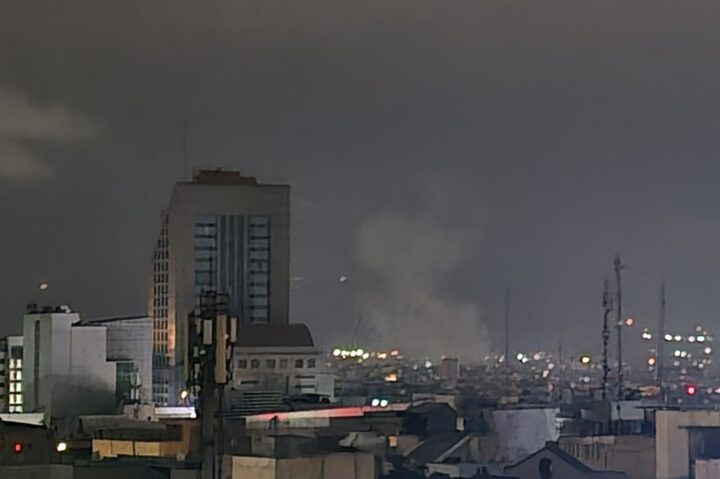
Tolga Akbaba/Anadolu via Getty Images
A view shows explosions lighting up the skyline amid ongoing US-Israel attacks in Tehran, Iran, on March 25, 2026.
Former U.S. Central Command head Gen. Frank McKenzie said Wednesday that the U.S. military is “in the heart of the plan” in its war against Iran, pointing to major military achievements against Tehran’s missile and military capabilities, while cautioning that the conflict remains a grinding, long-term campaign.
As the conflict between the U.S., Israel and Iran nears the one-month mark, officials say Iran’s capabilities have been severely degraded, while President Donald Trump has asserted that the war is nearly over and that its objectives have largely been achieved.
At the same time, reports indicate that Iran has rejected Trump administration proposals to negotiate an end to the conflict, while the Pentagon is deploying the military’s highly specialized 82nd Airborne Division to the Middle East — raising fresh questions about the trajectory of the war and the broader strategy.
During a webinar hosted by the Jewish Institute for National Security of America, McKenzie said the U.S. is “accomplishing the objectives that we set out. CENTCOM is executing a long-prepared campaign plan. This is not something that we’ve drawn up on the back of the envelope day-to-day. These are things that have been studied and refined for many years. If you are sitting down at CENTCOM right now, you are satisfied with where you are.”
McKenzie said one of the clearest indicators of success is that Iran has been unable to generate the kind of large ballistic missile salvos that U.S. military planners had long feared.
“Iran has not been able to mount massive volleys against Israel. Have they been able to fire some number of missiles against our targets? Yes, but not the massive volleys that we thought would make it hard for us to defend,” McKenzie said, attributing that in part to Iran’s own strategic miscalculation.
“The Iranians made a mistake in designing their ballistic missile force. They mistook hardening and burying for security,” McKenzie said. “The truth of warfare today is this: if you can see it, you can hit it. If you can hit it, you can kill it. And even if you dig yourself deep underground with these beautiful missile cities, that just makes it easier for us to strike and destroy these missiles wholesale rather than retail.”
Yaacov Ayish, former head of the IDF’s general staff, also said that “significant progress” has been made. He noted that Iran’s ballistic missile capabilities have subsided.
“When I’m thinking about the amount of ballistic missiles launched by the Iranians compared to what they had planned, I think they are in a very very bad place, and this is due to the fact that not only their command control capabilities were shattered since day one of this war, but also because we [the IDF] are, together with the U.S., hunting their launching capabilities.”
McKenzie said the U.S. is also making progress against Iran’s drone threat, though he acknowledged that it remains an evolving challenge. Throughout the conflict, Tehran has launched over 2,000 low-cost, easy-to-produce drones at targets across the Middle East.
“We are still absorbing how to employ and defend against drones, as is really everybody else,” he said. “The best way to do that is going to be by striking where the drones are manufactured, where they’re launched. The worst way to do it is to defend them in the terminal area.”
McKenzie also addressed the conflict over the Strait of Hormuz, where Iran has effectively blocked one of the world’s most critical oil routes. He said the U.S. has already struck Iran’s major naval assets and is now focused on “preparatory steps in order to clear” it.
“What that means is first clearing those craft, getting rid of Iranian submarines, looking at the fast-attack craft, the small cigarette-boat type vessels that can swarm out from the northern to the southern coast of Iran … to affect shipping in the region,” McKenzie said. “CENTCOM is busy on a program of doing that. I think there’s probably some days left ahead of work to finish that. But it’s progressing.”
He said Iran also retains a “large and capable stack of mines,” and suggested CENTCOM has likely been targeting both the mines and the vessels used to lay them.
“You don’t have to clear the whole Strait of Hormuz,” McKenzie said. “You’ve got to clear a route that you’re going to bring vessels through.”
Ayish noted that he sees “two ways to solve” the tension at the strait.
“One is the diplomatic channel that is under discussion between the U.S. and the Iranians via certain mediators, and there is the military option,” Ayish said. “When you are analyzing the achievements that were achieved, it seems like both options are viable, and I think the major reason for the Iranians to go into this negotiation is because they know that it’s very imminent. Both options are seriously on the table.”
When asked whether CENTCOM had failed to adequately prepare for what had unfolded in the strait, McKenzie rejected that premise.
“I’m not sure I’d agree with that assertion,” he said. “You build your plan off the forces that you have. We’ve always thought there’d be a struggle over this. The nature of warfare is you can’t get everything you want. Sometimes it takes a little while to get that. I think we’re working toward that end right now.”
McKenzie also declined to rule out the possibility of U.S. boots on the ground, an outcome many Democrats and some Republicans have strongly opposed.
“I think it’s certainly something we want the Iranians to worry about,” McKenzie said. “I would certainly leave that on the table, and then I wouldn’t share what I was going to do. I think we want them to be very worried about that.”
Meanwhile, while Ayish noted a goal of achieving “a situation that will allow a regime change in the future in Iran,” McKenzie said the U.S. is not directly pursuing regime change in Tehran, even if it could emerge as a consequence of the campaign, even as Trump told reporters Tuesday that regime change had already been achieved.
“The United States is not pursuing regime change directly. It may be a product of what we’re doing,” McKenzie said. “We’d like to get to a point where there’s going to be some entity in Tehran that will negotiate the objectives we want for this campaign, whether it’s a completely new regime or a version of this regime that is so affected by pressure that they’re willing to make these concessions.”
Please log in if you already have a subscription, or subscribe to access the latest updates.
 Continue with Google

 Continue with Apple