













































































A super PAC supporting Rogers ran an ad during the debate featuring a mother whose child attended school at Temple Israel and said she couldn’t vote for El-Sayed
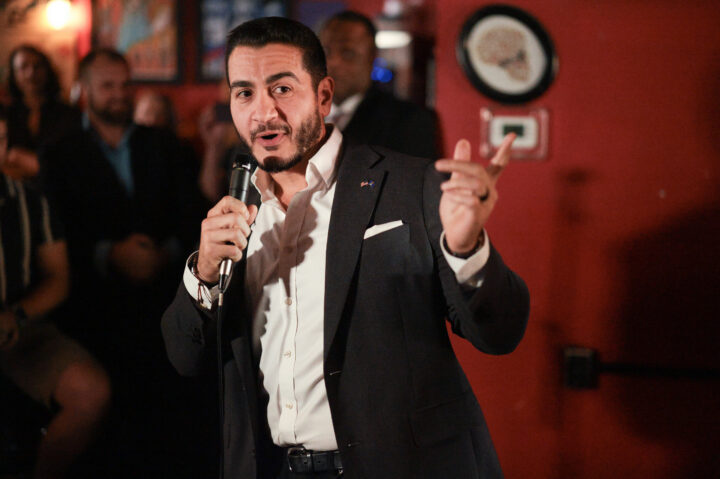
Chip Somodevilla/Getty Images
Michigan Democratic Senate candidate Abdul El-Sayed campaigns at The Meanwhile Bar on October 8, 2026 in Grand Rapids, Michigan.


 Add JewishInsider on Google
In the first debate of the general election for Senate in Michigan, former Rep. Mike Rogers (R-MI) repeatedly hit Democratic nominee Abdul El-Sayed over his supporters’ ties to and support for terrorist groups and El-Sayed’s comments on the Temple Israel terrorist attack — accusations that El-Sayed largely did not respond to during the deeply acrimonious exchange.
El-Sayed, for his part, said he would not support defensive aid to Israel even if it was under attack, framed Israel as a threat to the United States comparable to Iran, defended his decision not to issue a statement honoring the anniversary of Hamas’ Oct. 7, 2023, attacks on Israel and continued to sidestep questions on Iran’s persecution of its own civilians.
“He has taken money from groups in support of the Muslim Brotherhood. He has taken money from individuals on his campaign who openly support Hamas, Hezbollah, al-Qaida,” Rogers said several times throughout the debate, and accused El-Sayed of failing to condemn terrorist groups and attacks.
“The prattling and repetition of his argument does not solve the dismantling of terrorist networks that America demands,” Rogers added, framing himself — with a military and FBI background — as the clear choice for those concerned about national security, while El-Sayed repeatedly dinged Rogers as a war hawk who had been an avid cheerleader for the war in Iran and other conflicts.
At one point, Rogers suggested that El-Sayed opposed federal counterterrorism programs because people in El-Sayed’s family were tied to terrorism, leading El-Sayed to goad him, “Go ahead and say that I’m a — go ahead and say it. You’ve been tiptoeing around it the whole time. Just say it.”
Though he fired back at most of the attacks Rogers leveled throughout the debate, El-Sayed offered no direct response or rebuttal to Rogers’ barbs about his ties to terrorism. “He wants this to be about anything but his own record … going after my mom, my sister, got nothing to actually say about me. I’m a dad and a doctor,” the Democratic nominee said.
El-Sayed’s mother worked for the Islamic American Relief Agency, which was designated as a terrorist organization for supporting al-Qaida, and his sister-in-law sued to be removed from a federal terrorism watchlist, according to recent reports.
He also insisted that he had condemned the Temple Israel attack. (El-Sayed apologized for his initial response to the attack, which many in the Jewish community saw as justifying or excusing it, as he tried to appeal to Jewish voters this summer.)
Asked whether he considered Israel or Iran a bigger threat to the United States — a question he dismissed earlier this week when asked by a reporter — El-Sayed again called the question a “ridiculous hypothetical.”
“Our ostensible ally in Israel has lobbied us to go to war with Iran. We have watched as Iran has responded by bombing all kinds of countries in the Middle East, and then choking off the world’s energy supply,” he continued. “I think both of them have proven dangerous in their own way, one at risk of attacking us, one getting us into wars we have no business fighting.”
El-Sayed said he would not support providing defensive weapons to Israel if it were attacked by Iran or another state, and framed Israel as the aggressor against Iran, with the aim of drawing the U.S. into the Iran war and annexing southern Lebanon.
Abdul El-Sayed would not vote to provide defensive military weapons to Israel if it were under attack, the Michigan Democratic Senate nominee said during last night’s debate. Read more: https://t.co/HzcvnWB5Fg https://t.co/RbMKkzJwbf
— Jewish Insider (@jewishinsider) October 9, 2026
When Rogers raised the fact that El-Sayed had not issued a statement to commemorate the third anniversary of the Oct. 7 attacks — describing in detail some of Hamas’ atrocities — El-Sayed responded, “I’m not somebody who tries to make political theater out of other people’s pain.”
Later, in the post-debate spin room, El-Sayed reportedly said, “Let me make a clear point here: I learned that when people are grieving, don’t step on their grief, and I know that how much things were being watched that this was going to be — whatever I said — it was going to feel like politicizing that moment. So I decided not to say anything.”
Pressed during the debate on whether he would condemn the Islamic Revolutionary Guard Corps, El-Sayed broadly said he “will condemn any use of force against a diplomatic population abroad,” but focused his response primarily on condemning the war in Iran.
El-Sayed said that he believes that the U.S. can end the war in Iran without reopening the Strait of Hormuz or ensuring Iran cannot produce nuclear weapon and address those issues diplomatically after the end of the fighting.
Rogers, who has recently urged an end to the Iran war, said the conflict cannot end if Iran maintains the capability to produce nuclear weapons, but argued that Iran’s nuclear program has been set back 20 years so that is not a relevant concern at this point.
He also said that the use of nuclear weapons would be the only red line that Israel could cross that would cause him to withdraw support for the Jewish state.
Asked whether he would welcome public support from AIPAC, given reporting that his allies had urged the group not to get openly involved in the general election, Rogers sidestepped the issue but said that he would welcome anybody “that wants to help my campaign stop a guy who can’t condemn terrorism in our own country because he’s so close to the people who are supporting the Muslim Brotherhood.”
A newly formed super PAC, Together for Michigan, ran an ad during the debate featuring comments from Taylor Weintraub, a mother of a student at the Temple Israel preschool that was attacked by a terrorist earlier this year.
“Since I could vote, [I] have been a Democrat and have considered myself a Democrat. When Abdul El-Sayed said, ‘Hurt people hurt people,’ it allows people to believe that this is acceptable,” Weintraub said in the ad. “It was justification as to why a terrorist would want to hurt all of these children. … He put the words out there and he cannot take them back.”
“Mike Rogers is here to listen to us and here to help us feel safe,” Weintraub continued.
The ad directed viewers to a website for Democrats supporting Rogers.
Ahead of the debate, members of the Nonnegotiable Michigan campaign, which has been pressuring El-Sayed to make commitments to Jewish safety and Israel’s right to exist, held a call with reporters on Thursday to urge both candidates to address their concerns during the debate.
Organizers said that thousands of people have now signed onto the movement, but they still haven’t received sufficient responses from El-Sayed’s campaign.
“If anything, he’s only given a lot of Jewish Michiganders reasons not to vote for him,” Rabbi Aaron Starr, one of the organizers of the effort said. “It’s been very alarming to see that he hasn’t shown more support.”
But Starr emphasized that members of his community aren’t just choosing between Rogers and El-Sayed — some are also considering writing in a candidate or sitting out the Senate race altogether.
Two leaders of the group, Rabbi Josh Whinston and Joan Lowenstein, a member of the Michigan Democratic Party Central Committee and president of the Jewish Federation of Ann Arbor, said that — despite Rogers’ public appeals and private outreach to members of the Jewish community — they haven’t heard from Rogers or his camp directly about trying to secure their backing.
Lowenstein noted that she’s a longtime AIPAC club member, “so I’m definitely on a list if he was going to reach out — and I have not gotten anything.”
Some other leaders of the campaign have been in touch with Rogers’ team, however: another leader of the Nonnegotiable campaign told Jewish Insider Rogers had reached out to them, while El-Sayed had not. Starr did not say specifically which candidates he had met or spoken with, but told JI that he had “outreach from a variety of candidates, both Democrat and Republican.”
The Nonnegotiable organizers also emphasized that their message is not just one for the Michigan Senate race, but also for the Democratic Party as a whole and the 2028 presidential field. Starr said that, even if El-Sayed wins, the difference in the margin of victory between himself and other statewide Democratic candidates will also be a significant message to the party.
The Nonnegotiable members said they were disappointed by El-Sayed’s failure to issue a statement on Oct. 7, particularly given that he has been consistent in honoring other Jewish holidays in the past month.
“His lack of communication is noticeable, and it comes back to what we’ve been saying — I’ve been saying now for a while is — when he communicates, he often communicates out of both sides of his mouth, and when he doesn’t communicate, it also becomes noticeable,” Starr said.
Members of the Nonnegotiable group emphasized that they wanted to hear from Rogers at the debate not only about support for Israel and the Jewish community, but also about standing up for other priority issues including civil rights, democracy, abortion rights, the Supreme Court and other issues they consider to be Jewish values.
Several Jewish university students in Michigan also joined Thursday’s press call, having publicly signed onto the Nonnegotiable petition.
Jacob Reich, a sophomore at the University of Michigan, said that he is organizing for and supporting Democratic candidates in other states, but in Michigan feels “torn between both my Jewish identity and supporting the Democratic candidate in my state.”
“We don’t have a candidate who supports all of my beliefs,” Robert Kashan, a freshman at the University of Michigan, agreed.
Reich emphasized that he saw multiple people on his campus on the Oct. 7 anniversary wearing Hamas T-shirts, but “I expect a lot more from a leader, especially someone who would be representing me in the Senate … so I would expect at least a statement memorializing Oct. 7.”
The GOP Michigan Senate nominee said, ‘When people tell you who they are, believe them’
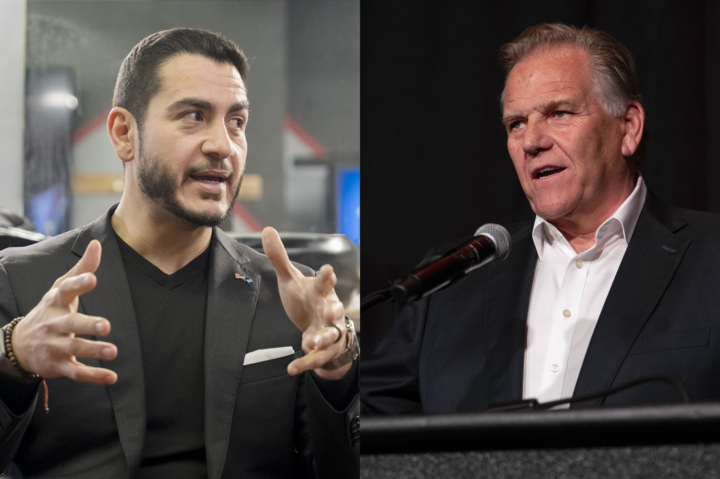
Getty
Michigan Senate candidates Abdul El-Sayed and Mike Rogers.
Former Rep. Mike Rogers, the Michigan Republican nominee for Senate, issued a statement Wednesday commemorating the third anniversary of Hamas’ Oct. 7, 2023, attacks on Israel and bashing his Democratic opponent, Abdul El-Sayed, while El-Sayed remained silent.
El-Sayed’s rhetoric and stances on Israel and other issues of concern to the Jewish community have been heavily scrutinized, and he is facing significant skepticism from traditional Jewish Democrats in Michigan, as some community leaders and elected officials say they plan to sit out the Senate race or support Rogers.
El-Sayed’s campaign did not respond to multiple inquiries from JI about whether he planned to issue a statement on the Oct. 7 anniversary, and has not shared any such statement publicly.
“Three years ago today, the world witnessed in horror the worst massacre of Jewish people since the Holocaust,” Rogers said. “This dark day is a sad reminder that evil exists all around us. And how we respond to evil determines how much it grows.”
Rogers went on accuse El-Sayed of stoking hate and violence, pointing to a fundraising message his campaign sent on the second anniversary of the Oct. 7 attacks criticizing Israel (his campaign has said it was sent in error); criticizing El-Sayed for campaigning with Hasan Piker, who has been dismissive of the attacks; and issuing a widely criticized statement following the terrorist attack on Temple Israel in West Bloomfield, Mich.
“Hate like that has no home in Michigan,” Rogers continued. “You have my work, I will always stand proudly alongside Michigan’s Jewish community, against terrorism, and for Israel’s right to defend itself. We must root out antisemitic hate in all forms — because when we say ‘never again,’ we must mean it.”
Rogers later called out El-Sayed for not issuing a statement.
“Radio silence from Abdul El-Sayed about the anniversary of the Oct. 7 attacks. … I wish I could say this is shocking,” Rogers said in a late-afternoon post on X. “When people tell you who they are, believe them.”
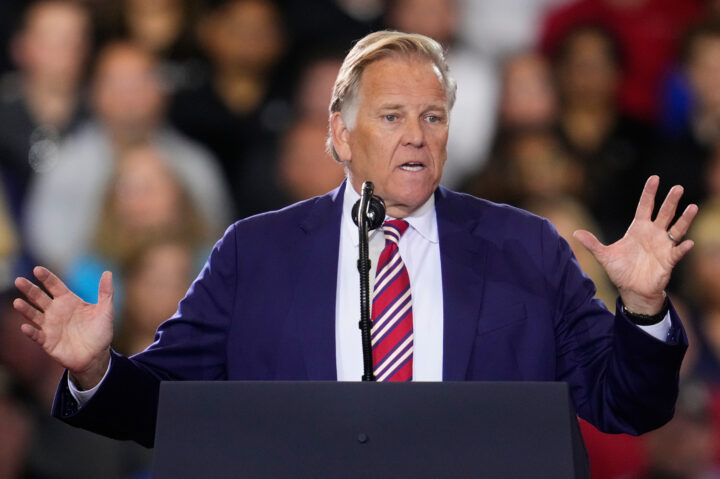
Paul Sancya/AP
Republican Senate candidate Mike Rogers speaks before President Donald Trump at an event at the General Motors Proving Ground Monday, July 27, 2026, in Milford, Mich.
The debate over AIPAC’s involvement in the high-stakes Michigan Senate race is drawing renewed attention after an Axios report outlined a request from allies of former Rep. Mike Rogers (R-MI) for the pro-Israel group’s super PAC to lay low for the general election. The Rogers campaign advisors suggested instead that the group transfer money for the race to a separate pro-Rogers entity so as not to make its outside spending a major issue in the contest.
The episode has touched a lot of raw nerves in both the pro-Israel world and the Republican political landscape. Rogers, a longtime supporter of the U.S.-Israel relationship, is highlighting his relationships with Michigan’s Jewish community, and has made attacking Democratic nominee Abdul El-Sayed’s anti-Israel virulence and his relationship with antisemitic figures like Hasan Piker a central element of his campaign message.
AIPAC’s super PAC, United Democracy Project, spent about $32 million in the Democratic primary to try to defeat El-Sayed, and there’s little doubt its money — in the absence of any moderate group willing to spend similar resources to stop a far-left candidate like El-Sayed from winning — made the race more competitive than it otherwise would have been. But it also gave El-Sayed a talking point in attacking outside money in the race that diluted the impact of the aggressive advertising campaign, especially at a time when support for Israel itself is diminishing within the Democratic Party.
Both the Rogers campaign and AIPAC see El-Sayed as uniquely vulnerable, with polls showing the race statistically tied despite the overall favorable environment for Democrats in the swing state. But beyond focusing on winning the race, both sides have slightly different tactical imperatives: AIPAC, after coming close to defeating El-Sayed in the primary, wants credit for helping finish the job in the general election. Rogers, meanwhile, is trying to turn the tables on El-Sayed, using his endless primary campaign attacks on Israel as a way to underscore he’s more obsessed about the Middle East than the issues critical to Michigan voters.
On one hand, support for Israel is decidedly higher among the general electorate than it was among primary voters — and likely is a winning issue for Rogers, especially given El-Sayed’s radicalism on the subject. But populist concerns about foreign aid and engagement abroad still resonate across party lines, with 44% of Michigan voters in a recent Fox News survey saying they favor continued military aid to Israel, while 55% oppose such aid.
The Rogers campaign believes that making the race about Middle East policy would be shortsighted, especially given that El-Sayed’s record and background makes him vulnerable to the charge that he’s the candidate more consumed with international affairs than improving the lives of Michiganders.
Furthermore, unlike in the Democratic primary, there will be no shortage of money available for the Rogers campaign and its allies in the general election. Rogers has been a solid fundraiser, and the deep pockets of both the Senate Leadership Fund GOP super PAC and a separate pro-Rogers super PAC should offer more than enough resources to run a full-fledged campaign. Rogers’ campaign would prefer donations get directed — and spent — under the Republican Party umbrella.
There’s a reason AIPAC’s super PAC hardly ever spends in general elections — most competitive races are already saturated with cash, so its involvement (or that of any outside nonpartisan super PAC) wouldn’t make much of a difference anyway.
AIPAC’s concerns are understandable as well, and I have heard them echoed by several senior GOP strategists involved with the race. El-Sayed’s ties to extremists and inability to forthrightly condemn antisemitism in his home state is a major reason why he’s vulnerable in the first place. Diluting or downplaying that argument takes one of the campaign’s strongest angles off the table.
It’s one thing to debate about whether advertisements would be best aired under the GOP banner or the UDP banner. It’s another issue to be concerned that the Rogers’ campaign, in its desire to universalize the race, isn’t taking full advantage of winning over the many Democratic-friendly Jewish voters who view El-Sayed’s record as intolerable. Asking AIPAC’s chair to stand down its ad campaign, as reported in the Axios story, might have been a tactical dispute, but it risks coming across as downplaying the importance of the pro-Israel and Jewish communities in the state.
Ultimately, the goals of the two sides are the same: winning the race. If the differences between the Rogers’ campaign and AIPAC are tactical, that’s understandable in a lengthy campaign. But if it’s a dispute about who gets credit for taking down El-Sayed, the argument seems a bit frivolous when the stakes in the race are so high.
Please log in if you already have a subscription, or subscribe to access the latest updates.
 Continue with Google

 Continue with Apple