






































































At least six prominent Jewish organizations hosted events at the Qatari-owned Plaza Hotel in the past year
Getty Images
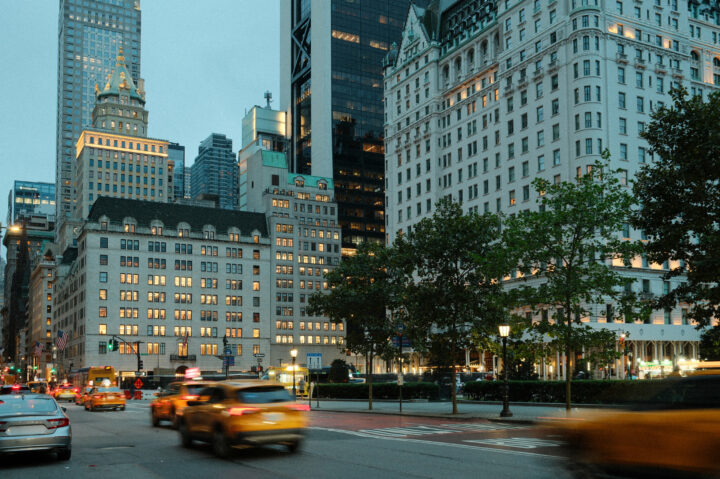
Yellow cabs driving on busy street with the pierre hotel and other skyscrapers in the background at dusk in new york city


 Add JewishInsider on Google
Few settings for a charity gala are more quintessentially New York than the Plaza Hotel. Under glittering chandeliers, philanthropists and civic leaders in tuxedos and gowns sip champagne, dine lavishly and raise millions of dollars for their chosen causes, all inside a landmark synonymous with old-world Manhattan elegance. Some of its grandest evenings belong to Jewish organizations, when the banquet is kosher and the pledges to Jewish and Israeli causes climb into the millions.
Since 2018, the Plaza has been owned by Katara Hospitality, a subsidiary of the Qatar Investment Authority, Doha’s flagship sovereign wealth fund. That means the Jewish organizations booking its ballrooms are sending some of their charitable dollars to a Qatari state-owned enterprise. Qatar funds Al Jazeera, a news network frequently hostile to the Jewish community’s interests, and has long hosted Hamas’ leaders in Doha.
Among the groups that return year after year is the American Friends of Rabin Medical Center, which has held its annual New York gala at the hotel since at least 2022. The group was back on Nov. 9 for its 2026 gala, which drew prominent figures from real estate, finance and philanthropy to raise money for the Israeli hospital. It declined to comment for this story.
American Friends of Rabin is not alone in bringing Jewish communal philanthropy to the Plaza, where renting the Grand Ballroom typically requires a stand-alone space rental fee of $12,000 to $15,000, according to an event planner.
Jewish Insider asked six Jewish organizations that hosted events at the Plaza in the past year whether they knew of the hotel’s Qatari ownership, whether they had considered the implications of spending their charitable dollars there and whether they planned to keep booking it. (The Plaza is set to close in January for at least four years of facade restoration.)
The Jewish Museum, American Friends of Soroka Medical Center, Commentary Magazine and the Weitzman National Museum of American Jewish History all held fundraising events at the venue in 2026. None responded to requests for comment for this article.
The Jewish Community Relations Council of New York, which held a gala at the Plaza in May, was the only group to answer the questions.
“Our event venues are selected based on a range of considerations, including accessibility, availability, and various other preferences,” said Mark Treyger, CEO of JCRC-NY.
“Ownership has not previously been a consideration, and we did not know about the Qatari interest in the Plaza. We will take ownership into account as part of future planning, consistent with our mission and values.”
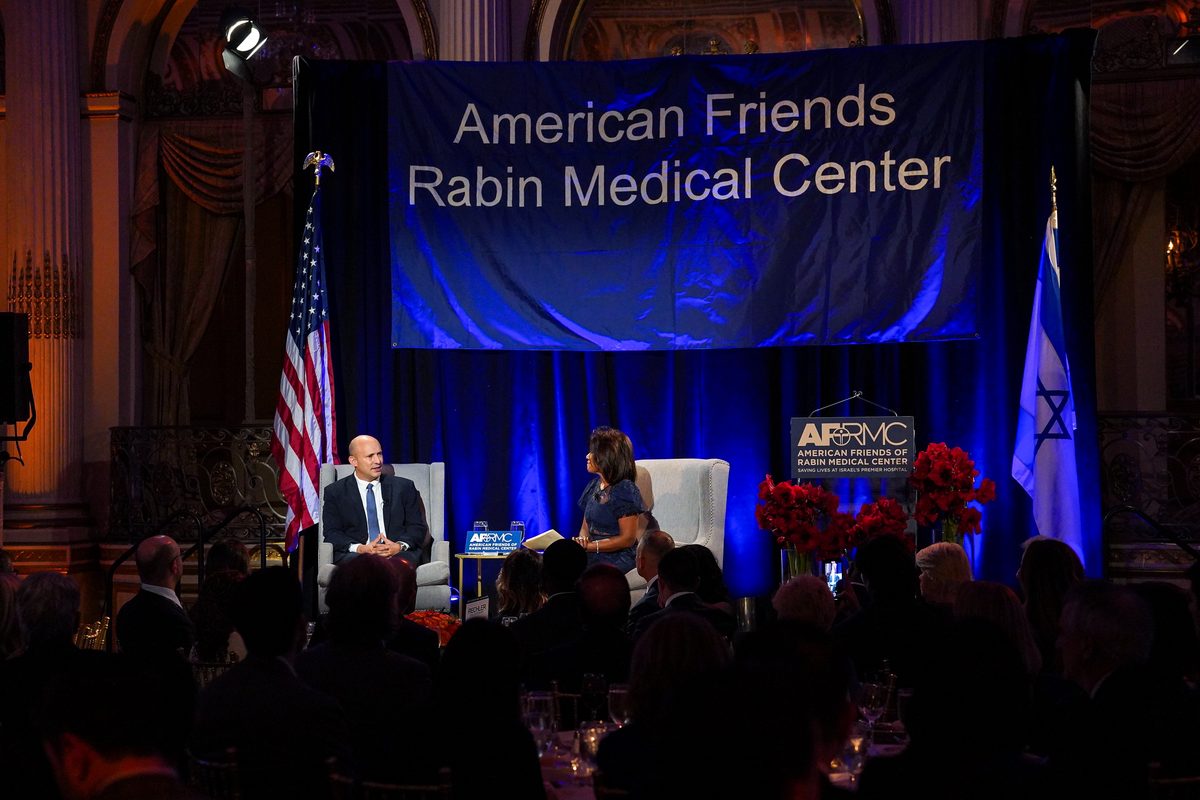
The Plaza’s draw reaches into the policy world as well. The Washington Institute for Near East Policy, a think tank long backed by prominent Jewish philanthropists and focused on Middle East policy, has also hosted events at the hotel, including its Scholar-Statesman Award gala dinner honoring former Secretary of State Hillary Clinton on Thursday night. The institute, which has published research scrutinizing Qatar’s regional role, declined to comment.
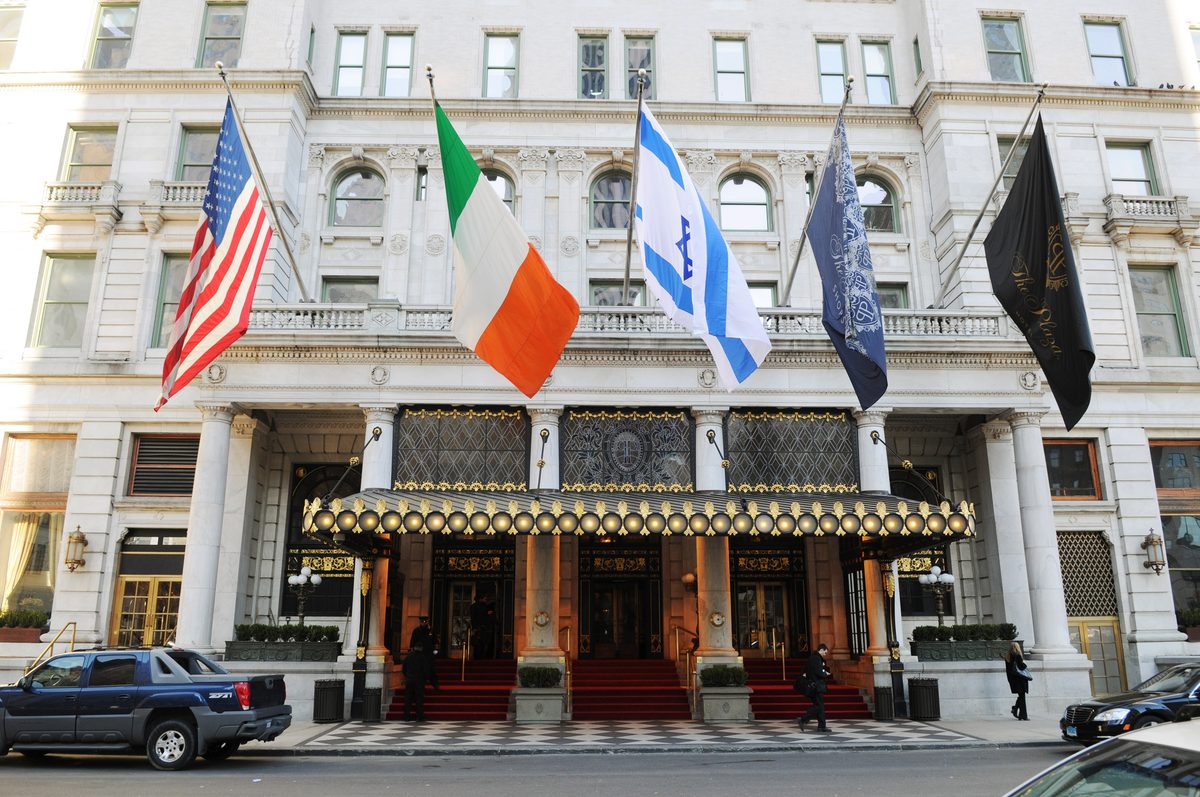
The Plaza has changed hands a number of times in its nearly 120-year history. The original hotel on the site opened in 1890, and the current French chateau-style building opened in 1907. It has since passed through a long list of prominent owners including Conrad Hilton and Donald Trump.
In 2004, the hotel was purchased by the Elad Group, a luxury real estate development firm headed by Israeli billionaire Yitzchak Tshuva. Tshuva’s firm had purchased the property, which has held national historic landmark status since 1986, from a group of investors that included Saudi Prince Alwaleed bin Talal. The Elad Group’s ownership of the property, a period that included major renovations, lasted until 2012. During that period, Israeli Prime Minister Benjamin Netanyahu joined a long list of notable figures who have passed through the hotel, speaking at a July 2010 event arranged by the Conference of Presidents of Major American Jewish Organizations.
In 2012, the Elad Group sold its share in the hotel to Sahara India Pariwar, and in 2018, Katara Hospitality purchased 100% of the property from Sahara and other investors that include bin Talal’s Kingdom Holding Co. and Israeli-American billionaire developer Ben Ashkenazy’s Ashkenazy Acquisition Corp. Katara is a hotel company owned by the Qatar Investment Authority, the country’s sovereign wealth fund, which invests Qatar’s oil and gas earnings in businesses and property around the world. Fairmont Hotels and Resorts, the third-party operator of the property, receives a portion of the hotel’s revenue. The profits go to Katara, as the owner.
The Plaza is part of a much broader pattern of Qatari investment in American real estate and institutions, said Jonathan Schanzer, executive director of the Foundation for Defense of Democracies, a nonprofit research institute that has long criticized Qatari influence in the U.S. He argued that Jewish and pro-Israel organizations have not sufficiently reckoned with the extent of Qatar’s influence in the U.S. or the implications of doing business with Qatari-owned entities.
Qatar has been a major non-NATO ally of the U.S. since 2022, and hosts the largest U.S. military base in the Middle East. In June, FDD published an analysis tracking at least $400 billion in Qatari investments, contracts, grants and spending in the U.S. since 2000.
“This problem is pervasive. It’s everywhere,” Schanzer told JI, pointing to what he called “the enormous portfolio” of U.S. real estate, including hotels, restaurants and buildings, owned by Qatar where Jewish groups and philanthropists do business.
“But it’s only a problem to the extent that the Jewish or pro-Israel communities want to recognize that it is,” said Schanzer. “There is not a wide enough grasp of the problem. The Qataris have bought an enormous amount of influence in this country, they’ve done so through influence peddling in Washington, through sportswashing, through foreign money in higher education and K-12. The extent of this is enormous.”
“It is not on anyone’s radar in any real sense,” continued Schanzer. “The Jewish and pro-Israel community in this country is going to have to decide whether they are OK with any of this. I don’t see the community pushing back in any real way against Qatari influence.”
“I think there is a fair amount of apathy and a fair amount of ignorance,” said Schanzer, adding that the “Jewish community is shrugging or looking the other way.”
Charles Asher Small, founder of the Institute for the Study of Global Antisemitism and Policy, a nonprofit that investigates undisclosed foreign donations from Qatar to the U.S., called on Jewish and all American organizations to be more deliberate about ownership of the businesses they patronize.
“The research is out there, raising alarm bells on this not only antisemitic, but anti-American and anti-democratic entryism into the United States,” Small told JI. “If we want to fight antisemitism and defend democratic principles, I think we should be boycotting businesses calling for the destruction of democracy.”
A similar story plays out in the Plaza’s lobby, where the boutique of the luxury publisher Assouline gives pride of place to “Tel Aviv Spirit,” its new coffee-table tribute to the Israeli city, on sale for $105 under a Qatari state-owned roof.
The FDD fellow, who said he was taught to hate Israel growing up in Iraq and Lebanon, spoke at a New York launch event for his book on why Arabs should reconsider their views on Israel
Lilya Espinosa, Soapbox Photography
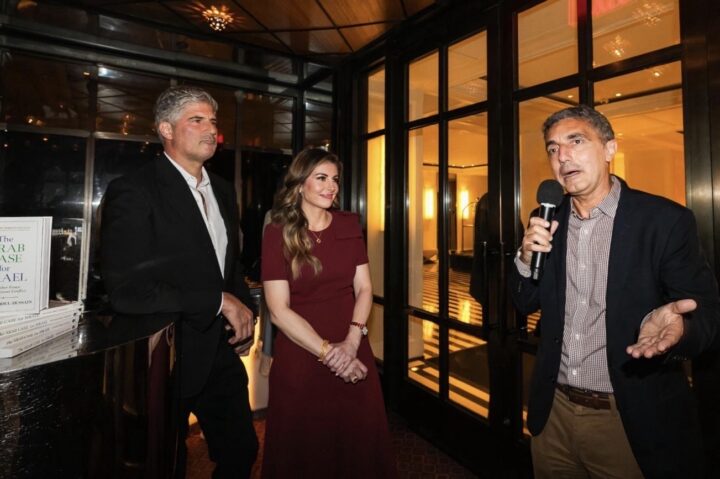
Philanthropist Antoun Sehnaoui, Morgan Ortagus, former deputy U.S. special envoy to the Middle East and Hussain Abdul-Hussain at the launch of The Arab Case for Israel in Manhattan.
At a launch event for his book, The Arab Case for Israel, on Tuesday, writer and researcher Hussain Abdul-Hussain argued that the path to peace in the Middle East begins with Arabs reexamining long-held assumptions about Israel, drawing on his own transformation from believing anti-Israel propaganda to an advocate for the Jewish state.
Speaking days after Israel and Lebanon signed a U.S.-brokered framework agreement, Abdul-Hussain said the Lebanese people can follow in his footsteps, as the country remains divided between a faction that promotes the Iranian narrative that Israel “only understands the language of war and force,” and those seeking to reclaim the country’s sovereignty.
“The Lebanese have had their share of sacrifices for big powers. This started back in the 1960s. The Lebanese will stand up for sovereignty and independence. They’ve been thrown under the bus time and time again and this makes them always wary and they try not to stick their neck out… this is what’s keeping them back,” Abdul-Hussain said.
The invitation-only event for the book, published in February, was hosted by Antoun Sehnaoui, businessman and philanthropist, and Morgan Ortagus, former deputy U.S. special envoy to the Middle East, at the Mark Hotel on Manhattan’s Upper East Side.
Abdul-Hussain, a Shia Muslim raised in Iraq and Lebanon where he said he was taught to hate Israel and the West, is now a Washington-based research fellow at the Foundation for Defense of Democracies. The Arab Case for Israel chronicles his unusual journey away from holding anti-Israel views, detailing his argument for why all Arabs should do the same.
“My story is the story of an average person who was told something and when he dug up the story it turned out to be something else,” Abdul-Hussain told some 50 attendees — a mix of Jews, Christians and Muslims — at the event. “I was taught, like every other kid was taught, that Israel must disappear. And I believed it.”
“Over the course of my life, events pushed me to try to learn about Israel.” The biggest turning point, he recalled, was in 2000 while he was working as a reporter in Lebanon. “We covered the Israeli military pulling out of the south and that day I drove my car to the border, which at the time was just a flimsy wire so I could see Israelis,” said Abdul-Hussain. “I became really curious. At the time, I could get on the FM radio of the Israeli channels. If you were in Lebanon at the time, your sources on Israel were [staunch Israel critics] Edward Said, [Noam] Chomsky and [Norman] Finkelstein.”
After learning Hebrew, Abdul-Hussain said he “discovered everything they taught us about Jews — that they were scheming to kill every Arab Lebanese kid — was not true.
“It was a long journey and I decided this journey must be told for other Lebanese, Syrians and Moroccans to understand what they are being fed is not true. I make the case that even if you think Israel has caused you injustice, moving on is much better for your future and the future of your children and grandchildren,” he said.
As Hezbollah continues to oppose the framework agreement aimed at restoring sovereignty and establishing lasting peace, Abdul-Hussain called on Americans to support the efforts of Lebanese President Joseph Aoun to resist the terror group.
“One of the main criticisms against President Aoun and his government is that he’s talking the talk and not walking the walk,” said Abdul-Hussain. “I understand that. But the guy is going all the way against Hezbollah. He’s being vilified and taking a lot of heat. The last thing he needs is for someone like me to try to push him down. Even if he’s not walking the walk, talking the talk is good enough.”
He also called on the U.S. to implement a long-term policy of protecting religious minorities in the Middle East “to make sure that non-Muslim minorities do not vanish.”
“The pattern of minority shrinking is happening all over the place, except for one place, and that’s Israel,” he said. He pointed to Lebanon where lists of registered voters show that Christians are 35% of the population, whereas 20 years ago they made up about half of the population.
“The trends are not lying. This is bad for everyone. It’s bad for diversity,” Abdul-Hussain continued.
“We in the U.S. should send the message to minorities that we are with you, that we will not let [adversaries] come after you and that Israel is something to be proud of.”
Please log in if you already have a subscription, or subscribe to access the latest updates.
 Continue with Google

 Continue with Apple