














































































The strikes reportedly targeted air-defense systems, radars and drone command-and-control units in southern Iran
ATTA KENARE / AFP via Getty Images
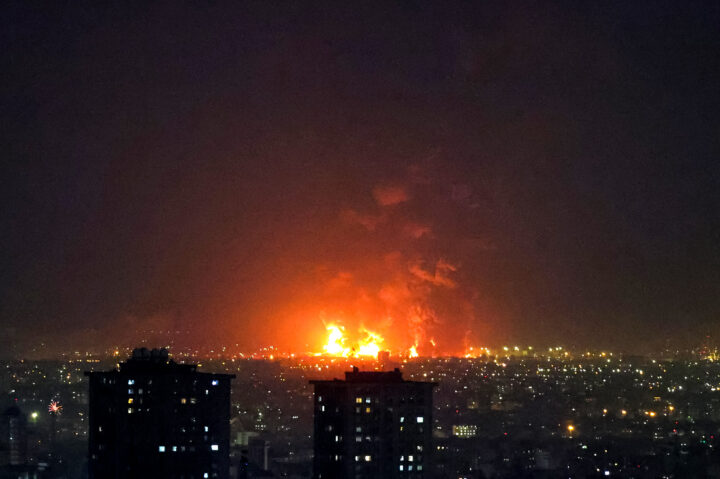
Explosions erupt following strikes at Tehran Oil Refinery in Tehran on March 7, 2026.


 Add JewishInsider on Google
CENTCOM announced on Wednesday evening that it had begun launching additional “self-defense” strikes against multiple targets in Iran, after initially renewing its attacks on Tuesday. A U.S. official told Axios the latest targets included air-defense systems, radars and drone command-and-control units in southern Iran.
The strikes came hours after President Donald Trump met with his national security team to discuss military options, and as Defense Secretary Pete Hegseth told reporters that CENTCOM would be “busy tonight” with “bombs dropping on key facilities in Iran.”
The military action came as Qatari mediators were reportedly meeting with officials in Tehran in an effort to revive negotiations and close remaining gaps between the U.S. and Iran.
Earlier in the day, Trump raised the possibility of targeting Iranian power plants and bridges, expressing frustration that Tehran is, in his view, stringing the U.S. along in diplomatic discussions. The strikes ultimately focused on military targets, according to a U.S. official.
A growing number of progressive candidates are now racing to disavow all military support for Israel, including for defensive systems such as the Iron Dome

JALAA MAREY/AFP via Getty Images
A picture taken on August 5, 2021, shows an Iron Dome defense system battery, designed to intercept and destroy incoming short-range rockets and artillery shells, in the Hula Valley in northern Israel near the border with Lebanon.
As U.S. discourse about Israel has become increasingly polarized and the left has grown increasingly hostile to the Jewish state, support for Israel’s missile-defense systems that protect the lives of millions of civilians remained a popular bipartisan priority.
Even among many progressives who were otherwise critical of Israel, U.S. aid for systems such as Iron Dome remained a rare exception, with most praising the system as an important protection measure for Israelis and Palestinians alike.
Emblematic of that fact: Just four House Democrats and two Republicans voted last year in favor of cutting $500 million in cooperative missile-defense funding that the U.S. provides to Israel annually.
But in the wake of the wars in Gaza, Iran and Lebanon, that consensus appears to be shifting quickly on the left. A growing number of progressive candidates — along with J Street, the left-wing Israel advocacy group — are now racing to disavow all military support for Israel, including for defensive systems such as the Iron Dome.
Rep. Alexandria Ocasio-Cortez (D-NY), one of the most prominent progressive standard-bearers, has been a trendsetter on the issue. She said earlier this month that she would not support any funding for Israeli missile defense going forward, after previously vociferously defending her vote against last year’s amendment cutting missile defense as a clear and easy choice.
Her reversal on the issue came amid criticism and pressure from Democratic Socialists of America members over that vote, as the far-left group debated whether to endorse her once more in her upcoming reelection bid.
Ocasio-Cortez argued that Israel is fully financially capable of funding Iron Dome and other defensive systems itself — pointing in part to Israeli Prime Minister Benjamin Netanyahu’s comments earlier this year that he wants to wind down U.S. aid to Israel, which have proven to be a thorn in the side of some pro-Israel advocates.
She was quickly followed by another prominent progressive Democrat, Rep. Ro Khanna (D-CA), who also harbors presidential ambitions, and other left-wing candidates. Another abrupt about-face on the issue came from former New York City Comptroller Brad Lander, who came out in support of Iron Dome funding during his 2025 mayoral campaign, but is now opposing it as he runs to the left of Rep. Dan Goldman (D-NY) in a congressional primary.
Michael Blake, the far-left challenger to Rep. Ritchie Torres (D-NY), also said he would continue to support Iron Dome funding just months ago, but has now flip-flopped to oppose it. Meanwhile, Torres doubled down on his support for Iron Dome funding in a post on social media over the weekend, saying, “I will never join that bandwagon—no matter how politically expedient it may become. Even the world’s most committed pacifist should have no objection to Iron Dome. It is purely defensive. It does not attack anyone. It simply intercepts projectiles that would otherwise strike homes, hospitals, schools, and synagogues. Its sole purpose is to prevent mass murder.”
Strikingly, J Street, which frames itself as a pro-Israel group, is echoing the same rhetoric used by far-left lawmakers like Ocasio-Cortez. “What progressives are saying is not radical, and in fact, Benjamin Netanyahu and Lindsey Graham are arguing the same thing. Israel is capable of paying for its own military equipment, including supplies for its missile defense systems,” a J Street spokesperson told JI.
That stance is at odds with J Street PAC’s own endorsement criteria for candidates, as displayed on its website as of Friday afternoon. J Street President Jeremy Ben Ami said in a Sunday Substack post that he wants to see U.S. direct aid and subsidies to Israel ended “responsibl[y] yet rapid[ly]” upon the conclusion of the current U.S.-Israel Memorandum of Understanding, but that the U.S. should continue to sell and co-develop defensive systems to Israel, subject to Israeli compliance with U.S. arms sales law.
Systems like Iron Dome are also co-produced by the U.S. and Israel, and similar arrangements would likely continue even if direct U.S. financial aid to Israel was ended in the short term.
And as the consensus among the left shifts, some anti-Israel Democratic candidates are pushing the envelope even further. Saikat Chakrabarti, a far-left candidate running for retiring Rep. Nancy Pelosi’s (D-CA) San Francisco House seat, said Thursday that “ending funding isn’t enough — we need sanctions.” Chakrabarti previously served as Ocasio-Cortez’s chief of staff.
There are signs that some more moderate lawmakers are also feeling the pressure from the left amid the declining support for Israel within the Democratic party: Sen. Ruben Gallego (D-AZ), who last year rejected efforts to block U.S. arms sales to Israel, said last week he’ll now oppose offensive aid while saying he views missile-defense support differently — a similar position to the one that progressives like Ocasio-Cortez and Lander held just months ago.
Lt.-Gen. Eyal Zamir said Israel is entering the war’s second phase with ‘additional surprises’ as Trump says he’ll pick Iranian leader – or else
ABIR SULTAN/POOL/AFP via Getty Images
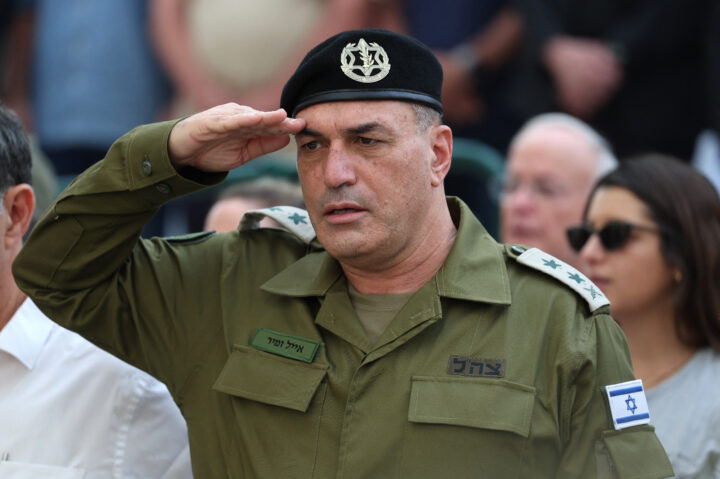
Israel's military chief Lieutenant General Eyal Zamir salutes during the funeral of Lieutenant Hadar Goldin who was killed during the six-week 2014 war in Gaza, at a military cemetery in Kfar Saba on November 11, 2025.
The U.S. and Israel have almost total control of Iranian airspace, IDF Chief of Staff, Lt.-Gen. Eyal Zamir said in a video statement on Thursday.
They “achieved near-complete air superiority over Iranian skies,” and Operation Roaring Lion, as Israel named the war with Iran, is entering its second phase, Zamir said.
The war is moving, he said, from the initial phase — beginning with Saturday’s “surprise strike” and followed by additional sorties to establish air superiority and degrade Iran’s ballistic missile array — to “further dismantle the regime and its military capabilities.”
“We have additional surprises ahead, which I do not intend to disclose. We will pursue our enemies, all of them, and we will overtake them,” Zamir added, paraphrasing Psalms 18:38.
Zamir said he is in “continuous contact with my American counterparts. We are fighting based on shared interests and shared values. We are fighting shoulder to shoulder. Through synchronized action, we are stripping the regime of its military capabilities, strategically isolating them and bringing them to a point of weakness unlike any it has known. This is truly historic cooperation״
The IDF Spokesperson’s Office said on Thursday that the military had struck over 300 of the Islamic Republic’s ballistic missile launchers and advanced defense systems in over 113 waves of strikes in western and central Iran, neutralizing 80% of Iran’s aerial-defense systems and over 60% of its ballistic missile launchers.
CENTCOM chief Adm. Brad Cooper said in a press conference on Thursday that Iranian ballistic missile attacks have decreased by 90% since Operation Epic Fury, the White House’s name for the operation, began on Saturday, with drone attacks declining by 83%.
The U.S. military has bombed nearly 200 targets inside Iran, including dropping 2,000-pound penetrator bombs targeting Iranian ballistic missile launchers stored underground, and sunk over 30 Iranian navy ships.
“We’re not just hitting what they have, we’re destroying their ability to rebuild. And so, as we transition to the next phase of this operation, we will systemically dismantle Iran’s missile production capability for the future, and that’s absolutely in progress,” Cooper said.
President Donald Trump told Politico on Thursday, “We’re taking out a threat to the United States of America, major threat, … and doing it like nobody’s ever seen before.”
Iran has “no navy. They have no air force. They have no detection of air. It’s all wiped out. Their radar is all wiped out. Their military is decimated. All they have is guts,” the president said.
Trump also said he plans to have a decisive influence on the next leader of Iran. “I’m going to have a big impact [on Iran’s future leadership], or they’re not going to have any settlement, because we’re not going to have to do this again,” Trump said. “We’ll work with the people and the regime to make sure that somebody gets there that can nicely build Iran but without nuclear weapons.”
The U.S. plans to “work with them to help make the proper choice,” so that the next Iranian leader will not “lead to having to do this [war] again in another 10 years.”
Trump said that Mojtaba Khamenei, the son of Iranian Supreme Leader Ayatollah Ali Khamenei, who was killed on the first day of the war, was a poor choice: “The reason the father wouldn’t give it to the son is they say he’s incompetent.”
Also on Thursday, the IDF launched its 26th wave of strikes in the Dahieh neighborhood of Beirut —a stronghold of the Hezbollah terrorist militia — hitting over 500 targets, including some in residential buildings in the Lebanese capital that the military said were used for terrorist infrastructure and UAV storage.
“Hezbollah made a strategic error,” Zamir said in his video statement, “[and] despite it directly conflicting with the interests of the Lebanese people, chose to join the campaign. Hezbollah is paying a heavy price.”
Israel killed the head of Hezbollah’s firepower array, known as Fidaa, whom Zamir said was “responsible for the deaths of many Israelis.”
“We will not let up on the objective of disarming Hezbollah,” Zamir added.
Magen David Adom emergency services reported 44 people injured amid attacks from Iran and Lebanon on Thursday through early Friday morning, all while making their way to shelters. MDA treated and evacuated 502 casualties from the start of Operation Lion’s Roar, including 359 injured on their way to shelter and five traffic accidents during sirens; there have been 12 fatalities.
Please log in if you already have a subscription, or subscribe to access the latest updates.
 Continue with Google

 Continue with Apple