














































































Rep. Josh Gottheimer called the trend ‘deeply alarming’ as Spain and Ireland moved to downgrade EU ties with Israel
Jens Kalaene/picture alliance via Getty Images
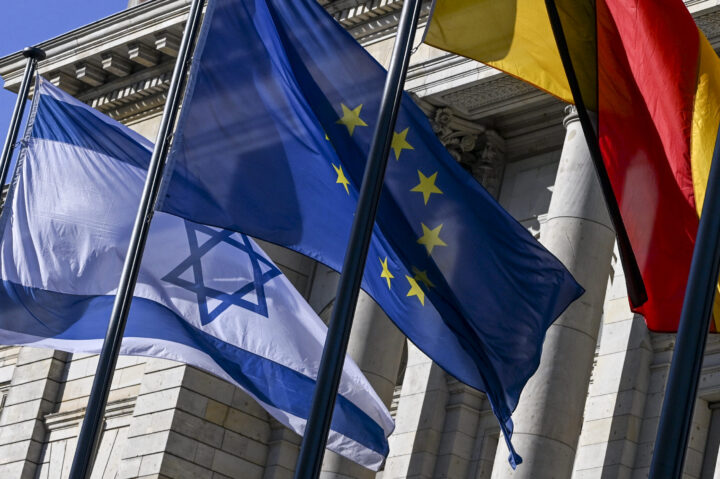
The flags of Israel (l-r), the EU and Germany fly in front of the Berlin House of Representatives.


 Add JewishInsider on Google
Democratic lawmakers are expressing concern over Israel’s fracturing relationship with key European allies, while experts say the shifting dynamics could carry longer-term economic and political risks for Jerusalem, even if Israel weathers threats to unwind largely symbolic defense agreements.
Israel’s relationships with various European countries have come under increasing strain in recent weeks. Last month, Israel halted all defense procurement from France amid worsening bilateral ties, while Italian Prime Minister Giorgia Meloni announced last week that Italy would cancel the automatic extension of its defense agreement with Jerusalem.
On Tuesday, Spain and Ireland led a push to suspend the EU’s association agreement with Israel — which has governed the bloc’s trade and political ties with Jerusalem since 2000. However, the move stalled as member states remained divided on the issue. A suspension of the full association agreement would require unanimity, a threshold that is not expected to be met as Germany and Italy indicated they would remain opposed for the time being. The European Commission has previously proposed suspending trade-related provisions of the agreement — which would only require a majority vote out of the 27 member states.
Rep. Josh Gottheimer (D-NJ) told Jewish Insider that the latest slate of moves unfolding in Europe is “deeply alarming” and “dangerous for all of us.”
“NATO allies like Spain, France and Italy are turning their backs on Israel, a key democratic partner that is actively fighting on the front lines against Iran,” Gottheimer said. “Singling out Israel represents a double standard.”
Gottheimer said that the U.S. “must make it clear” to European allies that “abandoning the world’s only Jewish state does not make them safer — it puts all of us at risk.”
Rep. Jake Auchincloss (D-MA) argued that the U.S. response should focus on strengthening regional and transatlantic ties, calling for an expanded Abraham Accords that are “knitted together with economic, energy and defense ties with Europe,” something he said would “create a more durable Eurasian security infrastructure.”
“As we look towards the next MOU [memorandum of understanding], it needs to be a regional security architecture,” Auchincloss said. “I think this Iran war has been such a complete catastrophe. As it relates to Europe, the president should close his mouth and stop belittling and degrading NATO.” President Donald Trump has taken repeated aim at the North Atlantic alliance over its leaders’ refusal to engage with the war in Iran.
When asked whether the U.S. should intervene in response to recent European measures, Rep. Brad Schneider (D-IL) said he believes the U.S. is “engaging” with European countries.
“We should continue to engage and work,” Schneider said. “My goal is to find a path to peace, Israel’s security and stability in the region, and ultimately peace for all peoples.”
“Israel is an incredible ally in an important region,” he continued. “We got to make sure we work together and strengthen that relationship and the same is true for Europe.”
Experts said that while the deterioration in Israel-Europe relations is real, the immediate military implications of these moves are limited.
“Israel’s relationship with Europe is certainly deteriorating,” Steven Cook, a senior fellow at the Council on Foreign Relations, told JI. But he called the moves from European countries “mostly symbolic.”
“There are European countries that have already embargoed weapons and parts, but it has not affected Israeli security,” Cook said. “Regardless, I suspect that the very fact that European countries are trying to use defense agreements and weapons systems as leverage with the Israeli government will only encourage the Israelis to be more self-sufficient in defense.”
Elliott Abrams, who served as Iran envoy during the first Trump administration, similarly told JI that the “military impact on Israel is not very large.” He noted that Israel did not maintain a serious military relationship with Spain and France.
Additionally, Abrams said that Meloni’s decision to cancel the automatic extension of the Israel-Italy defense agreement was not a sign that those ties are permanently broken, but rather it could provide her “leeway to renew” down the road “if the political situation is easier.”
“Nearly all of Israel’s military equipment comes from domestic production, the United States or Germany, so the deteriorating defense ties with European countries will not have a major impact on Israel’s military procurement,” David May, a senior research analyst at the Foundation for Defense of Democracies, said. “If anything, the European countries will be harmed by losing access to Israel’s battle-tested and innovative defense technology.”
Edmund Fitton-Brown, a former British diplomat and a senior fellow at FDD, also said that “defense issues are more symbolic than practical.”
“Israel’s overwhelming primary partnership is with the U.S., which regards Israel as a model ally,” Fitton-Brown said. However, he noted that putting “all Israeli eggs in one U.S. basket has drawbacks.”
“In an ideal world, any independent country will seek to diversify its supplies and partnerships to guard against excessive dependency on a single ally — but it reflects the reality that Israel no longer has any other load-bearing alliances besides the U.S. Netanyahu is investing everything in his management of the relationship with Trump,” Fitton-Brown added.
But while the military impact may be slim, experts warned of serious potential economic and political consequences of the worsening ties. Cook said that while he believes Sanchez’ EU push is unlikely to be successful due to a lack of support, he noted that it still has “enough support that it should make Israelis uncomfortable.”
“Israel’s security relationship pales in comparison to its economic relationship,” Cook said. “If the Europeans took action against Israel — like Sanchez’s proposal to end Israel’s association agreement with the EU — it would likely hurt the Israeli economy.”
The EU is currently Israel’s largest trading partner, accounting for roughly one-third of its total trade. Trade in goods between Jerusalem and the union has reached up to 42.6 billion euros in 2024. Israel is the EU’s third largest trading partner in the Mediterranean.
Fitton-Brown said that it would be a “serious matter” if Sanchez could “force the European Union to end its association agreement with Israel.” However, he similarly predicted that “he [Sanchez] probably can’t deliver on that threat.”
Abrams said that while Israel maintains relationships in “Central and Eastern Europe, and with Germany,” he warned that the changing dynamics among European nations could have political consequences.
“The political impact is serious, and here I would hope the U.S. can help,” Abrams said. “I am not sure we [the U.S.] can right now, given Trump’s own unpopularity in Europe and his too-frequent criticism of NATO countries.”
“The better path for Israel right now, in my view, is for Israel to ask friends like Germany, Poland and Czechia to block any Spanish initiative, and I think they will,” Abrams continued. “Sanchez’s hostility to Israel is not consensus among EU leaders, even given their criticism of [Israeli Prime Minister Benjamin] Netanyahu.”
Cook said Washington is unlikely to step in unless core defense supply chains are threatened. He noted that the “only way the U.S. would get involved is if Europeans tried to hold up parts for [Israel’s] F-35s [fighter jets],” adding that “critical components are built in Europe.”
Fitton-Brown, on the other hand, said that the U.S. should take action in response. He argued that a potential option could be for Washington to “question Spain’s right to protection from NATO,” adding that the U.S. could argue that such members that “undermine a key U.S. ally do not qualify as allies themselves.”
“The U.S. should make clear that it will not tolerate anti-Israeli policies beyond a certain point,” Fitton-Brown said. “Sanchez is almost equally showy in his anti-Americanism, and should be taught that such a policy is not without costs.”
The move marks the latest deterioration in the relationship between Jerusalem and Paris

Nathan Laine/Bloomberg via Getty Images
A display of air-to-surface munitions at the Elbit Systems Ltd. zone inside the Israel aerospace pavilion at the Paris Air Show in Paris, France, on Monday, June 16, 2025.
Israel is ending all defense procurement from France, the Israeli Defense Ministry said, citing Paris’ hostile posture toward Jerusalem and a desire to increase domestic production and purchases from allies.
“Israel will reduce all defense procurement from France to zero, replacing it with domestic Israeli procurement or purchases from allied countries,” Israel’s Ministry of Defense told Politico on Tuesday.
Maj. Gen. Air Baram, the director general of the ministry, said on Israel’s Channel 12 that the move is part of a larger effort to decrease military dependence on and partnerships with nations that have strained diplomatic relations with Israel.
The ministry also canceled meetings with France’s minister of the armed forces, instead insisting that “there will be no new professional engagement with the French military.”
The move is the latest rift in the bilateral relationship that has sharply deteriorated following the Oct. 7, 2023, terrorist attacks. During the Israel-Hamas war, France took a critical stance toward Jerusalem’s military conduct in the Gaza Strip and worked to pressure Israel to halt operations.
In September of last year, French President Emmanuel Macron became one of the first major U.S. allies to recognize Palestinian statehood. In that same month, Macron had said that Israel’s operations in Gaza were “making so many civilian casualties and victims that [Jerusalem is] completely destroying the credibility and image of Israel not only in the region but in public opinion everywhere.”
President Donald Trump has also expressed frustration with France for its actions amid the war in Iran, including prohibiting planes with military supplies destined for Israel from flying over its territory. He wrote on Truth Social that Paris has been “VERY UNHELPFUL” and that “The U.S.A. will REMEMBER!!!” — a post that surprised French officials.
Paris has also moved to limit Israeli participation in defense forums, barring dozens of Israeli companies from the Eurosatory 2024 exhibition, restricting their presence at the 2025 Paris Air Show and suspending export licenses.
Experts told Jewish Insider that the latest announcement is likely political posturing and will not have any practical impact on Israel given that defense ties between the two countries have already been on the decline.
“Israeli procurement from France was apparently quite limited and since the Israeli Ministry of Defense initiated the cut-off, they made the calculation that they could replace the items they obtain from France,” said Michael Eisenstadt, a fellow at The Washington Institute for Near East Policy. “I suspect there will be no practical consequence for Israeli manufacturers.”
A parliamentary report published in late 2025 found that France approved more than 200 dual-use export licenses to Israel in 2024 totaling €76.5 million — a roughly 60% drop from the previous year.
Eisenstadt noted that the latest action from Israel will not impact “collaboration between private companies or entities.” Existing agreements are expected to be upheld, and private firms can continue pursuing deals.
“Israel has lost patience with French criticism and unreliability,” Edmund Fitton-Brown, a former British diplomat and senior fellow at the Foundation for Defense of Democracies, told JI. “The fact is that Israel has historic reasons not to trust France, and now no longer needs France.”
Fitton-Brown said that moving forward Israel may increasingly “rely on the U.S. to represent its
interests in international affairs.” He similarly said that it will likely not have much impact on Israel.
“Israel is increasingly all-in with the U.S. as a defense partner, which makes diversifying defense supply an irrelevance,” Fitton-Brown said. “France has been the most disappointing of Israel’s European friends, adopting neutral or even hostile positions on a range of issues: recognition of a Palestinian state, a failure to back Israel fully against Hezbollah in Lebanon, ambivalence and obstruction regarding the U.S.-Israeli campaign against Iran.”
Please log in if you already have a subscription, or subscribe to access the latest updates.
 Continue with Google

 Continue with Apple