












































































The candidates’ views on Israel did not define the mayoral race, but they were a throughline in the background
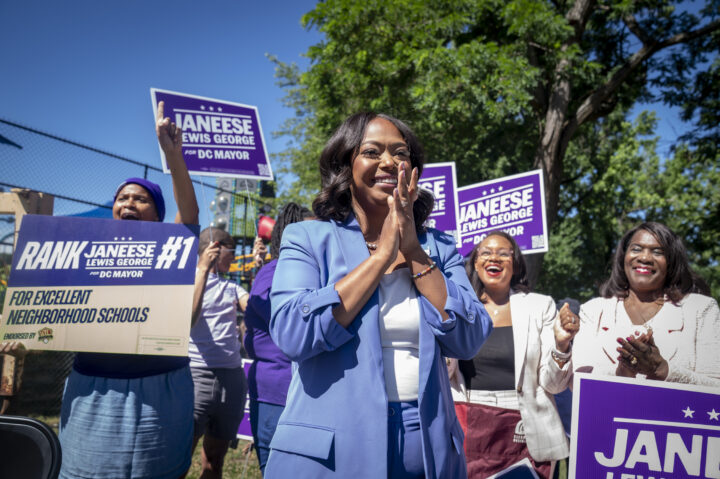
Maxine Wallace/The Washington Post via Getty Images
Janeese Lewis George volunteers continue to campaign for her at the Benning Stoddert Recreation Center on June 16,2026 in Washington, DC.


 Add JewishInsider on Google
Voters in Washington, D.C., appeared poised to select Councilmember Janeese Lewis George to be their Democratic nominee for mayor, all but guaranteeing that she will be elected in November to replace Mayor Muriel Bowser, who is not seeking another term after 12 years in office. The race has not been called, but Lewis George leads by more than 15,000 votes with 64% of the votes counted.
Lewis George, a 38-year-old member of the Democratic Socialists of America, ran a campaign powered by local labor unions that was focused on cost-of-living issues and countering President Donald Trump. She is on track to defeat Kenyan McDuffie, a former councilmember who ran on a more pragmatic platform that eschewed DSA’s brand of radical politics.
The candidates’ views on Israel did not define the race, but they were a throughline in the background. Lewis George filled out a DSA endorsement questionnaire early in the campaign in which she pledged to avoid engaging with “the Israeli government or Zionist lobby groups.” Later, she promised to stand firm in fighting antisemitism while also supporting Palestinian human rights. McDuffie tried to use the comments to appeal to anti-DSA voters and Jewish Washingtonians.
Lewis George will represent a shift from Bowser, a moderate Democrat who in 2019 led a trade mission to Israel and who regularly addressed the annual AIPAC policy conference in Washington before AIPAC canceled the event after 2020.
Elsewhere in Washington, Councilmember Robert White was elected in the Democratic primary to serve as Washington’s delegate to Congress, a nonvoting role. He’ll succeed Rep. Eleanor Holmes Norton, who is retiring after 35 years.
Aparna Raj, a DSA-backed candidate for D.C. Council, appeared likely to win the Democratic primary for Ward 1, a district that includes the neighborhoods of Adams Morgan and Columbia Heights. She told the D.C. Jewish Community Relations Council in a voter guide released last month that she “will not work with AIPAC or organizations whose mission is to lobby for pro-Israel policies.”
Meanwhile, it was a short night in Georgia, where Rep. Mike Collins (R-GA) quickly claimed victory over former college football coach Derek Dooley in a Senate primary runoff. Collins picked up a last-minute endorsement from President Donald Trump, while Dooley’s backing by Gov. Brian Kemp wasn’t enough to push him to victory.
Collins ultimately finished the race around 10 points ahead of Dooley, a similar margin as in the primary election earlier this year. Dooley dominated in Atlanta and Athens, Ga., home of the University of Georgia, while Collins led around the rest of the state.
Dooley was widely seen as the more moderate and more electable of the two Republicans, as compared to Collins, who has been trailed by a series of scandals. Republicans may struggle to reclaim the seat from Sen. Jon Ossoff (D-GA) with Collins as their standard-bearer in the race.
The race may also present a difficult choice for Jewish voters in the state, many of whom have been frustrated by Ossoff’s leftward turn on Israel issues and repeated votes to block arms sales. Some Jewish Ossoff donors sought, earlier in the cycle, to recruit Kemp to run for the seat.
But Collins might not be a palatable alternative for some Jewish voters, having endorsed a post by an antisemitic X account attacking a reporter for being Jewish. His current chief of staff was also recently revealed to be part of a group chat with several white nationalists, where he discussed his efforts to use his congressional influence to free a Holocaust denying far-right activist from prison. He also opposed the Antisemitism Awareness Act.
Many prominent Jewish conservatives supported Dooley in the primary, but could line up behind Collins for the general, given his consistently pro-Israel voting record in the House.
Already, some commentators are discussing the possibility that a decisive victory by Ossoff in the critical swing state could massively boost the rising Democratic star’s chances in the 2028 presidential primary, should he decide to throw his hat in the ring.
Lewis George, the mayoral candidate endorsed by the local Democratic Socialists of America chapter, did not show up but many of her D.C. City Council colleagues attended
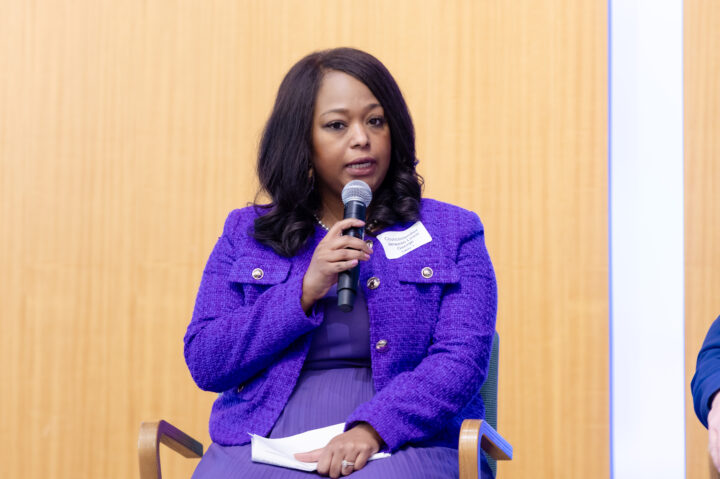
Jewish Community Relations Council of Greater Washington
D.C. City Councilmember Janeese Lewis George speaks at a "Lox and Legislators" breakfast held by the Jewish Community Relations Council of Greater Washington on Dec. 18, 2025
A group of Jewish District of Columbia residents gathered at the city’s municipal building on Wednesday for a scheduled meeting with Janeese Lewis George, a D.C. councilmember and one of the leading candidates in this year’s mayoral race, but she never showed, two people who were in the meeting told Jewish Insider.
A staff member for Lewis George told attendees at the start of the meeting that she was having a busy morning, and they should begin the conversation without her. At the end of the meeting, when Lewis George still had not arrived, the staff member apologized that she was unable to attend.
Lewis George’s attendance had been confirmed a day earlier by her staff.
Ben Rosenfeld, Lewis George’s communications director, told JI on Wednesday that the meeting “was scheduled before the Council hearing calendar was revised,” and Lewis George had to attend a hearing “addressing drastic cuts to paid family and medical leave, which was scheduled for the same time.”
In her place, Lewis George “was represented by senior legislative and office staff to meet with Ward 4 constituents and JCRC [Jewish Community Relations Council] leadership,” said Rosenfeld. “Councilmember Lewis George appreciates the opportunity to hear JCRC’s core priorities and shares these concerns in the upcoming budget process, including preserving the Early Childhood Educator Pay Equity Fund and ensuring houses of worship are supported amid a deeply concerning rise in antisemitism and hate.”
The meeting took place against the backdrop of a heated mayoral campaign, in which Lewis George has faced criticism from some in the Jewish community for her rhetoric around Israel and antisemitism.
She told members of the local Democratic Socialists of America chapter, of which she is a member, that she would not attend events that promote Zionism. In the DSA questionnaire, she criticized the JCRC of Greater Washington, a local advocacy group, for its approach to antisemitism, and ultimately earned the DSA’s endorsement.
“I was offended by her last minute no show. This was her chance to meet with Ward 4 residents to discuss issues affecting them and their families, and she was the only councilmember to not show up for her scheduled meeting,” one of the meeting attendees told JI.
The Wednesday meeting was part of JCRC’s annual D.C. Advocacy Day, which included meetings between Jewish Washingtonians and their councilmembers. The meetings were focused on local issues, like the city’s nonprofit security grant program and funding for early childhood educators. The two meeting attendees who spoke with JI said the meeting with Lewis George’s staff was generally positive and did not touch on the mayoral campaign controversies.
Jewish community leaders also met with Phil Mendelson, the council chair, and Councilmembers Brooke Pinto, Brianne Nadeau, Christina Henderson, Charles Allen and Doni Crawford.
Ward 4, which Lewis George represents, is home to several major Jewish institutions, including Sinai Temple, Ohev Sholom Congregation and the Milton Gottesman Jewish Day School, each of which had staff members at the meeting.
Greater Washington JCRC CEO Ron Halber called the meeting with Lewis George’s staff “thoughtful and productive,” and said he did not fault her for missing the meeting.
“We meet regularly with policymakers and their teams throughout the year. We know that there are many demands on their time and we understand completely when unanticipated scheduling changes come up,” said Halber. “We deeply appreciate their commitment to our policy priorities and look forward to continuing our shared work together.”
In February, Halber called the DSA endorsement questionnaire an “antisemitic manifesto” but has not specifically weighed in on Lewis George’s past comments about Zionism.
Lewis George met privately last month with a group of Washington rabbis, where she apologized for her answers in the DSA questionnaire, a sentiment she has not shared publicly. Her chief competitor in the race, former Councilmember Kenyan McDuffie, has criticized Lewis George for her comments in the questionnaire.
This story was updated on April 23 to add comment from Greater Washington JCRC CEO Ron Halber.
Councilmember Shahana Hanif faced pushback while interviewing for the endorsement of NYC-DSA for having belatedly condemned Hamas for the Oct. 7 attacks

Michael M. Santiago/Getty Images
Council Member Shahana Hanif speaks during a rally before a City Council Oversight hearing at City Hall on March 1, 2023, in New York City.
A New York City councilmember known for her fervent criticism of Israel faced harsh questioning at a recent gathering of the Democratic Socialists of America — because she had also spoken out against Hamas, as well as supporters of the terrorist organization who demonstrated outside New York synagogues.
The comments came during Councilmember Shahana Hanif’s interview earlier this month with the NYC-DSA Socialists in Office committee. Hanif, a DSA member who long lambasted Israel prior to facing a centrist challenger last year, appeared before the group in order to receive formal endorsement and volunteer support from the organization in the future.
But during the interview process, held both in-person and over Zoom, Hanif faced questioning for her condemnation of Hamas for its Oct. 7, 2023, attacks — which came belatedly in April 2024 — and her denouncement of protesters who chanted, “We support Hamas” outside a Queens synagogue in January, according to a recording obtained by Jewish Insider.
“Something that concerned me is the comparison of protesters who chanted support of Hamas to neo-Nazi protests, equating them both as antisemitism. Many of us, with 60% of Gen Z supporting Hamas against Israel, many of us are realizing now that we’ve been lied to all our lives,” one participant in the interview said to Hanif. “We do so under fear knowing that the politicians that represent us are supporting a genocide, as well as supporting political repression against us. So will you fight back against that effort to repress us, or will you take part in it yourself?”
Hanif asked the questioner to clarify her query.
“When we are accused of antisemitism for supporting the Palestinian resistance, many leftist politicians equate that to the antisemitism of neo-Nazis and I feel that is extremely dangerous,” the young woman said.
In response, Shanif did not directly engage with the speaker’s comments on Hamas but appeared to agree that too many protesters had been identified as antisemitic.
“The propaganda on antisemitism and what is antisemitism has certainly hurt our city in many, many ways,” the Brooklyn Democrat said. “I’m only looking forward to making sure to call out the bullshit where there is. And listen, I’m not perfect on messaging. This takes not only practice, but it also takes learning.”
Hanif further indicated that if admitted to the Socialists in Office group, which currently includes only two of the Council’s 51 members, they could collectively coordinate to push back on allegations of antisemitism.
“I think it’s a very important question, and I think having this cohort of city SIOs to work with will provide a healthy scholarship on issues pertaining to what is antisemitism, or calling out what is not antisemitism that is being called antisemitic,” Hanif continued.
Hanif’s office did not answer questions seeking clarity on her post-election stance toward Hamas. In a statement to JI, NYC-DSA stressed that all dues-paying members had access to the forum and that the group did not vet questions in advance. It also maintained it has criticized the conduct of both Israel and Hamas, even though it promoted protests against the Jewish state just one day after the Oct. 7 attacks.
“Individual participants and members do not reflect the positions of the organization,” said NYC-DSA Vice Chair Grace Mausser. “We have long been on the record in condemning all war crimes and massacres.”
Please log in if you already have a subscription, or subscribe to access the latest updates.
 Continue with Google

 Continue with Apple