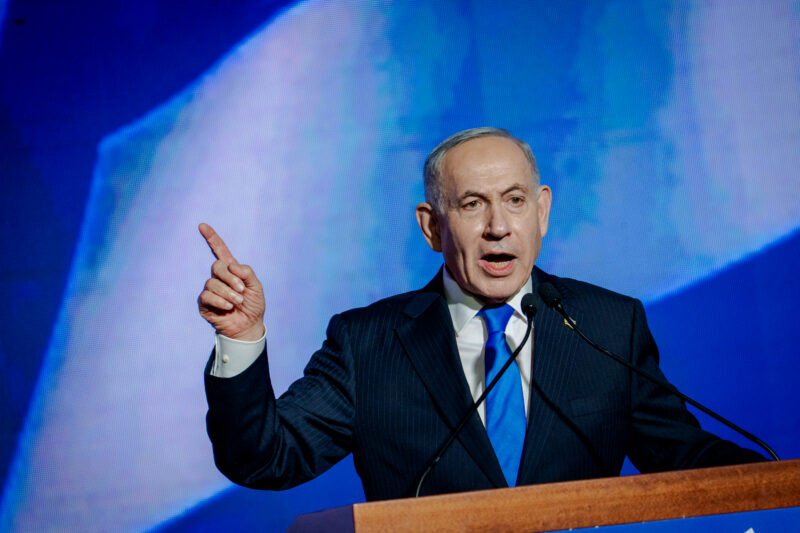

































































‘We all see Lebanon is at a point of change. We're here to tell you that we're buying into that change,’ Graham said, citing the country’s ‘religious diversity’
Houssam Shbaro/Anadolu via Getty Images
Sen. Lindsey Graham (R) speaks during a press conference alongside Sen. Jeanne Shaheen and Rep. Joe Wilson in Beirut, Lebanon on August 26, 2025.
Sen. Lindsey Graham (R-SC) championed a U.S. defense agreement with Lebanon during a bipartisan congressional delegation to Beirut on Tuesday, saying it would be the “biggest change in the history of Lebanon.”
Speaking at a press conference alongside Sen. Jeanne Shaheen (D-NH) and Rep. Joe Wilson (R-SC), Graham asked, “How many nations have a defense agreement with the United States? Very few. … The number of nations that America is willing to go to war for is very few. Why do I mention Lebanon being in that group? You have one thing going for you that is very valuable to me: religious diversity.”
“Christianity is under siege in the Mideast. Christians are being slaughtered and run out of all over, all over the region, except here. And so what I am going to tell my colleagues is, ‘Why don’t we invest in defending religious diversity in the Mideast? Why don’t we have a relationship with Lebanon where we would actually defend what you’re doing?’” he continued.
“I think it’s in America’s interest to defend religious diversity, whether you’re Druze or Alawite or a Christian or whatever. The idea that America may one day have a defense agreement with Lebanon changes Lebanon unlike any single thing I could think of,” Graham said.
During their visit, the delegation, joined by U.S. Ambassador to Turkey Tom Barrack, diplomat Morgan Ortagus and U.S. Ambassador to Lebanon Lisa Johnson, met with Lebanese President Joseph Aoun, Prime Minister Nawaf Salam, Parliament Speaker Nabih Berri and head of the Lebanese Armed Forces Gen. Rodolph Haykal.
During the press conference, the lawmakers conveyed their encouragement over the progress that Lebanon has made in military, financial and democratic reforms and their hope that the government would be able to execute the changes fully.
“We all see Lebanon is at a point of change. We’re here to tell you that we’re buying into that change, that we support what you’re trying to do. That if you do make an effort to disarm Hezbollah, we’ll be there trying to help. We’ll try to help your military, we’ll try to help your economy. We think that’s the right thing for you to do, and it benefits the entire region,” Graham said.
“If you’re able to pull this off, Saudi Arabia will look at you differently. If you’re able to pull it off, Israel will look at you differently. If you’re able to pull this off, there’ll be a groundswell of support in Washington to help your economy and to help your military,” he continued.
“Congress is looking at Lebanon differently because you’re behaving differently. If you continue to go down this road, I think you have a wonderful opportunity to secure your nation, economically, militarily, like anything I’ve seen since I’ve been coming to the region with [the late Sen.] John McCain (R-AZ). It all depends on what happens with the Hezbollah file and the Palestinian file.”
Wilson compared recent changes in Lebanon and in Syria with the fall of dictator Bashar al-Assad to the fall of the Berlin Wall in 1989. “There’s such an opportunity for stability, security, for economic prosperity, for everyone,” he said.
Graham also emphasized the potential for improved relations between Israel and Lebanon if Hezbollah was contained. “If I were the Israeli prime minister, I would be looking at Lebanon differently after Hezbollah was disarmed by the Lebanese people,” he said.
Pressed by reporters on what steps Israel is taking to disarm Hezbollah and de-escalate conflict, Graham answered, “Why do you need Israel to tell you to disarm Hezbollah? That’s not Israel’s decision. That’s yours. Whether [the IDF] withdraw[s from southern Lebanon] or not, it depends on what you do. So don’t tell me anymore, ‘We’re not going to disarm Hezbollah until Israel does something.’ If that’s the model, you’re going to fail.”
“The reason you disarm Hezbollah is because it’s best for you. This country is going backward, not forward, if you don’t follow through with disarming the Palestinians and Hezbollah and making the Lebanese army the central repository of arms for the nation. If you don’t do that, you’re going nowhere,” the South Carolina senator said.
Israeli Prime Minister Benjamin Netanyahu said in a statement yesterday that he “acknowledges the significant step taken by the Lebanese Government” and that “in light of this important development, Israel stands ready to support Lebanon in its efforts to disarm Hezbollah and to work together towards a more secure and stable future for both nations.”
Netanyahu pledged that if the Lebanese Armed Forces “take the necessary steps to implement the disarmament of Hezbollah, Israel will engage in reciprocal measures.”
Shaheen and Graham, both of whom serve on the Senate Appropriations Committee, also spoke about their support for supplying U.S. funding for the LAF and Lebanon’s financial recovery.
Shaheen called the steps Lebanon’s government has pledged to make in military and banking reforms “critical” and said the lawmakers will “continue to press for support, through legislation and through the appropriations process, support for the avenue that Lebanon has chosen for your future.”
'I think the timing just becomes all that much more important,' Rep. Brad Schneider (D-IL), who is leading the trip, told JI
Alex Brandon/AP Photo
Israeli Prime Minister Benjamin Netanyahu, United Arab Emirates Foreign Minister Abdullah bin Zayed al-Nahyan and Bahrain Foreign Minister Khalid bin Ahmed Al Khalifa, stand on the Blue Room Balcony during the Abraham Accords signing ceremony on the South Lawn of the White House, Tuesday, Sept. 15, 2020, in Washington.
A bipartisan group of lawmakers is departing today for Saudi Arabia, the first leg of an Abraham Accords-themed congressional delegation that also plans to visit Bahrain, the United Arab Emirates and Israel and meet with leaders in each country. Rep. Brad Schneider (D-IL), who is leading the delegation, told Jewish Insider that the trip will take place even as Israeli strikes against Iran continue.
“I think the timing just becomes all that much more important,” Schneider said in an interview on Friday. “Last night, Iran took a significant hit to its nuclear program and its military. So I think and hope maybe it opens up possibilities. We’ll find out.”
Other members attending the trip, which is hosted by the Atlantic Council’s N7 Initiative, include Reps. Don Bacon (R-NE), Jimmy Panetta (D-CA) and Zach Nunn (R-IA).
“During these times of instability in the region, support for the Accords is necessary to enhance Israel’s security and stability, as well as a way to counter threats posed by Iran,” Bacon said in a statement.
It has been nearly five years since Israel normalized ties with the UAE, Bahrain and Morocco in the Abraham Accords, which were widely viewed not just as a diplomatic accord but also a counterweight to Iran’s influence in the region.
“The Arab countries around Israel remain committed to this idea of a better future, a pathway to peace, and I believe the Abraham Accords are that path,” said Schneider. “The purpose of the trip, before the strikes against Iran, was to talk about that. That doesn’t change.”


