










































































The leading Jewish legal group alleges that the country’s largest teachers’ union has repeatedly discriminated against its Jewish members
Kristoffer Tripplaar/Sipa via AP Images
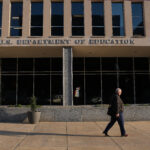
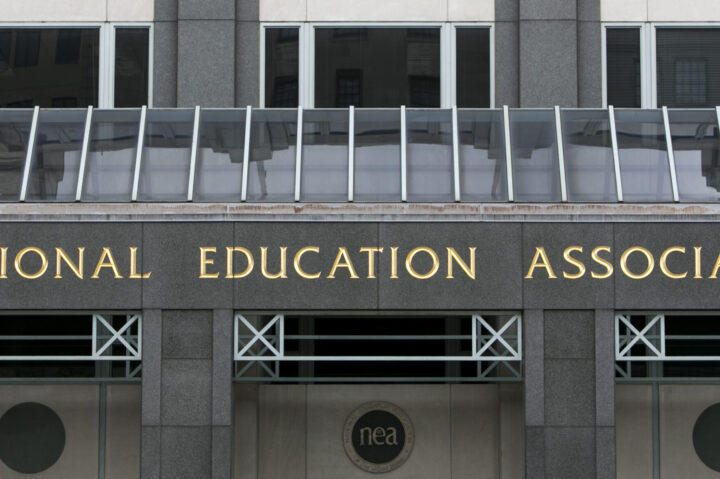
A logo sign outside of the headquarters of the National Education Association (NEA) labor union in Washington, D.C. on July 11, 2015.


 Add JewishInsider on Google
A leading Jewish legal group has filed a bias complaint with the U.S. Equal Employment Opportunity Commission against the National Education Association, alleging the country’s largest teachers’ union violated civil rights law by discriminating against its Jewish members, Jewish Insider has learned.
The complaint, filed Monday by the Louis D. Brandeis Center for Human Rights Under Law, highlights several incidents in which the NEA — which represents over 3 million educators — allegedly breached Title VII of the Civil Rights Act of 1964, which protects employees, resulting in the spread of antisemitism in K-12 public schools.
“Students are arriving to college much of the time already having antisemitic views,” Marci Miller, Brandeis Center’s director of legal investigations, told JI. “We needed to look at the K-12 space to see where this was originating, and we saw that a lot of the false narratives and antisemitic tropes were originating from local teachers’ unions — and in a lot of cases it came from the top, the NEA, which is the umbrella union.”
Last summer, the NEA’s Representative Assembly passed a resolution to boycott the Anti-Defamation League’s Holocaust education materials after union delegates complained the ADL’s definition of antisemitism was too strong. While NEA’s board of directors unanimously voted to reject the measure that would’ve ceased relations with the ADL, Jewish educators and parents continue to remain uneasy about rising antisemitism within the union.
The 297-page complaint highlights several concerns in the NEA’s 2025 handbook, a 434-page report outlining the organization’s “visionary goals” and “strategic objectives.”
Among these examples is official handbook language for International Holocaust Remembrance Day that removed Jews as the primary targeted victims of the Holocaust, reframing the genocide as a generalized tragedy, the Brandeis Center said.
The handbook stated that the “NEA shall promote the celebration of International Holocaust Remembrance Day on January 27 annually on its website and through other appropriate media to recognize the more than 12 million victims of the Holocaust from different faiths, ethnicities, races, political beliefs, genders, and gender identification, abilities/disabilities, and other targeted characteristics.”
Although the language was later revised following public backlash, the NEA did not issue an apology for the erasure of Jewish history from its handbook materials and provided no corrective guidance to members or affiliates.
On Oct. 8, 2025, one day after the two-year anniversary of Hamas’ Oct. 7, 2023, terrorist attacks, the NEA sent a mass email to its membership celebrating Indigenous lands and distributing a “Native Land Digital” map that erased Israel entirely, labeling the territory solely as Palestine and linking to materials associated with organizations that have expressed support for Hamas’ attacks.
After public backlash, the NEA removed the resource and issued a statement that the external resource did not meet its standards, but it did not advise members to stop using the materials or issue an apology to Jewish members.
According to the complaint, Jewish members reported facing harassment at the NEA’s 2025 Representative Assembly, a convening of the organization’s top leaders from around the country — the same group that voted to censure the ADL.
Allegations included Jewish delegates being physically surrounded and shouted at by anti-Israel advocates; delegates laughing after a Jewish delegate referred to the murder of an 82-year-old Holocaust survivor in the Boulder, Colo., antisemitic firebombing attack; and delegates physically intimidating and disrupting the Jewish Affairs Caucus when the executive chair tried to speak.
The complaint also alleges that the NEA engages in systematic discrimination by utilizing discriminatory racial quotas and preferences, a practice that harms Jewish members who are excluded from preferred racial groups, denying them equal access to opportunities and full participation in union governance.
“NEA is not taking enough steps to make Jewish teachers, Jewish members feel comfortable in the NEA,” said Miller. “They may have taken some minimal steps but haven’t really responded to complaints from members.”
The complaint comes as NEA is under investigation by the House Committee on Education and Workforce, as well as the Senate Health, Education, Labor, and Pensions Committee, following allegations that its policies and materials have fostered an environment conducive to antisemitism in K-12 schools.
Attendees are expected to include Harvard community members, Jewish activists, lawyers and scholars
Cassandra Klos/Bloomberg via Getty Images
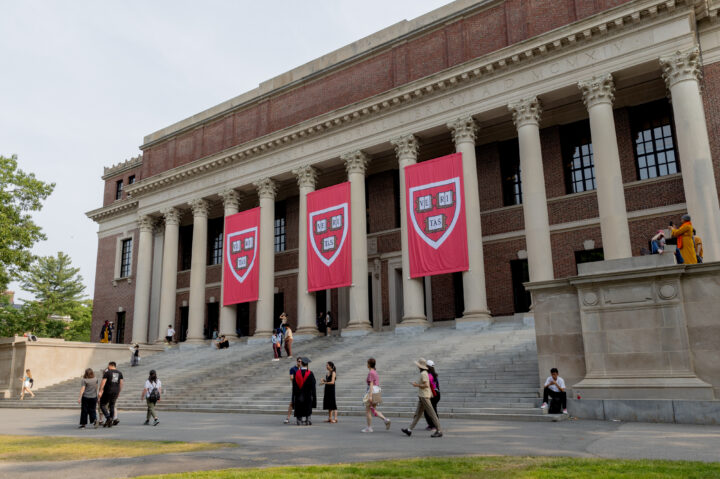
The Widener Library on the Harvard Campus in Cambridge, Massachusetts, US, on Wednesday, June 4, 2025.
A Jewish legal group will convene its inaugural conference on antisemitism and civil rights law at Harvard University on Thursday, an event that was born out of last year’s settlement of a Title VI lawsuit against the school and framed around the upcoming 250th anniversary of the United States.
“We’re very excited to have a mix of federal, high-level leadership, prominent scholars, Jewish communal leaders, high-powered litigators and experts in the field,” Ken Marcus, founder and chairman of the Louis D. Brandeis Center for Human Rights Under Law, the group hosting the conference, told Jewish Insider.
The day-long event is slated to open with an address from Marcus and benediction from Rabbi Hirschy Zarchi, who leads Harvard Chabad.
Held as America prepares to celebrate its 250th anniversary this summer, Marcus said the headline session will focus “on how we define antisemitism as lawyers and professionals, and why a proper definition of antisemitism matters for America at this point in time.” The panelists will include Andrea Martin, co-chair of the Center for Jewish Legal Studies; Nathan Diament, executive director for the Orthodox Union Advocacy Center; Alyza Lewin, president of U.S. affairs for Combat Antisemitism Movement; and Julie Paris, Mid-Atlantic regional director of StandWithUs.
The plenary session, “Towards a Jewish Civil Rights Movement,” moderated by Marcus, will feature William Daroff, CEO of the Conference of Presidents of Major American Jewish Organizations; Elan Carr, CEO of Israeli-American Council and former special envoy to monitor and combat antisemitism; and Miriam Elman, executive director of the Academic Engagement Network.
A separate panel, moderated by Anat Alon-Beck, a visiting professor at Harvard Law School, will explore new avenues for litigation against antisemitism.
Attendees are expected to include Harvard community members, Jewish activists, lawyers and scholars, according to Marcus, who served as assistant secretary of education for civil rights in President Donald Trump’s first administration.
In January 2025, the Brandeis Center settled its lawsuit with Harvard, which alleged that since the Oct. 7, 2023, terrorist attacks in Israel, students and faculty on campus called for violence against Jews and celebrated Hamas’ terrorism as the university ignored harassment — including a physical assault — of Jewish students.
Under the terms of the resolution, Harvard agreed to host Brandeis Center events, implement the International Holocaust Remembrance Alliance’s working definition of antisemitism, invest additional academic resources to study antisemitism and establish another partnership with a university in Israel, in addition to programs the university currently has in place with Israeli universities.
The conference comes as Harvard remains entrenched in legal battles with the Trump administration, which it has sued to recover billions in funding that was frozen over the government’s allegations that the school has not adequately addressed antisemitism. A federal judge ruled last September that the government violated Harvard’s First Amendment rights and federal law when it froze nearly $2 billion in federal grants. The Trump administration filed an appeal in December 2025, which is ongoing.
Last month, the clash escalated when the Trump administration filed a new lawsuit against the university, claiming that its leadership violated the civil rights of Jewish students by failing to address ongoing antisemitism that has roiled the campus since Oct. 7.
The conference is also held against the backdrop of a newly released report by Harvard’s official Jewish alumni group finding that Jewish enrollment at the Boston school has fallen to roughly 7% — its lowest level since the pre-World War II era.
Marcus said the Brandeis Center has been in “continuing engagement with Harvard University over both the challenges that we still see there and the efforts that they’re undertaking to address them.”
“This conference is a part of that process and we hope it can be used to take the problems that they have had at Harvard and to turn them into something positive, not just for Harvard University and the Commonwealth of Massachusetts, but for the country as a whole,” continued Marcus.
“We see this as the first of a series of conferences that we will have at Harvard University and may consider hosting them in other locations as well,” he said.
The administration alleges that GW’s anti-Israel encampment last spring led to harassment, abuse and assault

Ingfbruno/Flickr
George Washington University became the latest target of the Trump administration’s crackdown on campus antisemitism on Tuesday when the Department of Justice notified the D.C. private school that it is in violation of federal civil rights law.
In a letter addressed to GW President Ellen Granberg, the DOJ described the university administration as “deliberately indifferent” to antisemitism on campus and claimed that it took “no meaningful action” to combat increased antisemitism since the Oct. 7, 2023 terrorist attacks. More than 25% of the undergraduate students on GW’s campus identify as Jewish.
The letter called the anti-Israel encampment that overtook the center of GW’s campus for nearly two weeks in 2024 a “hostile environment” where “Jewish students [were] being harassed, abused, intimidated and assaulted by protesters.” The encampment, which began on April 25, was cleared on May 8 just hours before a planned Capitol Hill hearing on the D.C. government’s handling of the protest, after repeated public requests for assistance from GW’s administration.
“Based on its investigation, the Department has concluded that GW took no meaningful action and instead was deliberately indifferent to the hostile educational environment on its campus in violation of Title VI,” the letter said.
“We have received the letter and are currently reviewing its contents to respond in a timely manner,” Shannon McClendon, a GW spokesperson, told Jewish Insider.
“GW condemns antisemitism, which has absolutely no place on our campuses or in a civil and humane society. Moreover, our actions clearly demonstrate our commitment to addressing antisemitic actions and promoting an inclusive campus environment by upholding a safe, respectful, and accountable environment. We have taken appropriate action under university policy and the law to hold individuals or organizations accountable, including during the encampment, and we do not tolerate behavior that threatens our community or undermines meaningful dialogue.”
Teddy Schneiderman, a rising junior at GW who is president of the campus chapter of Alpha Epsilon Pi, told JI that if the university makes changes in light of the government crackdown, he would like to see it provide a campus police presence at Jewish events and institutions, such as Shabbat dinners.
“This would offer visible reassurance and protection at a time when safety is a significant concern for the Jewish community, especially following the tragic murder of two Israeli Embassy staff earlier this year in Washington, D.C. Taking such action would send a clear message that GW is committed to safeguarding all students, including the Jewish community and allow us to continue to safely demonstrate our Jewish pride,” said Schneiderman.
Rabbi Levi Shemtov, the executive vice president of American Friends of Lubavitch (Chabad), which oversees Chabad’s national and local activities, including on GW’s campus, told JI that during the encampment, he would have agreed with the government’s allegation of GW’s indifference. “I’ll never forget what I saw with my own eyes for weeks,” Shemtov said. “But I do believe things have slightly improved, given President Granberg’s increased focus on the problem.”
“If the university wants to resolve this without prosecution, they are being given a very generous chance by the DOJ to do so,” said Shemtov.
“We expect that the steps taken to resolve this matter will result in a GW that is safe and welcoming for Jewish students and faculty, and where teaching and research can thrive,” Abbey Frank, interim executive director of GW Hillel, said in a statement.
The DOJ wrote that it seeks “immediate remediation” with the university, giving campus administration until Aug. 22 to indicate whether it would like to engage in dialogue. Similar investigations earlier this year at schools including Harvard and Columbia resulted in the Trump administration pulling millions of dollars in federal funding. It restored Columbia’s funding in July, following months of negotiations and a $200 million settlement.
Please log in if you already have a subscription, or subscribe to access the latest updates.
 Continue with Google

 Continue with Apple