









































































Moreno said at an event commemorating Jewish American Heritage Month that he would push for the SACRED Act to be passed by unanimous consent in the coming days

Kevin Dietsch/Getty Images
U.S. Sen. Bernie Moreno (R-OH) participates in a Senate Commerce, Science, and Transportation Committee hearing in the Russell Senate Office Building on January 28, 2025 in Washington, DC.


 Add JewishInsider on Google
Sen. Bernie Moreno (R-OH) said Wednesday that he plans to call on the Senate to pass the SACRED Act, legislation imposing restrictions on protests around synagogues and other religious institutions, by unanimous consent.
The effort could be derailed by opposition from any one lawmaker, but highlights the momentum and desire by some on Capitol Hill to pass “buffer zone” legislation or other measures to combat antisemitism, which Congress has struggled to do on several occasions since Hamas’ Oct. 7, 2023, attacks on Israel and the ensuing spike of antisemitism.
“’I’m going to get the SACRED Act done,” Moreno said at a breakfast event held on the Hill by Jewish organizations commemorating Jewish American Heritage Month. “My plan is in the next day or two to put the SACRED Act on the floor of the United States Senate with unanimous consent, get that passed.”
The SACRED Act, which was introduced in late April in the House by Reps. Tom Suozzi (D-NY) and Max Miller (R-OH), would create criminal and civil penalties for individuals who attempt to intimidate or obstruct someone to prevent them from entering or exiting a place of worship, within 100 feet of a religious institution.
A Senate version of the bill has not yet been introduced. Republicans and outside advocates are also working on alternative buffer zone legislation that would likely take a different approach than Suozzi’s bill.
The breakfast event was organized by the Combat Antisemitism Movement, the Jewish Federations of North America, the Conference of Presidents of Major American Jewish Organizations and the Weitzman Museum of Jewish American History.
Other attendees included Sen. David McCormick (R-PA) and Reps. David Kustoff (R-TN), Haley Stevens (D-MI), Tim Kennedy (D-NY), Josh Gottheimer (D-NJ), Virginia Foxx (R-NC), Debbie Wasserman Schultz (D-FL), Wesley Bell (D-MO), Kim Schrier (D-WA), Brad Schneider (D-IL), Randy Weber (R-TX), Don Bacon (R-NE), Jim Jordan (R-OH), Dan Goldman (D-NY), Rick Allen (R-GA) and Randy Fine (R-FL).
Sam Salz, one of the first Orthodox Jewish NCAA Division I football players, was the keynote speaker.
Bacon, who is retiring at the end of his term, said that he’s concerned about the rising antisemitism on both sides, including on the right within the Church.
He said that some are rejecting and twisting scripture “just like Nazi Germany did in the 1930s and just like we’ve seen throughout history, where we’ve seen antisemitism using the Bible to condone it.”
Making reference to Rep. Thomas Massie (R-KY), he called it “just wrong” for Massie to blame Israel for his loss in his concession speech on Tuesday, also condemning Democratic Texas candidate Maureen Galindo, who has espoused a range of virulently antisemitic sentiments.
The bill would create criminal and civil penalties for individuals who attempt to intimidate or obstruct access to houses of worship within a 100-foot zone
Heather Diehl/Getty Images
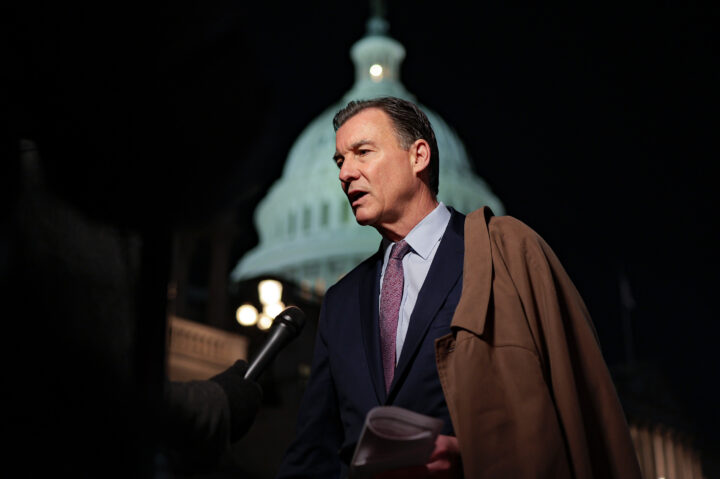
Rep. Tom Suozzi (D-NY) speaks with members of the media outside the U.S. Capitol on December 17, 2025 in Washington, DC.
Rep. Tom Suozzi (D-NY), joined by Rep. Max Miller (R-OH), introduced the SACRED Act this week, a new bill aimed at protecting attendees at religious institutions from harassment and threats by demonstrators — a phenomenon seen repeatedly outside synagogues that has spurred “buffer zone” legislation in New York and elsewhere.
The bill, which applies within 100 feet of a religious institution, would create criminal and civil penalties for individuals who attempt to intimidate or obstruct someone in a manner that causes reasonable fear for physical safety to prevent them from entering or exiting a place of worship. It also applies — within that 100-foot zone — to individuals who intentionally approach within eight feet of a person seeking to exercise their freedom to worship, for the purpose of intimidating or harassing them.
The bill builds on the existing FACE Act, invoked by the Trump administration in recent lawsuits, which bans the use of force, threats or physical obstruction to prevent an individual from exercising their religious freedom at a place of worship.
Unlike some legislation at the local and state level, the bill would not ban all protests within the 100-foot buffer zone, specifically permitting peaceful picketing and other non-disruptive demonstrations.
First offenders would be subject to fines or up to one year in prison, with repeat offenders subject to greater fines and up to three years in prison. The bill would also create a civil right of action for both victims of harassment as well as the Department of Justice and state attorneys general.
Suozzi told Jewish Insider the bill was prompted by constituents from various religious communities who have expressed concern about “aggressive action” against them at their places of worship.
The spate of incidents outside synagogues has been “very disturbing,” Suozzi said, adding that he’s been hearing an unprecedented amount of fear and concern from Jewish friends and supporters since the Oct. 7, 2023, Hamas attacks — ”[they] have said things to me that I never heard before, things like ‘We don’t know what to do? What would we do if they came for us?’ People are genuinely scared, and we see this hateful behavior not just [against] Jews but against other religious minorities as well.”
He described the bill as a delicate, and carefully crafted, balance designed to uphold First Amendment rights to both freedom of speech and freedom of religion.
“This is a very, very sensitive topic that involves First Amendment rights and also people’s concern about their safety and their not only their right to free speech, but also their right to worship,” Suozzi said. He added that he had consulted with a constitutional scholar, Erwin Chemerinsky, dean of Berkeley Law School, in drafting the bill, who said it is compliant with the First Amendment.
“If you’re doing a peaceful protest and you’re leafleting or something like that — we don’t have a problem with that. It’s with these people that are going up to people and yelling at them and saying meanspirited, awful things with an intent to try to physically stop them from entering into their religious institution [that are the issue],” Suozzi continued, adding that even offensive but peaceful speech like opposing a religion or Zionism would be permitted.
“It would be [banned] if you came up close to people and you start yelling in their faces and saying, ‘you’re a Zionist pig,’ or something like that — trying to intimidate them,” he explained.
Miller said in a statement, “Every American deserves to practice their faith free from fear, intimidation, or harassment.”
“The SACRED Act ensures that people can access their place of worship safely and without obstruction, while still preserving First Amendment protections for peaceful expression,” he continued. “This commonsense legislation draws a clear line: intimidation and threats have no place in our communities.”
Suozzi emphasized that the bill is different from other recent state- and local-level buffer zone legislation, and he took pains to avoid modeling the bill after a Massachusetts law that was struck down in court which had banned all protests within a 35-foot zone. The eight-foot “floating buffer zone” was based on a Colorado law that was upheld by the Supreme Court, he said.
And, he said, “we’re only focused on people’s conduct, not their speech.”
In New York City, a slice of which falls within Suozzi’s district, the City Council recently passed buffer zone legislation for educational and religious facilities, but Mayor Zohran Mamdani is reportedly considering a veto. He has until the end of the week to do so, or the legislation will become law by default.
Suozzi said he sees much of the harassment at synagogues as linked to social media, which rewards extremism, and deliberate efforts by adversaries like Iran, China, Russia and North Korea to enhance division in the country.
“So we have to take new actions to try and address that. And this is a way to say, ‘You can disagree. You can protest. You can disagree completely with what I think — even though I think that you’re wrong, you’re completely allowed to do that, but you’re not allowed to come close to a person and try and scare them and try and prevent them from feeling safe to go practice their religion,’” Suozzi said.
Suozzi is set to be joined by Anti-Defamation League CEO Jonathan Greenblatt for a press conference on the bill at the Holocaust Memorial and Tolerance Center of Nassau County on Friday morning.
“No one should have to face harassment or intimidation as they are trying to pray in peace at a place of religious worship,” Greenblatt said in a statement. “This important and much-needed legislation reflects both the urgency of this moment and the fundamental principle that every person should be able to practice their faith freely and safely.”
Leaders from several communities impacted by antisemitic violence lobbied in favor of the bill on Capitol Hill earlier this week.
It’s also being backed by the American Jewish Committee, Orthodox Union, Hadassah, Hindu American Foundation, Islamic Society of North America, Jewish Federations of North America, UJA-Federation of New York, the Holocaust Memorial and Tolerance Center and Agudath Israel of America.
In a statement, AJC CEO Ted Deutch emphasized that the group’s recent national survey found that more than a quarter of American Jews said that an institution with which they are affiliated has been targeted in the last five years, and more than half have changed their behavior out of fear of antisemitism.
“At a time of rising threats against Jewish institutions, we applaud Representatives Suozzi and Miller for introducing the bipartisan SACRED Act to ensure safe access to houses of worship,” Deutch continued.
“Houses of worship are sacred spaces and visitors gathering there to pray or attend communal events should be free from harassment. The SACRED Act helps protect communities by creating a buffer zone around places of religious worship and individuals and imposes penalties for violations of this law,” Rabbi A.D. Motzen, the national director of government affairs for Agudath Israel, said in a statement.
“Unfortunately, recent incidents in front of synagogues around the country highlight the need for additional protections,” Motzen continued.
Eric Fingerhut, the CEO of the Jewish Federations of North America, said, “Every American deserves to practice their faith free from intimidation, harassment, or fear at the doors of their place of worship. With incidents targeting synagogues and other houses of worship continuing to rise, we need this federal legislation to protect our fundamental right to religious freedom.”
“Intimidating and harassing people exercising their right to worship is unacceptable — anytime, anywhere,” said Carol Ann Schwartz, national president of Hadassah. “Hadassah has heard from Jewish women who are afraid to display symbols of their faith and who constantly watch their synagogue doors for attackers. The antisemitism these women face reflects the erosion of public safety at every place of worship, and we must act to keep sacred spaces safe.”
Menin, Mark Levine and Brad Hoylman-Sigal — the most senior Jewish elected officials in NYC — beseeched the Jewish community not to flee the city despite tensions with the mayor
Vladimir Kolesnikov/Michael Priest Photography
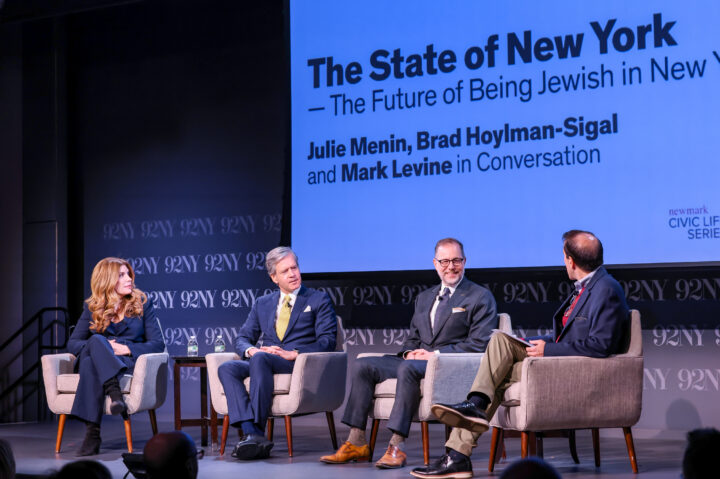
New York City Council Speaker Julie Menin, Comptroller Mark Levine and Manhattan Borough President Brad Hoylman-Sigal speak at 92NY on April 22, 2026.
New York City Council Speaker Julie Menin warned Wednesday morning that if Mayor Zohran Mamdani vetoes the council’s legislation intended to regulate protests at religious and educational sites, the city will face “more divisiveness,” calling the decision a critical test for the mayor.
The bills, which include measures to create standard NYPD policy for deploying buffer zones during protests at educational and religious facilities, face a potential veto as Mamdani has repeatedly declined to take a stand on the issue. He has acknowledged concerns against the legislation from left-wing activists and civil rights groups who have targeted synagogues and yeshivas with anti-Israel demonstrations, and has until the end of this week to veto the bills or they become law automatically.
“We need less divisiveness. I really hope — and I’ve said this to the mayor — that there is not a veto of the package of bills. That’s necessary. It will create much more division,” Menin said during a panel discussion at 92NY on “the future of being Jewish in New York,” featuring the city’s most senior Jewish elected officials: Menin, who is the first Jewish council speaker, Comptroller Mark Levine and Manhattan Borough President Brad Hoylman-Sigal.
The panel, moderated by 92NY CEO Seth Pinsky, comes as the city has experienced historic levels of antisemitism in the wake of the Oct. 7, 2023, terrorist attacks — and as Jews navigate a tense relationship with a mayor who has held hostile views towards several key communal issues. New York City has the largest population of Jews outside of Israel.
Asked by Pinsky what advice each would give to Mamdani to try to reassure the roughly 70% of the Jewish New York City electorate that did not vote for him, Hoylman-Sigal called on Mamdani to “follow the tradition of every mayor preceding him [since 1951] and visit Israel.”
He added that Mamdani already has some “really good Jewish advisors,” including Phylisa Wisdom, a progressive Jewish leader Mamdani tapped in February to run the Mayor’s Office to Combat Antisemitism. A range of Jewish Democratic politicians and advocates had lauded Wisdom’s selection, though she has alienated some Orthodox and Hasidic Jewish leaders over her work criticizing the secular education taught at yeshivas in the past.
Hoylman-Sigal’s assertion that the mayor’s heart “is in the right place” when it comes to the Jewish community was met with a chorus of “boos” from the audience.
Addressing the city’s long-standing Israel bonds investments, which Mamdani has called to end in a key source of tension for him and Levine, Levine said the investments “are not political [and] shouldn’t be political.”
“Israel bonds have never missed a payment in 70 years,” said Levine. “And by the way, we’ve had no protests about our investments in Saudi Arabia, our investments in Pakistan or China.”
All three Jewish leaders echoed the sentiment that despite a turbulent past few years, the New York City Jewish community remains resilient, and urged New Yorkers not give into the rising calls to decamp to Florida.
“Absolutely stay in New York,” said Menin. “This is not a time to lose hope. Hopefully the three of us here can embody the future of the commitment to fighting antisemitism, the commitment to supporting the Jewish community. This is a time to lean into it as opposed to shy away from it. New York is a city that has been a beacon of inclusion and tolerance; we need to make sure that it stays that way.”
“I believe the Jewish community in New York City is stronger than it’s ever been,” said Levine, who praised Mamdani’s decision to retain former Mayor Eric Adams’ NYPD commissioner, Jessica Tisch, who is Jewish and openly identifies as Zionist.
“In many synagogues, attendance is way up. Jewish New Yorkers are active in ways they haven’t been. We’ve seen new coalitions come together … This engagement gives me real hope for the future,” continued Levine.
“My wish looking forward to the next 25 years is that we see a community that fought — that didn’t move to Miami with its bad bagels — and that we kept this story going of what is really one of the most glorious Jewish communities.”
Please log in if you already have a subscription, or subscribe to access the latest updates.
 Continue with Google

 Continue with Apple