


































The comments, made after meeting with Turkish President Erdogan, are the first time Trump addressed the issue in his second term
Andrew Harnik/Getty Images
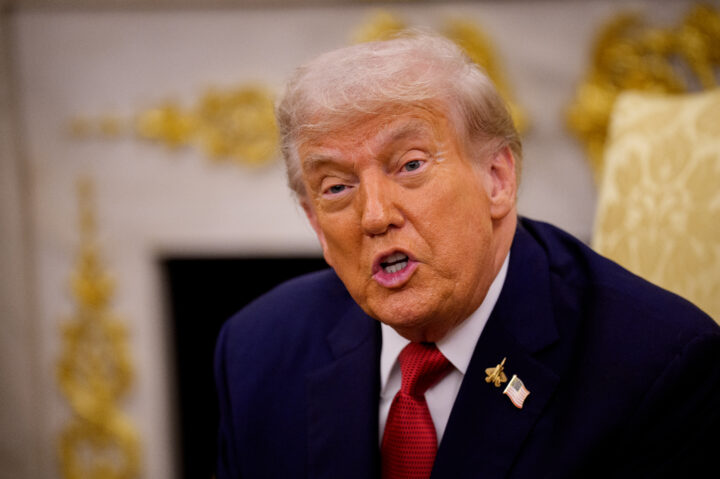
President Donald Trump in the Oval Office at the White House on September 25, 2025 in Washington, DC.


 Add JewishInsider on Google
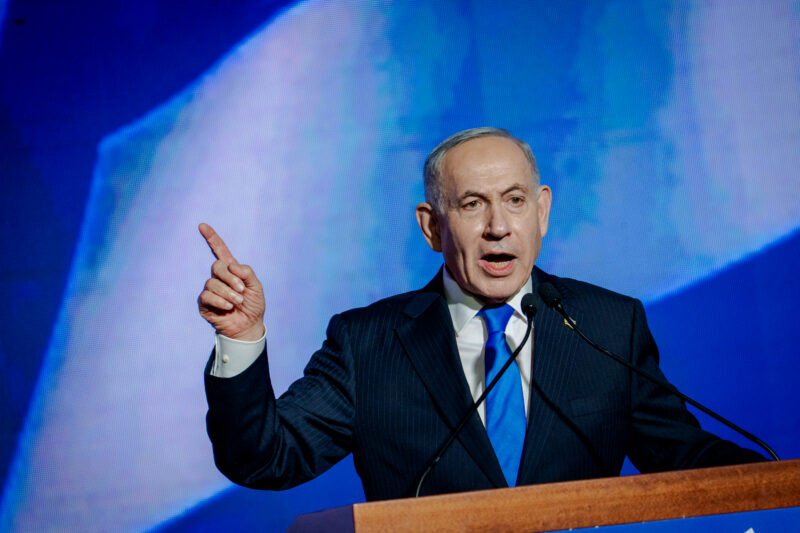
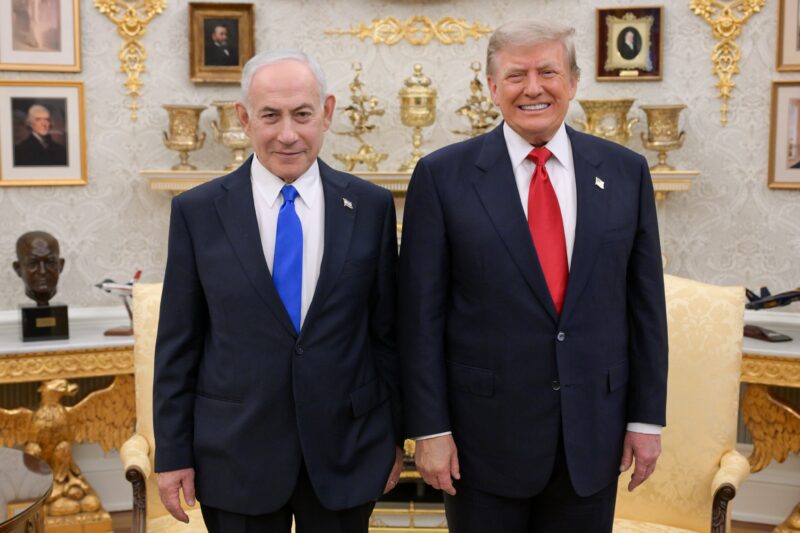
President Donald Trump pledged on Thursday that he will not allow Israel to annex the West Bank, the first time Trump has addressed the matter in his second term.
Asked about reports that he told Arab leaders this week he would not permit Israel to make the move, Trump confirmed to reporters in the Oval Office that he opposes annexation. “I will not allow Israel to annex the West Bank, nope, I will not allow it. It’s not gonna happen,” he said, hours after a meeting with Turkish President Recep Tayyip Erdogan.
Asked if he spoke with Israeli Prime Minister Benjamin Netanyahu about the issue, Trump said, “Yeah, but I’m not going to allow it. Whether I spoke to him or not — I did — but I’m not allowing Israel to annex the West Bank. There’s been enough, it’s time to stop now.”
Netanyahu will address the United Nations General Assembly in New York on Friday, and he and Trump will meet in the Oval Office on Monday, for their fourth White House meeting of the year.
In his own General Assembly address earlier this week, Trump pledged his support for Israel and sharply criticized several European nations who had unilaterally recognized a Palestinian state. He did not mention annexation or include any criticism of Israel in his remarks.
Netanyahu has pledged to respond to those moves next week, with annexation of the West Bank viewed as one possible action he could pursue, under pressure from right-wing elements of his governing coalition.
Reps. Schneider, Bacon, Panetta and Nunn traveled to Saudi Arabia, the United Arab Emirates and Bahrain last week

Faris Hadziq/SOPA Images/LightRocket via Getty Images
Saudi Arabia's Foreign Minister Prince Faisal bin Farhan al-Saud seen during the 2nd ASEAN GCC Summit at Kuala Lumpur.
Three House members who traveled to the Middle East last week told Jewish Insider on Friday that Arab leaders expressed to them concern about a potential broadening of the conflict between Israel and Iran, even as they acknowledged the threat posed by Iran and its nuclear program.
The trip, sponsored by the Atlantic Council’s N7 Initiative and the Jeffrey M. Talpins Foundation, took Reps. Brad Schneider (D-IL), Don Bacon (R-NE), Jimmy Panetta (D-CA) and Zach Nunn (R-IA) to Saudi Arabia, the United Arab Emirates and Bahrain immediately following Israel’s initial attacks on Iran. A stop in Israel was initially planned, but ultimately became infeasible due to the evolving war between Israel and Iran.
The initial goal of the trip was to discuss the Abraham Accords and their potential expansion.
The lawmakers said that the Arab leaders they met with were concerned that the war between Iran and Israel would expand and escalate, and their countries would be caught in the crossfire — particularly the UAE and Bahrain, given the presence of American bases in their countries. The conversations took place before the U.S. struck Iranian nuclear facilities on Saturday night.
“We heard quite a bit about their concerns with respect to a nuclear-armed Iran that would be an existential threat to every one of those countries,” Schneider said, “but also a desire to deescalate what’s happening because they rightly see [that] every day the war goes on is another day for an unintended consequence or an inadvertent escalation that could directly involve any of the Gulf countries.”
Schneider noted that the countries, particularly Saudi Arabia, have publicly condemned Israel’s attacks, but he said that in private conversations, the lawmakers heard a more nuanced message and stronger opposition to Iran’s nuclear program.
“While they’re not going to celebrate what Israel is doing, certainly they are not going to cry over Israel’s success in handling Iran’s nuclear program,” he said.
Panetta said that the Arab leaders also clearly understood why Israel had taken the action that it had.
“The leadership of the countries we met with, they understand how disruptive, how much of a destabilizing force, the regime of Iran is to the region of the Middle East,” Panetta said, adding that the pushback they heard against the conflict was not as strong as he anticipated.
Bacon also said that the Emirati and Bahraini leaders were clear about the threat of a nuclear-armed Iran, but preferred a diplomatic solution to the problem.
Bacon said the Saudis “held their cards much more tightly.”
“They were much more worried about Israel initiating this and they focused more on Gaza than anything else,” Bacon said. “In the end, if you pushed them, they would acknowledge Iran cannot have a nuclear weapon, but their public face was much more critical of Israel than the other countries.”
Panetta said Saudi leaders did not discuss whether they’d be willing to use their own forces to intercept attacks from Iran on Israel, as they did during Iran’s April 2024 attack on Israel.
Privately, Bacon said, Arab leaders were in “awe of what Israel’s been able to do” in its operations inside Iran and knew “that only Israel could pull something off like this.” Bacon said he also sensed relief from those countries that Israel was addressing the threat from Iran.
The lawmakers indicated that the normalization process between Saudi Arabia and Israel had been dealt setbacks by and since the Oct. 7, 2023, Hamas attacks on Israel. They said that the Saudis are demanding concrete progress toward a two-state solution before moving forward on normalization.
Schneider said that the Saudi deputy foreign minister indicated that “there has to be an irreversible path to a Palestinian state. It doesn’t have a timeline, it’s not saying a state tomorrow. I think there was recognition that that pathway and progress towards it must not be seen as a reward for Hamas and its actions on Oct. 7 and otherwise.”
“There needs to be hope and a pathway for the Palestinians for the Saudis to move forward,” Schneider continued.
Panetta noted that he had met with Saudi Crown Prince Mohammed bin Salman on Oct. 6, 2023, and left with “great hope” for normalization, but that two subsequent meetings with Saudi leadership made clear that, “the Palestinian issue is definitely something that needs to be addressed prior to normalization.”
Bacon said he challenged Saudi leaders on the issue of who in the Palestinian Authority would be willing to live and coexist peacefully with Israel as the leaders of a Palestinian state, “and I didn’t hear a good answer back.”
Schneider said that there was “no love for Hamas in any of our conversations,” and that Arab leaders recognized the issues within the PA and the need for a true partner for peace with Israel.
Panetta argued that, if the Saudis want to see a two-state solution develop, “it’s incumbent upon them to be involved in these types of discussions. And what that entails is obviously something that’s going to continue to develop during the hopefully diplomatic negotiations that we must continue to have.”
Bacon added that his impression was that if Iran were “defeated significantly” by Israel, it would increase the opportunities in the longer term for the expansion of the Abraham Accords.
In spite of the regional tensions the war in Gaza has produced, the lawmakers said that Emirati and Bahraini leaders highlighted the benefits they have experienced from the Abraham Accords as they relate to Gaza, including regular access and communication to the senior levels of the Israeli government and, in the case of the UAE, easier access to provide aid to Gaza.
Bacon added that the leaders of those countries expressed “no weakening” of their commitments to the agreements, and instead focused on the benefits.
Schneider said that the Arab leaders are eager to pursue an economically prosperous future, and are focused on ensuring that Iran and other malign actors cannot disrupt that.
Bacon said that the group had hoped to continue on to Israel, the final stop on their original itinerary, by driving in from Jordan, but that plan was blocked by House Ethics Committee staff, who are responsible for oversight of privately sponsored congressional travel.
Panetta also noted that the State Department and Department of Defense did not support the prospect of the lawmakers traveling to Israel in the midst of the conflict.
Schneider said that there was “never any hesitation” from the group’s members about going forward with the trip, which left a day after Israel launched its attacks, before the scope and nature of Iran’s retaliation was clear.
“Over the course of the days, it became clear that Israel was vastly overperforming expectations and Iran was vastly underperforming expectations and so the dynamic changed every day, but what I can say is, we spent our last two days in UAE — life was normal,” Schneider said.
‘It was made very clear to us it was not enough to just negotiate over their nuclear ambitions, that in their weakened state, you could not separate Iran's malignancy when it comes to all of their activity,’ she said

Anna Moneymaker/Getty Images
Rep. Debbie Wasserman Schultz (D-FL) speaks during a press conference on new legislation to support Holocaust education nationwide at the U.S. Capitol Building on January 27, 2023, in Washington, D.C.
Arab and Israeli leaders are insisting that any U.S. deal with Iran also include provisions to address Iran’s other malign activities in the region, including support for terrorist proxies, Rep. Debbie Wasserman Schultz (D-FL) told Jewish Insider following a trip earlier this month to meet with Israeli and Arab leaders in the Middle East.
Wasserman Schultz traveled with Sen. Joni Ernst (R-IA) to the Middle East for the third time since Oct. 7, 2023, visiting Israel, the United Arab Emirates, Bahrain and Jordan.
“There was a very clear urgency that the leaders we spoke to had to make sure that we … don’t let Iran up from their very weakened state. They’ve been badly pummeled and had significant defeats,” Wasserman Schultz told JI last week. “The consensus across the region, no matter where we went, was that we needed to make sure that continued and that we prevented them from achieving their nuclear weapons goals and that we particularly prevented them from continuing their support for terrorist activity.”
She said that notion was raised by multiple leaders without prompting from the U.S. lawmakers.
She said that “across the board” the leaders shared her view that any deal with Iran must “include defanging them — and that was a term that was used repeatedly, defanging them — and stopping them from continuing to terrorize” the region.
“It was made very clear to us it was not enough to just negotiate over their nuclear ambitions, that in their weakened state, you could not separate Iran’s malignancy when it comes to all of their activity — particularly if they got any relief from sanctions,” she said.
Middle East envoy Steve Witkoff, the lead negotiator for the U.S. in talks with Iran, suggested in a recent Fox News interview that the U.S. would consider allowing Iran to retain its enrichment capacity as part of a deal — a statement he later walked back — while Wasserman Schultz and Ernst were in the region. The outline Witkoff provided on Fox appeared to many to be equivalent to the original 2015 Joint Comprehensive Plan of Action which Trump withdrew from in his first term.
Wasserman Schultz called it “incredibly hypocritical” for officials from the new Trump administration, such as Witkoff, to endorse terms of a deal similar to the JCPOA. Wasserman Schultz ultimately voted for the JCPOA in 2015 and calls it “the most difficult vote I’ve cast in all the years I’ve been in Congress.”
She called on Witkoff and the American negotiators to seek a deal stronger than the original JCPOA, making her the latest pro-Israel Democrat to raise concerns about the potential terms of a new deal with Iran.
She said she’s “frustrated and concerned … and even angry” that the administration seems to be going “from pillar to post. Their discussions seem like they’re happening on quicksand and I have seen nothing that looks different than the agreement that [Trump] pulled out of.”
With Iran significantly weaker and more vulnerable than it was in 2015, Wasserman Schultz said the U.S. must seize the opportunity to push for a more comprehensive deal to prevent Iranian terrorist activity and stop Iran from obtaining a nuclear weapon.
If the U.S. does return to a deal similar to the JCPOA, Wasserman Schultz said that the ultimate result of Trump’s withdrawal from the original deal would have been allowing Iran to get “perilously close to a nuclear weapon” and removing the option to strengthen the original agreement through further negotiations.
Wasserman Schultz said that she told Israeli Prime Minister Benjamin Netanyahu, who aggressively opposed the 2015 deal, that she expected he would offer “the same howling pushback that occurred back during the Obama years when those negotiations were taking place” if Trump moves toward a deal similar to the JCPOA.
Wasserman Schultz and Ernst also discussed the ongoing war with Hamas in their meeting with Netanyahu. Compared to previous meetings, Wasserman Schultz said she believed that the prime minister and Israeli Minister of Strategic Affairs Ron Dermer outlined more comprehensive and specific strategies to achieve the release of the remaining hostages being held in Gaza.
“I probably have met with him five or six times over the course of the last year and a half there in Israel and in the U.S.,” Wasserman Schultz explained. “I was glad to see that they had varying approaches in terms of their negotiations and strategy with the ceasefire and hostage deals that they’re discussing. I was glad to see that and hear for the first time Dermer — and Netanyahu too — talk about the various options that they had, as opposed to it being a more minimalist conversation.”
Wasserman Schultz said she and Ernst had also spoken to Arab leaders about their proposals for post-war Gaza and achieving Saudi-Israeli normalization. She said the Arab leaders had been “very clear-eyed” about the difficulties of finding credible Palestinian leadership able to help move toward an eventual Palestinian state, but said they believed it was possible.
“I came away feeling like there could be some progress made. But it was clear that as a result of the war in Gaza, the signs of progress that we had hoped for when we were in Saudi Arabia on the night of Oct. 6 [2023] [were] further away at the moment than [they were] then,” Wasserman Schultz said.
But she added that the countries which have normalized relations with Israel are not retreating from those agreements and remain committed to them, highlighting as one example of the progress made that she was able to attend a Seder on the first night of Passover in Abu Dhabi.
Please log in if you already have a subscription, or subscribe to access the latest updates.
 Continue with Google
 Continue with Apple