








































































David Flippo received the legal allowable limit in donations from commentator Robert Beadles in May and June, the only donations Beadles has made thus far this election cycle
(Bill Clark/CQ-Roll Call, Inc via Getty Images)
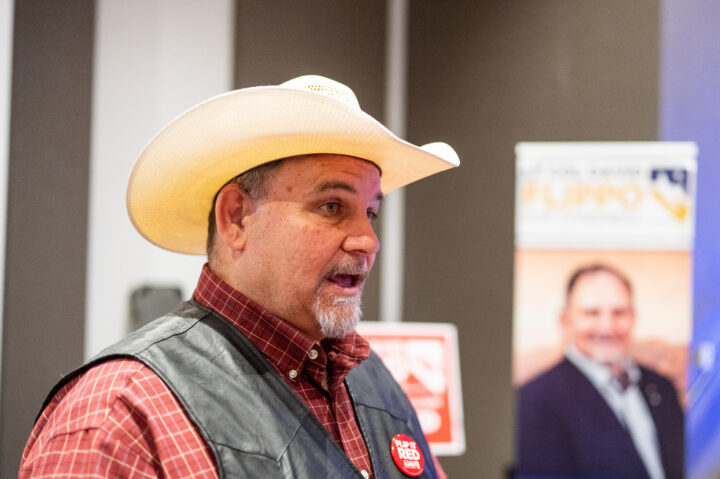
David Flippo, Republican candidate for Nevada's 4th Congressional district, speaks to Republicans gathered for the Freedom Rally and Candidate Roundup at the Ahern Hotel in Las Vegas, Nev., on Thursday, May 23, 2024.


 Add JewishInsider on Google
David Flippo, the Republican nominee in Nevada’s 2nd Congressional District, accepted a max-out donation from Robert Beadles, a prominent local GOP donor and commentator who has repeatedly promoted the Protocols of the Elders of Zion and other antisemitic conspiracy theories.
Flippo, a military veteran who is running in a district that strongly favors Republicans to replace Rep. Mark Amodei (R-NV), has positioned himself as a close ally of the Jewish community. But according to FEC records, he has received $7,000 in donations from Beadles — the legal allowable limit — in May and June of 2026, the only donations Beadles has made thus far this election cycle.
Beadles is one of several dozen donors to give similar max-out donations to Flippo’s campaign, but according to reporting by The Nevada Independent, Beadles is a prominent Republican activist and donor in the state who has worked to “reshape Nevada politics” at all levels.
The outlet reported that Beadles has repeatedly referenced and promoted in video streams and other commentary the Protocols of the Elders of Zion — the debunked antisemitic pamphlet claiming a global Jewish conspiracy to take over the world — as factual.
He discussed the Protocols on at least 12 livestreams in 2021 and encouraged listeners to read the work for themselves, denying evidence that the pamphlet is a fabrication. He has at times linked discussions of the Protocols to claims of election fraud in the 2020 presidential race.
Reached for comment, Flippo’s campaign described the candidate as an “an ardent supporter and close ally of the Jewish community,” noting that he serves as a member of the Republican Jewish Coalition leadership council and that he started a charity after the Oct. 7, 2023, Hamas attacks on Israel to send food to Israelis in need.
The RJC did not respond to a request for comment.
The Nevada Independent reported that Beadles’ history of antisemitic conspiracy theories goes back to at least 2009, when, in a book he wrote, he cited conspiracy theories that the Rothschilds, the Jewish banking family, had conspired to control various countries’ finances as well as worshipped Satan and had foreknowledge of the 9/11 terrorist attacks.
Beadles went on to state that he neither agreed nor disagreed with those conspiracies and that he had no proof of them, nor did their proponents. But, The Nevada Independent said, he “devoted the first three paragraphs of the introduction [to his book] to conspiracy theories involving the Rothschild family.”
Beadles also maintained an account on and was an early investor in Gab, the social media platform that became a hotbed of white nationalists and antisemites, and interviewed the site’s founder, Andrew Torba, who has engaged in antisemitism.
Beadles did not respond to a request for comment.
The Flippo campaign also told JI that his Democratic opponent, former state Rep. Teresa Benitez-Thompson, has “given into the rising anti-semitism of her own party by refusing donations from American citizens who support Israel”.
Benitez-Thompson has said on the campaign trail that she will reject support from AIPAC (not necessarily all supporters of Israel, as suggested by the Flippo campaign) and that the United Nations, which has described the war in Gaza as a genocide, “had the opportunity to leverage sanctions … but they didn’t move forward with any action.”
On her campaign site, she calls for the U.S. to phase out military aid to Israel and to place conditions on any further arms sales to the Jewish state.
The Flippo campaign noted that Benitez-Thompson has received donations from a prominent local politician affiliated with the Democratic Socialists of America which “engages in blood libel by calling Israel’s actions to defend itself genocide, celebrated the October 7th attack, and falsely describes Israel as an apartheid state.”
State Sen. John Cavanaugh, backed by left-wing Democrats, declined to sign a resolution supporting Israel and condemning Hamas on anniversary of Oct. 7 terrorist attack
Campaign page/Wikimedia Commons
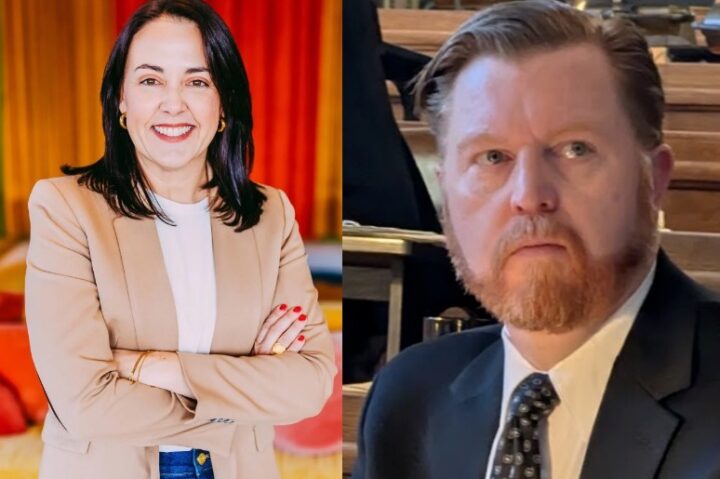
Denise Powell and John Cavanaugh
Nebraska’s 2nd Congressional District — the so-called “blue dot” in an otherwise red state — is a critical pickup opportunity for Democrats in November’s midterms. Vice President Kamala Harris won the district in 2024, and the popular, moderate Republican incumbent, Rep. Don Bacon (R-NE), is retiring.
The Democratic primary in the district on Tuesday is coming down to John Cavanaugh, a progressive state senator backed by a range of prominent left-wing leaders, and Denise Powell, a nonprofit executive backed by a host of Democratic political groups.
The outgoing Bacon has been an outspoken supporter of Israel, and is also a co-chair of the House’s bipartisan antisemitism task force, speaking out at times against members of his own party on the issue.
Cavanaugh was one of 10 state senators who declined to sign onto a resolution supporting Israel and condemning Hamas on the first anniversary of the terrorist group’s Oct. 7, 2023, attacks on Israel. “I support Israel and believe Israel has a right to exist. And I also believe a two-state solution is the only way to secure lasting peace,” Cavanaugh said in a statement to Jewish Insider in February.
He has been endorsed by the Congressional Progressive Caucus and a range of left-wing lawmakers including Reps. Jamie Raskin (D-MD), Pramila Jayapal (D-WA), Ro Khanna (D-CA), Greg Casar (D-TX), Chris Deluzio (D-PA), Adelita Grijalva (D-AZ), Jan Schakowsky (D-IL) and Mark Pocan (D-WI), as well as J Street.
Following the attempted terrorist attack on a synagogue and preschool in West Bloomfield, Mich., in March, Cavanaugh said on Facebook, “I’m horrified by the acts of violence we are seeing against Jewish Americans. Everybody has the right to worship in safety and security and while I’m thankful the gunman didn’t make it inside, violence like this shakes entire communities — my thoughts are with West Bloomfield.”
Powell is taking a more pro-Israel line, yet still falls to the left of other Democrats in the race on the issue. She said in a statement to JI earlier this year that she has “always unequivocally supported Israel’s right to exist and its right to defend itself.”
“My position is clear: I fully support providing aid to Israel and believe that we should ensure humanitarian aid reaches those in need,” the statement continued. “In order for the region to rebuild, it is imperative that we center our efforts around a two-state solution that both ensures Israel’s security and gives the Palestinian people the resources they need to reestablish their lives.”
She said during a candidate forum that she would have been hesitant to support a State Department funding bill that would have blocked funding to the United Nations Relief and Works Agency, provided $3.3 billion in military funding for Israel and penalized Palestinian international legal action against Israel, citing, in her statement to JI, concerns about “strip[ping] humanitarian aid to Gaza.”
Powell has been endorsed by Reps. Annie Kuster (D-NH), Emily Randall (D-WA), Norma Torres (D-CA), Andrea Salinas (D-WA) and former state Sen. Tony Vargas, the two-time Democratic nominee in the district, as well as the New Democrat Coalition, the Congressional Black Caucus, the Congressional Hispanic Caucus’ BOLD PAC, EMILY’s List and 33Elect Democratic Women.
Cavanaugh said at a candidate forum earlier this year that he wouldn’t accept funding from pro-Israel groups, while Powell said she wouldn’t accept backing from any special interest groups.
Democratic Majority for Israel filed with the Federal Election Commission its plans to spend $750,000 attacking Cavanaugh, but ultimately withdrew the buy. A person familiar with DMFI’s thinking told JI that DMFI PAC “decided to direct its resources into other races” for “strategic reasons” but remains focused on boosting pro-Israel Democrats who will help Democrats retake the House.
Nevertheless, Cavanaugh has repeatedly bashed Powell over the ultimately canceled DMFI intervention in the race.
“AIPAC aligned groups that are funded by Trump donors are now supporting Denise Powell. She said that she would refuse support from Democratic Majority for Israel or AIPAC, and now dark money groups are pouring millions into the Democratic primary here in NE-02 – and trying to hide it,” he said on X. “Voters deserve to know which out-of-state groups are funding these misleading attacks.”
Other candidates who have taken an outspoken pro-Israel stance, including district court clerk Crystal Rhoades and former Rep. Steny Hoyer (D-MD) aide James Leuschen, are seen as lagging behind in the race.
Gary Javitch, a board member of B’nai B’rith who hosted both Cavanaugh and Powell for lunch events with the Jewish community in Omaha and has long been involved in bipartisan pro-Israel politics in the state, described Cavanaugh as “the worst candidate [in the race] for people who favor Israel” and Powell as “very strongly pro-Israel,” based on their comments at the lunch events and their overall records.
“The Republican candidate is the closest to retiring [Rep.] Don Bacon,” Javitch added.
The expected Republican nominee is Omaha City Councilmember Brinker Harding, who faces no primary opposition.
Powell leads the field in fundraising with $1.6 million total raised, followed by Cavanaugh with $1.1 million. Harding, meanwhile, has raised $1.3 million. All other Democratic candidates trail significantly behind the three.
Notably, a GOP-linked outside group has been spending in the Democratic primary in an apparent effort to boost Powell, claiming Cavanaugh is a supporter of President Donald Trump. Yet other Republicans see Cavanaugh as the weaker challenger to Harding.
Powell and her allies — along with other candidates challenging Cavanaugh — have also argued that a Cavanaugh victory would have farther-reaching consequences for Democrats nationwide. If he wins, Nebraska’s Republican governor would appoint Cavanaugh’s replacement in the state Senate, likely delivering a stronger GOP majority in the chamber and potentially allowing Nebraska Republicans to overhaul the state’s electoral college apportionment.
Currently, the 2nd District has its own electoral college vote, apportioned separately, which went to Democrats in 2020 and 2024. Democrats assume that Republicans, given the chance, would move to a winner-take-all system in the electoral college — and would use the expanded Senate majority to pass other conservative priorities as well.
Cavanaugh has brushed off these criticisms as a “Republican talking point” spread by “dark money PACs.”
Only James Leuschen, a longtime former senior Capitol Hill staffer, did not say he would reject support from AIPAC and Democratic Majority for Israel
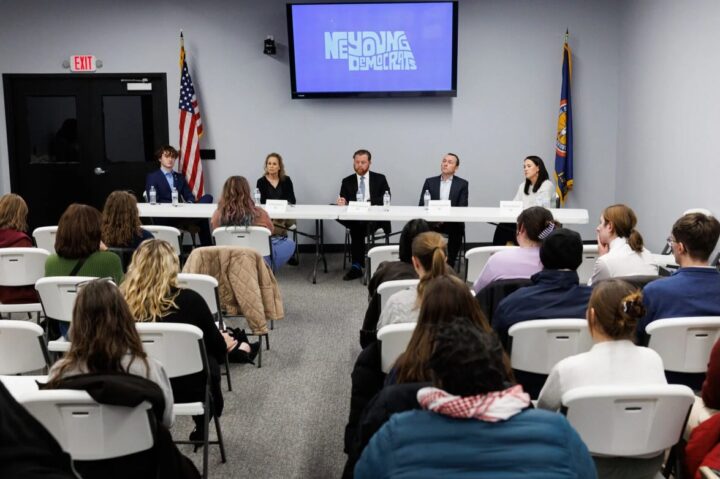
Kishla Askins, John Cavanaugh, James Leuschen and Denise Powell at a candidate forum hosted by the Nebraska Young Democrats, Jan. 23rd, 2026
Nebraska Young Democrats/Facebook
A majority of the Democratic candidates running in Nebraska’s 2nd Congressional District, a key swing seat that Democrats hope to flip in November, said at a candidate forum hosted by the Nebraska Young Democrats last week that they would reject support from pro-Israel groups, according to video of the event obtained by Jewish Insider.
The incumbent, Rep. Don Bacon (R-NE), who is retiring at the end of his current term, is an outspoken supporter of Israel and has also been active in combating antisemitism as a co-chair of the House Bipartisan Task Force for Combating Antisemitism. Bacon, a moderate, has repeatedly managed to fend off Democratic challengers in recent elections, but the Cook Political Report rates the seat as “Lean Democratic.”
Asked whether they would accept support from AIPAC or Democratic Majority for Israel, state Sen. John Cavanaugh committed to not taking any funding from either group, while activist Denise Powell said that she would not accept any funding from any special interest groups.
Navy veteran Kishla Askins offered a less definitive answer, saying she is “right now … not taking” funding from J Street, AIPAC or DMFI, while also noting that she had been to Israel and served alongside the IDF while she was in the military and understands how dangerous the region is.
“For me, every decision I make is about values and the rule of law, those two things. I do not align myself with anyone that breaks the law, nor aligns with Nebraskan values,” she said, describing the situation in Gaza as a humanitarian crisis. “Hamas is a terrorist group, and we need to all align around ridding this world of terrorism. Hamas is a terrorist group funded by Iran.”
She said she would “make decisions based on values and the rule of law.”
James Leuschen, a longtime former senior staffer for Rep. Steny Hoyer (D-MD) — a staunch Israel supporter who previously served in House Democratic leadership — was the only candidate to definitively say he would not commit to turning down support from the groups.
“Part of the reason why is I think that we, as Democrats, need to not unilaterally disarm when it comes to elections with Republicans that would be willing to do basically anything to win, right?” Leuschen explained. “The idea that we can win elections by pushing people away from us is, I think, wrongheaded, right? I think we need to be able to talk to folks in all communities. We need to be able to hear the concerns of folks who feel like, you know, maybe the things that happened on Oct. 7 weren’t quite the best thing in the world.”
He said that he wants to see the ceasefire agreement in Gaza hold, to pursue a two-state solution and to ensure that both Hamas and Israel abide by the terms of the deal reached last October.
“But at the same time, I think we have to acknowledge that the incident, the terrorist attacks on Oct. 7, were a tragedy in themselves and the situation we find ourselves in today — while not ideal — is progress toward that lasting peace and that two-state solution that I think we’re all going to get to,” he said. “It can’t be accomplished with coercion; it has to happen with both sides to get there on their own.”
Another prominent candidate, Douglas County district court clerk Crystal Rhoades, did not attend the forum. Rhoades has publicly expressed staunch support for Israel, saying in an op-ed published in The Jewish Press in Omaha, “no one will fight harder to strengthen the U.S.–Israel relationship than I will. My support for Israel isn’t political, it’s moral. It’s grounded in my values and in what I’ve seen firsthand about the importance of dignity, freedom and memory.”
In response to a later question, Leuschen also said he would have voted for a recent State Department funding package that included $3.3 billion in aid to Israel, maintained a block on funding for the U.N. Relief and Works Agency and contained provisions aimed at blocking Palestinian actions against Israel at the International Criminal Court and the International Court of Justice.
Askins and Cavanaugh both said they couldn’t weigh in on the legislation without having fully analyzed what was in it, though Cavanaugh added that he “would not be in support of defunding refugee services.”
Powell said that she hadn’t reviewed the bill but said that she was “a big believer that the U.S. needs to be doing more to support the Palestinian people in this moment. So I’m not sure what it all is in there. I’d love to read it. I don’t — from what you have said, it doesn’t feel like something I’d be super comfortable voting on. But I don’t have all the details on the bill.”
In a follow-up statement shared with Jewish Insider, Powell said that her answer at the forum did not fully capture her stance on the U.S.-Israel relationship.
“I have always unequivocally supported Israel’s right to exist and its right to defend itself. The question that was asked at a recent forum centered around a bill that would strip humanitarian aid to Gaza,” Powell said.
“My position is clear: I fully support providing aid to Israel and believe that we should ensure humanitarian aid reaches those in need,” the statement continued. “In order for the region to rebuild, it is imperative that we center our efforts around a two-state solution that both ensures Israel’s security and gives the Palestinian people the resources they need to reestablish their lives.”
Previously, Cavanaugh — who leads in polling of the race and hails from an established political dynasty in the state — has received pushback from pro-Israel voters for being one of 10 state senators who declined to sign onto a resolution supporting Israel and condemning Hamas on the first anniversary of the Oct. 7, 2023, attacks. He’s endorsed by progressive lawmakers including Reps. Pramila Jayapal (D-WA), Ro Khanna (D-CA) and Jamie Raskin (D-MD), as well as the Congressional Progressive Caucus PAC.
Please log in if you already have a subscription, or subscribe to access the latest updates.
 Continue with Google

 Continue with Apple