












































































A U.S. official said the longstanding designation could be removed by the end of the summer
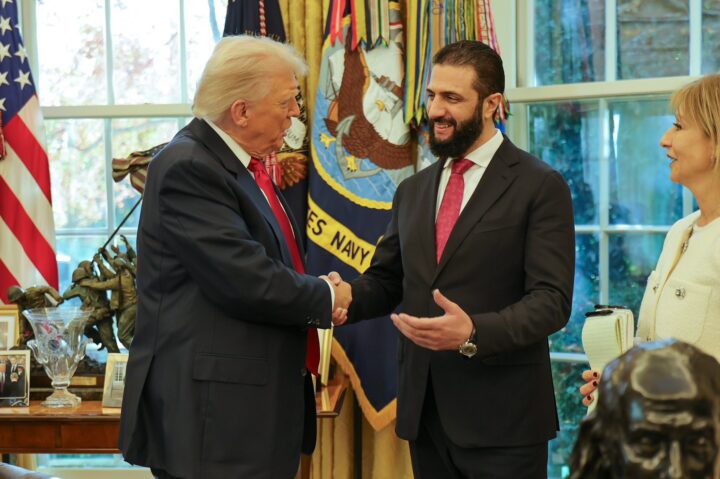
Syrian Presidency
President Donald Trump greets Syrian President Ahmad al-Sharaa in the Oval Office on Nov. 10, 2025.


 Add JewishInsider on Google
As the Trump administration moves to dismantle much of the decades-old U.S. sanctions regime imposed on Syria, one major obstacle remains: Damascus is still designated as a state sponsor of terrorism by the U.S. The White House and lawmakers have signaled that could be about to change, in another move to attempt to pull Syria back into the global order.
Syria remains one of just four countries — alongside Cuba, North Korea, and Iran — designated as an SST. It is a status Damascus has held since 1979 and its current government, led by President Ahmad al-Sharaa, has actively sought to shed.
During the second Trump administration and following the ouster of former Syrian President Bashar al-Assad, President Donald Trump and Congress have worked to rapidly unwind U.S. sanctions on Damascus in an effort to integrate the country into the global economy.
Congress repealed the Caesar Act last year, which had long imposed crippling secondary sanctions on Syrian individuals, companies and entities tied to the Assad regime. Under the direction of an executive order from Trump, the Treasury Department subsequently reviewed and waived a sweeping array of sanctions, though Washington still maintains targeted restrictions on Assad and his immediate associates.
As part of Trump’s executive order last year, the administration mandated a formal review of Syria’s SST designation. While the State Department has publicly maintained that there is no specific timeline for a conclusion, a U.S. official said the sanctions “will be off by end of summer,” Politico reported on Thursday. Trump “made [Secretary of State Marco] Rubio move it forward after Sharaa asked him,” the official said in messages to Mouaz Moustafa, executive director of the Syrian Emergency Task Force.
The prospect of delisting has also garnered support from members of Congress. Senate Foreign Relations ranking member Jeanne Shaheen (D-NH) told Politico that “other sanctions like the State Sponsor of Terrorism designation remain obstacles in Syria’s path to economic recovery and stability.”
On the other side of the aisle, Rep. Joe Wilson (R-SC) said in a video alongside the Syrian American Council’s Mohammed Ghanem this week that he has “an agreement with Secretary of State Marco Rubio … to eliminate the State Sponsor [of Terrorism] sanctions.”
“I’m just so confident that it would be bipartisan … because the American people are united in the hopes and dreams and possibility of a sovereign, peaceful and prosperous Syria,” Wilson said. “We have faith in the people of Syria, we want the best for the people of Syria to have the freedoms that can be enjoyed in all of the Middle East.”
Ahmad Sharawi, a senior research analyst at the Foundation for Defense of Democracies, told Jewish Insider that Washington would like to see Syria removed from the list in an effort to “pull Damascus out of the Iranian-Russian orbit and move it toward a U.S.-aligned regional order.”
“That shift is already underway, given that President Trump has rolled back most Syria sanctions,” Sharawi said. “For Damascus, removal from the list is essential to unlocking investment and reconstruction, especially as Gulf states signal a willingness to pour money into the country. Syrian officials have argued that the designation continues to limit the country’s recovery.”
However, Sharawi said that Syria should not be removed “unconditionally.” He argued that while Syria has taken important steps — such as joining the anti-ISIS coalition and “disrupting some Hezbollah weapons flows through Syria” — that Damascus still has work to do.
“The right approach is conditional delisting,” Sharawi said. “There are still designated foreign jihadist factions that have been integrated into the Syrian army, and ISIS has reportedly infiltrated parts of Syria’s new security structures. The United States should use the designation to demand measurable progress that brings Syria closer into the regional order.”
Some told JI they were concerned that President Trump could use it as legal justification to continue the campaign against Iran
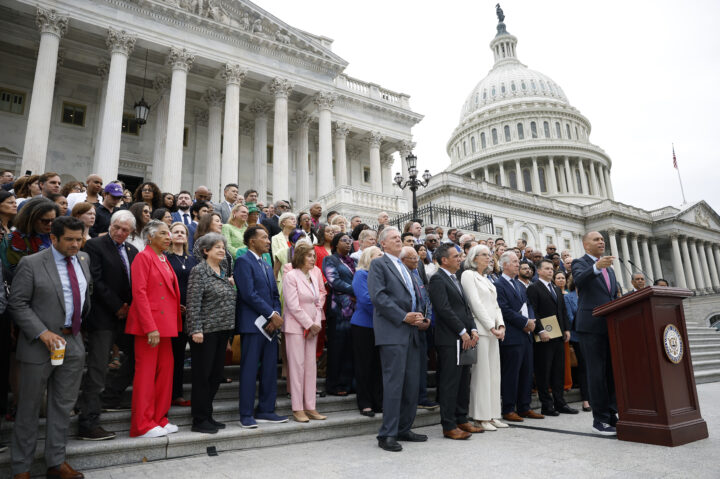
Kevin Dietsch/Getty Images
House Minority Leader Rep. Hakeem Jeffries (D-NY), joined by fellow Democrats outside of the U.S. Capitol on July 02, 2025 in Washington, DC.
In a surprise vote on Thursday afternoon that baffled some observers in Washington, 53 House Democrats voted against a resolution “reaffirming Iran remains the largest state sponsor of terrorism.” For some, their opposition traces to a desire not to give President Donald Trump rhetorical, or potentially legal, justification for continuing the Iran war, lawmakers said.
The resolution passed by a vote of 372-53, with two members voting “present.”
Most of the lawmakers voting against the resolution — like Reps. Rashida Tlaib (D-MI), Joaquin Castro (D-TX), Ilhan Omar (D-MN), Alexandria Ocasio-Cortez (D-NY) and Pramila Jayapal (D-WA) — are progressives, many of them frequent critics of Israel.
But a handful of others who ended up voting against the resolution are relative moderates who have taken more hawkish stances on Iran, such as Reps. Raja Krishnamoorthi (D-IL), Rob Menendez (D-NJ) and Steve Cohen (D-TN), who also voted against the resolution.
Many of the more moderate lawmakers who voted against the resolution are facing either competitive reelection races with challengers from their left or, in Krishnamoorthi’s case, running for higher office.
Newly elected Rep. Christian Menefee (D-TX), who had thus far not encountered any House votes on Middle East policy and faces Rep. Al Green (D-TX) in a member-on-member primary runoff, also voted no, as did Green.
Rep. Robert Garcia (D-CA), a Democratic rising star who is the top Democrat on the House Oversight Committee, told Jewish Insider he felt the legislation was meant to provide additional support for the war.
“Right now there’s an active situation that I oppose,” Garcia said. “That [resolution is] just meant to provide more pressure on that action. I think that right now, it’s a purely political stunt, and something that I won’t agree with.”
Another House Democrat, who asked to remain anonymous, explained that they were concerned about two clauses in the legislation, which they said could provide Trump with legal justifications for continuing the war.
One clause notes that “Tehran continues to harbor a network of senior al-Qaeda leaders, providing them with sanctuary space to fundraise in support of its fighters.” Given that the 2001 Authorization for Use of Military Force that approved the Afghanistan war includes language allowing the use of military power against any nations that harbored the organizations or individuals responsible for planning, carrying or aiding in the 9/11 attacks, the Democrat said that Trump could use the language “as a legal justification” for the war.
The other clause describes Iran as a “direct and persistent threat to the United States,” which the Democrat said could trigger the president’s self-defense authorities under Article II of the Constitution.
“Iran is a leading state sponsor of terrorism led by a regime that represses its own people and poses real dangers we must confront. We must ensure it never obtains a nuclear weapon. I will continue to support targeted efforts to counter the threats posed by Iran, but I voted against a separate resolution on Iran that President Trump may soon use to politically justify this war,” Krishnamoorthi said.
“Iran is obviously a state sponsor of terrorism. There’s no debate on that. The issue is that Republicans are using this to claim that Iran is harboring Al Qaeda (sound familiar?) and is a direct and persistent threat to the U.S. so they can legally justify this reckless war,” Rep. Sara Jacobs (D-CA) said on X.
Rep. Bonnie Watson Coleman (D-NJ), a progressive Israel critic who voted against the resolution, called it a “political messaging bill” designed to take attention away from the war powers resolution that failed in the House shortly after.
Rep. Adam Smith (D-WA), the ranking member of the House Armed Services Committee — who supported the resolution — said in a statement, “I agree with the principal assertion of this resolution that Iran is a bad actor. Iran’s malign and destabilizing actions in the region and treatment of its own citizens should be denounced. I have never contested this. What I do contest is that going to war is the reasonable response to this assertion. I support this resolution. I do not support the president’s war of choice with Iran.”
Please log in if you already have a subscription, or subscribe to access the latest updates.
 Continue with Google

 Continue with Apple