




















The International Federation of Social Workers voted against a measure that sought to remove Israel’s leading social work organization from the body
Ami Vitale/Getty Images
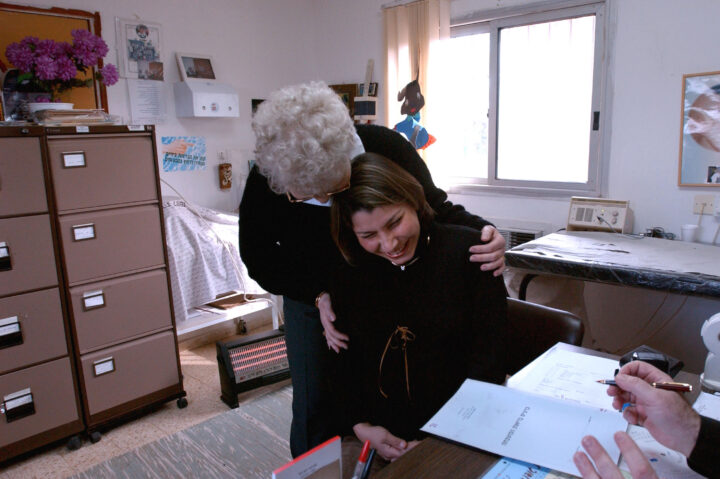
A nurse hugs one of her patients during a pre-natal checkup at the kibbutz Metzer February 21, 2003 in northern Israel.


 Add JewishInsider on Google
An effort to expel Israel from the leading global organization for social workers failed on Wednesday in a closed-door Zoom meeting. A second vote, on suspending Israel, also failed.
The International Federation of Social Workers, which counts social work organizations from 141 countries as members, was considering the measure against Israel after some European members complained that Israeli social workers had served in combat roles during Israel’s war against Hamas in Gaza. IFSW formally censured Israel last year.
Jewish social workers in the U.S. and Canada mounted a brief advocacy campaign against the measure, authoring a petition signed by 12,000 people urging the U.S.-based National Association of Social Workers and the Canadian Association of Social Workers to vote against the measure. NASW released a public statement a day before the vote, saying that the expulsion effort violates “the profession’s core values of unity, dialogue and compassion.”
Inbal Hermoni, the chair of the Israeli Union of Social Workers, said last week that kicking Israel out of the IFSW — whose members also include Russia, China and Iran — would not advance peace in the Middle East.
The leadership of the IFSW did not publicly comment on the results of Wednesday’s vote. 34 countries voted against expulsion, with 16 voting in favor. A majority of voting members supported suspending Israel — 27 voted to suspend Israel, and 23 voted against it — but the measure would have needed 75% of votes to pass.
NASW cheered the vote in a statement on Wednesday.
“Our position reflects our belief that professional engagement, ethical accountability and sustained dialogue are more effective than expulsion in advancing peace, justice and human rights,” NASW said.
Guila Franklin Siegel, the chief operating officer at the Jewish Community Relations Council of Greater Washington, called the vote “a victory for inclusion over discrimination.”
“While it is disappointing that the IFSW even considered such exclusionary motions, we are hopeful that this closes the door on any effort to isolate Israeli social workers initiated by international bodies that should be supporting and lifting them,” said Siegel, who had been working behind the scenes with Jewish social workers to rally opposition to the measure.
The U.S.-based National Association of Social Workers said it was ‘surprised and disappointed’ that International Federation of Social Workers members were ‘seeking to judge and exclude’ their Israeli counterparts
Leon Neal/Getty Images
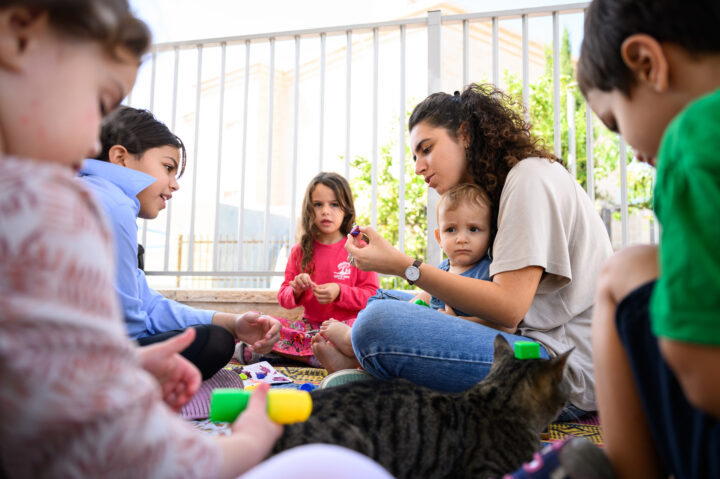
A university student studying social work helps provide emotional support to families who have been forced to evacuate from their homes in the south of Israel on October 16, 2023 in Beit Shemesh, Israel.
The leading membership organization of U.S. social workers called on Tuesday for the field’s largest international body to oppose efforts to expel Israel’s association of social workers, ahead of a planned vote on that question slated for Wednesday.
The International Federation of Social Workers will vote on Wednesday on a contentious effort to expel the Israeli Union of Social Workers, after some European members complained that Israeli social workers had served in combat roles during Israel’s war against Hamas in Gaza. A petition, organized by several Jewish social work associations, circulated last week urging the U.S.-based National Association of Social Workers and the Canadian Association of Social Workers to come out against the measure garnered more than 12,000 signatures.
NASW — which boasts more than 120,000 members and claims to be the largest national social work organization in the world — weighed in for the first time with a statement on Tuesday urging IFSW members to vote against the measure in order “to uphold the profession’s core values of unity, dialogue and compassion.”
“We are deeply surprised and disappointed that our European colleagues, who have not experienced circumstances comparable to those faced by their Israeli counterparts, are now seeking to judge and exclude them,” the NASW said in the statement. “We hope that, should they ever face similar challenges, they are met with the compassion, understanding, and empathy that they are currently denying to their Israeli colleagues.”
The field of social work, alongside psychology and counseling, has faced growing antisemitism in the aftermath of the Oct. 7, 2023, Hamas attacks in Israel. Jewish and Israeli practitioners who are taught to employ compassion and empathy in their work say that they have not received the same support they are expected to offer others.
The statement from NASW acknowledged these values as central to the profession.
“We urge our colleagues to resist efforts that promote divisiveness or exclusion,” the statements said. “Instead, let us embody the values of compassion, unity and healing that define our profession. Let us focus on constructive engagement, mutual understanding and the co-creation of solutions that honor the dignity and humanity of all.”
The Wednesday vote to expel or suspend Israel’s leading social work organization from the IFSW comes after the body voted to censure Israel last year. The only country to ever be suspended from the IFSW was South Africa, during the apartheid era.
The International Federation of Social Workers is set to hold a vote on Feb. 18 to expel Israel over its members’ service in the IDF
Leon Neal/Getty Images
A university student studying social work helps provide emotional support to families who have been forced to evacuate from their homes in the south of Israel on October 16, 2023 in Beit Shemesh, Israel.
The largest global membership organization for social workers from around the world will vote next week on whether to expel Israel’s leading social work body, sparking a feverish advocacy campaign by Jewish and Israeli practitioners to urge members to vote against the measure.
The vote by the International Federation of Social Workers is scheduled for Feb. 18, and it comes after several members in the IFSW complained that some Israeli social workers served in combat roles in the Israel Defense Forces during Israel’s war against Hamas in Gaza. The IFSW alleges that military service violates social workers’ professional and ethical commitments to nonviolence.
The Israeli Union of Social Workers — and its allies in the United States and Canada — argue that such a request ignores Israel’s mandatory draft policy, holds Israel to a different standard from other member nations and singles out the only Jewish state. The leader of the Israeli body said it would be “entirely unimaginable” for Israeli social workers to ask not to serve in combat, noting that it would come across as “elitist” and “mark our union as illegitimate in the eyes of both the government and the public.”
“If we believed that removing the [IUSW] from the IFSW would promote peace, guarantee the rights and security of both nations — we ourselves would vote in favor,” IUSW’s chair, Inbal Hermoni, wrote in a letter urging countries to vote against the measure. “This is a noble goal. However, this is not the case.”
The IFSW comprises 141 country members — including Russia, Iran and China — representing more than 3 million people. The only other country to ever face a similar punishment from the IFSW was South Africa, which was suspended during the era of apartheid rule.
Last year, the IFSW voted to formally censure Israel — the second time the body had done so.
“This position was grounded in our ethical mandate: social workers are called to uphold human dignity, promote peace, and work for social justice. Active participation in combat contradicts these principles,” IFSW President Joachim Mumba, who is from Zambia, said last year.
Social workers, psychologists, doctors and other practitioners in the so-called “helping professions” have complained about antisemitism that they say has become normalized since the Oct. 7, 2023, terror attacks in Israel — with double standards, anti-Zionist litmus tests and outright antisemitism now viewed as widespread and even acceptable among others working in those fields.
“This vote shouldn’t be seen in isolation. It’s a reflection of the systemic hostility towards Israel and towards Jews that have come to permeate these professional spaces,” said Guila Franklin Siegel, chief operating officer of the Jewish Community Relations Council of Greater Washington. “In fighting against this, we are fighting against a much bigger problem.”
Andrea Yudell, a therapist in Washington, told Jewish Insider on Thursday that voting to expel Israeli social workers “would effectively legitimize the hostility that we’ve been seeing in the field.”
A petition organized by several groups for Jewish therapists in the U.S. and Canada is urging the National Association of Social Workers and the Canadian Association of Social Workers — the two membership organizations in each country — to publicly oppose next week’s vote.
“It imposes a nationality-based collective sanction, treating professionals as ethically suspect solely because of their national affiliation. No other national association is held to this standard,” the petition states. It has been signed by more than 11,000 people. Spokespeople for NASW and CASW did not respond to requests for comment.
Several U.S. Jewish organizations are helping to circulate the petition and generate attention about the vote, which the Anti-Defamation League called “collective punishment.”
The issue, according to Jewish social workers, goes deeper than just professional drama among the practitioners. The spread of antisemitism in a field predicated on compassion could threaten to alienate or harm Jewish clients who turn to social workers to help meet their emotional and material needs.
“It’s not just the social workers themselves. It’s the people we are trying to serve. Those people. It’s unethical to them,” said Jennifer Kogan, a licensed clinical social worker in Washington, D.C. “Jewish clients are affected by this. They don’t feel safe.”
A new report details the ‘exclusion, isolation and public targeting’ that Jewish social workers have faced — particularly since Oct. 7

Getty Images
Two women in armchairs are sitting and talking.
Like most social workers, Jennifer Kogan went into the field to help people. A therapist who works in Ontario, Canada, and Washington, she markets her private practice as “compassion-focused counseling.” Everyone is welcome here, a banner on her website states.
But Kogan’s understanding of her profession has radically shifted in the two years since the Oct. 7 attacks in Israel. Despite its focus on compassion, the field of social work has been engulfed by antisemitism, according to a new report authored by Kogan and Andrea Yudell, a licensed clinical social worker in Washington and Maryland.
“Since Oct. 7, Jewish social workers have experienced unprecedented silencing, gaslighting, exclusion, isolation and public targeting in professional spaces,” states the report, which was published on Monday by the Jewish Social Work Consortium, an organization founded shortly after Oct. 7.
Accusations of antisemitism have roiled the mental health field over the past two years. In April, the state of Illinois formally reprimanded a therapist who had created a list of “Zionist” therapists and encouraged colleagues not to refer clients to them. Rep. Ritchie Torres (D-NY) warned the American Psychological Association in May to respond to “persistent and pernicious” antisemitism among its members.
The report describes Jewish social workers being targeted on industry-wide email listservs, doxed and publicly called out during academic courses and lectures. Many of the allegations took place in academic settings related to diversity, like a panel on “whiteness” at Catholic University’s National Catholic School of Social Service that reportedly called Jewish students “racist” and “white supremacists.”
“While we are concerned with systemic oppression or bias against all other minorities, I believe the social work profession perpetrates it on the Jews,” said Judith Schagrin, the retired administrator of a municipal foster care agency in Maryland. “I never dreamt that there would be this level of hostility and ignorance. On the other hand, I have believed for many years that just like institutional racism against Black folks lingers right beneath the surface, I firmly believe that institutional antisemitism does as well.”
Social work is a massive field, referring broadly to a profession that can encompass therapists in private practice, people working in public sector social services organizations, school counselors, religious leaders, administrators, social justice advocates and more.
The report’s authors claim that antisemitic rhetoric — and, in particular, anti-Israel litmus tests foisted on Jewish practitioners — has become endemic in the field.
Jewish social workers view this discrimination and disrespect as anathema to a key guiding principle of social work: the idea that empathy, and understanding individuals’ personal stories, is critical to “address life challenges and enhance wellbeing,” according to a global definition of social work adopted by the International Federation of Social Workers. They see a double standard applied to Jews, who are often expected to disavow Israel’s actions in Gaza before their concerns are taken seriously. (In January, the IFSW issued a formal “censure” against the Israeli Union of Social Workers because of its members’ history of service in Israel’s military, prompting a rebuke signed by nearly 4,000 Jewish therapists.)
“You’re supposed to extend cultural humility to various different groups, and I saw it extended to so many other groups. There’s Black Lives Matter, and then Asians that were experiencing anti-Asian hate. We were left out of that conversation, even though there were growing statistics that Jewish people were facing antisemitism in many contexts,” said Jodi Taub, a New York-based clinical social worker.
“The whole purpose of the field is, we’re there to support other humans,” added Taub. “Our job is to be supportive individuals, and social justice is supposed to be social justice for all. No one should have to go into graduate school and experience harassment and discrimination.”
Many of the complaints in the report target the National Association of Social Workers, the field’s leading professional body, with 110,000 members.
“The silence and negligence of NASW has been especially egregious,” the report’s authors write, referencing the group’s two-month delay in publicly addressing the events of Oct. 7 and its alleged reticence to strongly denounce antisemitism in the nearly two years since. An NASW spokesperson did not respond to a request for comment.
Debates about the war in Gaza have caused turmoil in an NASW listserv, where rhetoric condemning Israel’s “genocide” in Gaza and calls for boycotts of Israel have become increasingly common. Jewish social workers who wrote in the listserv to raise awareness about the hostages in Gaza or to respond to inaccurate messages about Israel often faced harassment.
Taub said that after posting about the Israeli hostages in Gaza, she was targeted by someone she did not know who shared a screenshot of Taub’s business profile with the word “PROHIBITED” over it in red text, urging people to avoid her. (That social media post was quickly taken down.)
These experiences have colored the way Jewish social workers engage with their colleagues, casting an air of suspicion to interactions between them.
“It’s hard to know who’s safe, like who is someone that basically hates you, or someone who just doesn’t have an opinion whatsoever, or someone that is behind you,” said Kogan. “It’s very dehumanizing to read what people are writing.”
Carole Cox, a professor at Fordham’s Graduate School of Social Service, has worked in the field for decades, with a particular focus on Alzheimer’s caregivers and on grandparents raising grandchildren. Now, she’d think twice about telling a young Jewish person to enter the field.
“”It’s difficult to tell a Jewish person, ‘Yes, go into social work, you will love it,’” Cox told JI. “There were so many Jewish pioneers in the profession, and now many social workers are actually hiding their Jewish identity.”
Please log in if you already have a subscription, or subscribe to access the latest updates.
 Continue with Google
 Continue with Apple