














































































The president called Fry, who defeated a Republican backing his impeachment in 2021, a ‘very, very talented person’ in an interview this week
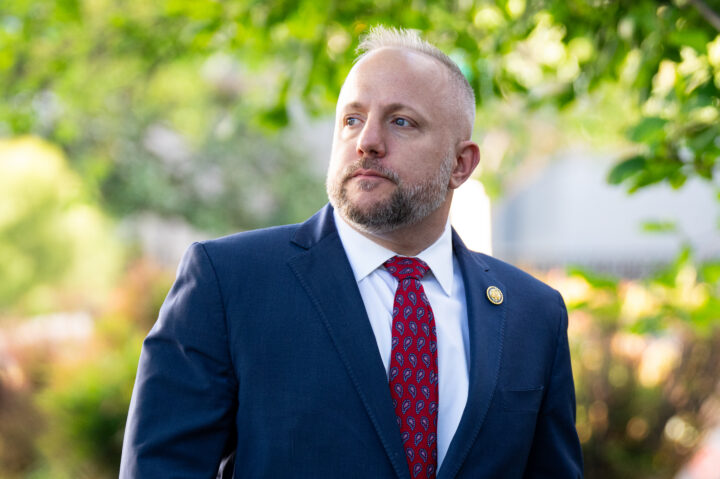
Bill Clark/CQ-Roll Call, Inc via Getty Images
Rep. Russell Fry (R-SC) arrives for the House Republican Conference caucus meeting at the Capitol Hill Club in Washington on Wednesday, May 13, 2026.


 Add JewishInsider on Google
The late Sen. Lindsey Graham (R-SC) understood the value of staying in President Donald Trump’s good graces — both to advance his top legislative priorities and to shield himself from challenges on his right flank.
In the wake of Graham’s sudden death, the candidates vying to succeed him have absorbed a central lesson of his career: the most decisive factor in the Republican primary will almost certainly be who wins Trump’s endorsement.
Rep. Russell Fry (R-SC), who ousted a sitting GOP lawmaker with Trump’s endorsement in 2022, is emerging as one of the leading contenders and someone who has an inside track to receive the president’s blessing. Fry’s defeat of former Rep. Tom Rice (R-SC), who was one of the few Republicans to vote for Trump’s impeachment in 2021, allowed him to build early relationships with Trump’s political circle.
Fry has been making calls to White House officials about a possible run this week, a source familiar with the matter told Jewish Insider.
Asked on Monday evening about the possibility of endorsing Fry if he launched a bid for a full term in Graham’s seat, Trump told Newsmax that Fry is “somebody you can watch out for” as a rising Republican star and did not deny he was considering backing the House lawmaker if he enters the race.
Fry, who became an ally of Graham’s while they served in Congress together, was one of the Republicans who had reached out to the White House about a possible interim appointment to the seat. South Carolina Gov. Henry McMaster ultimately announced on Monday that he was appointing Sen. Darline Graham Nordone (R-SC), Graham’s younger sister, to serve out the remainder of her older brother’s Senate term, which expires next January.
“Russell Fry, a young congressman, is outstanding. That could happen. I could see that happening,” Trump said of an endorsement. “I think he’s a very, very talented person. … I mean, he’s doing much better than the person that preceded him. He’s been very popular in the state.”
Reached for comment, a White House official told JI about the president potentially endorsing Fry that, “Until the president makes an announcement, any speculation is just speculation.”
Fry has been a reliably conservative and party-line vote in the House since elected, and also holds a solidly pro-Israel voting record. AIPAC congratulated him on his primary victory in 2024.
Graham’s GOP replacement on the November ballot will be chosen in a special election scheduled for Aug. 11. Candidates can file to run for the seat starting on July 21, in accordance with the timeline required by state law, and several others are also looking to throw their hats in the ring.
Among the other Republicans who have reportedly been lobbying the White House and considering jumping into the race are Rep. Ralph Norman (R-SC); Rep. Nancy Mace (R-SC); former Rep. Trey Gowdy (R-SC), a Fox News host and close ally of National Republican Senatorial Committee chairman Sen. Tim Scott; and Lt. Gov. Pamela Evette, who lost to the state’s Attorney General Alan Wilson in a runoff of South Carolina’s Republican gubernatorial primary in June.
Mark Lynch, who lost to Graham in last month’s primary by 30 points, said on Monday that he would enter the special election and committed $5 million to his campaign. During the campaign, Trump called him a “lunatic” who “would be a DISASTER for the Republican Party,” which came in response to Lynch blaming the U.S. war in Iran on Graham by arguing that the senator had convinced the president to start the conflict. Graham had criticized Lynch, a South Carolina businessman, for employing staffers with records of making antisemitic statements,
Rep. Joe Wilson (R-SC), who was also floated for a possible interim appointment, said on Sunday that he was committed to staying in the House to protect Republicans’ slim majority in the lower chamber. He has not divulged if he is considering entering the special election.
Rep. William Timmons (R-SC) said late Tuesday that he would not enter the race to replace Graham, adding in the announcement that he would not support Noman or Mace’s candidacies.
Regardless of who the nominee is, Republicans are confident that they will hold the Senate seat in November. Trump carried South Carolina in the 2024 presidential election by 18 points, 58-40%.
The Democratic nominee in the race is Dr. Annie Andrews, a pediatrician who handily won her primary. A political outsider who challenged Mace unsuccessfully in 2022, Andrews has drawn attention for her effective fundraising against Graham, outraising the incumbent in the last two quarters. National Democrats, however, have so far declined to prioritize the race, citing the need to use those resources in battleground states.
The Cook Political Report grades the race as solid Republican.
A national Democratic campaign source told JI that this is not expected to change unless Republicans were to nominate a weak candidate with a record of extremism or concerning accusations about their personal background, such as accusations of criminal activity or assault.
“If you remember back to [former Democratic National Committee Chair] Jaime Harrison’s campaign [in 2020], he was the head of the South Carolina Democratic Party and raised over $100 million and still got blown out,” Dr. Gibbs Knotts, a professor of political science at Coastal Carolina University, told JI. “South Carolina has not dipped its toe into that purple state category for two to three decades.”
“Whoever gets this [Republican] nomination, to state the obvious, is very likely to be the next senator.”
Led by Reps. Tim Walberg and Elise Stefanik, House members said they have ‘serious concerns regarding the inadequacy’ of the task force’s recommendations

JOSEPH PREZIOSO/AFP via Getty Images
People walk through Harvard Yard at Harvard University in Cambridge, Massachusetts on December 12, 2023.
In a new letter to interim Harvard President Alan Garber sent on Monday, 28 Republican House members, led by Reps. Tim Walberg (R-MI) and Elise Stefanik (R-NY), said that the Harvard antisemitism task force’s recent preliminary recommendations on responding to campus antisemitism don’t go nearly far enough to address the situation on the campus.
The lawmakers said they have “serious concerns regarding the inadequacy” of the recommendations, which are “weaker, less detailed, and less comprehensive” than those presented by a previous task force in December 2023. Harvard Jewish leaders and alumni have said they’re disappointed by the recommendations, released in late June.
“Instead of offering a tangible plan to address antisemitism at Harvard, the task force’s most specific and actionable recommendations are to organize public talks on respectful dialogue and religious relations, increase the availability of hot kosher meals, and to circulate guidance about accommodating Jewish religious observance and a calendar of Jewish holidays,” the letter reads.
It calls the recommendations “particularly alarming given that Harvard’s leaders had already received a strong, detailed, and comprehensive set of recommendations” from the previous task force, arguing that the current group should have built on that framework.
The lawmakers said that Garber needs to “publicly address” criticisms of the task force from Jewish community members, adopt and begin to implement the recommendations from both task forces before the next semester and sever Harvard’s relationship with Birzeit University in the West Bank, whose student government and administration have expressed support for Hamas.
The letter states that the task force was correct to support disciplinary action and condemnation in response to the “serious problem with antisemitism” on Harvard’s campus but did not “offer real solutions for doing so.” It also accuses the task force of giving “insufficient attention” to Harvard’s “failures in imposing discipline for antisemitic misconduct.”
The lawmakers said that the task force “left numerous other significant issues wholly unaddressed,” such as academic programs that have seen significant issues with anti-Israel and antisemitic sentiment, student groups’ violations of Harvard rules, failures by Harvard’s Equity, Diversity, Inclusion, and Belonging office to address antisemitism, falling Jewish enrollment, a lack of viewpoint diversity among faculty on the Middle East, masked protests and possible foreign influence.
They further said that the university “has a consistent practice of balancing statements and efforts regarding antisemitism with similar ones regarding Islamophobia and anti-Arab bias.”
“While hatred and discrimination against Muslims and Arabs is deplorable and must be addressed, there is simply no comparison between the explosion of pervasive antisemitism on Harvard’s campus and instances of Islamophobia or anti-Arab bias,” the Republicans continued. “These constant attempts at balancing serve to trivialize antisemitism and distract from the urgency and severity of the problem.”
Other signatories to the letter include Reps. Kelly Armstrong (R-ND), Jim Banks (R-IN), Aaron Bean (R-FL), Gus Bilirakis (R-FL), Lori Chavez-DeRemer (R-OR), Anthony D’Esposito (D-NY), Randy Feenstra (R-IA), Russell Fry (R-SC), Lance Gooden (R-TX), Michael Guest (R-MS), Erin Houchin (R-IN), Ronny Jackson (R-TX), Nick LaLota (R-NY), Nick Langworthy (R-NY), Mike Lawler (R-NY), Mariannete Miller-Meeks (R-IA), Burgess Owens (R-UT), Keith Self (R-TX), Pete Sessions (R-TX), Jason Smith (R-MO), Lloyd Smucker (R-PA), Michelle Steel (R-CA), Claudia Tenney (R-NY), Jeff Van Drew (R-NJ), Randy Weber (R-TX) and Rudy Yakym (R-IN).
Please log in if you already have a subscription, or subscribe to access the latest updates.
 Continue with Google

 Continue with Apple