












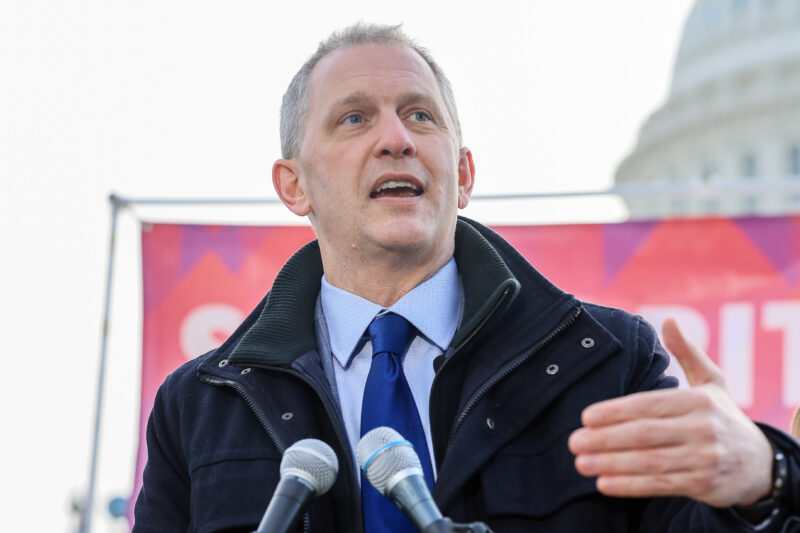







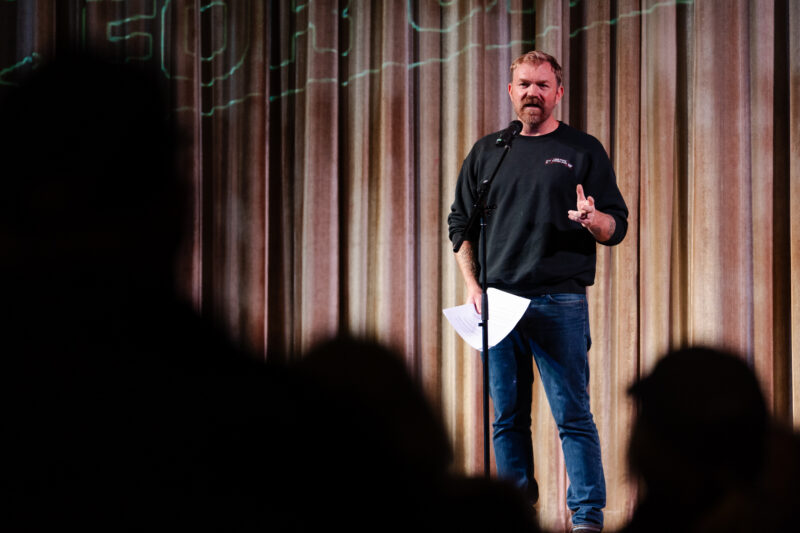


















‘All it would take is a few examples of swift and severe punishment, expulsions, suspensions, that type of response, and everyone would get the message,’ Pollak said

JOSEPH PREZIOSO/AFP via Getty Images
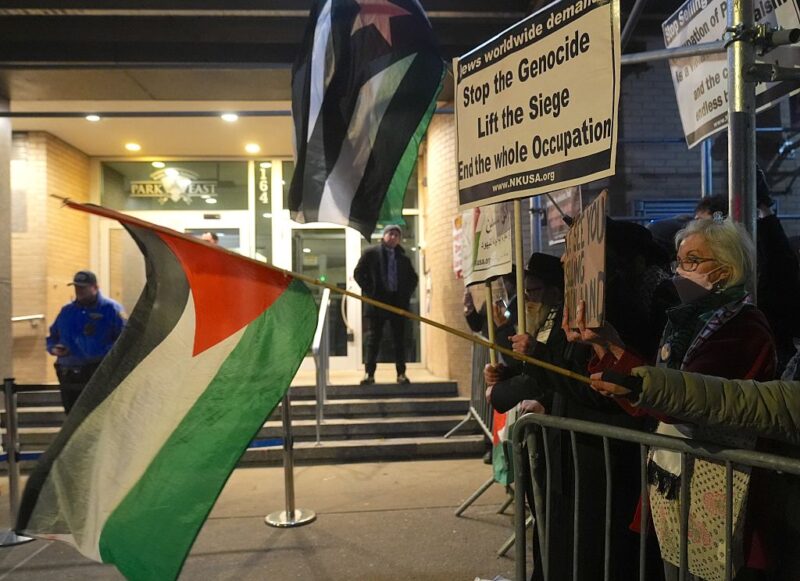
Pro-Palestinian student protestors and activists rally at an encampment on the campus of Brown University in Providence, Rhode Island, on April 29, 2024.


 Add JewishInsider on Google
Noah Pollak, a senior advisor at the Department of Education, offered a series of recommendations, including broader cultural changes and vigorous disciplinary action, on how universities can and should reform to better address antisemitism on campus.
Speaking at an antisemitism conference on Tuesday organized by The George Washington University Program on Extremism, Pollak said that schools need to have “backbone” in enforcing their disciplinary codes, offering as one example Brown University, which he said failed to uphold a new code of conduct rules when an encampment sprung up to protest the war in Gaza in 2024. He attributed schools’ reticence to a “cultural problem” for the universities.
“The schools have got to discipline students and faculty who are troublemakers, who break the rules, and discipline them hard, discipline them fast and discipline them very publicly,” Pollak said. “All it would take is a few examples of swift and severe punishment, expulsions, suspensions, that type of response, and everyone would get the message, and everything would settle down.”
Pollak argued that the ultimate answer to antisemitism on campuses lies in overhauls to university governance to promote political diversity and proper enforcement of civil rights. He called for overhauls of Middle East studies departments and other academic programs he said have lost sight of their original missions. “You have to go upstream,” he said.
Broadly, Pollak also described many campus protests as “anti-intellectual” and “anti-democratic” and often “pretty stupid,” saying that many students are joining in to shout slogans and intimidate people with little idea of the actual issue about which they’re protesting.
“Universities could stop encouraging protesting — they could stop and they could demand that their academic departments actually diversify and expose students to the actual complexity of the world and not the slogan version of the world,” Pollak said.
He also argued that issues of distinguishing between protected speech and unprotected discriminatory conduct have been overstated and that the line is “not actually that complicated,” saying schools “did a lot of hiding behind the First Amendment as an excuse to avoid taking action.”
In particular, he added, the use of “Zionist” as a euphemism for Jews is often “a pretty easy call,” and should not be treated as a “get-out-of-jail-free card.”
“It’s pretty obvious what [the anti-Israel activists are] up to. It’s pretty obvious the intent when they do that,” Pollak said. “A little too much stock has been placed in the idea that these are such blurry lines, it’s so hard to make these discussions. Well, it’s really not. You take a look at the activity that’s going on, and it’s pretty obvious what the intent is.”
He also said that schools should make clear how students file Title VI complaints and that they should have dedicated officials responsible for handling such complaints, who understand and can apply Title VI rules and regulations.
Pollak said that schools had been “caught off-guard” by the years of organizing by anti-Israel groups prior to Oct. 7, but that they are “doing a somewhat better job” now that they have had time to catch up, noting that he has heard anecdotally that complaints have dropped this year.
A report from the school’s regional review committee recommended a set of remedies, including new professorships on modern Israel
CHARLY TRIBALLEAU/AFP via Getty Images
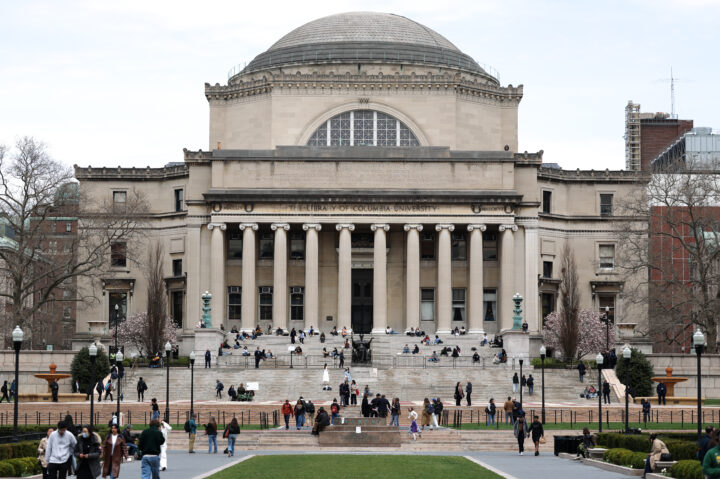
Students are seen on the campus of Columbia University on April 14, 2025, in New York City.
Columbia University is considering expanding and refocusing its Middle Eastern studies department’s instruction on Israel, the provost’s regional review committee announced in a set of recommendations this week, marking a pivot in a field and at a school that have come under immense scrutiny from the federal government and Jewish leaders following the Oct. 7, 2023, Hamas attacks.
Among its recommendations, the review committee urged the department to strengthen its relationship with the school’s Institute for Israel and Jewish Studies through visiting professorships. The IIJS will host a multiyear visiting appointment for a professor to teach about the history of modern Israel beginning this fall, the report said.
Some faculty in Middle Eastern studies departments at Columbia and other elite institutions praised Oct. 7 as “resistance” against the “settler-colonial” Israeli state. Critics of the field have long alleged that it teaches students a one-sided history of the Middle East, describing Israel as the perpetual villain.
A December report by the Columbia University task force overseeing efforts to combat antisemitism on campus spotlighted Columbia’s lack of “full-time tenure line faculty expertise in Middle East history, politics, political economy and policy that is not explicitly anti-Zionist.” The task force found that the absence of ideological diversity had an impact on course offerings — in listening sessions, students said that classes at the university more often than not treat Israel as entirely illegitimate.
The provost’s review committee is headed by Miguel Urquiola, senior vice provost for academic initiatives, whom the university appointed to oversee the department as part of a settlement with the Trump administration after $400 million in federal funding was cut last year over Columbia’s alleged failure to address antisemitism.
Among Trump’s demands for funding to be restored was a mandate to place the Middle Eastern, South Asian, and African Studies (MESAAS) department under academic receivership. While Columbia did not commit to academic receivership, it appointed Urquiola and created the review committee in September, selecting the Middle East as the first region to be reviewed.
The committee’s report additionally states that the School of International and Public Affairs is “finalizing” arrangements for a visiting professor to teach about economic and other policy issues in Israel, scheduled to begin this fall. SIPA partnered with the IIJS to appoint a visiting professor to teach courses on the Jewish world and Middle East policy for a three-year term. The two schools are searching for a joint professor of Israel and Jewish studies, which the review committee notes “may be on the tenure- or practice-track.” The review committee also suggested offering a new undergraduate major or minor in Middle East social sciences and policy, which would fall under SIPA’s undergraduate offerings.
The report further states that the school’s political science department is “actively considering” launching a search for a permanent faculty member to be appointed together with IIJS.
“Columbia’s MESAAS department is notoriously lacking viewpoint diversity, particularly as it relates to Israel,” Lishi Baker, a senior studying Middle East history, told Jewish Insider. “I am grateful that Columbia is finding other ways to increase its course offerings about Israel so that students interested in the region are not stuck with the MESAAS propaganda.”
The recommendations also noted that the search to fill the Edward Said professorship in modern Arab studies and literature is ongoing. The role has been open since Rashid Khalidi retired in August after two decades at Columbia, stating that the university’s adoption of the International Holocaust Remembrance Alliance working definition of antisemitism — which he said conflated criticism of the state of Israel with antisemitism — made it “impossible for me to teach modern Middle East history.”
Two professors under consideration for the position have faced disciplinary action from their universities for participating in antisemitic and anti-Israel activity, The Washington Free Beacon reported this week.
Rosie Bsheer, an associate professor of history at Harvard and formerly the associate director of the university’s Center for Middle Eastern Studies was removed from her role at the Center for Middle Eastern Studies after events she hosted “very likely” violated the IHRA definition of antisemitism, according to former Harvard President Lawrence Summers.
Max Weiss, a Princeton University professor of history and an advocate of an academic boycott of Israel, was put on probation for holding class inside an anti-Israel encampment.
The suggestions range from enforcing campus codes of conduct to holding faculty accountable for political coercion

Wesley Lapointe for The Washington Post via Getty Images
A row of tents line one side of a student encampment protesting the war in Gaza at the Johns Hopkins University Homewood Campus on Tuesday April 30, 2024, in Baltimore, MD.
As students return to school in the coming weeks, four leading Jewish organizations are encouraging university leaders to adopt a new set of recommendations, released on Monday, designed to curb the antisemitism that has overwhelmed many campuses since the Oct. 7, 2023, terrorist attacks in Israel, Jewish Insider has learned.
The guidelines — which call for increased safety measures as well as long-term structural reforms and build upon a four-page set of recommendations released last August — are a joint effort from the Anti-Defamation League, Conference of Presidents of Major American Jewish Organizations, Hillel International and Jewish Federations of North America.
The recommendations urge university leaders to “consistently enforce” codes of conduct around protests; appoint a coordinator to address Title VI discrimination complaints; reject academic boycotts of Israel; conduct annual student and faculty surveys in regard to campus antisemitism; crackdown on online harassment (in addition to physical safety concerns); and hold faculty accountable for political coercion and identity-based discrimination.
Some of the guidelines, such as the appointment of a Title VI coordinator, echo commitments that several university leaders have made in recent months amid battles with the Trump administration over federal funding. At Columbia University, some Jewish students expressed skepticism that the moves would have a significant impact on campus antisemitism.
“These recommendations aren’t just suggestions, they’re essential steps universities need to take to ensure Jewish students can learn without fear,” ADL CEO Jonathan Greenblatt said in a statement. “Jewish students are being forced to hide who they are, and that’s unacceptable — we need more administrators to step up.”
“We are encouraged by the universities that have taken prior recommendations seriously, implementing changes that have reduced the most severe types of incidents, creating safer and more welcoming environments as a result. But our work is far from complete,” Hillel International president and CEO Adam Lehman said in a statement. “These updated recommendations provide a roadmap for institutions to build on their progress and address the challenges Jewish students continue to face.”
The recommendations released last summer by the same groups, in addition to the American Jewish Committee, called for university leaders to “anticipate and mitigate disruptions” on the one-year anniversary of Oct. 7. Other suggestions included that universities clearly communicate campus rules, standards and policies, support Jewish students, ensure campus safety and reaffirm faculty responsibilities.
Please log in if you already have a subscription, or subscribe to access the latest updates.