











































































The advantage of having a defined group of reliable donors can be neutralized by an online feeding frenzy that galvanizes enough individuals to give to a radical cause or candidate
Nam Y. Huh/AP
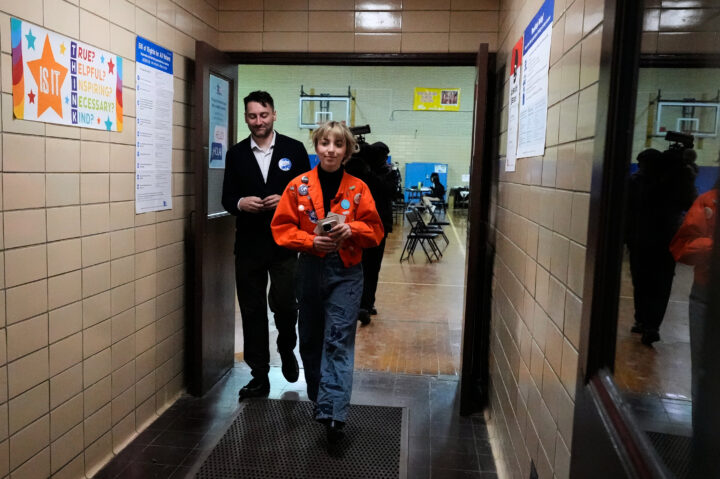
Democratic candidate for Congress, Kat Abughazaleh, right, and her boyfriend Ben Collins, leave the Chicago Park District Loyola field house after voting in the primary election for the upcoming midterms, in Chicago, Tuesday, March 17, 2026.


 Add JewishInsider on Google
Tomorrow (April 15) isn’t just Tax Day, but it’s also the deadline for candidates vying in the pivotal midterms to report their latest fundraising figures — an important marker on the political calendar in determining which candidates are raising enough money to run credible campaigns and which will be left financially behind.
Historically, having a critical mass of prominent, well-heeled supporters was a prerequisite for a congressional candidate being able to get their message out to the public.
Not long ago, candidates with extreme or exotic views — such as those affiliated with the Democratic Socialists of America on the left or those embracing conspiracy theories on the far right — would have a hard time being taken seriously by rank-and-file donors, who typically want a back a winner and would shy away from those with far-out-of-the-mainstream views.
Similarly, the pro-Israel community historically benefited from the presence of strong organizations like AIPAC that helped pool supporters’ money to favored candidates, giving them outsized impact within both parties. More recently, AIPAC’s super PAC has led the way in engaging directly in political campaigns, directly spending money on behalf of favored candidates and attacking some of the most radical candidates on the ballot.
But in our brave new decentralized world of politics and media, where a critical mass of small-dollar donations from passionate individuals can easily be amassed online (especially through an incendiary video clip or well-timed fundraising appeal), the comparative advantage of having a defined group of reliable donors can be neutralized by an online feeding frenzy that galvanizes enough individuals to give to a radical cause or candidate.
At the same time, the social media-driven public conversation — without any guardrails and few standards — has totally transformed what is viewed as normal. One recent example: 27-year-old Kat Abughazaleh, a far-left social media influencer without any roots in the Chicago-area district she was running in, raised well over $3 million for her (unsuccessful) primary campaign, fueled by high-volume, low-dollar, largely out-of-state contributions.
If Tip O’Neill once said all politics is local, the opposite is true today. All politics is now nationalized, with the most outlandish hot takes and incendiary commentary most likely to go viral.
The same viral clips that lead unsuspecting audiences to extreme voices like Hasan Piker and Candace Owens live in the same ecosystem that makes it easy for a candidate like Abughazaleh to bring in big money. It’s not a coincidence that former Rep. Marjorie Taylor Greene (R-GA) and Rep. Alexandria Ocasio-Cortez (D-NY) were among the top fundraisers within their respective parties this cycle.
There are two different ways for Jewish and pro-Israel voices to adapt to this still-evolving revolution in both media and politics — one on the supply side and one on the demand side.
On the demand side, it’s clear that the algorithmic preferences for leading social media platforms prioritize constant unthinking engagement (at best) and rage and radicalism (at worst).
It doesn’t seem like a coincidence that Twitter/X’s decision to unblock neo-Nazi influencer Nick Fuentes from the platform in May 2024 quickly led to an upsurge in antisemitic content being embraced by a wide range of far-right podcasters. There are thoughtful policy proposals that have been floated to do a better job regulating what has increasingly become an anarchic space.
Most of the focus, however, has been on how politicians and outside groups can adapt on the supply side. As Obama campaign manager David Plouffe wrote in The New York Times last week, “A successful campaign in 2026 must operate like a full-time production studio… It means creating output tailored specifically for TikTok or Instagram or YouTube.”
Plouffe also noted that campaigns need to focus on what he called “answer engine optimization” for artificial intelligence, essentially working to ensure friendlier responses from AI bots.
If the old media and fundraising model was to rely on scale (of donations) and volume (of ads) to persuade voters, the new media ecosystem requires nimbleness and adaptability. Raising the most money and saturating the airwaves with advertisements was once a time-tested tool of success.
Now, campaigns and advocacy groups alike are facing a multifront challenge, figuring out whether to accommodate what appears to be a new political and media reality where the loudest and most polarizing voices prevail — or fight for a more fair-and-balanced ecosystem while also engaging with the fractured landscape as best as possible.
The major Democratic donor said the outsized scrutiny of AIPAC’s political involvement is an effort to ‘chase Jews and their allies out of our big tent coalition’
Vernon Yuen/NurPhoto via Getty Images
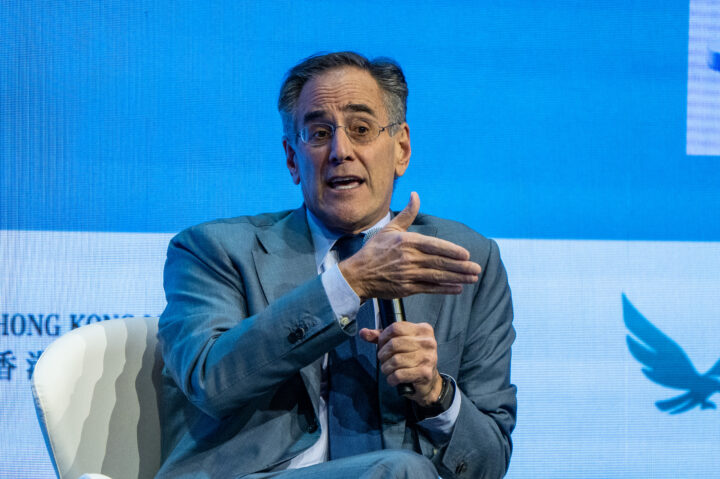
Michael J. Sacks at the Global Hong Kong Global Financial Leaders Investment Summit on October 8, 2023 in Hong Kong, China.
A prominent Jewish Democratic donor in Chicago is raising alarms that growing efforts to demonize AIPAC and its engagement in political campaigns are part of a more sinister effort to make pro-Israel Jews feel unwelcome in a party they have long called home.
In an opinion article published in The Chicago Tribune on Tuesday headlined “Why I support AIPAC and a big tent Democratic Party,” Michael Sacks, an asset manager and longtime ally of former Chicago Mayor Rahm Emanuel, pointed to what he called a “double standard” for AIPAC’s political involvement, and warned of “a coordinated effort to make support for Israel a litmus test for Democratic primary candidates in 2026 and beyond.”
“Let’s be clear: The campaign against AIPAC is not a policy discussion,” he wrote. “It’s a thinly disguised effort to make support for Israel politically toxic in the Democratic Party, to chase Jews and their allies out of our big tent coalition.”
His public comments on a hot-button issue come in the wake of a contentious primary cycle in Illinois earlier this month, where AIPAC’s spending in a range of contested House races was a subject of particularly heated criticism that is expected to play a role in the midterms and 2028 presidential election.
His op-ed also lands as some Democratic leaders have distanced themselves from AIPAC, including Illinois Gov. JB Pritzker, a rumored 2028 presidential contender and a former AIPAC donor who in recent interviews has said he abandoned the pro-Israel group because it leaned too heavily to the right and lost its commitment to bipartisanship. He has also accused AIPAC of “interference” in Illinois’ recent House races, where its affiliated groups spent more than $20 million across four major primaries.
Despite their differences over AIPAC, Pritzker defended Sacks on Tuesday during an unrelated press conference. “Do I think that people who supported AIPAC can be good Democrats? I can tell you Michael Sacks is a very good, decent, honorable human being who cares deeply about the Democratic values I expressed to you,” Pritzker said.
He added that it was “very unfair for people to have targeted” Sacks “when what he believes is the same thing,” referring to “the security of the state of Israel and the security of the Palestinian people at the very same time.”
During the primaries, Sacks himself faced personal blowback after a progressive House candidate said he was rejecting his campaign contribution because of Sacks’ ties to AIPAC — a move Sacks lamented at the time as a sign of growing “anti-Israel sentiment and outright Jew hate.”
Sacks contributed a combined $1.2 million to two super PACS linked to AIPAC that faced scrutiny for obscuring their donors until after the primaries on March 17. He also donated to pro-Israel candidates who were backed by AIPAC, including former Rep. Melissa Bean (D-IL), who clinched the nomination in Illinois’ 8th Congressional District, and state Sen. Laura Fine, who lost to an outspoken Israel critic in Illinois’ 9th.
In the Tribune, Sacks clarified that he has not always aligned with AIPAC, saying he had “stepped away” from the group in 2017 over its fierce opposition to President Barack Obama’s Iran nuclear agreement, after decades of involvement.
But following the Hamas attacks of Oct. 7, 2023, Sacks wrote, “as I watched anti-Israel sentiment accelerate within my party, including in Illinois,” he reconnected with AIPAC, asking how he could help to “ensure we didn’t send more people to Congress from Chicago who would deny Israel access to even essential defensive weapons.”
His experience observing the Illinois primaries, where other special-interest groups linked to the crypto and artificial intelligence industries had also invested heavily, ultimately exposed what he called a “stark and deliberate” attempt to single out AIPAC and broader pro-Israel activism as a unique source of backlash, he said, arguing that such criticism had not been evenly allocated throughout the campaign.
“I don’t agree with everything Israel and AIPAC do. Like many Israeli leaders as well as elected officials who receive AIPAC support, I believe in a two-state solution,” Sacks wrote. “If you’re not for two states, you’re for endless war. I also believe in a big tent Democratic Party. Democratic leaders claim to be for those things as well. Yet we demonize AIPAC and pro-Israel Jewish Democrats, while accepting those who cannot even say they support a two-state solution that includes Israel.”
Sacks, who chaired the 2024 Democratic National Convention host committee in Chicago, concluded the op-ed with a call to “Democratic leadership to brave this issue,” saying “we need more thermostats and fewer thermometers.”
“Real leadership recognizes that we can hold complicated views about the Israeli government and still refuse to make Jewish identity and pro-Israel sentiment a political disqualifier in our party,” he said in his article on Tuesday. “We can defend the big tent when it is inconvenient, not just when it is easy.”
Please log in if you already have a subscription, or subscribe to access the latest updates.
 Continue with Google

 Continue with Apple