


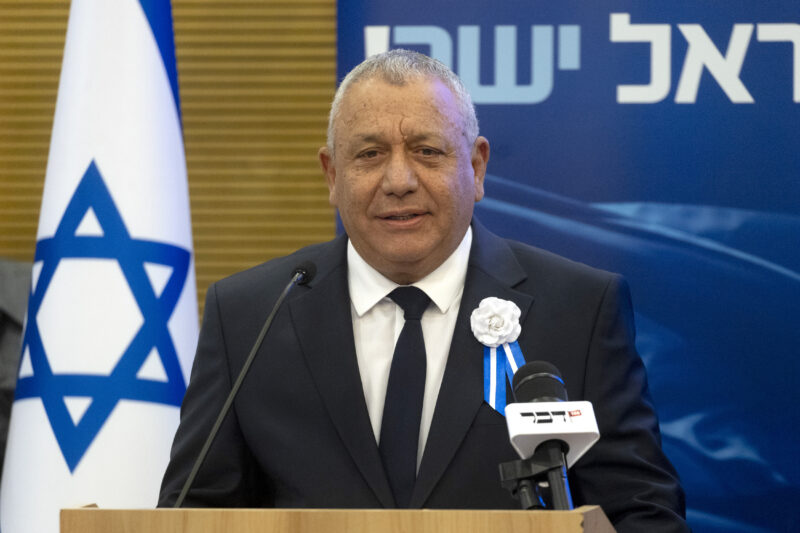






































































Antisemitism envoy Yehuda Kaploun, who also spoke at the event, praised Argentina as having ‘transformed from a beacon where terrorism once reigned supreme to a beacon of Jewish life’
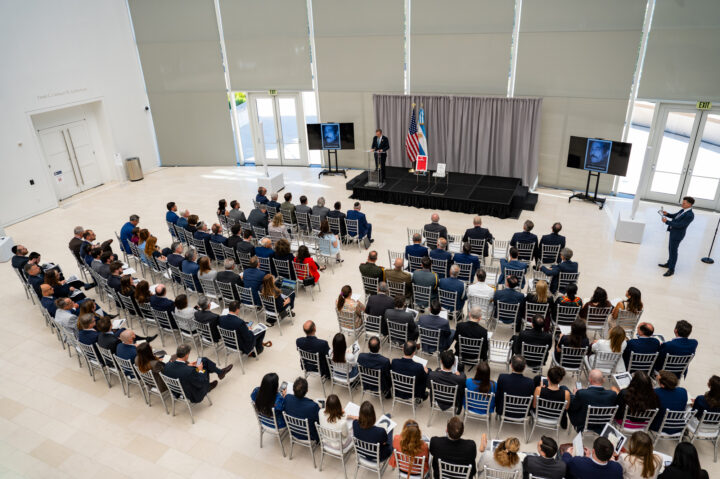
Embassy of Argentina
The State Department and Argentine Embassy in Washington host a commemoration ceremony for the 32nd anniversary of the AMIA bombing.


 Add JewishInsider on Google
The State Department’s top legal advisor on Wednesday drew a direct connection from the signing of the Oslo Accords in 1993 — which sought to bring peace between the Israelis and Palestinians — to the global rise in Islamist terrorism, in remarks delivered at an event in Washington marking the anniversary of the deadly 1994 terror attacks on the AMIA Jewish Center in Buenos Aires. The suicide bombing, orchestrated by Hezbollah, killed 85 people and injured more than 300 others one year after the signing of the Oslo Accords at the White House.
Diplomats, survivors of the attack, Jewish community members and State Department officials gathered on Wednesday at the U.S. Institute of Peace to commemorate the July 18 attacks, where U.S. and Argentine officials vowed to work together to fight Islamist terrorism. Reed Rubinstein, the State Department legal advisor, used his remarks to herald President Donald Trump’s efforts to fight terrorism, which he described as a course correction from decades of failed leadership.
“The fruit of those accords paradoxically included a massive increase in brutal terrorism,” Rubinstein said, referring to the Oslo Accords. “Oslo led to an unprecedented wave of suicide bombing and death.”
He criticized activists who called the dead “sacrifices to peace,” chastising them for using biblical language “to justify the murder of many as ‘unfortunate but necessary’ sacrifices on the path to peace.”
“In those days, and for so many years after, when moral clarity and truth telling were required, the leadership failed,” said Rubinstein. He took aim at institutions like the United Nations, universities and the media for failing to speak out against antisemitism — and placed blame on Trump’s predecessor, President Joe Biden.
“Candidly, prior to Jan. 20, 2025, the United States government more often than not failed, and in many cases failed spectacularly,” said Rubinstein. “But under President Trump, things have changed. Under his direction, the United States has taken and is taking decisive and unprecedented steps to fight antisemitism.”
Rabbi Yehuda Kaploun, the U.S. special envoy to monitor and combat antisemitism, called Argentina a “model for the world” in combating terrorism. He shared that two days earlier, during a visit to the South American country, he met with President Javier Milei and thanked him for designating Iran’s Islamic Revolutionary Guard Corps as a terrorist organization.
“Argentina has transformed from a beacon where terrorism once reigned supreme to a beacon of Jewish life,” said Kaploun.
Other senior State Department officials at the event included Jacob Helberg, the under secretary of state for economic affairs; Thomas DiNanno, under secretary of state for arms control and international security; and the State Department’s counterterrorism coordinator, Gregory LoGerfo. Argentine Ambassador to the U.S. Alejandro Oxenford introduced the event, which was organized by Rep. Brian Mast (R-FL), chair of the House Foreign Affairs Committee.
Former President Bill Clinton invoked slain Israeli Prime Minister Yitzhak Rabin’s ‘law’: ‘We will fight terror as if there are no negotiations. We will negotiate as if there is no terror’
Haley Cohen
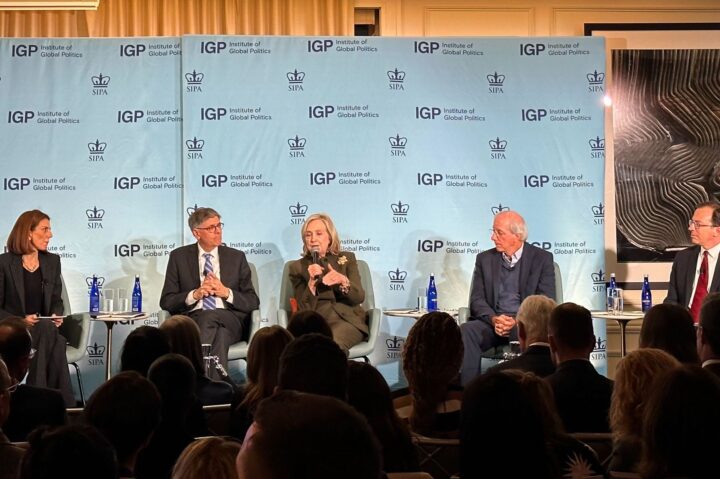
Panel discussion moderated by Keren Yarhi-Milo, dean of Columbia’s School of International and Public Affairs, features Israeli journalist Nadav Eyal; Hillary Clinton, former secretary of state; former diplomat and Middle East envoy Dennis Ross; and Jacob Lew, former ambassador to Israel. The panel was hosted by Columbia University’s Institute of Global Politics, Nov. 11, 2025.
Weeks after President Donald Trump announced a 20-point peace plan to end the war in Gaza, former Secretary of State Hillary Clinton said on Monday that this could be a “new moment of hope and possibility.” But it will only be successful if there is “a level of organization” applied to the implementation, a lesson that can be drawn from the Oslo process, she said.
“One thing that can be learned from the Oslo process and applied to the situation now with the peace plan is that there was a process,” Clinton said during a panel hosted by Columbia University’s Institute of Global Politics. The event commemorated the 30th anniversary of the assassination of Israeli Prime Minister Yitzhak Rabin, who was murdered by Yigal Amir, a right-wing extremist, soon after signing the Oslo II Accords peace agreements with then- Palestinian Authority President Yasser Arafat in 1995 — two years after the signing of the Oslo I Accords.
“You have to have a level of organization, it can’t just have few people at the top — whether it be a president or special envoy, as necessary as they are, you have to have teams of people who can be working with their counterparts,” continued Clinton, who is a professor of international and public affairs at Columbia.
As phase two of Trump’s plan is still being formulated, Hillary Clinton said the “devil is in the details” to determine its success. “Who’s gonna hammer out those details? Who’s going to be there going over maps?” she said.
“In the plan are many of the same goals as the Oslo process,” she continued. “But it starts from a different perspective. The region is different. Israeli leadership is different. Palestinian leadership is not different and that has to change. There are a lot of lessons that can be learned. Understand some of the procedural lessons that will enable us to build more of an infrastructure of peace going forward.”
The panel discussion also featured Jacob Lew, former U.S. ambassador to Israel; Israeli journalist Nadav Eyal; and former diplomat and Middle East envoy Dennis Ross. It was moderated by Keren Yarhi-Milo, dean of Columbia’s School of International and Public Affairs.
The event opened with remarks delivered by Claire Shipman, acting president of Columbia University, and former President Bill Clinton. Shipman, a former journalist, reflected on her time covering the White House during the Clinton administration.
In 40-minute remarks, former President Clinton, who mediated the Oslo Accords signing — which he hosted at the White House — spoke about his close personal and professional relationship with Rabin, calling the assassination one of the worst days of his life.
“We have to begin again, where the trust level is low,” Clinton said of achieving Israeli-Palestinian peace. “People in power might not be in favor of giving up on anything now.”
Clinton invoked “Rabin’s law — that’s what we called it in the White House.”
“We will fight terror as if there are no negotiations. We will negotiate as if there is no terror, never stop talking to people about resolving this,” Clinton said. “[Rabin] always believed peace is achieved through compromise.”
Please log in if you already have a subscription, or subscribe to access the latest updates.
 Continue with Google

 Continue with Apple