












































































Former Iran envoy Elliott Abrams: ‘His policy is working right now, but the enemy gets a vote’
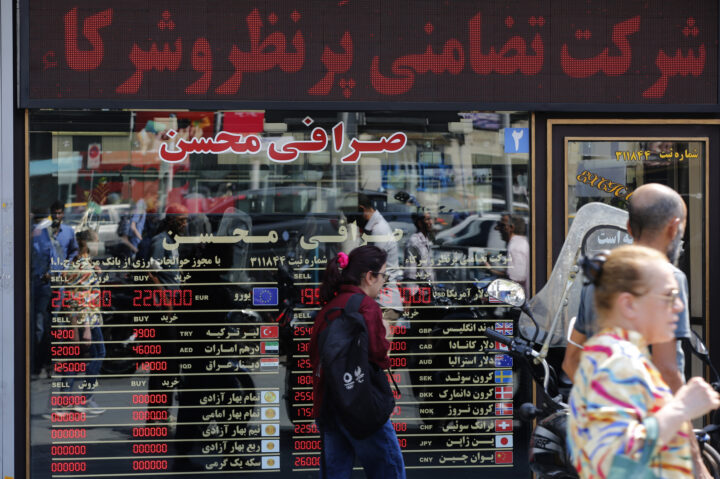
Fatemeh Bahrami/Anadolu via Getty Images
Currency exchange offices begin applying the new exchange rate to their buying and selling transactions as US dollars selling rate on the free market reaches an all-time high, hitting the 200,000 toman mark in Tehran, Iran on August 24, 2026.


 Add JewishInsider on Google
As the conflict between the United States and Iran passes the six month mark, former White House officials and regional analysts remain divided over whether Washington’s economic campaign and naval blockade are meaningfully changing the strategic landscape.
Hostilities briefly renewed for the first time in weeks over the weekend, as the U.S. struck Iranian rocket launchers to prevent them from deploying mines in the Strait of Hormuz and Tehran in turn fired on U.S. forces in Jordan. President Donald Trump vowed on Monday that the U.S. would retaliate for the attack.
Alexander Gray, former chief of staff on the National Security Council during Trump’s first term, expressed confidence in the administration’s trajectory, arguing U.S. leverage is “only growing.”
“As President Trump has accurately noted, the military metrics of American operational success — destruction of the regime’s navy, air force, and leadership — are clear. But it is the economic impact, and particularly the sustained pressure on the Iranian currency that is so damaging,” Gray told Jewish Insider.
Richard Goldberg, a former Trump administration official, also expressed support for continued economic pressure and indicated that the current strategy will “put the United States on a course to total victory.”
“Unless and until we have military solutions to deeply buried and hardened underground missile and command facilities, a return to widespread major military operations risks blowing up the global oil market without any assurance of bringing down the regime,” Goldberg said. “On the other hand, if you can capitalize on all the strategic gains already achieved, put the regime on a pressure cooker clock toward financial collapse, relieve the pressure on the global oil market by moving more and more product out of Hormuz via the U.S. military, and surge covert support to the Iranian people, you can put the United States on a course to total victory.”
Brett McGurk, a former senior national security official who served under Presidents George Bush, Barack Obama, Trump and Joe Biden and now is a global affairs analyst at CNN, wrote this week that Iran is “not winning” the war, but is actually “losing its leverage” in the Strait of Hormuz.
However, other former White House officials warned that Iran could turn the tide.
“Right now the U.S. has the upper hand because Arab states are able to export some oil — through pipelines or the Strait of Hormuz — while Iran is not,” Elliott Abrams, a former U.S. special representative for Iran during the first Trump administration, told JI. “Iran’s economy is being battered badly.”
Abrams described the current balance as a “very good situation” for Washington, but cautioned that it “may not last” given Tehran’s unpredictability.
“Iran might lash out at Gulf Arab oil facilities again, or at power and desalination plants,” Abrams said. “That would present President Trump with a situation he’s been trying to avoid: the need to go back to war. His policy is working right now, but the enemy gets a vote.”
Jason Greenblatt, a former White House Middle East envoy in the first Trump administration, agreed that Washington currently holds the edge, but cautioned that it is “not yet” decisive.
“At the six-month mark, the balance of leverage remains with Washington, although not yet decisively,” Greenblatt said. “The Trump administration’s economic campaign is raising the cost for Tehran and those helping the regime. President Trump’s strategy is working because it attacks the regime’s ability to finance the conflict while preserving overwhelming American military power.”
Greenblatt acknowledged that Tehran retains the ability to “create instability,” pointing to the flare up in tensions between the two sides over the weekend. However, he asserted that Trump has shown “zero tolerance” for maritime disruptions.
“The latest strikes show that Iran remains willing to create instability, but also that the United States is willing and able to enforce that warning,” Greenblatt said. “The question now is whether anyone in Tehran has the authority to turn mounting economic pain into an agreement and enforce it. At the moment, I do not believe there is. But as President Trump’s Operation Economic Outcast grinds on, that may change. That is the point of the campaign.”
Meanwhile, other experts offered a more cautious assessment, questioning whether Washington’s leverage can endure given Tehran’s ability to outmaneuver economic pressure.
Dan Shapiro, former deputy assistant secretary of defense under the Biden administration and former U.S. ambassador to Israel, acknowledged that there has been a “modest increase in U.S. leverage” due to the economic and maritime pressures imposed by the Trump administration.
However, he expressed concern over the military and strategic costs required to sustain it.
“A range of measures have resulted in a decent resumption of oil flowing through the strait, although still well below pre-war levels and with far less shipping generally,” Shapiro said. “But one really has to ask, how sustainable is this leverage? It requires a major U.S. naval presence to impose the blockade, conduct escorts, and support an aerial defense against Iranian attacks.”
Shapiro cautioned that the administration’s economic pressure may not be as effective as expected, arguing that secondary sanctions may lack impact given the Iranian regime “cares nothing about passing that [economic] pain” onto the Iranian public.
“The exchange over the weekend suggests that at some point, Iran will resume threats against ships to regain leverage,” Shapiro said. “The only way we could prevent that is with a permanent U.S. naval presence that would significantly strain the Navy beyond what it has already endured over the last six months, with long-range implications for U.S. readiness and deterrence in other regions.”
Jonathan Ruhe, director of foreign policy at the Jewish Institute for National Security of America, argued it is still unclear whether either side has the edge six months into the conflict, but suggested that Iran “more likely” retains an advantage.
“At best, the verdict is still out on whether the U.S. has regained meaningful leverage over Iran,” Ruhe said. “More likely though, Iran retains the initiative and escalation dominance over the U.S. and its partners.”
Ruhe suggested Tehran views Washington’s shift toward sanctions as a sign that the U.S. has expended its military options.
“Economic pain is a small price to pay, especially because Iran’s regime thinks the latest sanctions regime is shot full of holes, and because it clearly doesn’t care if its own people suffer in the process,” Ruhe said. “If anything, the sanctions-first approach will merely embolden Tehran to step up its military threats to shipping, U.S. bases, and our Gulf partners.”
Rachel Brandenburg, a senior policy analyst at Israel Policy Forum, similarly pointed out that while Iran’s economic crisis is worsening, the regime is willing to absorb economic costs in order to survive.
“The Iranian regime has a very high tolerance for pain, particularly pain that is inflicted most harshly upon the Iranian people,” Brandenburg said. “It is unlikely that even a deteriorating economic situation changes the regime’s calculus with respect to Iran’s nuclear or ballistic missile program.”
Brandenburg added that Washington’s unilateral approach limits its options.
“The United States is operating mostly alone in this fight,” Brandenburg said. “It is clear that Trump prefers not to go back to war, and he has not displayed an ability to stick to one approach for very long.”
Signing ceremony set for Friday in Switzerland; Israeli security officials express concern

Christopher Furlong/Getty Images
President Donald Trump holds up an executive order after signing it during an indoor inauguration parade at Capital One Arena on January 20, 2025 in Washington, DC.
The United States and Iran have secured a ceasefire agreement, President Donald Trump announced on Sunday. The deal is slated to immediately freeze regional military actions, and will lift the U.S. naval blockade and restore commercial shipping through the critical Strait of Hormuz after a formal signing ceremony set for Friday in Switzerland.
“The Deal with the Islamic Republic of Iran is now complete,” Trump posted on Truth Social on Sunday. “I hereby fully authorize the toll free opening of the Strait of Hormuz, and, simultaneously herewith, authorize the immediate removal of the United States Naval blockade.” He later clarified the Strait would open after the deal was officially signed on Friday.
Iran’s deputy foreign minister, Kazem Gharibabadi, also told Iranian media that the agreement had been finalized and stressed that Iran’s “commitments will take effect starting Friday.”
The agreement establishes a 60-day ceasefire extension, during which Washington and Tehran are expected to enter technical negotiations on the scope of Iran’s nuclear enrichment program and the dismantling of its highly enriched uranium stockpiles. The cessation of hostilities extends across the entire region, including in Lebanon, according to Pakistani Prime Minister Shehbaz Sharif, who helped mediate the agreement.
“Following intensive talks, we are pleased to announce that the Peace Deal between the United States of America and Islamic Republic of Iran has been REACHED,” Sharif posted on X. He noted that international mediators will facilitate a “series of meetings” and “technical talks” ahead of the signing ceremony.
Sharif’s statement thanked Qatar, Saudi Arabia and Turkey for their roles in the negotiations, but made no mention of Israel, which had fought alongside the U.S. in the conflict with Iran.
The diplomatic breakthrough followed a tense escalation earlier on Sunday that threatened to derail the negotiations. Israeli forces struck Hezbollah targets in Beirut in response to a Hezbollah drone strike on northern Israel, prompting Tehran to warn it would abandon talks and strike against Israel.
Vice President JD Vance said the U.S. was able to deter an Iranian attack on Israel prior to the deal being reached. “After the Israelis struck Beirut, we saw a lot of evidence the Iranians were going to launch a large number of missiles at…them,” Vance said on Fox News. “[Iran] assured us they were not going to respond to the Israelis. They were going to sign the agreement, and get to peace.”
Writing on Truth Social, Trump criticized the Israeli response as an unnecessary escalation against a “meaningless” initial drone strike, and demanded an immediate halt to all military activity in Lebanon. “There should be no more attacks by Israel anywhere in Lebanon, but there should also be no more attacks by any other party, including Hezbollah, against Israel,” he wrote.
Gharibabadi said the Iranian threats against Israel “helped facilitate progress in the negotiations.” Iranian state media reported that Iran called off the attack on Israel because of “last-minute concessions” offered by Trump, including “preserving Lebanon’s territorial integrity” and Israel’s withdrawal from the Lebanese border. The U.S. did not confirm the reported concessions on Lebanon.
Israeli Prime Minister Benjamin Netanyahu has said that the IDF would not follow such a request and that Israel does not consider itself bound to the Lebanon ceasefire under the agreement. It is unclear whether the Trump administration will pressure Jerusalem to comply.
Israeli security officials have reportedly expressed concern with the deal, warning that it could harm Israeli security interests and leave Iran stronger.
Please log in if you already have a subscription, or subscribe to access the latest updates.
 Continue with Google

 Continue with Apple