










































































JFNA CEO Eric Fingerhut: ‘There's no other religious faith that has to incur this kind of expense just to protect itself in its places of worship and communal gathering’

Tom Brenner For The Washington Post via Getty Images
Metropolitan Police Department and Federal Bureau of Investigation officers stand guard at a perimeter near the Capital Jewish Museum on May 22, 2025 in Washington.


 Add JewishInsider on Google
The American Jewish community spent over $1 billion on security in 2025, according to a new Jewish Federations of North America study — a record high and a 33% increase over 2024. The results, published today, showed that on average, Jewish communal organizations, including Jewish community centers, synagogues, schools, summer camps and nonprofits, spend roughly $225,000 on security per institution.
“Even the old number, $765 million [spent in 2024], was just a demonstration of the impossible situation that the Jewish community is being put in,” Eric Fingerhut, JFNA’s president and CEO said. “To have to raise extraordinary sums of money and dedicate extraordinary sums of money to security just to be able to fully live a flourishing Jewish life in this great and free country,”
Fingerhut said the statistics didn’t shock him. According to the Anti-Defamation League, last year was the deadliest year for Jews in three decades. The security threats had grown, alongside the necessary precautionary measures.
“This is just not the way America is supposed to work,” Fingerhut said. “There’s no other religious faith that has to incur this kind of expense just to protect itself in its places of worship and communal gathering.”
According to the latest FBI Hate Crime data, Jews remain the most targeted religious group in America — making up 64% of all religiously motivated hate crimes. While the numbers of antisemitic hate crimes have decreased since 2024 — from 1,938 to 1,528 — last year remains the third highest year on record.
The statistics arrive as Fingerhut and other leaders are pushing Congress to pass the bipartisan Jewish American Security Act, legislation which would fund the nonprofit security grant program at a billion dollars and better address antisemitism online, on campus and across the country.
Although the U.S. government has “been on our side,” Fingerhut said, “they have to do more to address this crisis of terror that’s directed at the Jewish community.”
The nonprofit security grants would be available to other nonprofits, but would have a disproportionate impact on the Jewish world, Fingerhut said. “Given that we’re 2% of the population and over 50% of all the hate crimes, it obviously is going to make a significant difference in our institutions.”
The study only looked at Jewish nonprofits, leaving out the cost incurred by the privately-owned businesses including over 1,600 kosher restaurants, 500 markets and Judaica shops and bookstores.
This funding spent on security could be used towards other initiatives, Fingerhut said, with the JFNA estimating that it would be able to send 44,000 kids to Jewish day schools and cover the costs of every attendee at Jewish camp.
Members of synagogues and schools understand the need for increased security and have stepped up, Fingerhut said. “There’s been extraordinary generosity in the Jewish community with regard to security [but] clearly there are limits.”
The majority of the cost for security goes towards personnel, including security guards, with additional funding goes towards protecting windows and doors, improving security cameras and putting bollards in front of buildings.
“Those are capital expenses, which largely occur one time, and the personnel costs are ongoing and growing expenses,” Fingerhut said. “Demand for security guards is growing … Maybe there was a time a few years ago, you thought, ‘Well, we only have to have [security] if we’re having high holidays or big crowds or a special event.’ Now, it’s a necessity anytime there are people coming in and out of the building.”
Needing constant security is the reality the Jewish world lives in now, Fingerhut said, and it’s not going to change in the foreseeable future.
“There’s not a synagogue in America that isn’t spending money on security for the high holidays,” he said. “It’s an extraordinary expense, and so … it’s on everybody’s mind. But … this is a year-round crisis, this isn’t just a high holiday crisis. It’s affecting our ability to live full and complete Jewish lives because every time a synagogue or a school or a camp or JCC is planning a program, they have to factor in this extraordinary cost of security for that program, and that may mean that the programs don’t go forward because you can’t afford the cost of security.”
Still, Fingerhut said, not practicing Judaism, not celebrating, not coming together — that isn’t an option. “We’re not going to let Jewish life be curtailed because of the cost of security.”
LePatner, a Blackstone executive, served on the boards of the Abraham Joshua Heschel School and UJA-Federation of New York
courtesy/UJA-Federation of NY
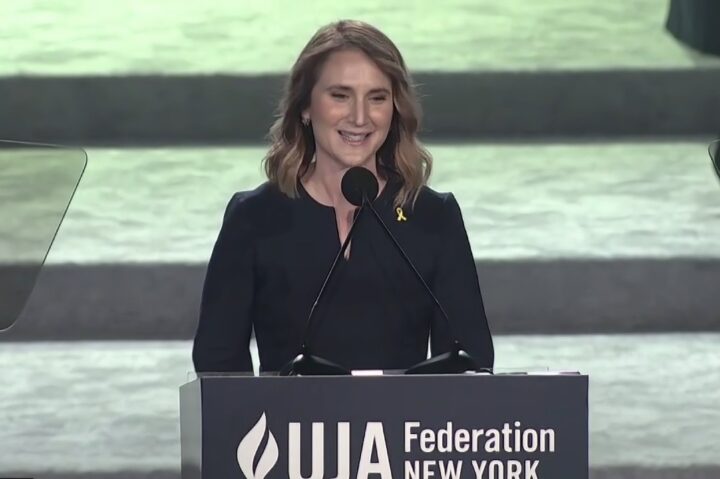
Wesley LePatner speaks at the UJA-Federation of New York's annual Wall Street Dinner in December 2023.
Wesley LePatner, a Blackstone executive who was involved with Jewish communal organizations in New York City, was killed in the Monday shooting at the firm’s Midtown headquarters, the company confirmed on Tuesday.
LePatner was the global head of Core+ Real Estate at Blackstone and CEO of Blackstone Real Estate Income Trust, according to Blackstone’s website. A Yale graduate, she joined the company in 2014 after more than a decade at Goldman Sachs.
She served on the board of trustees at the Abraham Joshua Heschel School, a pluralistic Jewish day school in New York, and she joined the board of directors at UJA-Federation of New York earlier this month.
“We are devastated by the tragic loss of Wesley LePatner, a beloved member of UJA’s community and a member of our board of directors, who was killed in yesterday’s mass shooting in Midtown,” the federation said in a statement.
“Wesley was extraordinary in every way — personally, professionally, and philanthropically,” the organization said. “In the wake of Oct. 7, Wesley led a solidarity mission with UJA to Israel, demonstrating her enduring commitment in Israel’s moment of heartache. She lived with courage and conviction, instilling in her two children a deep love for Judaism and the Jewish people.”
In 2023, LePatner was awarded the Alan C. Greenberg Young Leadership Award at UJA’s 2023 annual Wall Street dinner. In a speech, she outlined her involvement with the organization, dating back nearly two decades.
“I first attended the UJA Wall Street dinner as a young analyst in 2004, where I am pretty certain I sat in one of the last tables at the back of the room,” LePatner said at the event, which took place two months after the Oct. 7 attacks. “Never in my wildest imagination could I have believed that I would be up on this stage two decades later. UJA has many super-powers, but its most important in my view is its power to create a sense of community and belonging, and that ability to create a sense of community and belonging matters now more than ever.”
LePatner also sat on the board of the Metropolitan Museum of Art, the Yale University Library Council and Nareit, a real estate organization.
The shooting also claimed a second Jewish victim, Julia Hyman. A Cornell graduate, Hyman worked for Rudin Management in the Midtown skyscraper.
Ofir Akunis, consul general of Israel in New York, called the murder of LePatner and Hyman — as well as NYPD Officer Didarul Islam — “horrific and senseless” at the Israel on Campus Coalition’s National Leadership Summit in Washington on Tuesday. “In this difficult moment, Israel stands in solidarity with New Yorkers and all Americans,” Akunis said.
Please log in if you already have a subscription, or subscribe to access the latest updates.
 Continue with Google

 Continue with Apple