













































































A clear divide is emerging in the prospective 2028 presidential field over the issues of the U.S.-Israel relationship and dealing with rising antisemitism
Israel Hadari
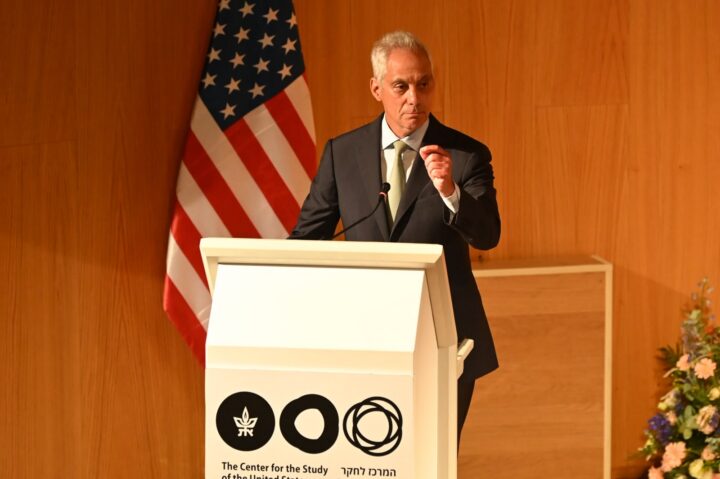
Rahm Emanuel speaks at Tel Aviv University on July 8, 2026.


 Add JewishInsider on Google
A quarter century ago, when the late Sen. Joe Lieberman was tapped by Al Gore, the Democratic nominee for president, to be his running mate on the 2000 ticket, the question around many a Shabbat table was, “Is he too Jewish to be in the White House?”
There’s a different question being asked, largely in Democratic circles, of today’s Jewish presidential candidates: “Is he the ‘right’ kind of Jewish candidate to be president?” — a question that is almost entirely centered around a candidate’s position on Israel and how openly he identifies with his religious faith.
A long list of Jewish candidates are considering a presidential campaign or are being touted as credible contenders, ranging from moderates like Pennsylvania Gov. Josh Shapiro, Sen. Elissa Slotkin (D-MI) and former Chicago Mayor Rahm Emanuel to progressives like Illinois Gov. JB Pritzker and those who straddle the ideological divide, like Sen. Jon Ossoff (D-GA).
In both 2026 and 2028, the debate over Israel is on the ballot: Congressional primaries are pitting pro-Israel candidates against those who don’t acknowledge Israel’s right to exist as a
Jewish state, and already a clear divide is emerging in the prospective 2028 presidential field over the issues of the U.S.-Israel relationship and dealing with rising antisemitism.
Even in races where Israel policy is not front-and-center, invoking AIPAC has become something of a catch-all slur for progressives attacking the role of outside money in Democratic primaries. California Gov. Gavin Newsom, a likely 2028 hopeful, proudly proclaimed in February that he’d never taken AIPAC money — which of course he hasn’t, given that AIPAC and its affiliated super PAC historically focus on federal, not state, races.
Since soft-launching his presidential campaign last month (in Tel Aviv, no less), former Chicago Mayor Rahm Emanuel has made the Jewish state — and its relationship with the U.S. — one of his top issues in speeches and interviews. Even when his views are well within the mainstream, his signaling that he’s talking tough against Israel is a sign he recognizes his long-standing pro-Israel record is a vulnerability in a Democratic presidential primary.
A week after his Tel Aviv speech, Emanuel appeared on the Council on Foreign Relations’ “The Spillover” podcast in an episode titled “Rahm Emanuel Talks Israel, Midterm Elections, and the Democratic Party.” Two days later, The New Yorker’s “Radio Hour” podcast aired an interview with Emanuel in conversation with David Remnick titled, “Rahm Emanuel Says Israel’s Path Is ‘Not Sustainable Politically.’” Earlier this week, Emanuel appeared on the podcast of anti-Zionist Peter Beinart for a conversation largely focused on Israel.
The polling reality is that despite his lengthy and impressive resume — a former U.S. ambassador, congressman, Chicago mayor and White House chief of staff — Emanuel’s record is out of step with the ascendant progressivism that’s taken hold within the party. (He is currently polling at 0% in most 2028 Democratic primary polls.)
Emanuel could be using his skill as a straight-talking political operative to push his party to the center on antisemitism and Israel, akin to the way former New Jersey Gov. Chris Christie used his anti-Trump bromides against the MAGA-aligned candidates during the 2024 presidential debates. But Emanuel’s candidacy has thus far been an opportunity to push the party leftward on Israel — in essence, kashering an increasingly unfriendly approach to the U.S.-Israel relationship — and throw jabs at Israeli Prime Minister Benjamin Netanyahu, with whom Emanuel has a long and less-than-amicable history.
Both Emanuel and Newsom’s approaches reflect what they see as a political reality as the 2028 race comes into view: criticizing Israel might garner some support, while backing it is a losing argument.
Other leading Jewish Democrats who are considering 2028 bids are opting not to make Israel — and the future of its relationship with the U.S. — a cornerstone of their campaigns. Some, such as Shapiro, attempt to pivot when pressed on Israel questions, focusing instead on the domestic impact of the war with Iran or on U.S. national security. And when they do talk about Israel, criticism is largely focused on Israel’s government and not the country as a whole.
Shapiro, whose Israel stance was reportedly one reason former Vice President Kamala Harris opted against selecting him as her running mate in 2024, has frequently criticized Netanyahu while also legitimizing Israeli security concerns.
“I don’t think that if you are critical of Benjamin Netanyahu, you’re an antisemite,” Shapiro said on the “Higher Learning” podcast earlier this year. “By the way, I’m critical of Benjamin Netanyahu. And I have been for years and years and years, even predating Oct. 7. I think his approach has made Israel less safe.”
Pritzker has similarly kept the message — largely — focused on Netanyahu. In an in-depth New York Times interview in March, Pritzker said he felt Israelis had erred in selecting Netanyahu, saying that his leadership has led the country into “additional wars” and caused excess death and destruction in Gaza. On AIPAC, the Illinois Democrat, who previously supported the group, explained to The Times that his efforts to distance himself from the group were because it had become increasingly partisan and “pro-Trump,” rather than because of Israeli policy itself.
And then there’s Ossoff , who has always held positions on Israel that fall to the left of the others. We wrote last month that many Peach State Jews find themselves in a political no-win situation as Ossoff, who has voted to block weapons shipments to Israel, defends his seat against Rep. Mike Collins (R-GA), who has a history of inflammatory right-wing rhetoric — and a son-in-law who openly espouses white nationalist, antisemitic propaganda.
While all four have tacked left on Israel, they have done so to varying degrees — for example, Shapiro has expressed support for some aid to Israel to be conditioned, while Ossoff has voted to block weapons sales to Israel and Emanuel has called to immediately end all military aid to Israel.
2028 candidates rightfully sense that the party is shifting, not just on Israel but on a range of policies. When Lieberman was on the ticket a quarter century ago, the question was whether Americans were ready to elect a Jewish president (or vice president). Now, the question facing potential Jewish 2028 contenders is different: What do they have to say about Israel to persuade primary voters they are the “right” kind of Jew to become president?
The Kids Table endorsed several candidates to sit on the board of directors of the district, which has faced several high-profile antisemitic incidents

JASON REDMOND/AFP via Getty Images
Pro-Palestinian demonstrators rally in Seattle, Washington on May 27, 2024.
With eyes on several high-profile races across the country featuring candidates antagonistic to Jewish interests, activists in one of the most progressive parts of the country are raising the alarm on local seats that act as a “rung on a ladder” to higher office, saying the problems the Jewish community face “start further upstream.”
The Kids Table, a new PAC in Washington state supporting “pro-Jewish candidates” and led by “Millennials and moms, public affairs experts and gymnastics dads,” unveiled a slate of endorsements this month in races for the board of directors of Seattle Public Schools, a school district that has seen several major antisemitic incidents since the Oct. 7, 2023, attacks in Israel and subsequent rise of antisemitism across the country, including in K-12 classrooms, amid the two-year war between Israel and Hamas.
“We need help in the school districts now,” Sam Jefferies, co-chair of The Kids Table, told Jewish Insider. “We also know that school boards can be a rung on a ladder as [candidates] seek higher office, and we want to make sure that we are building relationships with them early, providing them critical context and education around our issues, and then carry that forward, whether it’s on the school board or elsewhere.”
The district’s board of directors, a nonpartisan elected body of seven citizens who serve four-year terms and represent regions in the district, manages a more than $1 billion budget and has responsibilities including establishing policies for governing the district, adopting instructional materials and overseeing the hiring of a new superintendent, a process currently underway.
“Seattle Public School is the largest school district in the state, and so from my standpoint, SPS, in many ways, sets the tone or has influence over education, education policy, implementation that shows up in many other school districts around the state,” Jefferies said. “For all the attention paid to campus and other spaces, the problems start further upstream. Students are facing hostile environments, teachers are not held accountable and school boards can claim ignorance.”
One Jewish family is suing the district over claims that it failed to respond to antisemitic harassment their daughter experienced that started shortly after Oct. 7 and eventually led her to leave Nathan Hale High School, including an incident in May 2024 where 20 students allegedly tried to assault her before a teacher locked her in a classroom for protection.
This month, SPS walkouts by students protesting the war in Gaza shortly before the ceasefire was enacted included the burning of Israeli flags and signs reading “Power grows from the barrel of a gun” and “Long Live Operational Al Aqsa Flood,” referencing Hamas’ name for the Oct. 7 attacks.
In another incident, the chair of the social studies department at an SPS high school was placed on paid administrative leave for a year over a video in which he questioned the validity of accusations of sexual violence by Hamas on Oct. 7 and said, in reference to women being killed at the Nova Music Festival, “I think resistance against Israel is justified.” He was eventually terminated at the end of the last academic year.
Aviad Benzikry, an SPS parent and board member of The Kids Table, told JI, “Every Jewish parent I talk to is worried about antisemitism in schools. We feel placated and patronized when we bring it up. Of course we see it explicitly — swastikas and pro-Hamas walkouts — but the quiet antisemitism we don’t see is even scarier.”
One of The Kids Table’s endorsees, Sarah Clark, who is running for the first time after being appointed to her seat on the SPS board, said that she was “appalled to learn of the allegations of antisemitic threats and bullying at Nathan Hale. … School officials, administrators, and security staff are obligated by school board policy and state law, to investigate and act decisively to protect students from harm. That did not happen in this case, which is unacceptable.”
The other two candidates on the slate of endorsees are Vivian Song and Carol Rava. Rava said her father is “an Italian Jew who, with his parents and younger sister, fled fascist Italy during WWII,” and therefore antisemitism “is not an existential concept to me, it is personal and very real.”
The Kids Table also endorsed candidates in several other Washington state races, including the high-profile Seattle mayor’s race, where Mayor Bruce Harrell, a Democrat, is trailing in his reelection behind self-proclaimed socialist Katie Wilson, whom Jewish leaders in the area have voiced concern over.
In its voter guide, published earlier this month, the advocacy group endorsed Harrell with an asterisk next to his name, which read, “Mayor Harrell has failed to demonstrate moral leadership at a time of crisis for the community, including when ‘kill your local colonizer’ was spray painted on statues at the mayor’s alma mater [the University of Washington], with zero comment from his office. Still, Wilson’s candidacy, alliances with anti-Jewish figures and organizations, and lack of engagement would be much, much worse.”
Please log in if you already have a subscription, or subscribe to access the latest updates.
 Continue with Google

 Continue with Apple