














































































Many Jewish Trump administration staffers are expected to attend the White House’s official reception in the Indian Treaty Room

Getty Images


 Add JewishInsider on Google
Washington, D.C., will be buzzing with events on Friday evening bringing in Shabbat 250, a national Sabbath marking the 250th birthday of the United States.
Several Jewish organizations have been planning celebratory gatherings, both in Washington and across the country, to commemorate Shabbat 250 since President Donald Trump encouraged Jewish Americans to observe Shabbat this weekend in his Jewish American Heritage Month proclamation.
The proclamation marked the first time a U.S. president had called for a national Shabbat, prompting some Jewish leaders to rush to organize events.
“There will be a number of events taking place around town for Shabbat 250,” Rabbi Levi Shemtov, the executive vice president of American Friends of Lubavitch (Chabad), told Jewish Insider. “In observance of the Sabbath, I’ll need to walk everywhere, so I hope to make it to as many gatherings as possible.”
Shemtov said the message he’s taken from his conversations with fellow Jewish leaders going into this weekend is one of gratitude toward the president for including the national Sabbath in his JAHM proclamation and of hope that the venture would prompt more Jewish Americans to keep Shabbat.
“I’m obviously delighted by the president’s call to observe Shabbat, because this reinforces Jewish identity with Jewish observance and tradition. I hope those who don’t yet observe Shabbat will choose to do so, and those who already observe will choose to share with a friend who doesn’t yet know about this beautiful cornerstone of our heritage,” Shemtov said. “I would imagine that those Jewish people who were in America 250 years ago could not have imagined our good fortunes today and must be kvelling.”
“Some Jewish leaders have said that much like Shabbat gives us a break from the week for renewal and recalibration, their hope is that this Shabbat will be a moment of reprieve from partisan political battles for even just one day,” he continued.
The most difficult ticket to snag is the White House’s official Shabbat 250 reception, which is slated to take place at 6 p.m. ET in the Indian Treaty Room. While Trump and Vice President JD Vance are not expected to be in attendance, Trump administration staffers have been invited to and are expected at the gathering.
Several invite-only dinners are taking place around D.C. after the White House event concludes and before sundown on Saturday. Details for many events are being kept under wraps due to security concerns.
One of those receptions is being co-sponsored by the American Association of Jewish Lawyers & Jurists and the Combat Antisemitism Movement. The gathering, titled, “Shabbat 250 Dinner: A Celebration of the President’s National Sabbath,” will feature a “family style” Sabbath meal and an afterparty dubbed “Farbrengen 250,” according to an invitation obtained by JI.
An event organizer described the gathering to JI in a statement as an “off-the-record dinner” bringing together “Jewish members of the administration, Capitol Hill staff, media and policy professionals in celebration of the president’s National Sabbath.” The organizer told JI that guests will receive “the usual kippot and benchers” and copies of Charlie Kirk’s book on Shabbat. The wine served at the event will be donated by Psagot Winery, the Israeli vineyard located in the West Bank.
“We were incredibly moved by President Trump’s call for a national Sabbath as part of the USA250 commemorations,” Arie Lipnick, advisory board chairman of the Combat Antisemitism Movement, told JI in a statement. “In that spirit, CAM is excited to help bring together more than a hundred Jewish members of the administration, Hill staff, media and policy professionals in celebration of America and Shabbat.”
Former House Majority Leader Steny Hoyer said antisemitism has worsened to the point that Jews aren’t guaranteed safety in the U.S.
Marc Rod
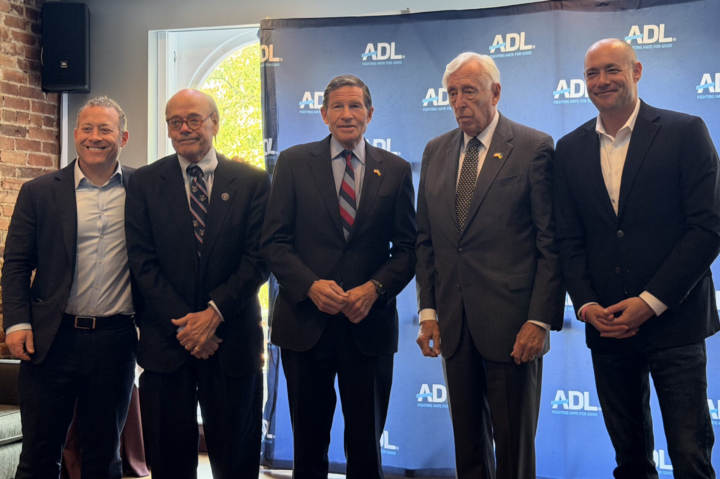
Lawmakers attend Anti-Defamation League reception honoring Jewish American Heritage Month on Capitol Hill on Tuesday, May 12, 2026
A series of largely Democratic lawmakers painted an unusually dire portrait of the state of rising antisemitism and threats to the Jewish community in remarks at an Anti-Defamation League reception honoring Jewish American Heritage Month on Capitol Hill on Tuesday evening.
Several emphasized the need for those in the audience, many of them young Jewish congressional staffers and Washington professionals, to continue speaking out and fighting for the Jewish community in a time of crisis.
Rep. Steny Hoyer (D-MD), the retiring former No. 2 House Democrat, said that antisemitism has escalated to the point that Jews are no longer guaranteed safety in the United States.
“There were two places in the world where Jews felt really safe. One, of course, was Israel, and the second was the United States of America,” Hoyer said. “That’s not true today, and that is a sad statement of what’s going on in the country today. So you all need to be involved. You all need to when you see something that’s not right, not fair, not just stand up, speak up and make a difference.”
Rep. Laura Friedman (D-CA) emphasized that efforts to fight antisemitism have often been met with additional hostility.
“It is a very scary time for the Jewish community,” Friedman said. “And to make matters worse, when we express that we’re scared and that there’s this rising level of hatred directed towards the Jewish community, we’re often met with people telling us that we’re not allowed to feel that way. And how dare we even say that there’s anything wrong with treatment towards Jews in this country?”
She offered as an example of “how bad it’s gotten” that her synagogue was graffitied this year with a swastika, and that she ended up in an argument online with local activists “who were trying to tell me why it was appropriate for people to put swastikas on the sides of buildings in the Jewish part of Los Angeles, where there are Holocaust survivors still living, why they thought that was OK and not antisemitic.”
Friedman used as another example a recent ad created by a super PAC backing Rep. Thomas Massie (R-KY) in his reelection race attacking a Jewish conservative donor, Paul Singer, who is supporting Massie’s opponent, which prominently featured a graphic of a Jewish star alongside the Singer’s face.
“A super PAC thought it was totally fine to do a hit on a candidate by showing one of their donors and by flashing a Jewish star behind that donor to let everyone know that, ‘Hey, if everything else we’ve said about this candidate isn’t convincing enough, they have a donor who’s Jewish,’” Friedman said.
“I don’t think anyone can sit this one out and you all being here is part of that effort, so thank you … for showing up, thanks for the work you do,” she concluded.
Rep. Haley Stevens (D-MI), who is running for Senate in Michigan and has faced attacks over her support for Israel and ties to the Jewish community, said that she would not “sugarcoat” the situation, explaining that “the faces of hate in this country have morphed into violent extremism,” with an increasing pace of violent attacks targeting the Jewish community, including in her own district.
“Extremist words matter. They absolutely matter,” Stevens said.
She also maintained that she is “unequivocal in declaring that I am very much a proud Zionist” in spite of facing attacks for that stance. “When I show my face in my community, every so often [I] get chased out because of violent extremism, because people feel so emboldened to shout at me that I am a ‘Zionist pig.’ That cannot be acceptable.”
Rep. Steve Cohen (D-TN), whose congressional district was recently carved up by Tennessee Republicans, likely ending his career, warned that prejudice is still a real and very active problem.
He recounted a story of when he ran for governor in 1994: “I went to a little radio station in Dixon, Tenn. — one person radio station, gravel road. [I] came in, talked to the man for a while and he said, ‘Son, you Jewish?’ I said, ‘Yes sir.’ He said, ‘Good luck,’” Cohen recounted. “It ain’t changed a lot since then. Be careful. There’s a lot of mamzers out there. They don’t know us, but they don’t like us,” he said, using the Hebrew word for bastard.
Rep. Greg Landsman (D-OH) said that it is “obviously a very bad time” for the American Jewish community and “in my opinion, it’s going to get a lot worse.” He urged the crowd “to lead through such difficult, chaotic, awful times.”
Rep. Mike Lawler (R-NY) lambasted New York City Mayor Zohran Mamdani as emboldening and encouraging antisemitism.
“We see a mayor in New York City who has, in many respects, OKed his supporters engaging in antisemitic hate, engaging in conduct that threatens Jewish students and Jewish lives,” Lawler added. “We see these protests happening outside places of worship — these are real issues that we have to combat.”
He also emphasized that antisemitic influencers like Hasan Piker, Candace Owens and Tucker Carlson have been using antisemitism as a “grift” and playing on hatred to “make a buck” and create further division.
Rep. Jake Auchincloss (D-MA) said that it is “unacceptably scary to be a Jew in the United States” and that the country is “violating the core promise that George Washington made” to the Jewish community in Rhode Island in 1790 that the country would be one of religious freedom and pluralism.
Auchincloss highlighted his efforts in Congress to combat antisemitism on social media, describing platforms as having become “failed societies online. It’s become so toxic, it’s become so rotten on these platforms that antisemitism is mushrooming as a symptom of something that is deeply rotten underneath.”
Rep. Kim Schrier (D-WA) said that Jews are “all feeling so threatened right now” and emphasized the need for broader understanding of antisemitism.
“They need to understand that anti-Zionism is kind of a new iteration [of antisemitism], if you don’t want another country wiped off the map,” Schrier said. “And I just think we all need to recognize that we all need to call it out, whether it’s in our party or another party.”
Rep. Jamie Raskin (D-MD), the ranking member of the House Judiciary Committee, said that “antisemitism and racism are the gateway to the destruction of liberal democracy” and that “the extremism, the fascism, the racism and the antisemitism” are infecting politics in the U.S. and around the world.
He praised Hungary as an example of a country that had been able to buck such trends, ousting its longtime right-wing government.
Several of the lawmakers who addressed the group also offered remembrances about Abe Foxman, the former longtime ADL leader who died last weekend.
“We’re all thinking about Abe Foxman right now, who looms over this room in a powerful way and taught us so much,” Rep. Josh Gottheimer (D-NJ) said. “I think what he taught us most was to be courageous, to fight, to never back down. That’s my ask of you. It’s tough out there, by the way. The harder they hit us, the more fight I feel.”
Rep. Debbie Wasserman Schultz (D-FL) said that Foxman was “a giant, a hero of mine, hero of so many, and really built this organization practically from the ground up.” She said she’d been stunned by his death, having spoken to him at a Holocaust remembrance event at the Capitol just weeks ago.
Sen. Richard Blumenthal (D-CT) also urged those in attendance to follow Foxman’s model, and emphasized the need for additional funding for the Nonprofit Security Grant Program.
In a statement, Lauren Wolman, ADL’s senior director of government relations and strategy, said the group was “honored to host our annual Jewish American Heritage Month (JAHM) reception celebrating Jewish Members of Congress and congressional staff.”
“At a time when many of these dedicated public servants are navigating rising antisemitism and growing challenges on Capitol Hill, the reception served as an important opportunity to celebrate their work and create a space for Jewish professionals to come together in community, connect with one another, and feel supported,” Wolman continued.
This year’s White House proclamation marks the first time that the call for a national Shabbat has been included
Graeme Sloan/Bloomberg via Getty Images
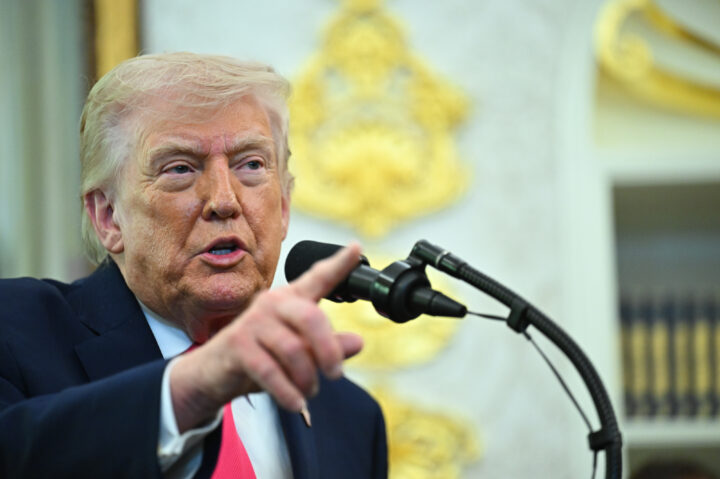
President Donald Trump speaks during a swearing-in ceremony in the Oval Office of the White House in Washington, DC, US, on Tuesday, March 24, 2026.
President Donald Trump encouraged Jewish Americans to observe Shabbat next weekend in his Jewish American Heritage Month proclamation issued earlier this week, marking the first time a U.S. president has called for a national Shabbat.
The president wrote in the proclamation, issued on Monday, that he urged American Jews to “observe a national Sabbath” from sundown on Friday, May 15, 2026, to sundown on Saturday, May 16, 2026. The Shabbat coincides with Rededicate 250, Trump’s national prayer event commemorating “250 glorious years of American independence” as part of his Freedom 250 initiative, the public-private partnership overseeing the Semiquincentennial of the United States.
“Throughout this historic year, we rejoice in the triumph of the American spirit and rededicate ourselves to the cause of liberty and justice for all,” the proclamation reads. “From sundown on May 15 to nightfall on May 16, friends, families, and communities of all backgrounds may come together in gratitude for our great Nation. This day will recognize the sacred Jewish tradition of setting aside time for rest, reflection, and gratitude to the Almighty.”
“I call upon Americans to celebrate the heritage and contributions of Jewish Americans and to observe this month with appropriate programs, activities, and ceremonies,” it continues. “I further call on all Americans to celebrate their faith and freedom throughout this year, during this month, and especially on Shabbat to celebrate our 250th year.”
The decree went on to highlight the resilient nature of the Jewish people and encourage religious tolerance.
“This month, we celebrate the contributions that Jewish Americans have made to our way of life, we honor their role in shaping the story of our Nation, and we remember that religious devotion, learning, and service to others are enduring pillars of a thriving culture,” it read. “Through every trial and triumph, the contributions of Jewish Americans have shaped our past, have strengthened our communities, and will continue to inspire American greatness for generations to come.”
U.S. presidents have been recognizing Jewish American Heritage Month annually since 2006, the result of a bipartisan, bicameral push by Rep. Debbie Wasserman Schultz (D-FL) and the late Sen. Arlen Specter, who was a Republican at the time. Wasserman Schultz has led the House resolution recognizing Jewish American Heritage Month every year since.
This year’s White House proclamation marks the first time that the call for a national Shabbat has been included.
A source who engaged with the White House as they were drafting the proclamation and planning Rededicate 250 told Jewish Insider that the White House Faith Office made overtures to several Jewish leaders to inquire about “what would be appropriate to do for people who are Jewish.” The office, the source said, “emphasized that this was a directive from the president. He asked them to make sure that Jewish Americans are comfortable at this faithful celebration.”
“They floated various ideas, but they discussed how they would like to do something that would be comfortable for Jewish people. They thought it would be a good idea to mark Shabbat,” the source said, adding that officials with the Faith Office “conveyed to us that this idea of helping ensure there will be something for the people of the Jewish faith came from the president.”
The White House did not respond to JI’s request for comment, though Freedom 250 CEO Keith Krach — the former DocuSign chairman and Ariba co-founder who served as undersecretary of state for economic growth, energy, and the environment in the first Trump administration — released a statement celebrating the news.
“This national observance is a moment to step away from the noise, reflect, and give thanks as we prepare to mark 250 years of American independence,” Krach said. “It honors the enduring contributions of Jewish Americans and offers a simple but powerful chance for people of all backgrounds to come together, unite in prayer, and remember the freedom that binds us as a nation.”
The announcement was also lauded by several Orthodox leaders.
Rabbi Levi Shemtov, the executive vice president of American Friends of Lubavitch (Chabad), heralded the development, telling JI that the Trump White House has been especially accommodating to the Jewish community.
“This White House is one of the most openly and obviously religious White Houses in many years. I have noticed an unprecedented and extraordinary effort to ensure a particular comfort level for Jewish Americans,” Shemtov told JI. “I’ve been invited to the White House on many occasions in various administrations. I’ve been invited several times in this administration, and every time, when we review what I’m going to do, they say I should do what makes me religiously comfortable.”
“I’ve been asked several times to participate in events,” he continued of this administration, “I was told each time that I should pray the way which I feel comfortable and that it’s important to them that people of the Jewish faith feel comfortable practicing our faith in whatever way we want.”
Stephen Flatow, president of the Religious Zionists of America – Mizrachi, released a statement calling the inclusion of a national Shabbat in the proclamation “especially appropriate.”
“The president’s proclamation is a meaningful tribute to the Jewish role in the American story and to America’s historic promise of religious liberty,” Flatow said. “For generations, Jews in America have been blessed with the freedom to build synagogues, educate our children, observe Shabbat and contribute fully to the civic life of this great country.”
“As America prepares to mark 250 years of independence, the call for a national Shabbat of gratitude is especially appropriate,” he added. “Shabbat is not merely a day of rest. It is one of the great pillars of Jewish faith, family and continuity. America gave Jews the freedom to keep Shabbat; Shabbat gave Jews the strength to remain Jews.”
The second-largest school system in the country also embraced curriculum based on Tishby’s YouTube series teaching kids about Judaism, antisemitism, the Holocaust and Israel

Noa Tishby from her YouTube series "What is?"
The Los Angeles Unified School District unanimously passed its first-ever resolution recognizing May as Jewish American Heritage Month, embracing a new educational curriculum on Judaism and Israel provided by Israeli activist and author Noa Tishby.
Designed for middle and high schoolers, the curriculum is based on Noa Tishby’s eight- episode YouTube series, “What is?,” which explores topics including Judaism, antisemitism, the Holocaust and Israel.
“We decided the series needed to be a curriculum in schools,” Tishby, founder of the nonprofit media company Eighteen and Israel’s former special envoy for combating antisemitism, told Jewish Insider.
When she found out that the LAUSD had never recognized JAHM, Tishby reached out to a Los Angeles educator to create a curriculum based on parts of her video series.
Tishby, who lives in LA, then connected with LAUSD School Board Member Nick Melvoin to draft the resolution, which was co-sponsored by Board Member Sherlett Hendy Newbill and Board President Scott Schmerelson.
The resolution passed with full support on April 21.
LAUSD, the second largest school district in the country after New York City, honors cultural heritage months including Black History Month in February, but has never formally acknowledged Jewish American Heritage Month. Several other school districts, such as NYC Public Schools and Berkeley Unified, also promote curricula, books and resources to celebrate the month.
“I think at this time with rising antisemitism and knowing that education is the best antidote, it was important to commemorate May as Jewish American Heritage Month and make sure it’s more than symbolism, with those resources that Noa created,” Melvoin told JI. “There are [existing] resources even prior to the resolution around the contributions of Jewish Americans. But I thought at this time, given the climate [of antisemitism], it’s important to be more explicit about it.”
As a supplement to the curriculum, the Jewish Federation Los Angeles plans to promote a poster series celebrating Jewish Americans to be distributed to public schools.
A spokesperson for the Weitzman National Museum of American Jewish History in Philadelphia told JI that the museum, which spearheads Jewish American Heritage Month, is “thrilled to hear that LAUSD, one of the largest school districts in America, is adopting JAHM, a federally recognized annual celebration that is held every May and powered by The Weitzman. This move is especially meaningful as we celebrate America’s 250th [anniversary].”
Tishby recalled being “shocked” that she only learned about the month’s existence a few years ago, despite President George W. Bush issuing the first presidential proclamation designating it as such in 2006.
“I was blown away,” she told JI. “Jewish American Heritage Month is suffering from very low PR, and it’s not celebrated as much as it should be. We’re trying to make it more visible … There’s never been an LA resolution that actually acknowledges this month at all.”
The resolution comes as the LAUSD, which serves more than 560,000 students across Los Angeles County, has been accused of failing to address antisemitism — including in teachers’ unions. The district was named in a February lawsuit that highlighted several complaints from Jewish parents and children in districts across California.
While the resolution cannot require schools to implement the curriculum, Melvoin said he’s “pretty confident” that many will adopt it. “This is where collaborations with folks like Noa and her network and parent leadership [helps],” he said.
“We want to make sure the Jewish community, which stands with others historically through celebrations and commemorations, also has an opportunity to be celebrated and appreciated,” said Melvoin. “There was no pushback. The board passed it unanimously, and the district staff will work to implement it by making sure there are resources available to districts and schools.”
“In L.A., there was a sense that Jewish educators and parents didn’t have to be vocal, because we felt comfortable,” he continued. “Since Oct. 7, and even before, Jewish educators and parents have felt galvanized to demand better.”
Given the heavy workload teachers already face, Melvoin said the resolution is not “explicit with [demanding how much time] they must spend covering this. But the spirit of the resolutions is this is something that will be commemorated [every] May.”
“If we hear anecdotally from teachers and parents that it wasn’t as celebrated as it needs to be, then next year I’ll be a little more prescriptive about what needs to happen,” he said.
Tishby added, “As a Jewish community, we have not taken a seat at the table. We have kind of kept to ourselves, and I don’t think that’s true for where we are right now. We need to claim our seat at the table, and a part of that is to acknowledge that just like any other ethnicity, race or minority, we have this month, and we would love to teach you about us.”
This story was updated on Apr. 30 to reflect that LAUSD is the second-largest school district in the country, not the first, and that the district did not officially adopt the curriculum but is rather encouraging its use.
Please log in if you already have a subscription, or subscribe to access the latest updates.
 Continue with Google

 Continue with Apple