













































































Scott Stringer called successor Mark Levine’s rationale, which included concerns over upcoming Israeli elections, ‘nonsense’
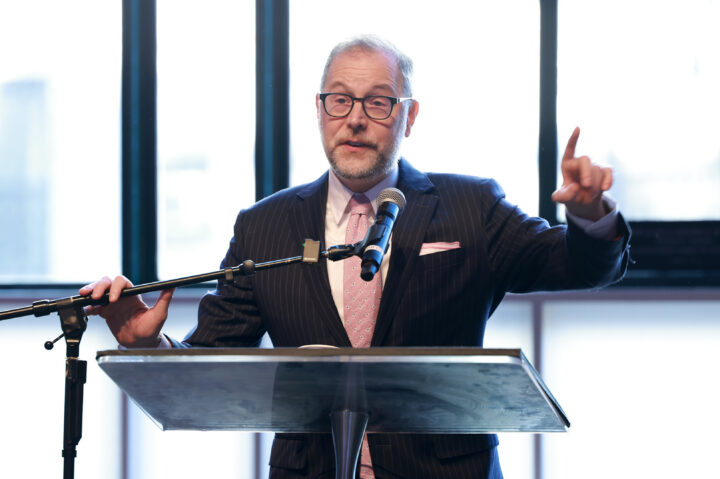
Jason Mendez/Getty Images for Brooklyn Academy Of Music
New York City Comptroller Mark Levine speaks at Brooklyn Academy of Music on January 19, 2026 in New York City.


 Add JewishInsider on Google
New York City Comptroller Mark Levine came under fire on Wednesday after he revealed to The New York Times that he would reverse course on a long-standing pledge to reinvest municipal pension dollars in State of Israel bonds — criticism that came even from his predecessor in the role, Scott Stringer.
Speaking to the Times, Levine stressed his continued personal relationship with and support for the Jewish state, and maintained his decision not to purchase the bonds was based solely on “technical challenges” and “financial considerations.” In a statement to Jewish Insider, his office explicitly echoed a recent analysis by the ratings agency Fitch that cited upcoming Israeli elections as a stability risk, and further pointed to growing state debt and the possibility of additional military clashes with Iran or Hezbollah.
One of Levine’s predecessors, Scott Stringer dismissed his rationale as short-term concerns outside the scope of the city’s chief fiduciary.
“The notion that [Israel Bonds] are not a worthy investment today is simply nonsense,” argued Stringer, citing strong returns that the state debt issuances delivered during his tenure between 2014 and 2022. “We’re not investors that try to game the system in the moment. The job of the comptroller, and the pension fund, is to create an asset allocation for the long term.”
By contrast, now-Democratic congressional nominee Brad Lander, who held the comptroller role for four years between Stringer and Levine — and who was responsible for zeroing out the city’s holdings in Israel Bonds for the first time in half a century in 2025 — praised Levine in a statement to a local reporter. Lander asserted that neither his choice nor Levine’s was political, and noted the city does not carry other foreign countries’ sovereign debt.
“As I said when I ceased investments in Israel bonds during my tenure as comptroller, these investments were not consistent with the financial policies and investment goals of New York City’s pension fund,” Lander said, before repeating his own campaign vow to cut off U.S. support to Israel. “As a member of Congress, I will oppose U.S. military aid to Israel while it violates international law and Palestinian human rights.”
Stringer, however, noted the city continues to hold U.S. securities despite the unpredictability of President Donald Trump’s foreign and domestic policy and compounding national debt. But he asserted the greatest risk is not to the city’s finances but to the Jewish community from which both he, Lander and Levine all hail.
“I think the real ramifications here is that this is a victory for the [Boycott, Divestment, and Sanctions] movement,” Stringer, a Democrat like Levine and Lander, asserted. “This will be used as a vehicle to create a more toxic antisemitic environment, and I’m very, very concerned about it as a father of two Jewish kids.”
Anti-Zionist activist group Jewish Voice for Peace put out a statement after the Levine interview in the Times declaring a “MAJOR BDS VICTORY IN NEW YORK CITY,” asserting Levine was “bowing to grassroots pressure.”
Nathan Miller, a spokesperson for the Development Corporation for Israel, which underwrites and brokers the country’s debt, highlighted the country’s strong economic growth, particularly in its tech sector. He also cited Levine’s own past words, and indicated he hoped the comptroller would pivot again.
“Comptroller Levine pledged many times to restore New York City’s investment in Israel Bonds and had it right when he called them ‘a long-term safe and secure investment.’ That remains true,” Miller said in a statement to JI. “The New York City Comptroller has said his office’s analysis is ongoing, and we look forward to sitting down with him and his team.”
The Detroit convention also featured Abdul El-Sayed, a United Auto Workers-endorsed Michigan Senate candidate who has said the Israeli government is ‘just as evil as Hamas’
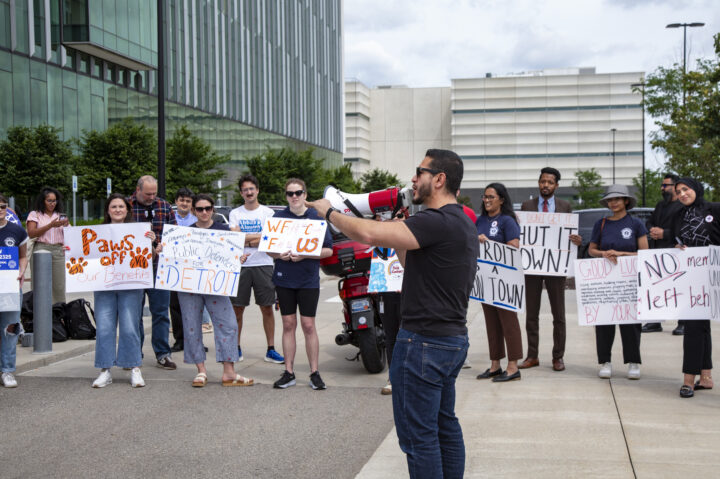
Jim West/UCG/Universal Images Group via Getty Images
Abdul El-Sayed speaks at a union rally in Detroit on June 17, 2026.
Delegates at the United Auto Workers convention in Detroit voted on Thursday to divest from Israel Bonds, citing the war in Gaza.
One of the largest unions in the country, the UAW previously held an estimated $400,000 to $700,000 in Israeli bonds and securities, according to the Detroit Free Press. It has not been disclosed how much money the divestment will affect or how many members voted to pass the resolution.
The annual convention also featured a speech from Abdul El-Sayed, a far-left, UAW-endorsed Democratic Senate candidate in Michigan who told Jewish supporters last month that he “often struggle[s]” to answer whether he believes Israel has a right to exist as a Jewish state. He said in an interview with CNN in April that he believes the Israeli government is just as evil as Hamas.
While UAW historically evokes imagery of assembly lines, picket lines and blue-collar solidarity, the union has increasingly drifted away from its core mission of representing autoworkers, largely driven by individuals pushing extreme political agendas that leave critics questioning their relevance to workplace issues.
In January, 30% of the 275 employees of the Israeli-owned Breads Bakery signed union authorization cards for UAW Local 2179, the percentage necessary to petition the National Labor Relations Board for a union election. The group, which calls itself “Breaking Breads,” said in a statement, “Workers are demanding a living wage, safe workplace, and basic respect.” But the group’s demands also included that the management of the New York-based bakery chain, CEO Yonatan Floman and founder Gadi Peleg, “halt use of bakery profit to materially support the Israeli occupation.” Breaking Breads also condemned the bakery’s participation in the Great Nosh, an annual Jewish food festival in New York City, and said it will not participate in baking cookies with an image of the Israeli flag.
A number of labor unions have seen a rise of antisemitism and anti-Israel activity since the Oct. 7, 2023, Hamas terrorist attacks, despite many being historically supportive of Israel, dating back nearly a century, when many American unions donated money to the Histadrut, Israel’s national labor union. Multiple groups — including the Louis D. Brandeis Center for Human Rights Under Law — have now taken legal action against UAW branches in response to certain campaigns, which some legal experts allege were discriminatory against Israelis and Jews.
UAW did not respond to a request for comment from Jewish Insider.
Please log in if you already have a subscription, or subscribe to access the latest updates.
 Continue with Google

 Continue with Apple