














































































DMFI President Brian Romick: ‘We are equally clear that there is no lasting peace without Israeli responsibility and no Palestinian state without credible Palestinian governance’

Adobe Stock
Two flags: American and Israeli waving in the blue sky


 Add JewishInsider on Google
Democratic Majority for Israel, the Democratic pro-Israel advocacy group, released a proposal on Thursday for a “modernized U.S.-Israel relationship,” with a focus on reimagined ties between the countries following the end of the current memorandum of understanding on military aid, set to expire in 2028.
The plan comes as Democrats grapple with the future of the U.S.-Israel relationship, particularly ahead of a potential Democratic majority in one or both chambers of Congress, which could bring renewed efforts to end or substantially condition U.S. military aid and sales to the Jewish state.
The framework laid out by DMFI mirrors the policies likely to be championed by moderate pro-Israel Democrats in the coming Congress.
“‘Cut everything’ and ‘defend everything’ are shortcuts. Neither is a serious policy for advancing peace in the region,” DMFI said in a press release. “Our vision offers a path grounded in security, responsibility, regional cooperation, and sustained American leadership.”
DMFI said that the U.S. should fulfill its commitments on military aid through the end of the current MOU, arguing that failing to do so “would diminish the close defense partnership through which the United States and Israel plan, develop, and produce the capabilities both countries need to confront shared threats.”
The group maintained that the U.S. and the region “have far more to gain from a stronger and more effective partnership” than from cutting off the U.S.-Israel relationship, and that the path forward will help secure military victories against Iran and its proxies, protect American troops and civilians, support regional partners and strengthen the path toward a two-state solution.
Beyond 2028, the group urged focusing on “more joint development and production in missile defense, cybersecurity, and emerging technologies” — which itself has proven to be a controversial idea among some congressional Democrats and, to a lesser extent, Republicans.
But it also did not fully rule out the potential for “some” continued military aid and missile defense funding past 2028, while suggesting that such aid would likely be phased out “over time, and by mutual agreement … toward an increasingly reciprocal relationship centered on joint investment, innovation, and technological advantage.”
And it said that the U.S. still “has a strategic and moral interest in ensuring that Israel can deter and defend against threats to Israel’s fundamental security,” including preserving Israel’s qualitative military edge and ensuring that Israel maintains access to the military capabilities it needs.
DMFI said that cooperative military programs redound to the U.S.’ benefit, allowing “access to capabilities, operational experience, and regional insights that would be difficult and costly to replicate independently,” while allowing Israel and other partners to “shoulder more of the security burden” while the U.S. turns attention toward China and the Indo-Pacific.
The group emphasized that continued support for Israel “does not require support for every decision made by an Israeli government” and that the U.S. should speak out when Israel undermines “shared interests, democratic values, prospects for peace, or Israel’s own long-term security” and work with Israel to ensure that security assistance “continues to be used in accordance with U.S. law and that military operations incorporate effective measures to minimize civilian harm.”
But it also firmly rejected the Boycott, Divestment and Sanctions movement and other efforts to delegitimize Israel and deny its right to exist as a Jewish state, as well as double standards singling out Israel.
“Criticism of Israeli governments and policies is legitimate, but political debate about Israel must never become a vehicle for antisemitism or collective blame of Jews,” the DMFI plan argues.
It said that the U.S., Israel, Palestinians and Arab states should continue to push toward a two-state solution, and that such a path includes obligations for both Israelis and Palestinians, and steps to improve conditions for Palestinians even without broader final-status negotiations.
The group said Israel must act to halt settler violence in the West Bank; “preserve the territorial integrity, economic viability, and institutional capacity necessary for legitimate Palestinian governance and eventual statehood”; and not work to weaken the Palestinian Authority, arguing that it’s in Israel’s interest to ensure stronger PA institutions and economic conditions as an alternative to extremism.
At the same time, DMFI’s plan describes Israeli skepticism of and concern about a Palestinian state as valid and based on Israel’s experience, particularly in the Oct. 7, 2023 attacks, and said that security arrangements around a two-state solution must “give Israelis confidence that a future Palestinian state will not become another base for terrorism.”
It also argues that the PA is a critical part of a two-state solution but must be significantly reformed to reject terrorism, support Hamas’ removal, stop incitement, overhaul educational materials that incite terrorism, combat corruption and improve governance.
“A reformed PA must demonstrate that it can serve its population, maintain security, govern responsibly, and act as a credible partner for peace before assuming responsibility for Gaza,” DMFI said. “The United States and its regional partners should help the PA undertake these reforms while establishing clear benchmarks to measure and verify progress.”
DMFI called on Arab states to work to strengthen the PA while integrating more closely with Israel.
In Gaza, the DMFI plan largely aligns with the 20-point peace plan put forward by the Trump administration, including disarming Hamas, establishing governance and ensuring humanitarian assistance, which “will require sustained American leadership and diplomatic engagement over many years.”
It argues that recovery and reconstruction should start in Israeli-controlled areas with a shift toward civilian governance and international oversight.
The plan speaks in broad strokes about a path forward for Iran, describing diplomacy as “an essential tool” to addressing Iran’s various threats, “backed by credible deterrence, rigorous verification, economic pressure, and close coordination with allies and regional partners,” alongside “military force [when] necessary” with clear goals and congressional authorization.
It also calls on Lebanon to disarm Hezbollah and offers support for “stable governance” in Syria that will block Iran and other terrorist groups from using Syrian territory to attack Israel.
“DMFI is proposing a vision for the Middle East that a Democratic majority can actually govern with: security for Israel, self-determination for the Palestinian people, and stability for the region, with every party carrying obligations you can name, measure, and verify,” DMFI President Brian Romick said in a statement. “Our commitment to Israel’s security is ironclad, and we are equally clear that there is no lasting peace without Israeli responsibility and no Palestinian state without credible Palestinian governance.”
Former Chicago Mayor Rahm Emanuel, who is seen as a potential presidential contender, also praised the plan. The Democratic operative delivered a major speech in Israel earlier this year offering criticisms of Israeli policy and calling for an end of unconditional support for the Jewish state.
“DMFI is right to put regional stability, Israel’s security, and Palestinian self-determination in the same conversation. None succeeds on its own,” Emanuel said. “The next step is to make the Arab states full partners in building a credible path to Palestinian sovereignty and Israeli security — and to be clear that America’s support for Israel does not mean silence when its government makes choices that undermine both.”
Rep. Lois Frankel (D-FL), the ranking member of the House Appropriations Committee subcommittee that oversees U.S. military aid to Israel, said in a statement on the proposal that “U.S. partnership with Israel is essential to our national security and to advancing peace and stability in the Middle East” and that the DMFI plan “offer[s] a thoughtful and serious vision for strengthening that relationship to meet today’s challenges, while making clear that American interests, Israel’s security and Palestinian self-determination can be advanced together.”
Rep. Brad Schneider (D-IL), who co-chairs the Congressional Jewish Caucus and the Abraham Accords Caucus and is a leader among moderate pro-Israel Democrats, said, “Especially at this critical moment, it is vitally important to chart a course that strengthens the U.S.-Israel relationship and advances our mutual security interests and shared democratic values. I look forward to working with DMFI and others committed to this effort to help shape that future.”
In a statement, J Street said that its spending effort to boost progressive California state Sen. Aisha Wahab is intended to counter the pro-Hernandez spending by AIPAC and others
Tayfun Coskun/Anadolu via Getty Images
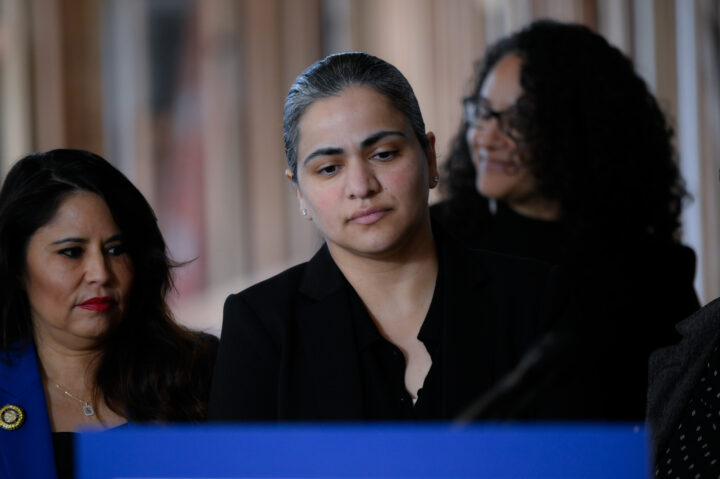
California state Sen. Aisha Wahab attends a press conference in Hayward, Calif., on March 2, 2026.
J Street Action Fund, the super PAC affiliated with the progressive Israel advocacy group, spent $108,000 on Thursday on digital advertisements to boost progressive California state Sen. Aisha Wahab in the special election in California’s 14th Congressional District.
The AIPAC-affiliated super PAC United Democracy Project has spent nearly $2.5 million — along with significant independent expenditures by other groups — attacking Wahab and boosting moderate former local mayor Melissa Hernandez in the special election runoff to replace former Rep. Eric Swalwell (D-CA).
J Street said in a statement that its spending effort is intended to counter the pro-Hernandez spending by AIPAC and others. The J Street ad praises Wahab for work on housing affordability issues.
Wahab’s campaign has raised concerns from members of the Jewish community, given that she voted against or abstained on votes on top-priority legislation to combat campus antisemitism and is closely aligned with teachers’ unions that have opposed antisemitism bills. She has also accused Israel of committing genocide and shared a page on her campaign site individually calling out specific “AIPAC-linked donors” supporting Hernandez’s campaign.
“Aisha Wahab is an Afghan-American and the first Muslim elected to the California State Senate,” J Street said in a statement. “In September 2025, she introduced a resolution calling for an end to the humanitarian catastrophe in Gaza and the immediate release of all hostages. She is exactly the kind of compassionate leader constituents of the 14th District should have in Congress.”
Wahab introduced the 2025 resolution alongside Jewish state Sen. Scott Wiener, who is running for Congress in another Bay Area district.
“This is once again a cynical attempt by AIPAC to defeat a candidate who won’t rubber-stamp their agenda,” Tali deGroot, J Street’s vice president of political and digital strategy, said in a statement. “AIPAC’s super PAC has failed time and again this cycle, and we expect this latest attempt to take Republican billionaire dollars and buy a Democratic primary to fail as well. Voters in the 14th deserve better, and they deserve a Member of Congress who will bring the kind of clear-eyed, nuanced and compassionate leadership that Dr. Wahab has shown throughout her career.”
A Jewish leader in the district said that, while they harbored concerns about Wahab, they did not believe that even significant UDP spending would be enough to swing the race against her and worried that UDP spending could push her toward stronger anti-Israel stances.
The progressive Israel advocacy group said it did not ‘have anything to share at this time’ about Maine’s scandal-plagued Democratic Senate nominee
Sophie Park/Bloomberg via Getty Images
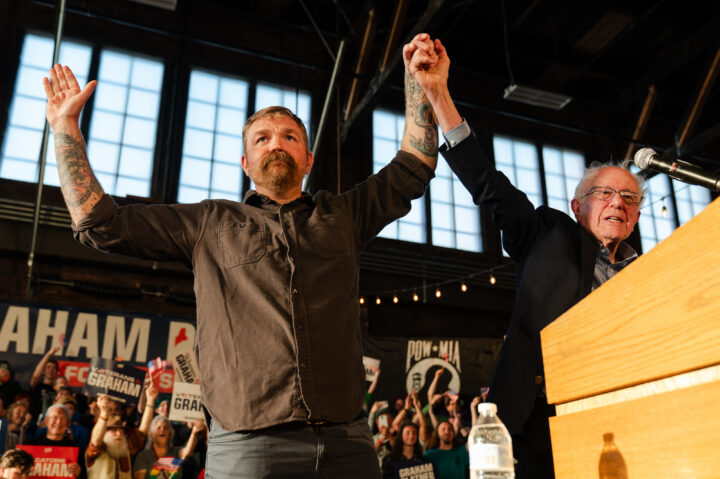
Graham Platner, Democratic Senate candidate for Maine, left, and Sen. Bernie Sanders (I-VT) during a Fighting Oligarchy event in Portland, Maine, on May 25, 2026.
J Street, the progressive Israel advocacy group, is for now withholding an endorsement of Graham Platner, the scandal-plagued Democratic Senate nominee in Maine, underscoring the extent to which even some left-wing Jewish activists appear skeptical of his insurgent campaign.
A spokesperson for J Street told Jewish Insider on Wednesday that the group did not “have anything to share at this time” about a Platner endorsement but would provide more information “if that changes.”
The spokesperson declined to confirm if J Street, which this cycle has backed a handful of Democratic Senate candidates vying for open seats or challenging Republican incumbents, had considered whether it will make an endorsement. The group had told JI in early May that it did “not currently have a position in the race.”
In a statement to JI on Thursday, the spokesperson said that it “is incorrect to frame J Street as actively withholding an endorsement from Graham Platner.”
The group “evaluates candidates and makes endorsement decisions on a rolling basis,” and its “endorsement process is ongoing,” the spokesperson said. “The timing of endorsement decisions does not reflect judgment about any individual candidate.”
J Street’s response came after Platner had clinched the nomination on Tuesday to challenge Sen. Susan Collins (R-ME), in a high-profile race Democrats see as crucial to reclaiming control of the upper chamber.
Platner won the Democratic primary decisively even as he has faced a mounting series of controversies over alleged “toxic” relationships with past girlfriends, sexual messages he sent to women while married and deleted Reddit comments expressing a range of incendiary views.
He also weathered a scandal relating to a Nazi tattoo on his chest for nearly two decades that he covered up last October. Platner has insisted that he did not recognize its imagery, despite claims to the contrary from a former girlfriend who first spoke with JI last year, shortly after he had announced his campaign.
The tattoo, along with Platner’s hostile criticism of Israel and insistent demonization of AIPAC, have stoked ongoing concerns among Jewish Democrats. Halie Soifer, CEO of the Jewish Democratic Council of America, has said the group is not ready to endorse Platner.
“We won’t support a Democrat who doesn’t represent the views and values of the vast majority of American Jews,” Soifer said in a statement in late April echoing a sense of discomfort with Platner’s candidacy felt by mainstream Jewish leaders.
JDCA had endorsed Maine Gov. Janet Mills, who suspended her campaign amid lackluster fundraising but remained on the ballot Tuesday, pulling in 19% of the vote. Platner won 72%.
Following Tuesday’s win, some prominent Senate Democrats have also declined to endorse Platner as he prepares for a bruising and expensive campaign.
J Street, which has moved to the left in recent years as it has sought to capitalize on growing Democratic frustration with Israel, is in many ways aligned with Platner on Middle East policy, including accusations that Israel committed genocide in its war in Gaza and calls to block U.S. military aid to the Jewish state that are now gaining momentum in Congress.
Still, the group has shown its intolerance for some extreme views that could be seen as antisemitic. In 2024, for instance, J Street revoked its endorsement of former Rep. Jamaal Bowman (D-NY), who was at the time fighting for reelection in a bitterly contested primary he would later lose, saying his inflammatory rhetoric on Israel had crossed a line.
Even as the group officially stays on the sidelines in Maine’s marquee Senate race, J Street’s state leader, Steven Koltai, who helped organize a Passover Seder with Platner, told the Jewish Telegraphic Agency he is “still very much” supporting the oyster farmer and former Marine in spite of recent revelations about his past.
In the statement to JI on Thursday, J Street’s spokesperson said the group “remains steadfast in our commitment to ensuring a pro-Israel, pro-peace majority in the Senate and House come January.”
J Street’s Ilan Goldenberg said the surge in far-left calls to cut off missile-defense aid ‘stirred up the conversation a little more’ but says the group was moving that way regardless

Saeed Qaq/Anadolu via Getty Images
Rockets fired from Gaza are neutralized in the air by Israel's 'Iron Dome' air defense system on the fourth day of the clashes in the city of Ashkelon, Israel on October 10, 2023.
In recent years, as the progressive Israel advocacy group J Street joined left-wing calls to place restrictions on U.S. military aid to Israel, support for funding Israel’s Iron Dome missile-defense system remained a sacred cow for the group — the final aspect of the old-school U.S.-Israel defense relationship that, even for most progressives, was unaffected by the broader Democratic shift away from unconditional support for Israel.
That consensus has shattered in recent weeks. Instead of steering the conversation among Democrats, where J Street maintains a solid base of support, the organization found itself playing catch-up to the progressive lawmakers it supports after several of them announced in early April that they think the U.S. should no longer fund Iron Dome batteries.
J Street released a statement on April 13 calling for the U.S. to cease funding Iron Dome batteries, arguing that Israel — a wealthy nation with a substantial defense budget — should pay for its own missile-defense systems. The announcement marked a significant policy shift for J Street, which has long stated that a congressional candidate’s support for U.S. financial backing of the Iron Dome system is one of its most important endorsement criteria.
J Street’s leaders have insisted that they reached this conclusion independently, and not as a result of shifting political winds. But in a conversation on Monday, J Street’s chief policy officer, Ilan Goldenberg, acknowledged that progressives’ rapid shift on the issue factored into J Street’s announcement, even as the group insists it was moving in that direction anyway.
“It stirred up the conversation a little more, but that memo was already written,” Goldenberg told Jewish Insider. “It’s not like this came out of nowhere. It was part of a track record of things we were doing. AOC kind of spurred up the conversation further.”
Goldenberg was referring to Rep. Alexandria Ocasio-Cortez (D-NY) telling the Democratic Socialists of America’s New York chapter that she opposes “any spending on arms for Israel, including so-called defensive capabilities,” as she also called for an arms embargo on the country. Several progressive lawmakers followed, including Reps. Ro Khanna (D-CA), Jim McGovern (D-MA), Jared Huffman (D-CA) and Mark Pocan (D-WI), all of whom were endorsed by J Street and voted for Iron Dome funding in 2021. Ocasio-Cortez, who is not a J Street endorsee, voted “present” on that 2021 legislation but signed onto a 2024 statement with several other progressive lawmakers saying they “support strengthening the Iron Dome and other defense systems,” even as they opposed offensive weapons sales to Israel.
“It’s been a combination of knowing this is coming, thinking through the substance of it ourselves and seeing the politics shift on it altogether that brought us to this point of making a decision about a week and a half ago to move in this direction,” Goldenberg said.
Alan Solomont, a former U.S. ambassador to Spain and the past board chair of J Street, said the decision was something J Street was heading towards on its own. Since the beginning of this year, the group has begun calling for an end to U.S. military aid to Israel, saying that Israel can afford to buy its own weapons systems, though it had not specifically made that argument for the Iron Dome until last week.
“We’re not following anyone else’s political lead. I think that, yes, we have been thinking about how we treat our military assistance in light of the policies of the current [Israeli] government, and we’ve been thinking about that for some time,” Solomont told JI last week. “Why people continue to support a government that is undermining Israel’s future is still sort of a puzzle to me.”
J Street’s leaders insist they are merely following the lead of Israeli Prime Minister Benjamin Netanyahu, who said in an interview with The Economist in January that Israel is seeking to end U.S. financial assistance in the next decade. Sen. Lindsey Graham (R-SC), a staunch Israel ally and a foreign policy hawk, then said he would accelerate that process, but he softened that position after a meeting with Netanyahu.
“Israel’s in a position now where it can pay for its weapons itself as a country that is as wealthy and powerful and successful as it is,” said Goldenberg, who served as Jewish outreach director on former Vice President Kamala Harris’ 2024 presidential campaign. “I think it got accelerated when Bibi and Lindsey Graham came out early this year.”
Still, Netanyahu’s call to phase out U.S. military aid has not yet resulted in any major policy shifts just yet, as the Memorandum of Understanding that provides Israel with its current $3.8 billion in annual military aid runs through 2028. Goldenberg said J Street wants to see the financial assistance “phased out in a responsible, rapid manner,” which he noted is “different than saying ‘cut it all off tomorrow.’” When asked whether J Street would support another Iron Dome missile-defense package if it were introduced at present, he suggested the organization would not.
“I would say that probably we support that not being in the supplemental,” Goldenberg said.
At the same time that J Street and many progressive lawmakers are calling for an end to U.S. financial assistance for the Iron Dome, other far-left candidates don’t think Israel should have access to Iron Dome batteries at all, even if paid for with its own funds.
Abdul El-Sayed, a candidate for Senate in Michigan, has said the U.S. should not sell any weapons to Israel. DSA and other far-left groups argue that Israel’s access to strong missile-defense systems like the Iron Dome allow it to perpetuate bombing campaigns in Gaza and Lebanon because Israeli civilians are protected, and therefore the Iron Dome is responsible for bloodshed in the region. J Street argues that its position is holding the line against that more extreme view.
“I think that is a position that we need to guard against. We need to recognize Israel’s legitimate security needs,” Solomont said. “We should certainly be concerned about Israel’s security, and work with Israel as an ally around its security. Our commitment to Iron Dome is simply that we think that Israel, with an economy and per capita GDP that is higher than other allies — we’re just following Netanyahu’s lead to say that Israel can pay for these things itself.”
‘AIPAC may call itself pro-American. They may call themselves pro-Israel. But they are neither,’ the Maryland senator said

Eric Lee for The Washington Post via Getty Images
Sen. Chris Van Hollen (D-MD) speaks during an Election Night party at in Baltimore, Maryland on November 8, 2022.
Sen. Chris Van Hollen (D-MD) took aim at the pro-Israel advocacy group AIPAC during an address on Sunday morning at the opening plenary of J Street’s convention in Washington and accused it of being un-American.
Van Hollen elicited a loud chorus of boos in response to his description of AIPAC’s opposition to legislation he had sponsored seeking to place conditions on U.S. military assistance to Israel.
“I put forward months and months ago a proposal that said, with respect to any country, any country that receives U.S. military assistance — has to agree to, No. 1, comply by American law and by international law. You know who came out against that? AIPAC came out against that,” Van Hollen said.
“AIPAC came out against a proposal that says American taxpayer dollars that are used for military assistance — it’s OK to give them to any country in the world, even if that country doesn’t agree to abide by American law or international law,” said Van Hollen. “I will tell you that AIPAC may call itself pro-American. They may call themselves pro-Israel. But they are neither.”
Van Hollen accused Israel of violating American and international law during its war against Hamas in Gaza, and earned cheers for saying Israeli Prime Minister Benjamin Netanyahu’s actions should be reined in.
“There can’t be a continuing blank check when the Netanyahu government is operating in violation of American law, which they have repeatedly, or in violation of international law,” he said.
Van Hollen has emerged as one of Israel’s staunchest critics in Congress over the course of Israel’s war against Hamas in Gaza in response to the terror group’s Oct. 7, 2023, attacks. In his speech, he gave a shout-out to his wife, Katherine Wilkens, a longtime liberal analyst on the Middle East at think tanks in Washington.
“I’m also very pleased to be joined here today by the real expert in the Van Hollen family on the Middle East, and that’s my wife and partner, Katherine,” he said.
Van Hollen used his speech to tie the U.S. strikes against Iran that began early Saturday morning to President Donald Trump’s “lawless” actions domestically.
“What we see is this lawlessness and attack on freedoms here at home also infecting our foreign policy,” said Van Hollen. “It is a gross violation of international law just to go all off and attack another country. It’s not a preemptive strike … It also is a gross violation of your constitution. This isn’t a close call.”
Van Hollen criticized Trump’s stated goal of regime change in Iran, and said the president’s actions will harm civilians in Iran.
“Yes, we hate the Iranian regime. It’s been brutal against its own people,” said Van Hollen. “But I don’t think you’re going to help the Iranian people by watching bombs that kill civilians. We’ve seen over 140 school kids killed in one of the very first attacks of the war. That is not a way to bring solidarity and support from the people of Iran.”
Iranian forces said more than 150 people were killed after a strike hit a school in the county’s south, but the Israeli military said it was “not aware” of any IDF operations in that area. A CENTCOM spokesperson told The New York Times it is “aware of reports concerning civilian harm resulting from ongoing military operations. We take these reports seriously and are looking into them.”
Van Hollen was the only member of Congress to speak at J Street’s opening session. Other congressional speakers slated to address the conference on Monday include Sens. Brian Schatz (D-HI), Chris Murphy (D-CT), Adam Schiff (D-CA) and Tim Kaine (D-VA), as well as Reps. Nancy Pelosi (D-CA), Sean Casten (D-IL), Madeleine Dean (D-PA) and Sara Jacobs (D-CA).
Please log in if you already have a subscription, or subscribe to access the latest updates.
 Continue with Google

 Continue with Apple